At the Sun Gate above Machu Picchu, on a clear morning, you’re sharing that first postcard view with several thousand other people who set their alarms for the same 4 a.m. bus queue. It’s still worth doing once. But four days’ walk away, across a canyon most tourists never hear about, sits a citadel almost the same age, built by the same empire, that some archaeologists think is actually bigger — and on a good week you might share it with twenty other travelers, not twenty thousand. That’s Choquequirao, and it’s the first stop on this list of Peru hidden gems beyond Machu Picchu that we think are worth building an entire trip around, not just a day trip.
This isn’t a “top 10 things to do in Peru” roundup. You already know Machu Picchu is extraordinary — every list on the internet tells you that. What this piece is really about is where to go once you’ve decided one Inca citadel isn’t enough, or you’d rather spend your Peru trip somewhere that hasn’t been photographed from the exact same angle eleven million times. Cloud-forest fortresses in the north, a desert oasis ringed by 500-foot dunes, condors riding thermals over one of the world’s deepest canyons, and a Sacred Valley village where the textiles take four months to weave, not four minutes to buy. Let’s get into it.
In this guide
- Why go beyond the standard Peru circuit
- Choquequirao: the other lost city of the Inca
- Chachapoyas and Kuélap: Peru’s cloud-forest fortress
- Huacachina: the desert oasis nobody expects
- Colca Canyon: chasing condors, not crowds
- Choquecancha: the Sacred Valley village most tourists miss
- Best time to visit
- Getting there from India: flights and visas
- Where to stay: mid-range to luxury
- What it actually costs
- Altitude and safety notes
- What to eat
- FAQs
Why go beyond the standard Peru circuit
The classic Peru itinerary — Lima, Cusco, Sacred Valley, Inca Trail or the train to Machu Picchu, done in seven or eight days — is classic for a reason. It works, and it’s genuinely beautiful. The problem is that “classic” now also means booking the Inca Trail four to six months out because the government caps permits at around 500 people a day (guides and porters included), and it means sharing Ollantaytambo’s ruins with tour buses on a rotation.
None of that ruins the trip. But if you’ve got 12-14 days rather than 7, or if you’ve already done the postcard version on a previous visit, there’s a second Peru sitting right next to the first one — less curated, harder to reach, and honestly more interesting to talk about at dinner afterward. The four places below aren’t obscure for the sake of it. Each one gives you something Machu Picchu genuinely can’t: scale without crowds at Choquequirao, a pre-Inca culture almost nobody in India has heard of at Kuélap, a landscape that looks like nowhere else in Peru at Huacachina, and wildlife you can’t fake at Colca Canyon. (Peru’s official tourism board, PROMPERÚ, is a good general reference if you want to cross-check any of this as you plan.)
Choquequirao: the other lost city of the Inca
Choquequirao (the name means “cradle of gold” in Quechua) sits on a ridge above the Apurímac River at around 3,050 metres, and archaeologists generally agree its total footprint is larger than Machu Picchu’s — though only a fraction of the site has actually been excavated, so much of it is still under vegetation, waiting. It was built in the same Inca-imperial period, likely as a royal estate and ceremonial center, and it was never found by the Spanish, which is part of why it stayed so intact.
The detail most people don’t know until they see it in person: several of the lower agricultural terraces have white stone inlaid directly into the retaining walls, forming llama figures visible from a distance. Nobody fully agrees on why — ceremonial marker, boundary symbol, offering to the mountain gods — and that unresolved-mystery quality is a lot of the appeal.
The trek: what it actually involves
Most trekkers do a 4-5 day round trip starting from Cachora, a small town about a 4-hour drive from Cusco. The honest version: this is not a gentle walk. You descend roughly 1,500 metres into the Apurímac Canyon on day one, then climb back out the other side to reach the ruins — and do both directions again on the way back, in warm canyon heat that can hit the high 20s°C even while Cusco stays cold. Longer 7-9 day versions connect all the way through to Machu Picchu itself, for travelers who want the “other” Inca city and the famous one in a single expedition.
The honest caveat: Choquequirao is harder on the body than the Inca Trail, mainly because of the canyon’s up-and-down profile rather than sustained altitude. If your Inca Trail comparison point is “beautiful but manageable,” recalibrate — this is a proper trek, and a guide is strongly recommended even though it isn’t legally required.
Permits — the actual good news
Unlike the Inca Trail, there’s currently no daily quota system for Choquequirao. You need an entrance ticket to the archaeological site and, in practice, a licensed guide, but you’re not racing other travelers for one of 500 daily slots months in advance. That’s the practical reason this is a genuine Machu Picchu alternative and not just a nice-sounding one — you can plan it on a few weeks’ notice, not six months.
Why “now” actually matters here
There’s a real reason not to wait too long on this one. The Peruvian government has been advancing a cable car project — the Choquequirao telecabina — connecting the Apurímac side near Kiuñalla to the Cusco side near Yanama, cutting a multi-day approach down to a roughly 15-20 minute gondola ride. It’s a genuinely large project, reportedly north of US$260 million, with concession bidding targeted for late 2026 and construction potentially starting in 2027 — but there’s no confirmed opening date yet, and industry sources are explicit that nothing should be booked around a completion timeline until construction is underway. Still, the direction is clear: at some point in the next several years, this stops being a remote multi-day trek and starts being a half-day excursion, and the silence and earned-view character of the place will change with it. If that’s the version you want, go while the walk in is still the only way in.
Chachapoyas and Kuélap: Peru’s cloud-forest fortress
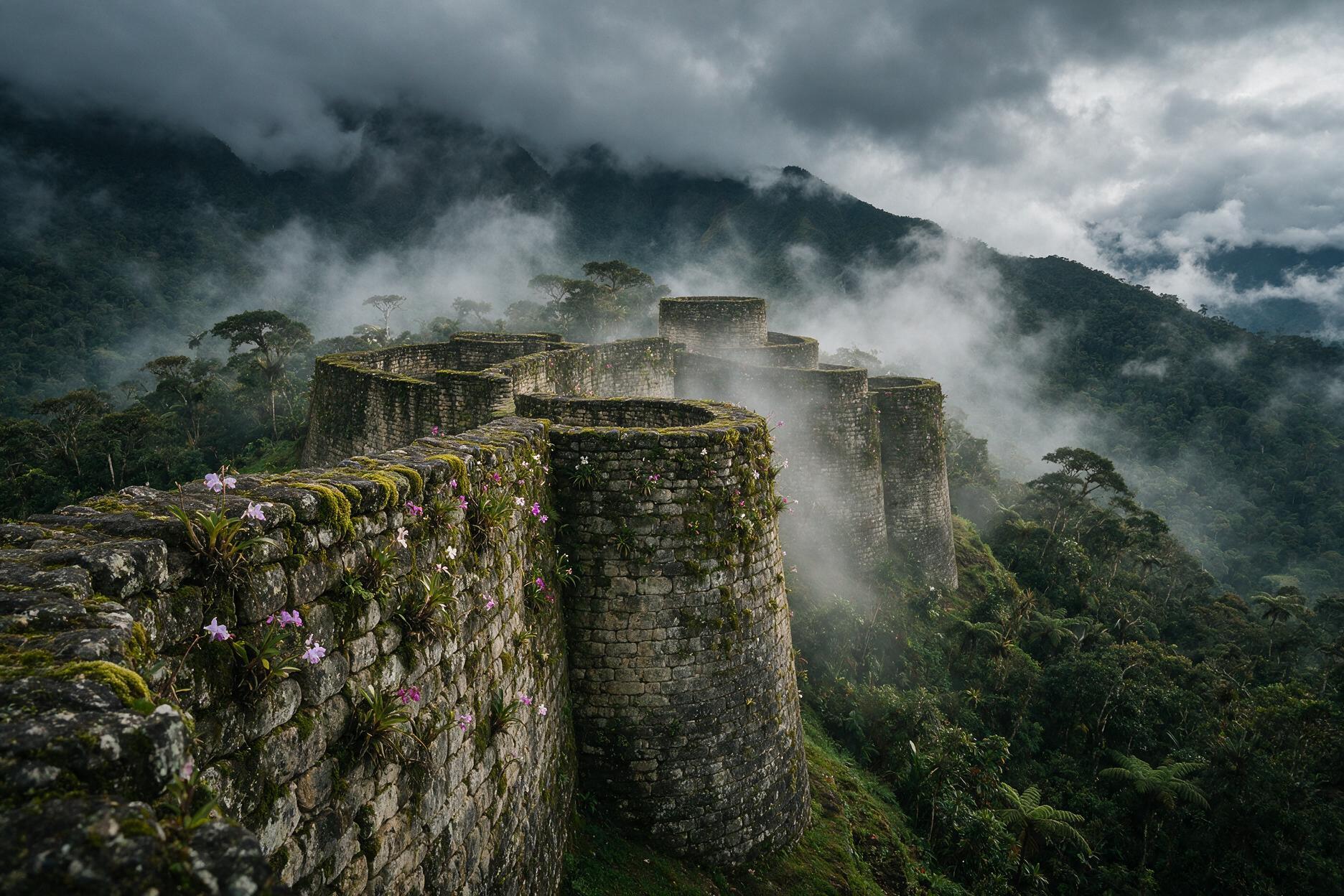
Kuélap’s towering stone ramparts, built by the Chachapoyas culture centuries before the Inca, wrapped in cloud forest.
Head north instead of south from Cusco — geographically and mentally — and you land in a completely different Peru. Chachapoyas, in the northern highlands, sees a fraction of the visitors that Cusco does, and its centerpiece, the fortress of Kuélap, predates the Inca Empire by centuries. It was built by the Chachapoyas culture (the Spanish called them “the Cloud Warriors”) starting around 900 CE, and its perimeter walls — some over 19 metres tall in places — actually contain a greater volume of stone than the Great Pyramid of Giza. That’s the fun fact that tends to land better than anything else in this list.
The site sits on a ridge at roughly 3,000 metres, wrapped in genuine cloud forest — mist rolling through, orchids growing out of the old walls, birdsong instead of tour-guide megaphones. Inside are the round stone foundations of several hundred circular houses, many decorated with zigzag and diamond friezes unlike anything in Inca architecture.
Here’s the twist: getting up to Kuélap is now easier than getting to Choquequirao. Since 2017, a cable car — Telecabinas Kuélap — has run from the town of Nuevo Tingo up to the fortress in about 20 minutes, replacing what used to be a rough two-hour drive up switchbacks. It’s the inverse hidden gem: the remote-feeling site with easy access, next door to the famous site about to get easy access for the first time.
Getting there: ATSA Airlines runs seasonal direct flights from Lima to Chachapoyas (about 1 hour 25 minutes, roughly US$80-170 one-way), though schedules can be irregular. The steadier year-round route is Lima to Jaén with LATAM, followed by a 3-4 hour drive to Chachapoyas — what most operators default to when direct flights get disrupted in the wetter months. Budget it as its own 3-4 day add-on rather than a rushed detour; the region also holds the Karajía sarcophagi and the Gocta waterfall, one of the tallest in the world. Tickets for the fortress and cable car can be checked and booked through Peru’s official Boleto Perú portal.
Huacachina: the desert oasis nobody expects
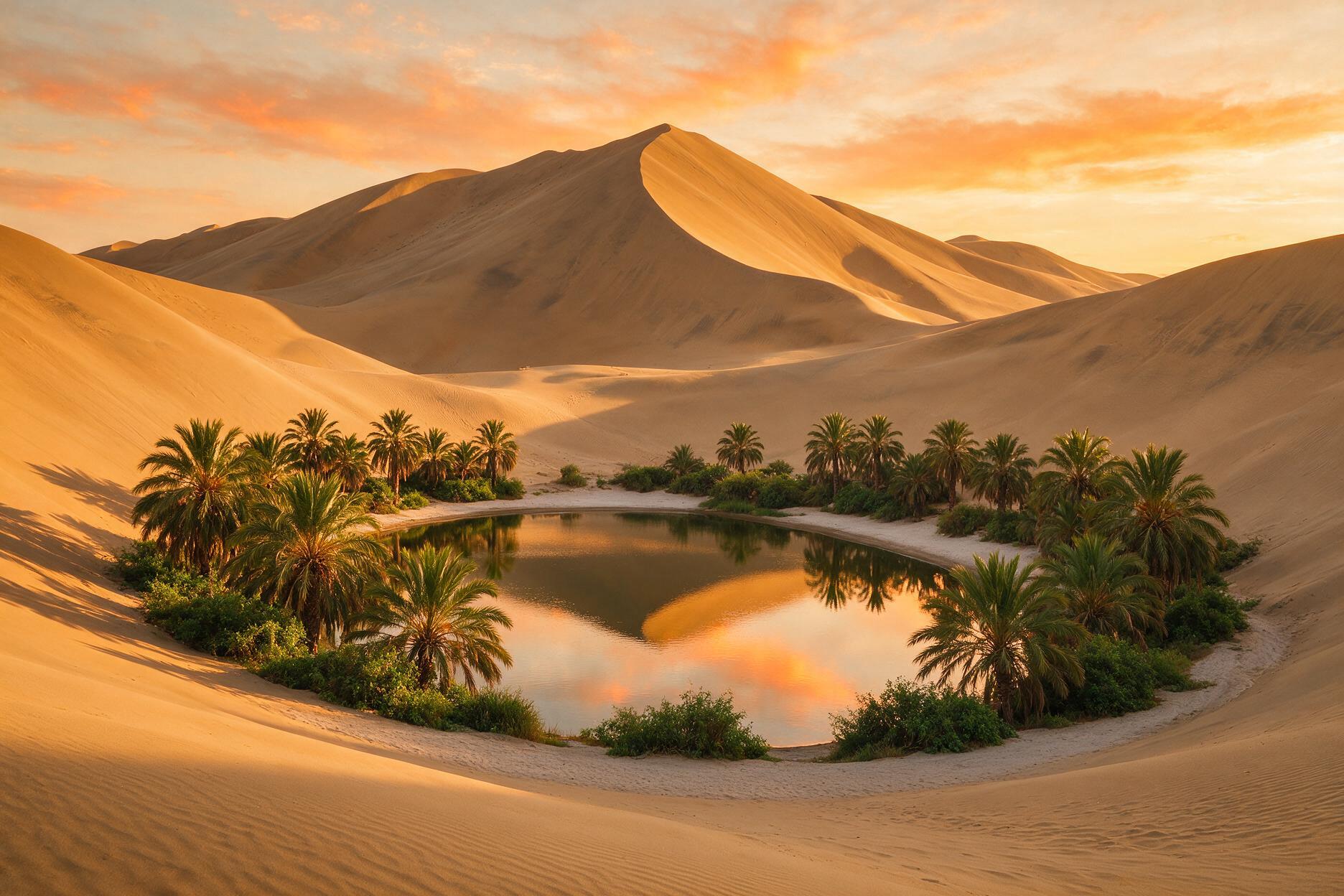
Huacachina’s palm-fringed lagoon, ringed by dunes that rise 500 feet or more.
Nothing else in Peru looks like this. Huacachina is a small lagoon town, palm trees and all, sitting in the middle of Pacific coastal desert about four hours south of Lima (fifteen minutes from the city of Ica), surrounded on all sides by dunes that rise 500 feet or more. It photographs like a mirage because, functionally, it kind of is one.
The two things everyone comes for are dune buggy rides and sandboarding, and they’re usually sold as a single package. A good operator takes you out in late afternoon — the light goes gold, the sand cools down, and the buggy climbs and drops over ridgelines before parking so you can sandboard down a few different slopes, finishing with a proper sunset from the top of a dune. The mistake to avoid: some budget operators sell one-hour sessions that get you maybe two runs down the sand before rushing you back; pay the bit extra for a two-hour slot, and confirm the operator is actually insured — informal, uninsured buggy operators still work this stretch of desert, and buggy accidents aren’t unheard of.
Stay overnight if your schedule allows it. Sunrise over the dunes, before the buggies start up, is quieter and arguably prettier than sunset — and a slow morning by the lagoon, followed by Ica’s local sweet specialty, tejas (a soft candy usually filled with pecans, manjar blanco or dried fruit), is a good, low-key way to break up the long haul between Lima and Cusco.
Colca Canyon: chasing condors, not crowds
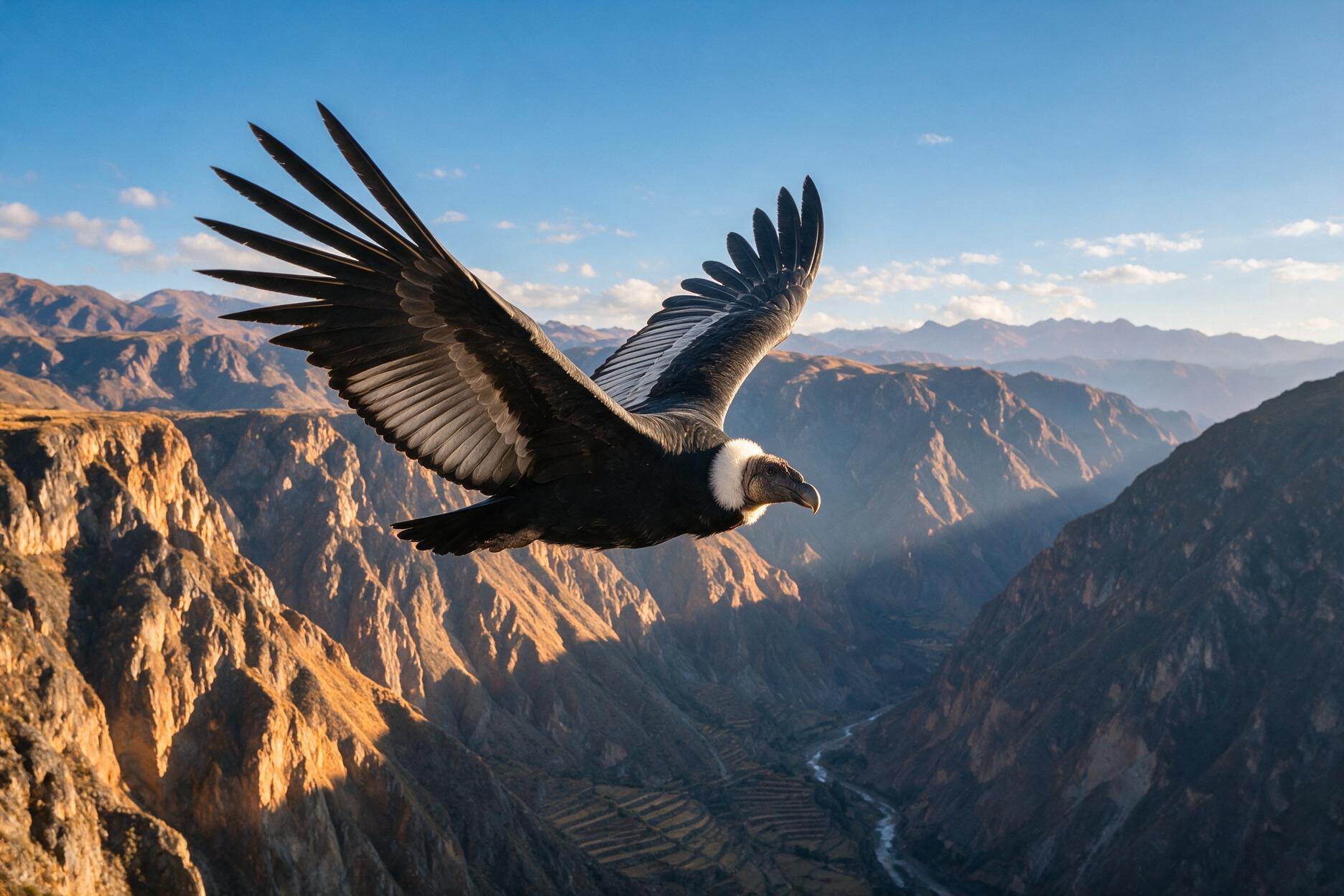
An Andean condor riding the morning thermals above Colca Canyon, near Cruz del Cóndor.
Most first-time Peru itineraries route straight from Lima to Cusco to the Sacred Valley. Colca Canyon, reached from Arequipa rather than Cusco, is the alternative circuit — and it earns its place for one reason above all: this is one of the most reliable places on Earth to watch Andean condors, up close, in flight, for free.
The viewpoint is Cruz del Cóndor, and timing matters more than almost anything else on this list. Condors need thermal air currents that build after sunrise to soar, so the real window is roughly 8:00-9:30 a.m. Most tours leave Arequipa around 2:30 a.m. to make it in time — brutal, but watching a bird with a nearly 3-metre wingspan glide at eye level, close enough to hear the wind move through its feathers, is worth the alarm clock. Dry season, roughly April through November and peaking May to August, gives the clearest skies and most reliable sightings; cloudy mornings weaken the thermals and can mean a quieter show.
Beyond the condors, Colca is also one of the world’s deepest canyons, lined with pre-Inca terracing still farmed today, and dotted with hot springs at Chivay for the evening after an early wildlife shift. It pairs naturally with Arequipa itself, a handsome colonial city built largely from white volcanic stone — locals call it the “White City” — that most Peru itineraries skip entirely on their way between Lima and Cusco.
Choquecancha: the Sacred Valley village most tourists miss
Everyone visits Pisac’s market and Ollantaytambo’s ruins, and both are genuinely worth it. But tucked further into the valley’s side folds is Choquecancha, a small weaving village accessed mainly through a handful of specialist operators rather than the standard tour-bus circuit. The community’s textile tradition runs deep: local weavers, working with wool dyed using entirely natural methods — cochineal insects for red, local plants and minerals for the rest — produce pieces so labor-intensive that a single, intricate textile can take a weaver up to four months to complete.
There’s no souvenir-stall version of this. You watch the actual process, in the actual village, from people for whom it’s a living inheritance rather than a demonstration staged for tour groups. If your Peru trip has room for one slow, human-scale afternoon between ruins, this is where to spend it — and it’s the kind of stop a well-connected local operator can arrange that a standard package tour typically can’t.
Best time to visit
For the Andean sections of this itinerary — Choquequirao, the Sacred Valley, Colca Canyon — the dry season runs roughly May through September, with June to August as the coldest, clearest, and busiest stretch (book Choquequirao guides and Sacred Valley lodges ahead for these months even without a permit system). April, and September into early October, are quieter shoulder-season options with good weather and fewer other trekkers on the trail.
The wet season, November through March, brings afternoon rain to the highlands and can disrupt direct flights into Chachapoyas specifically, though Kuélap and the Sacred Valley remain visitable with proper rain gear and a bit more flexibility. Huacachina, on the coast, is dry and sandboardable essentially year-round — it’s a genuinely good rainy-season add-on when the highlands turn grey. If condor viewing at Colca is a priority, aim for May through August for the most consistent thermals and clearest skies.
Getting there from India: flights and visas
There’s no way around it — Peru is a long haul from India. There are no direct flights from Delhi or Mumbai to Lima; realistically you’re connecting once or twice through a hub such as Amsterdam, Madrid, Paris, São Paulo, or Panama City, with total journey time landing somewhere between 24 and 32 hours depending on the routing. Fares fluctuate, but budget for a premium long-haul ticket rather than a regional one — economy round trips commonly run well over ₹1.5 lakh in standard season, more around the June-August peak, so book a few months out and compare routings through a good travel agent rather than assuming the cheapest online fare connects sensibly. Once you land in Lima, getting to Cusco is easy by Peruvian standards — multiple daily domestic flights (LATAM, Sky Airline, JetSmart) cover it in about 1.5 hours.
Visa: worth checking before you book anything, since it affects your timeline. As of 2026, Indian passport holders generally need a visa to enter Peru, processed through the Embassy of Peru in New Delhi, involving an in-person application, an interview, and several working days’ processing — not a same-week formality. The exception: Indian citizens who already hold a valid US, UK, Canadian, Australian, or Schengen visa or residency, with at least six months’ remaining validity, can currently enter Peru visa-free for up to 180 days. If that applies to you, it changes your planning timeline considerably. Because visa rules shift, verify current requirements directly on the Consulate of Peru, New Delhi’s official tourist visa page (or through Get Tripped’s visa desk) before locking in flights.
Where to stay: mid-range to luxury
None of this is a hostel-dorm itinerary, and Peru doesn’t ask you to rough it to see any of these places properly. In the Sacred Valley, Belmond Rio Sagrado, Explora Sacred Valley, and Inkaterra Hacienda Urubamba sit at the true-luxury end, while Sol y Luna and Tambo del Inka in Urubamba are well-run mid-range-to-luxury options that make a good base before or after Choquequirao. For Choquequirao itself, expect proper trekking camps rather than hotels — good operators run comfortable tented camps with real meals, but it’s still a trek, worth being clear-eyed about that before booking. Chachapoyas runs more boutique and simpler than Cusco, though comfortable mid-range guesthouses near Kuélap and Gocta waterfall cover it well. At Huacachina, a handful of properties sit directly on the lagoon with dune views and pool access — book ahead, since the town itself is tiny. Near Colca Canyon, Arequipa has excellent boutique hotels in restored colonial buildings, and Colca itself has a small number of comfortable lodges right along the canyon rim, some with their own hot spring pools.
What it actually costs
Real ranges, not the cheapest-possible numbers. A well-organized Choquequirao trek with a licensed guide, camping gear, cook, and mules typically runs US$500-900+ per person for 4-5 days, depending on group size and season. A comfortable Sacred Valley lodge night runs roughly US$150 at the accessible-luxury end to well over US$500 at true five-star properties. Colca Canyon day tours from Arequipa, condor departure included, typically run US$40-90 per person for a group tour, more for private guiding. Huacachina’s dune buggy-and-sandboard experience usually runs US$15-30 shared, more for a private sunset session. None of this includes domestic flights or the long-haul India-Lima leg, which remains the single biggest line item in the whole trip.
Altitude and safety notes
Cusco sits at 3,400 metres (11,155 feet), and this is the mistake most first-time Peru travelers make: flying straight in from Lima (sea level) and heading out on a strenuous activity the same day. Give yourself at least two full days in Cusco or the Sacred Valley before anything demanding, and three-plus if you’re heading toward Choquequirao specifically, since the trek’s canyon profile adds its own physical demand on top of the altitude.
Basic acclimatization advice that actually works: drink more water than feels necessary, skip alcohol for the first couple of days, eat light, walk slowly (Cusco’s cobbled uphill streets catch people out), and try coca tea — it’s the standard local remedy and genuinely helps with mild symptoms for most people. Watch for real warning signs — severe shortness of breath, confusion, chest pain, persistent vomiting — which mean descend and seek medical help rather than push through.
General safety in Peru’s main tourist areas is good; standard precautions apply (watch bags in markets and bus stations, use registered taxis or apps in Lima, keep photocopies of your passport). Choquequirao and Chachapoyas are remote enough that a licensed guide isn’t just a nicety — it’s the difference between a well-run trip and a genuinely risky one if weather or a medical issue turns up mid-trek.
What to eat
Peru’s food scene deserves its own trip, but a few specifics worth building around this itinerary. In Arequipa, near Colca, try rocoto relleno — a stuffed spicy pepper that’s a genuine regional specialty, not a tourist-menu invention. Around Chachapoyas, look for juanes: rice and chicken or trout, wrapped and steamed in bijao leaves, a dish that leans more Amazonian than Andean given the region’s cloud-forest geography. In Cachora, before setting off on the Choquequirao trek, a simple chicharrón sandwich from a local stall sets you up better than anything fancier would. And everywhere — Lima especially — a proper pisco sour, made with real key lime and egg white rather than the syrupy tourist-menu version, is worth seeking out from a bar that takes it seriously.
FAQs
Is Choquequirao harder than the Inca Trail?
Physically, most guides say yes — not because of altitude, but because of the canyon’s steep descent-then-ascent profile. It’s a genuinely demanding trek worth training for, not something to book on a whim a week before you fly.
Do I need a permit for Choquequirao?
No daily quota permit like the Inca Trail’s currently exists. You need a site entrance ticket and, practically, a licensed guide — but you’re not competing for a limited number of daily slots.
Is the Choquequirao cable car open yet?
Not as of 2026. It’s still in the concession and planning stage, with bidding targeted for late 2026 and construction potentially starting in 2027 — no confirmed opening date exists, so don’t plan a trip around it being finished.
Do Indians need a visa for Peru?
Generally yes, unless you hold a valid US, UK, Canadian, Australian, or Schengen visa or residency with at least six months’ remaining validity, in which case you can enter visa-free for up to 180 days. Confirm current rules with the Embassy of Peru in New Delhi before booking.
How many days do I need for this itinerary?
To do Choquequirao, the Sacred Valley, and one of Chachapoyas or Colca Canyon properly, plan on 12-14 days minimum, plus international travel days.
Is Huacachina worth a detour from Lima?
Yes, especially with a day or two before heading to Cusco — it’s about four hours south and skips the altitude adjustment the Andean sites need, a good way to ease into the trip.
What’s the best month to see condors at Colca Canyon?
May through August gives the most reliable sightings, though April through November as a whole is good. Arrive at Cruz del Cóndor by 8-9:30 a.m. — afternoon visits rarely deliver.
Can I combine Choquequirao and Machu Picchu in one trek?
Yes — longer 7-9 day routes connect the two, for travelers who want both the crowd-free “other” city and the classic one in a single expedition.
Go now, while it’s still quiet
Every one of these places rewards a bit more effort than the standard circuit asks for — a longer flight connection, an early wake-up call for condors, a canyon that has to be walked down before it can be walked back up. None of them are secret exactly; guides know them, operators run trips to them, and none of that is likely to change. What is changing, gradually, is the ease of getting to some of them — and that ease tends to arrive with the crowds close behind. If the idea of Peru hidden gems beyond Machu Picchu appeals more than another photo at the Sun Gate, this is genuinely a good decade to go looking for them.
Get Tripped’s Peru trip packages are built around exactly this kind of itinerary — Choquequirao treks, Chachapoyas add-ons, Colca Canyon condor mornings, and proper mid-range-to-luxury stays throughout, sequenced so the altitude, the flights, and the trekking days actually make sense together. If you’d rather talk it through than plan it solo, get in touch and we’ll put together a route that fits how much time, effort, and comfort you actually want out of the trip.