The first thing that struck me on Lion’s Head wasn’t the view. It was the silence — a few dozen people scattered across the saddle, nearly all of them Capetonians walking dogs or running before work, waiting on a rock ledge for the sun to clear the mountains behind Somerset West. Then the light hit Table Mountain’s flat top from the side, turned the sandstone the color of a rusted coin, and somebody’s dog started barking at nothing in particular. Nobody was taking a selfie. Everybody was just watching.
That’s the version of Cape Town worth planning a day around — not the queue for the cable car at noon with four tour buses idling in the parking lot, but the two or three hours on either side of it when the city still belongs to the people who live there.
September is a good month to try this. It’s early spring in the Southern Hemisphere, which means Cape Town is coming out of its wet winter: days average in the low-to-mid 20s°C, the rain that soaked the Cape from June through August is tapering off, and the wind — the notorious summer “Cape Doctor” southeaster that flattens beach plans in January — hasn’t really started yet. Southern right whales are also moving into the bays along the coast to calve, with sightings building toward their peak in October and November, and the West Coast is starting its wildflower bloom. None of that means Cape Town in September is sleepy — school holidays land at the very end of the month and the city fills up fast — but for most of September, you get decent weather, thinner crowds than December’s peak, and a genuine reason to be here beyond “it looked nice on Instagram.”
This is one day, built the way I’d actually walk a friend through it — not a top-ten list, a sequence. Table Mountain before the buses arrive, Bo-Kaap for breakfast and colour, a long lunch in the Constantia winelands, and sundowners looking back at the mountain from across the bay. You could stretch any one of these into an afternoon on its own. Compressed into a day, it’s still one of the best 12 hours you can spend in South Africa.
Table of Contents
- Why This Day, Why September
- 5:45 AM — Dawn on Lion’s Head, Before the City Wakes
- 8:00 AM — First Car Up Table Mountain
- 10:30 AM — Bo-Kaap’s Colored Streets and a Cape Malay Breakfast
- 12:30 PM — Kirstenbosch in Spring Bloom
- 2:00 PM — A Long Lunch in the Constantia Winelands
- 5:30 PM — Sundowners at Camps Bay or Signal Hill
- Getting There, Visa, and the Practical Stuff
- Who This Day Works Best For
- FAQs
- Final Word
Why This Day, Why September
Every guidebook tells you to “do” Table Mountain, Bo-Kaap, and the Winelands. Fewer tell you what order to do them in — and the order is the difference between a good day and a day spent standing in lines. The logic here is simple: chase the light, dodge the crowds. Table Mountain’s cableway gets genuinely unpleasant between about 10:30 AM and 3 PM, once every tour operator in the city funnels groups through at once, so you go up with the first car instead. Bo-Kaap is prettiest — and quietest — mid-morning, before the afternoon tour groups arrive with their matching lanyards. Constantia’s wine estates are built for a slow two-hour lunch, not a rushed tasting, so that’s where the pace deliberately drops. And sunset over the Atlantic from the Camps Bay side simply doesn’t work at any other hour.
September adds a layer most itineraries miss, because it’s not the obvious season to visit. It’s shoulder season — past the wet winter, well before the packed, pricey peak of December and January. Mornings are usually clear, spring flowers are starting to open along the West Coast and in Kirstenbosch’s fynbos beds, and if you’d extend the trip by a day or two, this is also when southern right whales start showing up reliably in the bays around Hermanus, 90 minutes from the city — one of the best land-based whale-watching windows anywhere, and one that really gets going from September onward.
5:45 AM — Dawn on Lion’s Head, Before the City Wakes
Here’s a piece of honesty most Cape Town posts skip: you cannot watch sunrise from the top of Table Mountain. The cableway’s first car up is scheduled for 8:30 AM — well after the sun is already up — so if actual sunrise light is what you’re after, you go to Lion’s Head instead, the cone-shaped peak next door with no cable car, and no crowds this early.
You don’t need to summit it. The lower saddle — a 25 to 35 minute walk from the Kloof Corner car park on Tafelberg Road — gets you a clear, uninterrupted view of Table Mountain’s eastern face lighting up as the sun clears the inland mountains, city and harbour spread below, Signal Hill and the Atlantic to your right. Sunrise in September lands around 6:50 AM, so leaving your hotel by 5:45 gives you time to park, walk up in the dark, and settle in before the light changes.
One safety note worth taking seriously: Cape Town’s hiking trails, Lion’s Head included, have had documented muggings on quieter stretches, usually when a hiker is alone. It’s uncommon, and most people who do this walk have zero issues — but standard local advice is to go in a small group, not solo, ideally with a guide if you’re booking through your hotel. Lion’s Head draws a genuinely large local crowd for its monthly full-moon hikes, which says something about how normal this walk is — just do it in numbers, the way locals do.
Skipping the pre-dawn walk is a legitimate call too — you trade the sunrise moment for an hour of sleep, and the next stop still delivers plenty.
8:00 AM — First Car Up Table Mountain
Whether you’ve done the Lion’s Head walk or not, be at the lower cableway station by opening — 8:30 AM currently (last car up 6 PM, last down 7 PM; hours shift seasonally, so check the day before). Buy your ticket online rather than at the counter; it’s cheaper — a return adult ticket runs about R475 online versus R530 at the window — and it skips the ticket-office queue entirely, which matters more than the price difference once the day gets going.
The mistake to actively avoid: assuming the mountain will be open. The cableway shuts down in high wind or heavy cloud — locals call the low cloud that rolls over the top “the tablecloth,” and on a bad day the whole thing can close by 9 AM. Check the live webcam the morning of, and have a backup plan (Bo-Kaap and Constantia both work fine without Table Mountain; you’d just swap the order). Tickets are generally valid for a different day rather than refunded if weather closes it, so don’t panic if you’re staying more than one night.
The summit plateau is bigger than photos suggest — about 3 kilometres across, with marked, mostly flat paths. Ten minutes in from the first car, you’ll likely have long stretches to yourself. Watch for dassies (rock hyraxes) sunning on the rocks — small, stubby creatures that happen to be the closest living relative of the elephant, genetically speaking, which sounds made up and isn’t.
Photography tip: the clearest, least crowded shots come in that first hour after opening, looking back toward Lion’s Head and Camps Bay with the light still low and warm. By 10:30 AM the light’s gone flat and every angle has someone else’s hand holding a phone in it.
Budget 60 to 90 minutes at the top, then head back down — you have a breakfast reservation to keep.
10:30 AM — Bo-Kaap’s Colored Streets and a Cape Malay Breakfast
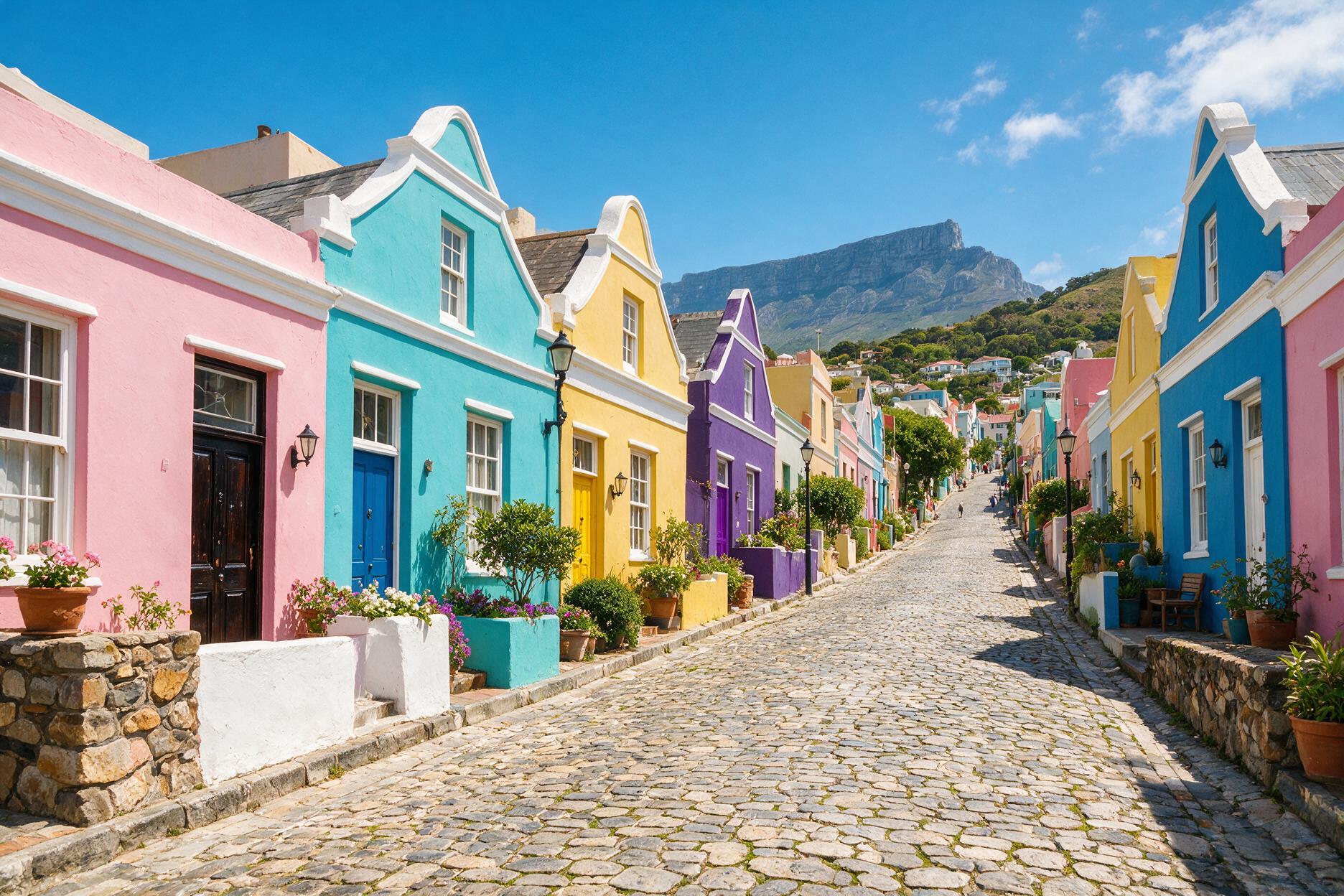
Fifteen minutes from the cableway’s base station, on the slope of Signal Hill overlooking the City Bowl, Bo-Kaap is the neighbourhood every Cape Town photo essay uses for its cover image — steep cobbled streets lined with houses in candy pink, turquoise, mustard, violet. The commonly told local story is that when formerly enslaved residents gained the right to own property after emancipation in 1834, they began painting their homes in bright, individual colours as an act of visibility and pride, breaking from the whitewashed uniformity that had been imposed on them. Historians debate the precise origin, but the neighbourhood’s identity as the historic home of Cape Town’s Muslim community — many descended from enslaved people brought from what’s now Indonesia, Malaysia, and elsewhere in Southeast Asia — is well documented, and it’s still a living, working neighbourhood, not a museum set.
That last part matters practically: people live behind those bright doors, and Bo-Kaap residents have been increasingly vocal about tourists treating their doorsteps like a photo backdrop — posing on stairs, blocking driveways, occasionally wandering into front gardens. Take your photos from the street, be quick about it if someone’s clearly trying to get past you with groceries, and you’ll get exactly the same shot without being the reason locals are tired of tour buses.
For breakfast, Biesmiellah on Wale Street is the neighbourhood’s best-known Cape Malay restaurant — family-run, halal, alcohol-free, serving the denningvleis, bobotie, and koesisters (a syrup-soaked, coconut-rolled doughnut twist worth the sugar crash) that built Cape Malay cuisine’s reputation. It fills with tour groups by midday, which is exactly why you’re there at 10:30 instead. If you’d rather do something more hands-on, several Bo-Kaap households run small cooking demonstrations out of their own kitchens, usually booked a day ahead through your hotel or a local operator — a good chance to learn the masala-heavy spice base behind dishes like bredie, closer in spirit to Indian cooking than most visitors expect, a legacy of the Cape Malay community’s roots in the Indian Ocean spice trade.
The small Bo-Kaap Museum on Wale Street and the Auwal Mosque — South Africa’s oldest, founded in 1794 — are both worth the twenty minutes it takes to see them, and give useful context for the neighbourhood you’ve just been photographing.
12:30 PM — Kirstenbosch in Spring Bloom
From Bo-Kaap, it’s about a 20-minute drive around the eastern flank of Table Mountain to Kirstenbosch National Botanical Garden, laid out against the mountain’s slopes with the city dropping away behind you. September is one of the better months to visit — the fynbos beds and protea collections are moving into spring bloom, and while peak wildflower season on the broader West Coast runs a little later, Kirstenbosch is already colourful and far quieter than it gets in summer.
Walk the Boomslang canopy walkway — a curved steel-and-timber bridge above the tree canopy — then sit somewhere on the lawns rather than power-walking the whole garden. It rewards slowing down, which is conveniently what you’re about to do at lunch.
If botanical gardens aren’t your thing, or you’re travelling with kids who’ve had enough walking, the V&A Waterfront is the honest alternative — harbourside restaurants, an aquarium, shopping, and boat trips out to Robben Island (book well ahead; it’s a half-day on its own, so treat it as a separate day if it’s a priority). Either detour works; Kirstenbosch just leans into the September story more directly.
2:00 PM — A Long Lunch in the Constantia Winelands
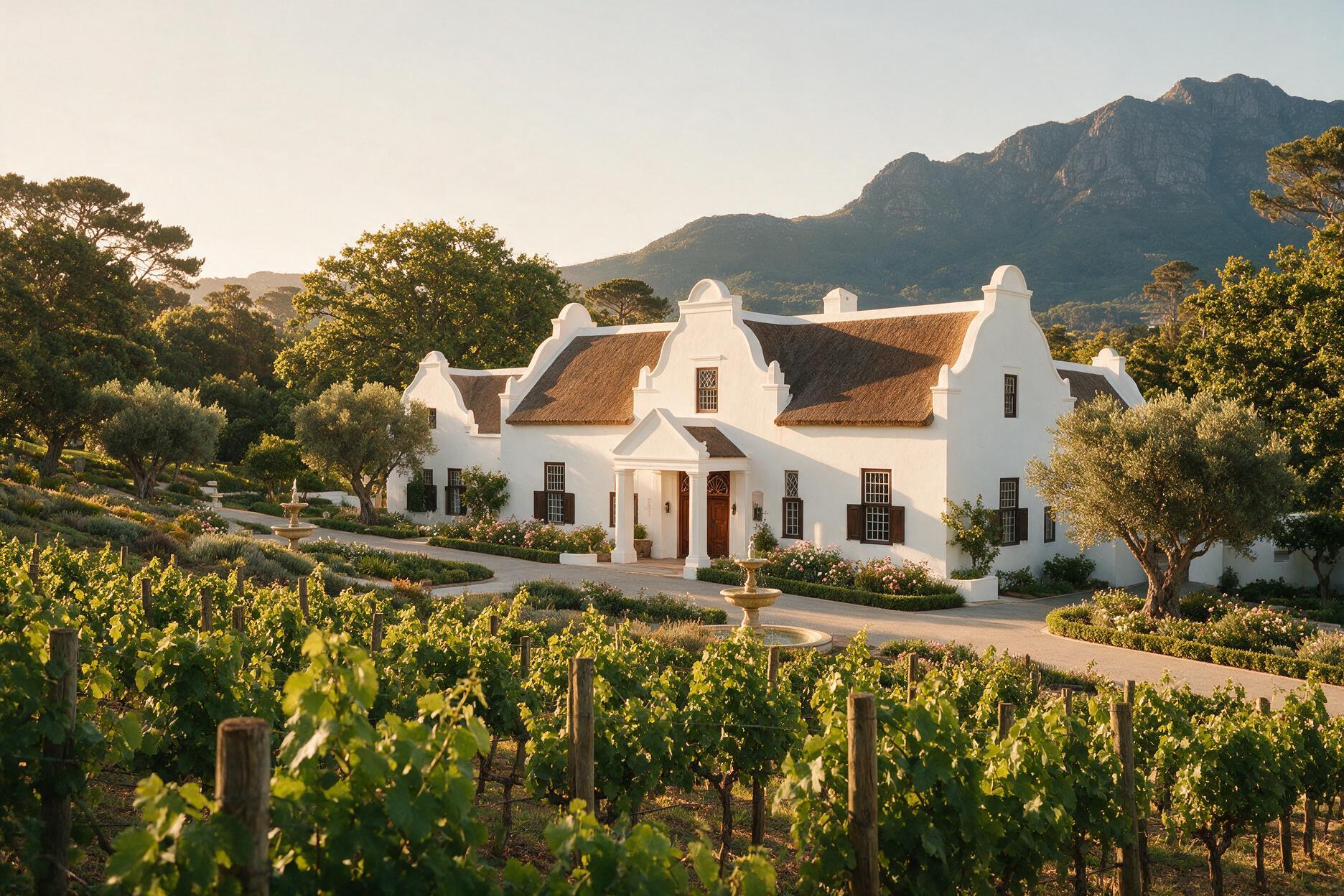
This is where the day deliberately slows down. Constantia, about 20 minutes from Kirstenbosch, is South Africa’s oldest wine-producing region and genuinely walkable-vineyard pretty — nothing like the multi-hour drive to Stellenbosch or Franschhoek, which makes it the only wine detour that realistically fits into a single Cape Town day.
Groot Constantia, founded in 1685 by Dutch East India Company governor Simon van der Stel, is the estate to anchor the afternoon around — the oldest wine estate in South Africa, still producing after 340 years, with a Cape Dutch manor house and cellar you can tour in twenty minutes before lunch at Jonkershuis or Simon’s, the two restaurants on the property. A tasting flight runs a modest R100 to R150 for five or six pours; lunch for two with a bottle sits comfortably in the R900 to R1,400 range, a proper meal by Cape Town standards, not a splurge.
If wine specifically is the draw, Klein Constantia, a short drive further into the valley, is worth it for one reason: its Vin de Constance, a sweet dessert wine with a genuinely wild history — reportedly a favourite of Napoleon in exile, mentioned by name in Jane Austen’s Sense and Sensibility, served at European courts before the original vineyards were wiped out by phylloxera and replanted from scratch. Tasting a wine with that paper trail, on the estate that made it, beats a standard flight.
One easy-to-overlook note: don’t drive yourself. A private driver for the day — normal practice in Cape Town’s wine regions, easily arranged through your hotel — means everyone at the table can actually enjoy the tasting.
5:30 PM — Sundowners at Camps Bay or Signal Hill
By late afternoon, head back over Constantia Nek and around to the Atlantic side of the peninsula. You’ve got two good options here, and which one you pick says something about what kind of evening you want.
Signal Hill is free, unfussy, and exactly what Capetonians actually do — park along Signal Hill Road, walk out to one of the viewpoints with a blanket and whatever you picked up from a bottle store on the way, and watch the sun drop into the Atlantic with Lion’s Head, Table Mountain, Robben Island, and the whole sweep of the Atlantic Seaboard laid out below you. It gets busy but rarely feels crowded the way a restaurant terrace does — there’s enough rock to spread out.
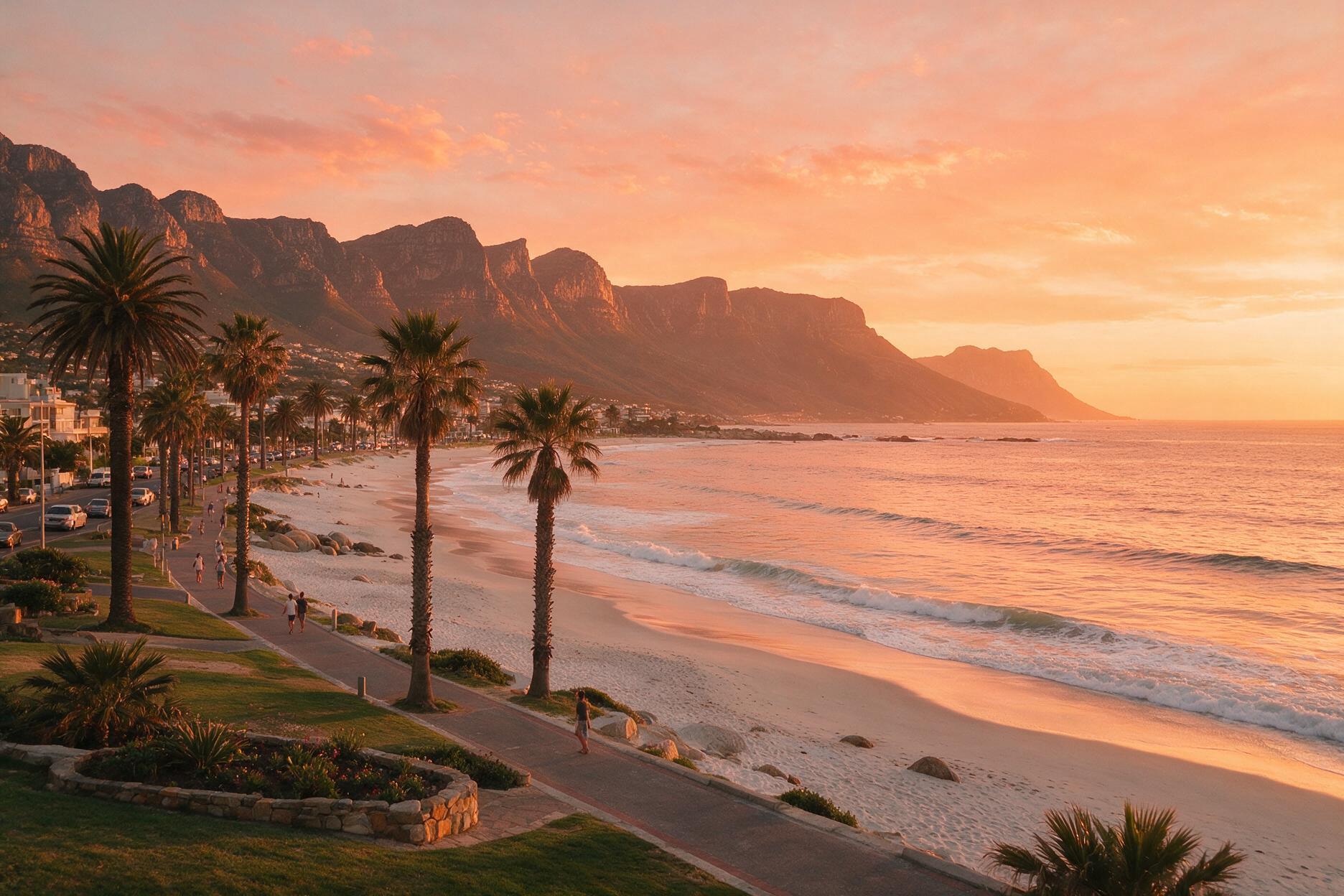
Camps Bay is the more polished version: a white-sand beach backed by palm trees and a strip of restaurant terraces directly across the road, all facing west into the sunset, with the Twelve Apostles mountain range as a backdrop. The Bungalow and Café Caprice are two of the long-running names on that strip for a reason — good cocktails, unbeatable position, and a crowd that leans stylish rather than backpacker. Book ahead if you want a table right on the sunset side; it’s the single most in-demand seat in the city at 6 PM.
Sunset in September lands around 6:15 to 6:30 PM, so aim to be settled — on the hill or at the table — by 5:30. Either way, you’re closing the loop: the mountain you climbed at dawn is now the thing you’re watching the light leave, from the other side of the bay.
Getting There, Visa, and the Practical Stuff
Flights: there’s no nonstop flight from India to Cape Town, so budget one connection. Emirates (via Dubai), Qatar Airways (via Doha), and Ethiopian Airlines (via Addis Ababa) are the most commonly used routings from Delhi, Mumbai, and Bengaluru, with total journey times typically running 15 to 20 hours. Fares move with season and booking window, so treat any number you see online as a starting point and check live fares closer to your travel date.
Visa: Indian passport holders need a visa arranged in advance — there’s no visa-on-arrival for South Africa. Apply through the official South African e-Visa portal or via VFS Global, with a comfortable buffer before travel. You’ll need your passport (valid 6+ months beyond your trip), proof of accommodation, a return ticket, and bank statements showing sufficient funds. Rules do get revised, so confirm current requirements on South Africa’s Department of Home Affairs site before you book anything.
Currency and payments: South Africa uses the Rand (ZAR). Cards are accepted almost everywhere in Cape Town, including market stalls and casual restaurants, but carry some cash for tips — a meaningful number of servers only see their tip if it’s handed over in cash rather than added to the card slip. Ten percent is standard for restaurants; guides and drivers are usually tipped separately, often R150–R300 for a half or full day. The Rand-to-Rupee rate moves, so check it close to travel — recent rates have it around ₹5.9 to the Rand.
Safety, honestly: Cape Town’s “tourist corridor” — City Bowl, V&A Waterfront, the Atlantic Seaboard (Camps Bay, Clifton, Sea Point), and Constantia — is comfortable to walk around in daylight, with heavy foot traffic and visible private security. The real risk here is opportunistic petty theft, not anything more serious, and it’s largely avoidable: don’t walk with your phone out, stay alert on quiet streets after dark, and use Uber or Bolt rather than an unlicensed taxi. If you drive, keep doors locked in traffic — smash-and-grabs at red lights happen occasionally. Township tours are genuinely worth doing, but through a reputable guided operator, not independently.
Who This Day Works Best For
Couples and honeymooners get the most out of this exact sequence — the sunrise hike, the long wine lunch, and the sunset table at Camps Bay all lean romantic without trying too hard. Book the Camps Bay table over the Signal Hill picnic if that’s the version of the evening you want.
Families with older kids should swap the dawn Lion’s Head walk for a later start and consider the V&A Waterfront instead of Kirstenbosch — more forgiving for shorter attention spans, and it gives you the aquarium as a fallback if the mountain’s closed for weather.
Solo travellers can do almost all of this comfortably; the one real caveat is the pre-dawn hike, best done in a small group rather than alone. Everything else — cableway, Bo-Kaap, wine tasting, sundowners — is entirely normal, and enjoyable, solo.
Anyone extending beyond one day should seriously consider Hermanus, 90 minutes along the coast, for land-based whale watching — September through November is one of the most reliable windows anywhere to watch southern right whales from shore, no boat required. It doesn’t fit into this particular day, but pairs naturally with it if you have a second one to spare.
FAQs
Is one day enough to see Cape Town?
It’s enough for a full, well-paced taste of the city’s best-known experiences — Table Mountain, Bo-Kaap, Constantia — but not enough to see Cape Town properly. Robben Island, the Cape Peninsula, the townships, and the Waterfront all deserve their own time. Most travellers pair a day like this with two or three more for the peninsula and a Winelands day trip further afield.
Do I need a visa to visit Cape Town from India?
Yes. Indian passport holders need a visa arranged in advance through South Africa’s e-Visa portal or VFS Global — there’s no visa-on-arrival. Apply with time to spare, since processing windows and requirements can shift.
Is Cape Town safe for tourists?
Within the main tourist areas — City Bowl, Atlantic Seaboard, V&A Waterfront, Constantia — yes, with normal city precautions. The main risk is opportunistic petty theft rather than anything more serious. Stick to licensed ride-hailing apps after dark, keep your phone out of sight when walking, and book hikes and township visits through reputable guides rather than going independently.
What’s the best time of day to go up Table Mountain?
Right at opening. The cableway typically opens around 8:30 AM, and the first hour or so after opening is dramatically quieter and better lit for photos than the 11 AM to 2 PM window, when tour groups arrive in bulk.
Can I see whales from Cape Town itself in September?
Occasionally — southern right whales are sometimes spotted from the Atlantic Seaboard promenade in season — but Hermanus, about 90 minutes away, is the reliable, land-based whale-watching destination, with sightings building through September into their October-November peak.
Is Bo-Kaap safe and okay to just walk around?
Yes, it’s a well-visited, generally safe daytime neighbourhood — just remember it’s residential. Keep photography to the street, be mindful of driveways and front steps, and it’s a genuinely welcoming place to spend a couple of hours.
Do I need to book Table Mountain tickets in advance?
Yes — book online rather than at the counter. It’s cheaper, and more importantly it lets you skip the queue, which matters most if you’re aiming for the first car of the day.
What should I wear or bring for this day?
Layers. Mornings on Lion’s Head and Table Mountain can be genuinely cold and windy even when the afternoon turns warm at Constantia and Camps Bay. Bring a light jacket, comfortable walking shoes for the mountain sections, sunscreen (the sun here is stronger than it looks even on a mild day), and cash for tips.
Final Word
What makes this day work isn’t any single stop — Table Mountain and Bo-Kaap and Constantia all show up on every generic Cape Town list. It’s the order, and the discipline of chasing the quiet hours instead of the convenient ones. Up before the tour buses, breakfast before the lunch crowd, wine while the light is still soft, sundowners when the whole sky over the Atlantic turns the colour of the inside of a shell. September gives you the added case for going now rather than waiting for peak season: mild weather, a city that isn’t at capacity, whales starting to show up down the coast, and spring color coming into the gardens.
If you’d like this day built into a longer, fully planned Cape Town and Cape Peninsula itinerary — with private drivers, the right guesthouses in Camps Bay or the City Bowl, and the wine estates and township experiences that don’t fit into a single day — get in touch with the Get Tripped team and we’ll put together a trip around exactly this kind of pacing.