5 Hidden Gems of Tasmania to Explore
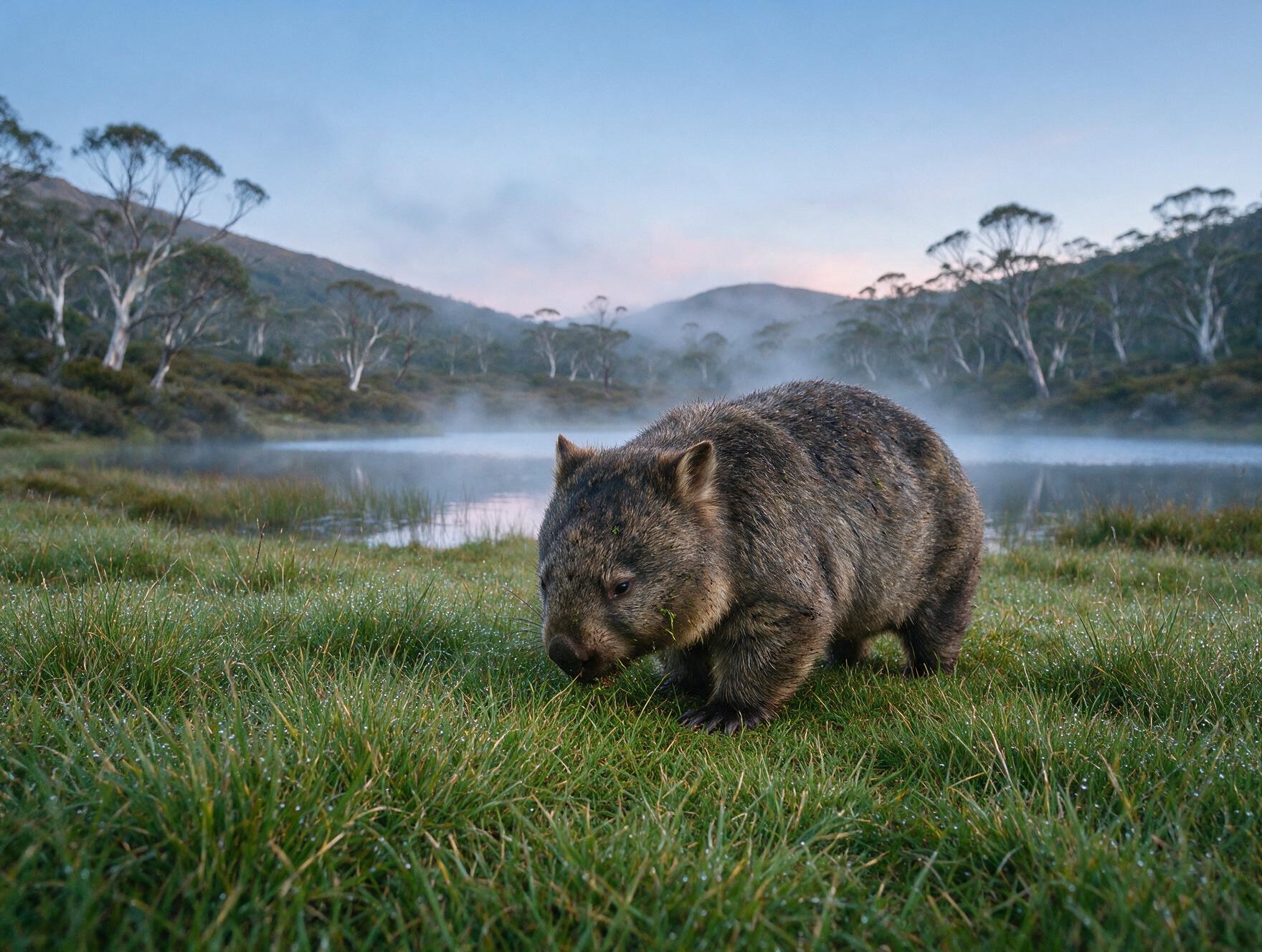
The first time a wombat crossed our path at the Lake Dobson car park, it didn’t look up once. Six o’clock, cold enough to see your breath, and this thing just kept grazing with its backside turned to us, completely unbothered, like we were the ones interrupting its evening. That’s Tasmania in one image: wildlife that isn’t performing for you, in a landscape that doesn’t care whether you showed up or not.
Most “best places to visit in Australia” lists mention Tasmania once, usually as a side note to Cradle Mountain, Wineglass Bay and MONA in Hobart. Fair enough — those three are genuinely worth the trip. But they’re also the three things every second-time Australia traveller has already photographed. This Australia travel guide goes a layer deeper, into the parts of Tasmania that don’t make the top-ten graphics: a bird hide at the edge of the known world, a beach lit orange by lichen instead of sunset, a dusk parade of penguins, an alpine shelf that turns copper for three weeks a year, and a stretch of sea cliff most people drive straight past on their way to a museum.
None of this is backpacker territory, and we’re not pretending it is. Tasmania rewards travellers who want a proper lodge with a fireplace after a day outdoors, not a hostel bunk — this is a guide for that traveller.
Quick Table of Contents
- 1. Bay of Fires, beyond the postcard beach
- 2. Bruny Island Neck at dusk
- 3. Tarn Shelf, Mount Field National Park
- 4. Melaleuca, Southwest National Park
- 5. The Tasman Peninsula’s sea cliffs
- Getting there and getting around
- Best time to visit (and the honest caveat)
- How many days you need, and what it costs from India
- FAQs
1. Bay of Fires, beyond the postcard beach
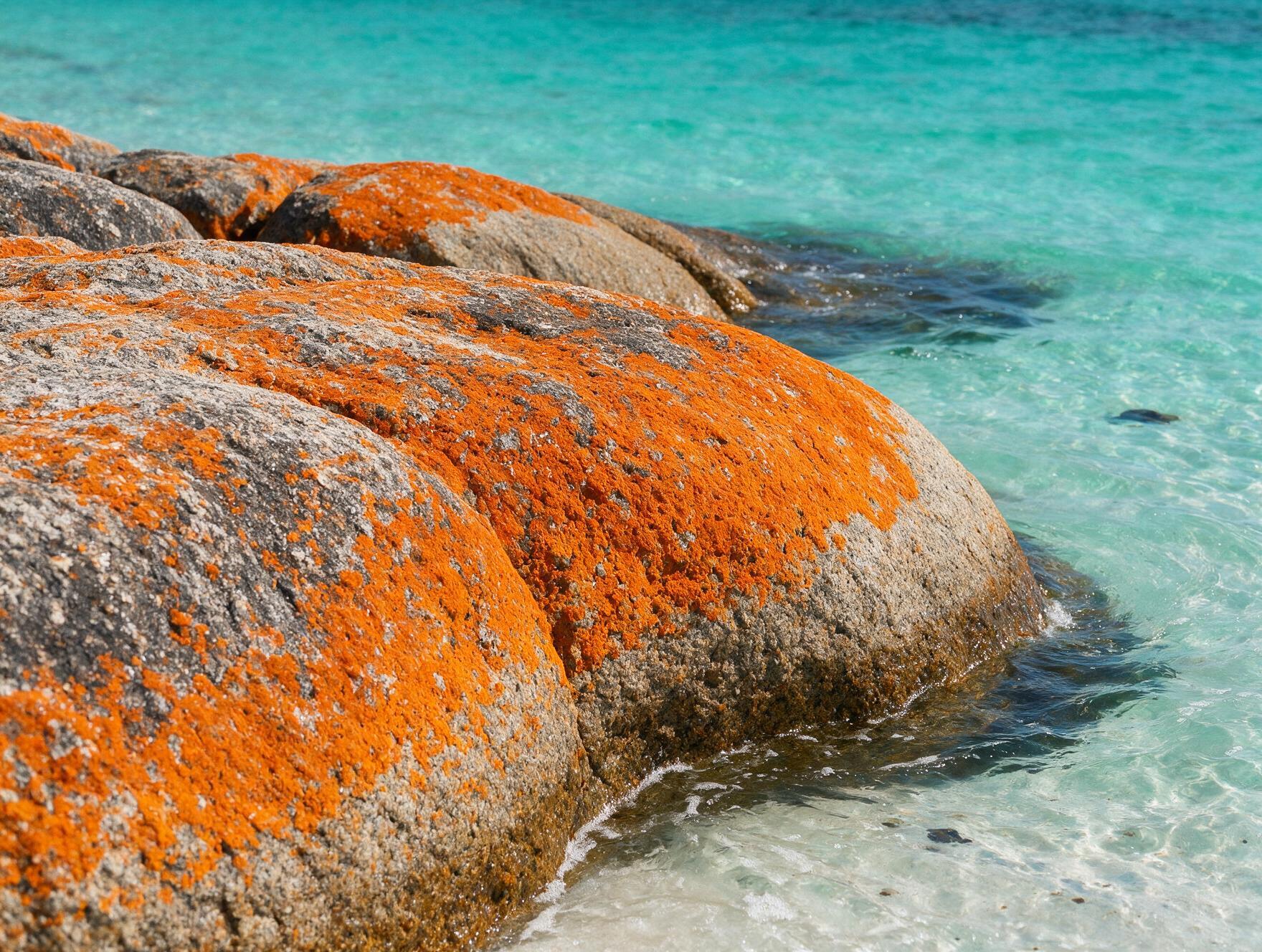
Everyone’s seen the photo: white sand, turquoise water, boulders stained a fierce orange. That’s Binalong Bay, and it’s real, and it’s crowded on a summer weekend because it’s real. The actual hidden gem is what’s north of it — Bay of Fires runs for more than 50 kilometres up Tasmania’s northeast coast, from Binalong Bay all the way to the Eddystone Point lighthouse, and most day-trippers never get past the first few kilometres.
Keep driving to The Gardens, a scatter of granite boulders and empty sand about 20 minutes north of Binalong Bay, and you’ll likely have it to yourself on a weekday. Further on, Ansons Bay is a quiet fishing hamlet where the loudest sound is oystercatchers working the shoreline. The orange isn’t paint or sunset — it’s a lichen called Caloplaca that only grows on rock exposed to clean, unpolluted air, which is a fair summary of northeast Tasmania generally.
Fun fact: Captain Tobias Furneaux named the bay in 1773 after spotting fires burning along the coastline at night — almost certainly the campfires of the region’s Aboriginal people, not the rocks. The lichen-name coincidence came later.
Mistake to avoid: don’t try to “do” all 50km of coast in one afternoon and then complain there’s nothing to see. Pick two or three stops and actually get out of the car — the lichen only looks like fire in direct light, so overcast midday photos of Binalong Bay from the car park look flat and disappointing, and that’s the shot most people post before giving up on the place.
2. Bruny Island Neck at dusk
Bruny Island itself isn’t a secret — the oysters and the cheese trail have seen to that. What most visitors skip is staying past 5pm to watch The Neck, the narrow isthmus connecting Bruny’s north and south halves, do what it does every single evening between September and February: little penguins waddling up from the surf in tight, nervous huddles, and short-tailed shearwaters gliding in low over the dunes to their burrows.
There’s a viewing platform and boardwalk built specifically so you’re not standing on burrows while you watch, and it’s a genuinely quiet, unhurried thing to witness — nobody’s selling anything, there’s no show, the birds are just doing what they do because the tide and the light told them to. Bring a red-filtered torch if you have one; white light disorients the penguins and they’ll sit frozen instead of moving up the beach.
Local tip: most tour buses leave Bruny by mid-afternoon after lunch at the cheese and whisky stops, which means the Neck at 7pm in summer is one of the few spots on the island where you’ll outnumber the birds rather than the other tourists. Combine it with dinner at one of Bruny’s food producers first, since the island’s food scene is worth its own detour — our Australia food trail guide covers what to eat around here in more depth.
Honest caveat: come in winter and there’s a real chance you’ll stand on that boardwalk in the wind for 40 minutes and see nothing — the birds are migratory, and outside the September-to-February window many burrows are simply empty.
Getting to Bruny at all means the vehicle ferry from Kettering, about 40 minutes south of Hobart, and it’s worth checking the Discover Tasmania Bruny Island Neck page for current ferry timetables before you plan the evening around it.
3. Tarn Shelf, Mount Field National Park
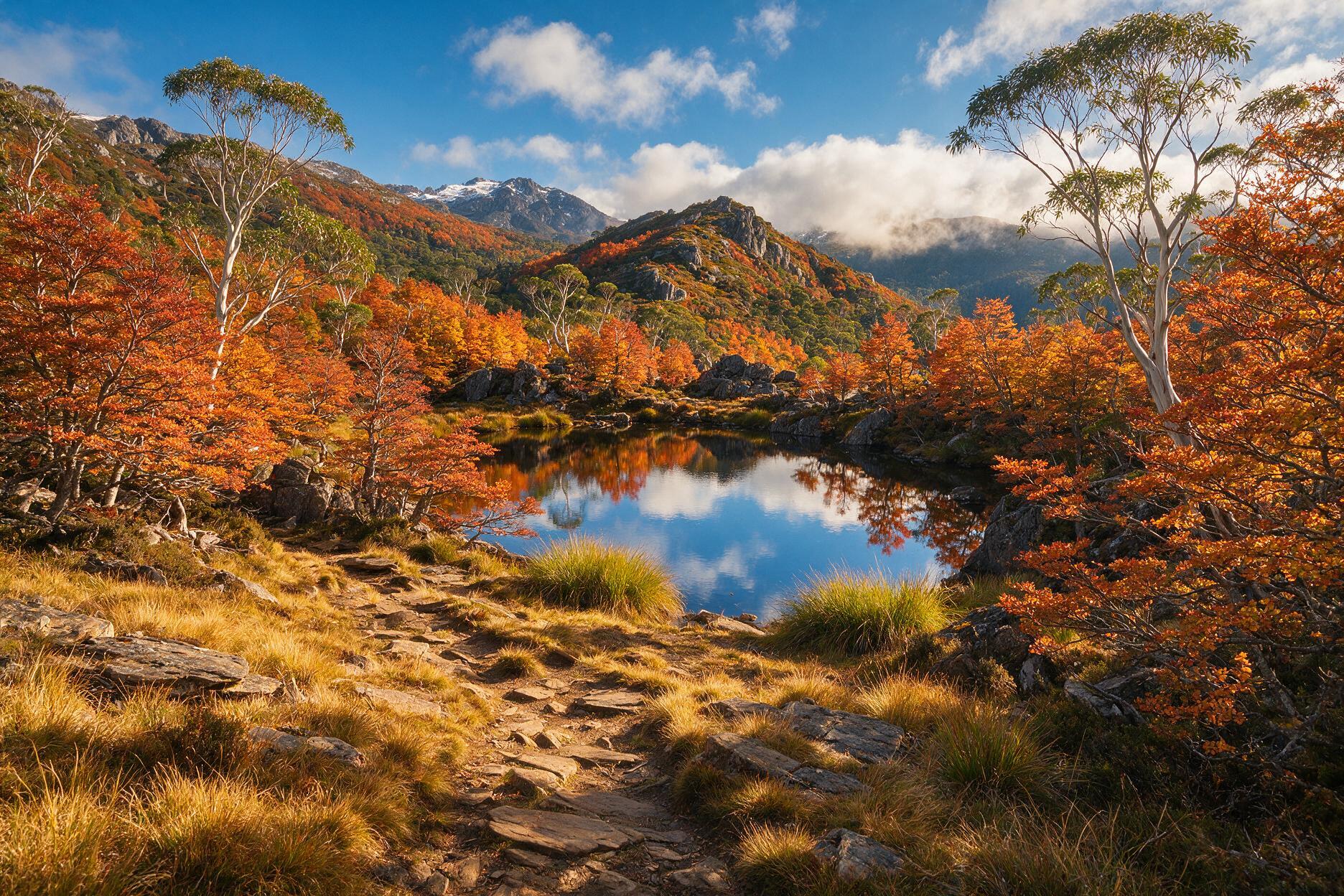
Mount Field gets visitors for one reason: Russell Falls, a genuinely gorgeous three-tiered waterfall that’s a flat 20-minute walk from the car park and, frankly, deserves the crowd it gets. What almost nobody continues on to is Tarn Shelf, a high alpine circuit that starts from Lake Dobson, about 70 minutes’ drive from Hobart through the Derwent Valley.
The Tarn Shelf circuit runs roughly 15 kilometres past a string of glacial tarns — small mountain lakes carved out during the last ice age — through snow gums and alpine moorland. For three or four weeks each April, the walk is lined with Tasmania’s only native deciduous tree, the fagus (Nothofagus gunnii), turning from green to a deep, glowing copper-orange before dropping its leaves for the season. Locals plan entire weekends around guessing the peak week, since it shifts slightly every year depending on the first proper cold snap.
Wombats and wallabies are common around Lake Dobson at dawn and dusk — which is exactly when we met the one that ignored us completely — and there are echidnas along the lower forest tracks if you’re quiet. Glow-worms show up after dark near Russell Falls too, if you’re staying nearby and don’t mind a torch-lit walk back.
Mistake to avoid: the Tarn Shelf track is genuinely alpine, not a stroll — weather turns fast up there even in summer, and people in sneakers and t-shirts regularly turn back cold and miserable partway. Check current conditions on the Parks and Wildlife Service Tasmania Tarn Shelf page before you go, and pack a proper layer even in January.
4. Melaleuca, Southwest National Park
This is the one that separates “we saw Tasmania” from “we actually went into it.” Melaleuca sits inside Southwest National Park, one of the largest and least-visited wilderness areas in Australia, and there’s no road in. You get there by light aircraft — Par Avion flies daily out of Cambridge, about 15 minutes from Hobart — or you walk in over several days on the South Coast or Port Davey Tracks, which is a different kind of holiday entirely.
What’s waiting at the other end is a former tin-mining settlement founded by Deny King, a bushman and naturalist who lived there for over 50 years and is remembered at the small Deny King Heritage Museum on site. There’s a 1.2km boardwalk called the Needwonnee Walk with sculptural installations telling the stories of the Needwonnee Aboriginal people who lived in this country long before any mining began. And there’s a bird hide built specifically for the orange-bellied parrot, a critically endangered species that breeds nowhere else on earth — Melaleuca is its entire breeding range, roughly October through late March.
Honest caveat: this is not a casual afternoon add-on. Southwest Tasmania has genuinely extreme, fast-changing weather — wild winds, sleet, snow and full sun in the same few hours isn’t an exaggeration, it’s a normal Tuesday, according to the Tasmania Parks and Wildlife Service’s own Melaleuca page. Flights can be delayed or cancelled with little notice, and self-sufficiency is expected if you’re staying overnight — there are two small walkers’ huts and a basic campsite, nothing more. Book it as a day flight with a scenic cruise if a multi-day wilderness stay isn’t your thing; the flying-and-boating combination is how most mid-range and luxury travellers experience this part of Tasmania anyway.
If wilderness flying like this appeals, it’s worth building into a longer Australia itinerary rather than a rushed side trip — see our 7 nights, 8 days Australia itinerary for how the pacing can work.
5. The Tasman Peninsula’s sea cliffs
Most visitors to the Tasman Peninsula come for one thing — the Port Arthur convict site, which is genuinely important history and worth your time. Fewer make the short detour to Tasman Arch and Devils Kitchen, about 25 minutes from Port Arthur or roughly an hour and fifteen from Hobart, where two collapsed sea caves have left a natural rock bridge and a sheer-walled chasm cut into the dolerite coastline.
From the same car park, the Waterfall Bay walk is an easy 3.4km return, about an hour, mostly flat, following the clifftop past Patersons Arch to a lookout over Waterfall Bay itself — sheer dolerite cliffs dropping straight into deep blue water, with fur seals sometimes visible on the rocks below if you’ve brought binoculars. It connects, for the more ambitious, to the start of the longer Three Capes Track, but you don’t need to commit to a multi-day hike to get the view.
Honest caveat: the “waterfall” the bay is named for is entirely rain-dependent — turn up after a dry spell and you’ll see a damp streak on the cliff face rather than a cascade. Go for the cliffs and the sea arches, not the waterfall itself, and you won’t be let down.
The Tasman National Park page from Parks and Wildlife Service Tasmania has current track notes and closures, which are worth checking since this stretch of coast gets serious wind.
Getting there and getting around
There are no direct international flights into Tasmania — you’ll connect through Melbourne, Sydney, Brisbane or Adelaide, all of which have frequent onward flights to Hobart or Launceston (Melbourne to Hobart is just over an hour in the air; Sydney is closer to an hour forty-five). If you’re already building an Australia trip around Sydney or Melbourne, Tasmania slots in cleanly as a 5-7 day extension rather than requiring a separate visit. Indian passport holders need a valid visa for Australia arranged in advance — our Australia visa guide for Indian travellers walks through the current process.
Once you’re on the island, self-drive is genuinely the way to see any of these five spots — Tasmania has limited public transport outside Hobart and Launceston, and none of these gems are on a regular bus route. Distances look small on a map and take longer than expected on winding roads, so budget more driving time than Google Maps suggests, especially after dark when wildlife on the road is a real hazard.
Best time to visit (and the honest caveat about weather)
If you’re asking about the best time to visit Australia broadly, the answer changes by region — but for Tasmania specifically, it’s genuinely its own climate zone, cooler and wetter than the mainland year-round. Summer (December to February) is the easiest window: long daylight hours, the Bruny Island penguins are active, and alpine walks like Tarn Shelf are at their most accessible. Autumn (April) is when the fagus turns, and it’s arguably the single best short window for a nature-focused trip if you can time it. Winter brings snow to the highlands and genuinely wild weather to the southwest and the coast — beautiful if you’re prepared for it, miserable if you’re not.
The honest caveat, and Tasmanians will tell you this themselves: the weather changes fast and doesn’t read the forecast. Four seasons in one day isn’t a cliché here, it’s a packing instruction. A waterproof layer and proper shoes matter more in Tasmania than almost anywhere else in Australia, whatever the season. Our Australia packing guide by season is worth a look before you finalise a Tasmania-specific bag.
How many days you need, and what it costs from India
People often ask how many days are enough for Australia as a whole, and the honest answer is that it depends entirely on how many regions you’re trying to cover. For Tasmania alone, five to seven days lets you comfortably reach three or four of the five gems above without the trip turning into a driving marathon — Bay of Fires and Bruny Island pair naturally with Hobart, while Melaleuca and the deeper Southwest need a dedicated day given the flight-dependent access.
On Australia trip cost from India: for a mid-range to luxury Tasmania add-on of 5-6 days — comfortable lodges, a rental car, national park entry, a scenic flight to Melaleuca and a few guided experiences — figure on a meaningfully higher per-day spend than mainland Australia, mostly because remote-area transport (flights, boat cruises) and premium wilderness lodges carry a real cost. It’s not a destination that rewards trying to do it cheaply; the appeal is precisely the remoteness that makes it expensive to reach.
FAQs
What is the best time to visit Australia if Tasmania is the focus of the trip?
December through February for reliable weather and wildlife activity, or a tight window in April if you want to see the fagus turn colour in the highlands. Winter (June-August) suits travellers who specifically want snow on the alpine areas and don’t mind shorter days.
Are these five spots suitable for a family trip, or mainly for hikers?
A mix. Bay of Fires and Bruny Island Neck involve short, easy walks and work well for most fitness levels and ages. Tarn Shelf is a proper alpine day walk, and Melaleuca requires a flight or multi-day hike, so those two suit travellers comfortable with a more active, remote-feeling day.
Do I need a 4WD to reach these places?
No — every location here is reachable by a standard rental car on sealed or well-maintained gravel roads, except Melaleuca, which requires a light aircraft or a multi-day walk regardless of vehicle.
Is Tasmanian wildlife dangerous to be around?
Not really. Wombats and wallabies are common and generally ignore people entirely, as ours did. Tasmanian devils are shy, nocturnal, and rarely seen in the wild by casual visitors — most people who see one up close do so at a wildlife sanctuary rather than on a hiking trail.
Can I see this much of Tasmania in a short stopover from a mainland Australia trip?
You can see two or three of these five gems comfortably in 3-4 days if you base yourself in Hobart, but rushing all five in that window means very little time actually at each place. Five to seven days is the more honest number.
What should I pack that most people forget?
A proper waterproof shell, not just an umbrella, and shoes with real grip — Tasmania’s weather shifts fast enough that a sunny morning can turn into a cold, wet afternoon on the same walk.
Is Tasmania good value, or is it an expensive add-on to an Australia trip?
It leans toward the pricier side of an Australia trip specifically because reaching the wildest parts — Melaleuca especially — depends on scenic flights and boat access rather than a cheap bus ticket. Budget accordingly if these five spots are the priority.
Final thoughts
Tasmania doesn’t need embellishment. A rock that’s actually orange because of lichen, not filter. A parrot that breeds in exactly one place on the planet and nowhere else. A wombat that couldn’t care less about your camera. The five spots above aren’t secret in the sense that nobody’s heard of them — Parks and Wildlife Service Tasmania publishes track notes for all of them — they’re simply the ones most itineraries skip in favour of the same three photographs everyone already has.
If you’re mapping out things to do in Australia beyond the obvious circuit, Tasmania is worth treating as its own dedicated leg rather than a rushed afternoon tacked onto Sydney or Melbourne. Explore our full Australia destination guide for how Tasmania fits into a broader trip.
Plan it with Get Tripped
This is exactly the kind of trip we like building — not a fixed package off a shelf, but a custom Australia trip shaped around what you actually want to see, whether that’s a week tracing Tasmania’s coastline, unique Australian outback tours through the red centre, or both stitched into one longer holiday. As a luxury travel agency for Australia trips from India, we handle the parts that are genuinely hard to get right from here — flight routing through Melbourne or Sydney, lodge bookings in places like Bruny Island and the Tasman Peninsula, and the timing that makes a five-day Tasmania add-on actually work instead of feeling rushed.
If you’re comparing Australia tour packages from India or just starting to think about Australia vacation packages that go beyond the obvious stops, get in touch with Get Tripped and we’ll build a Tasmania itinerary — or a full Australia trip around it — that matches how you actually like to travel.