Most Croatia itineraries you’ll find online are written for backpackers with rail passes and no fixed sleep schedule. This one isn’t that. This is a Croatia 7 days travel itinerary built the way we’d actually route it for a couple or a family flying out of Mumbai or Delhi with eight days on the calendar, wanting real hotels, a car or a driver when it makes sense, and evenings that don’t end with a 6am ferry alarm the next morning. Seven nights, eight days, five of Croatia’s six headline stops covered properly instead of all six rushed.
- Planning the basics: visa, flights and timing
- The route we picked, and the one place we skipped
- Day-by-day itinerary
- Where to stay, stop by stop
- Getting around: ferries, buses and rental cars
- What this trip actually costs
- Two add-on days if you have more time
- Frequently asked questions
Planning the basics: visa, flights and timing
Croatia visa for Indians: Croatia has been a full Schengen member since January 2023, so Indian passport holders need a Schengen Type C visa applied for through VFS Global, generally submitted at least three to four weeks ahead of travel. Budget around ₹10,000–11,000 total once you add the visa fee and VFS service charge, and factor in travel insurance with a minimum of €30,000 medical coverage — this is checked at the application stage, not something you can skip and buy later. Processing officially takes 10–15 working days but stretches close to a month between April and September, so this is the first thing to sort, well before you lock hotel dates.
There are no non-stop flights from India to Croatia. Every routing from Mumbai or Delhi runs through a connecting hub — Qatar Airways via Doha, Turkish Airlines via Istanbul, Emirates via Dubai, or Lufthansa/Air India via Frankfurt or Munich are the usual options, landing you in Zagreb, Split, or (seasonally, April to October) Dubrovnik. Total travel time including the layover generally lands somewhere between 13 and 18 hours depending on the connection. For this particular route, we’d book it as an open-jaw: fly into Dubrovnik, fly home out of Zagreb (with a short final-day hop or transfer from Zadar). It avoids doubling back on yourself, and it’s a standard setup for travel agents booking Croatia tour packages from India.
On timing: the sweet spot for this exact itinerary is late May, June, or September. July and August are when Dubrovnik’s Old Town becomes genuinely uncomfortable at midday — we’re talking shoulder-to-shoulder foot traffic on the Stradun and 35°C heat bouncing off limestone — and ferry and hotel prices roughly double. Shoulder season keeps the water warm enough to swim, keeps the Hvar–Split catamarans running frequently, and knocks a meaningful amount off accommodation. If you’re locked into travel between November and March, Croatia trips over that window work better as a Zagreb/Zadar city-and-Christmas-market trip than as this coastal itinerary — Plitvice’s shuttle boats and some island ferries scale right back, and a few restaurants and small hotels close entirely.
The route we picked, and the one place we skipped
Croatia’s tourist board lists six places to visit as the country’s headline stops: Dubrovnik, Plitvice Lakes National Park, Hvar Island, Split, Rovinj, and Zadar. In eight days, trying to hit all six means you spend more hours in transit than at any one of them — Rovinj alone sits on the Istrian peninsula in the far north, close enough to the Slovenian and Italian borders that it’s practically a different trip. The direct road distance from Zadar to Rovinj is over 300 km, and there’s no ferry shortcut; you’re looking at four-plus hours each way, or a separate flight into Pula. Bolting that onto a Dubrovnik-based week either means arriving exhausted or cutting every other stop down to a photo-and-go.
So this itinerary covers five of the six: Dubrovnik → Split → Hvar Island → Plitvice Lakes National Park → Zadar, in that order. It’s a real geographic loop, not a checklist. Dubrovnik and Split sit on the same coastal highway, now connected without the old Bosnia border hassle since the Pelješac Bridge opened in 2022. Split is the ferry gateway to Hvar. From Hvar, you loop back through Split and head inland to Plitvice, then continue north to Zadar, which functions as a natural last stop before flying home via Zagreb. Rovinj gets left for a dedicated Istria trip — we’ll come back to that under the add-on section, because it deserves its own three or four days rather than a rushed detour.
Day-by-day itinerary
Day 1 — Arrival in Dubrovnik
Most connecting flights from Mumbai or Delhi land in Dubrovnik in the afternoon or early evening after an overnight departure from India. Clear immigration, collect bags, and take a private transfer or taxi into town — Dubrovnik Airport sits about 20 km south of the Old Town, roughly a 25–30 minute drive. Check in, and if daylight’s left, walk down toward the Old Town walls just for bearings, not sightseeing. Dinner at a konoba (a small traditional Dalmatian tavern) nearby, then an early night to shake off the jet lag before tomorrow.
Day 2 — Dubrovnik Old Town and the city walls
Start at 8am, before the cruise-ship crowds hit. The City Walls loop (around two hours at an unhurried pace, roughly 1,940 meters) gives you the best orientation of the city and the Adriatic beyond — tickets currently run around €40 for adults, and it’s worth paying for the earliest available slot. Come down and walk the Stradun, the main limestone-paved street, then duck into the side alleys where the actual residents live and hang laundry between fifteenth-century buildings. By early afternoon, take the cable car up Srđ Hill (a four-minute ride) for a panoramic view over the Old Town and the islands — go around 4-5pm rather than at sunset, when every tour bus has the same idea and the platform gets packed. Free evening: seafood dinner at a terrace restaurant just outside the Pile Gate.
Day 3 — Lokrum Island, then the drive to Split
Take the short 10-minute passenger ferry to Lokrum Island in the morning — it’s a genuinely different pace from the Old Town, with a botanical garden, a ruined Benedictine monastery, and (this is the honest local tip) resident peacocks that wander the paths completely unbothered by visitors, descendants of a small flock brought over by Archduke Maximilian in the 1850s. Swim off the rocks if the weather’s warm, then head back by early afternoon. Check out of your Dubrovnik hotel, and set off for Split — by private car or rental, the highway route via the Pelješac Bridge covers roughly 230 km in about 2 hours 45 minutes to 3 hours, tolls included (around €10). The old coastal road is prettier but adds an hour or more, and standard tour buses on this route can take 4.5–5 hours with stops. Arrive Split by early evening, check in, and walk the Riva promenade after dinner.
Day 4 — Split’s old town, then the catamaran to Hvar
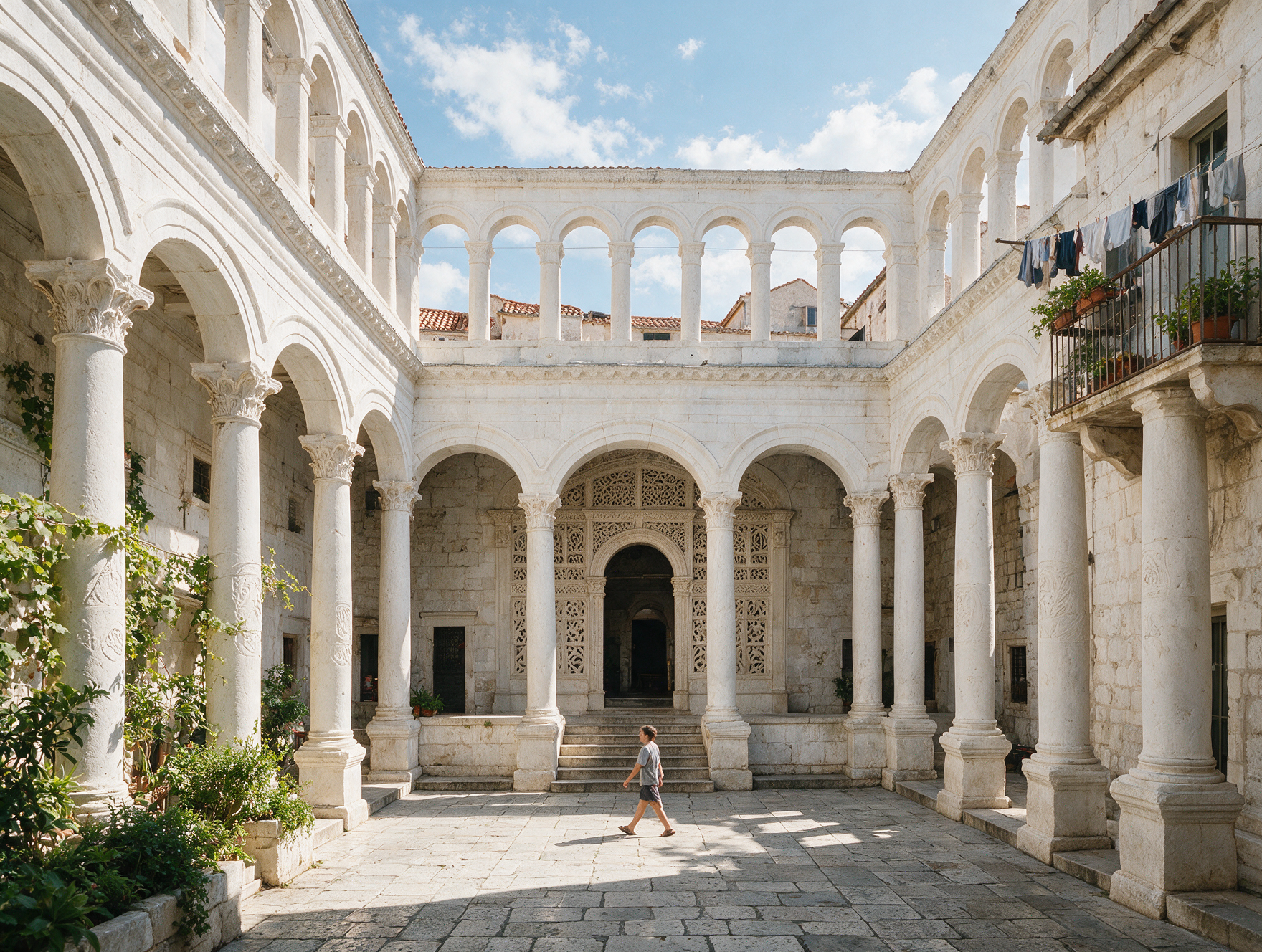
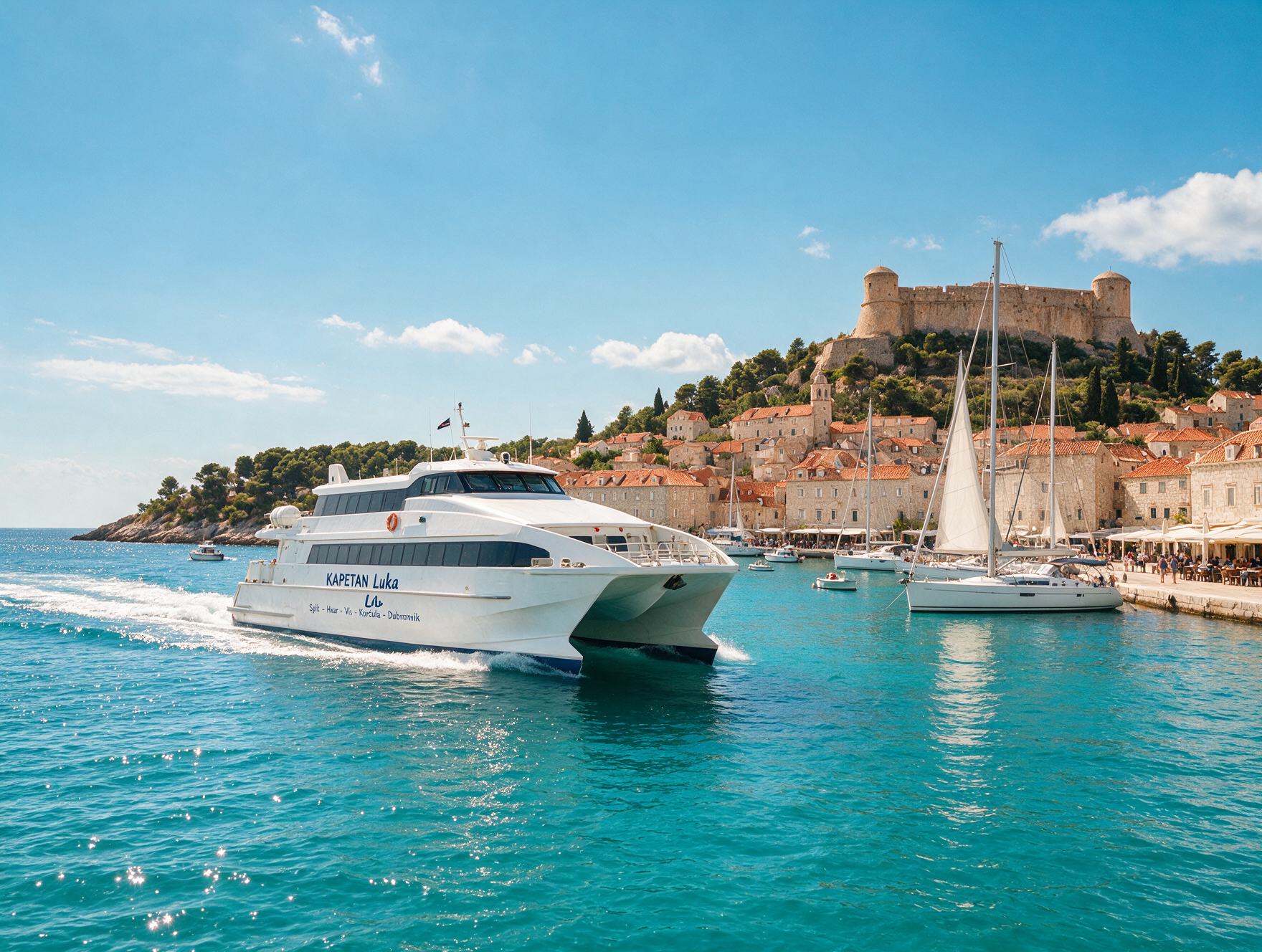
Morning in Diocletian’s Palace — and here’s a fact worth knowing before you go: this isn’t a museum you buy a ticket for and walk into. It’s a functioning neighborhood; roughly 3,000 people still live and work inside the Roman-era walls, so the “palace” is really the old city itself. Walking through the peristyle and basement halls is free; climbing the Cathedral of St. Domnius bell tower (around €7) for a rooftop view over the terracotta roofs is the one paid add-on worth doing. Grab lunch near the Green Market, then catch an early-to-mid-afternoon high-speed catamaran to Hvar Town — the crossing takes 50 minutes to just over an hour depending on the operator (Krilo, TP Line, and Jadrolinija all run this route), with up to 19 sailings a day in peak summer and far fewer, sometimes just two or three, outside June–September. Book this leg online the evening before if you’re traveling in July or August — walk-up tickets at the Split ferry terminal routinely sell out for same-day departures by mid-morning, and that’s the one mistake we’d flag first on this whole itinerary. Evening in Hvar: walk up to the Spanjola Fortress for sunset over the Pakleni Islands, then dinner at the harbor.
Day 5 — Full day on Hvar
This is the itinerary’s one true slow day, and it earns its place. Book a half-day boat trip out to the Pakleni Islands in the morning — a scattering of pine-covered islets a short hop from Hvar harbor, with coves that are far quieter than anything on the main island. Swim, have lunch at a beach club on Marinkovac or Sveti Klement, and be back in Hvar Town by mid-afternoon for the lavender and rosemary stalls near the main square, then the Franciscan monastery on the harbor’s edge. One honest opinion: skip the Blue Cave day trip every operator in Hvar will try to sell you. It’s actually near Vis, a 1.5–2 hour round-trip by boat, for a three-to-five-minute window inside the cave shared with a queue of other boats in peak season. The Pakleni Islands give you far more for the time.
Day 6 — Back to Split, then inland to Plitvice Lakes
Take a mid-morning catamaran back to Split. From here, it’s a genuine change of scenery: the road to Plitvice Lakes National Park runs inland through hill country, roughly 260 km by road (the straight-line distance is shorter, but there’s no direct route through the mountains), taking about 2 hours 45 minutes to 3 hours by private car or rental, or 3.5–4.5 hours by public bus with a change. Fewer buses run this route outside summer, so if you’re not self-driving, book ahead. Check into accommodation near the park entrance and, if you arrive with energy left, take a short evening walk near Entrance 1 — but save the real hiking for tomorrow, since the light in the canyon fades early once you’re under tree cover.
Day 7 — Plitvice Lakes, then on to Zadar
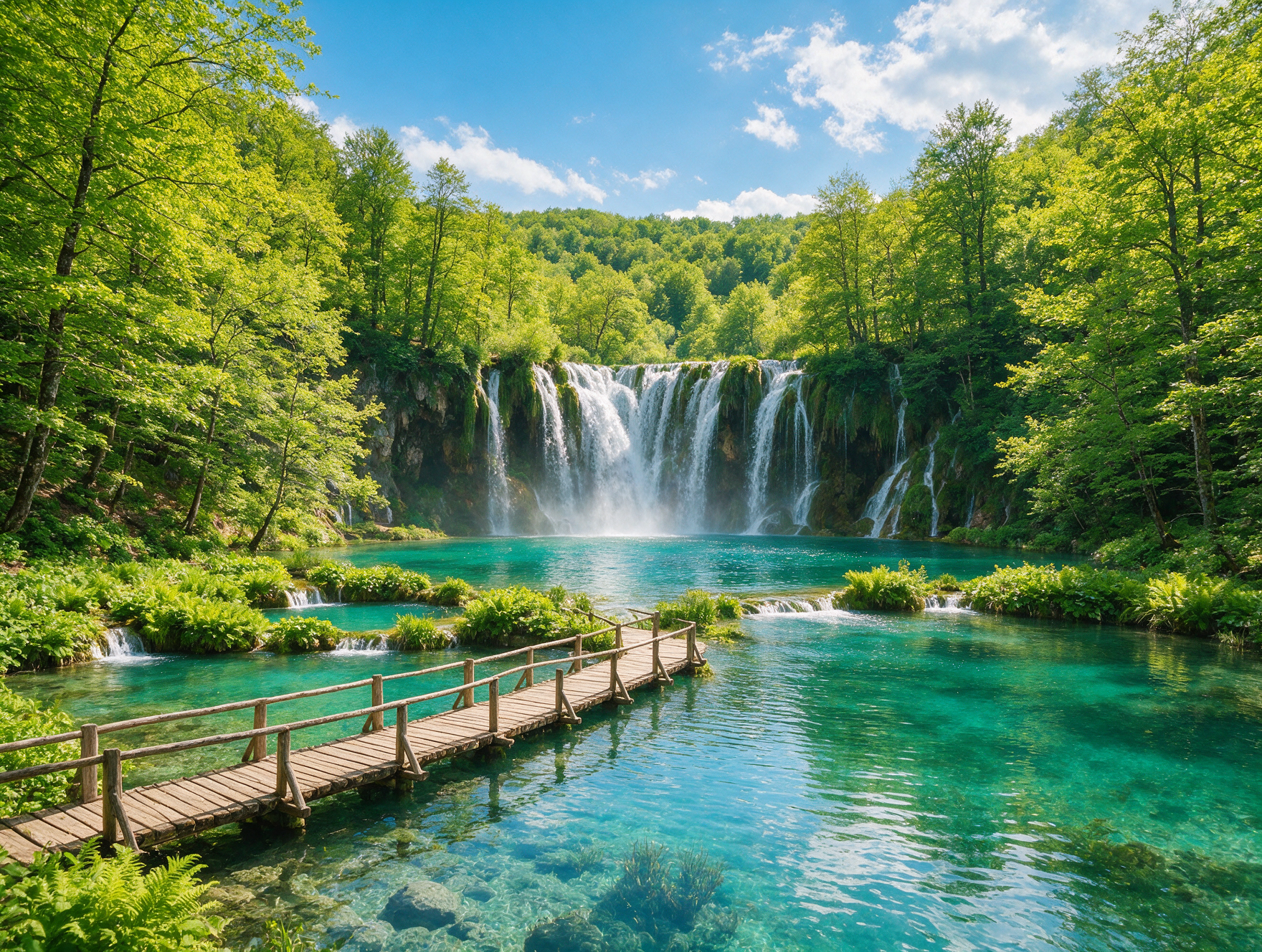
Start early — the park gets genuinely crowded by late morning in peak season. Plitvice’s sixteen terraced lakes, connected by waterfalls and wooden boardwalks through beech and fir forest, are usually walked via one of the marked programs (letter-coded routes of three to eight hours) that include a short electric boat crossing over Kozjak, the largest lake. Peak-season adult entry runs around €40; if you’re visiting in the November–March off season, it drops to roughly €10, though several trails and boat crossings are limited or closed then. Budget four to five hours on the lower and upper lakes combined, have a late lunch near the entrance, and set off for Zadar by mid-afternoon — it’s about 130 km and roughly 1.5 hours by road. Time your arrival for early evening and head straight to the waterfront for sunset at the Sea Organ, a set of stone steps built in 2005 by architect Nikola Bašić that uses wave action and hidden pipes to generate genuinely musical, unpredictable tones — genuinely one of the more original public installations in Europe, not just a photo stop. The adjoining Sun Salutation, 300 solar glass panels set into the pavement, lights up after dark in sync with the harbor’s rhythm rather than on any fixed schedule.
Day 8 — Zadar and departure
Spend the morning in Zadar’s compact old town on its peninsula — the Roman Forum, the ninth-century Church of St. Donatus, and the narrow marble-paved lanes are all walkable in two to three hours. One quieter alternative to the crowded Sea Organ steps at peak hours: locals tend to watch the light change from the steps near St. Donatus itself in the late morning, when the tour groups haven’t arrived yet. By early afternoon, head to Zadar Airport for a connecting flight, or arrange a transfer back to Split or on to Zagreb (about 3.5 hours by road, or a short domestic Croatia Airlines hop) depending on which city your international flight home departs from — Zadar’s own airport has good seasonal links within Europe but far fewer options connecting onward to Gulf or Turkish hubs, so double-check your outbound routing when you book rather than assuming Zadar works for the international leg.
Where to stay, stop by stop
None of this is hostel territory — Get Tripped plans this route mid-range to luxury throughout, and each stop has a clear “best area” rather than one that just happens to be cheapest.
Dubrovnik: Staying inside the Old Town walls means you’re steps from everything but paying a premium for it, with no vehicle access to your door. Lapad Bay and Babin Kuk, about a 15–20 minute walk or short bus ride from the Old Town, offer more contemporary hotels and resorts with sea-view terraces at a noticeably gentler price, and it’s where we’d point most couples and families on this itinerary. Split: Veli Varoš, the old stone-house quarter just west of Diocletian’s Palace, is quieter and more atmospheric than staying inside the palace walls themselves, with excellent small restaurants and a five-minute walk to the Riva. Hvar Town: stick close to the harbor — the walk up to the Spanjola Fortress and out to the Pakleni Islands ferry dock both start from there, and Hvar’s better boutique hotels cluster within a few minutes of the main square. Plitvice: there’s genuinely limited luxury inventory right at the park gates — most good options are small family-run hotels and guesthouses in the villages just outside Entrance 1 or Entrance 2, and booking two or three months ahead in summer matters more here than anywhere else on this route. Zadar: the old town peninsula puts you inside walking distance of the Sea Organ and Forum, while Puntamika and Borik, just north of the center, offer newer beachfront hotels with a short taxi or bus ride in.
Getting around: ferries, buses and rental cars
For this specific route, a mix works best rather than committing to one mode throughout. Between Dubrovnik and Split, and again between Plitvice and Zadar, a private transfer or rental car is the more comfortable choice — you control timing, can stop at viewpoints, and avoid the multiple-transfer bus routes. Indian driving licenses use the Latin alphabet, so Croatia doesn’t technically require an International Driving Permit for short stays — but get one anyway before leaving India, since rental counters in smaller towns routinely ask for it. If you’re crossing into Bosnia’s short Neum corridor (largely avoidable now via the Pelješac Bridge) or putting the car on a ferry, tell the rental agency in advance — rules vary by company.
The Split–Hvar leg is a catamaran, not a drive — there’s no bridge or car ferry that makes sense for a single overnight stop, and the boat is faster anyway. Book it through the operator’s own site or app a day ahead in peak season. For Plitvice, note that Croatia switched from the Kuna to the Euro back in January 2023, so any older blog post still quoting Kuna prices is out of date — cards are widely accepted everywhere on this route, though small konobas and market stalls in Hvar and Plitvice villages still sometimes prefer cash, so carry some euros.
What this trip actually costs
This isn’t a Croatia trip cost from India breakdown aimed at doing it as cheaply as possible — it’s a realistic mid-range-to-comfortable range, per couple, excluding international flights and visa fees.
| Stop | Hotel (per night, mid-range) | Per-day spend incl. meals, transport, entries |
|---|---|---|
| Dubrovnik | €180–320 | €220–380 |
| Split | €130–220 | €180–300 |
| Hvar Island | €160–280 | €200–350 |
| Plitvice area | €90–160 | €140–220 |
| Zadar | €120–200 | €170–280 |
Add it up across seven nights and you’re realistically looking at roughly €1,700–3,000 (about ₹1.55–2.75 lakh) per couple for the ground portion of an 8-day Croatia trip, before flights. International economy airfare from Mumbai or Delhi currently starts around ₹32,000–46,000 one-way per person on fare trackers, which usually works out to somewhere between ₹65,000 and ₹1,10,000 round-trip per person depending on season and how far ahead you book — August and Christmas week push well past that. Add the roughly ₹10,000–11,000 per person for the Schengen visa. It isn’t a budget trip and Get Tripped doesn’t frame it as one, but it also isn’t the €500-a-day luxury tier — this is comfortable, well-located, mid-range-and-up travel with a few genuine splurges built in.
Two add-on days if you have more time
Add a Zagreb stopover (1 day). Since most international connections route through Zagreb anyway, breaking your journey there for a night — either on arrival or before your flight home — lets you see the Upper Town, Dolac market, and the cathedral without adding much extra transit. It also gives you a buffer day if flights are delayed, which matters more on a one-stop international itinerary than people usually plan for.
Add an Istria extension with Rovinj (2–3 days). This is the honest way to include the sixth of Croatia’s headline stops rather than squeezing it in. From Zadar or Zagreb, it’s a separate multi-hour drive or a short domestic flight into Pula, followed by a roughly 40-minute transfer to Rovinj’s colorful harbor and Venetian-era old town. Treat it as its own mini-trip bolted onto the end, not a day trip from anywhere on the main route — the geography just doesn’t allow that.
Frequently Asked Questions
Is 7 nights and 8 days enough time for Croatia?
For this specific route — Dubrovnik, Split, Hvar, Plitvice Lakes and Zadar — yes, comfortably, as long as you accept covering five of Croatia’s six top places rather than all six. Trying to add Rovinj or Zagreb sightseeing into the same eight days turns most stops into overnight stopovers rather than places you actually experience.
Do Indian citizens need a visa for Croatia?
Yes. Croatia is a Schengen member, so Indian passport holders need a Schengen Type C tourist visa, applied for through VFS Global with proof of accommodation, return flights, financial means, and travel insurance covering at least €30,000. Apply three to four weeks ahead of travel, longer in peak season.
What’s the best way to get from Split to Hvar Island?
A high-speed catamaran, run by operators including Krilo, TP Line and Jadrolinija. The crossing takes 50 minutes to just over an hour, with up to 19 daily sailings in summer and a much thinner schedule outside June–September. Book ahead in July and August — tickets sell out.
Should I rent a car for this itinerary, or rely on ferries and buses?
A mix works best. Use a private transfer or rental car for the Dubrovnik–Split and Plitvice–Zadar road legs, where you control timing and can stop along the way, and take the catamaran for Split–Hvar, since there’s no practical driving alternative for that crossing.
Is Croatia expensive to visit for Indian travelers?
It sits mid-pack for Western Europe — pricier than Southeast Asia, generally a notch below Italy or France for equivalent hotel quality, and noticeably cheaper on the mainland than on Hvar or in central Dubrovnik during July and August. Traveling in late May, June or September brings costs down meaningfully without losing good weather.
What’s the best time to visit Croatia for this route?
Late May through June, or September, give you warm sea temperatures, full ferry schedules, and open hiking trails at Plitvice, without the peak-July-August crowding and price spike in Dubrovnik and on Hvar.
Can I skip Plitvice Lakes and spend more time on the coast instead?
You can, and it’s a reasonable trade if waterfalls and forest trails interest you less than beaches and island time — in that case, swap the Plitvice–Zadar leg for an extra night on Hvar or a Split-based day trip to Krka National Park, which is closer to the coast and has a similar waterfall landscape on a smaller scale.
Do I need to speak Croatian, or is English enough?
English is enough throughout this route. Hotel staff, ferry operators, restaurant servers and most tour guides in Dubrovnik, Split, Hvar, Plitvice and Zadar all handle English comfortably — it’s one of the more visitor-friendly countries in Europe on this front.
If you’d rather hand off the ferry bookings, the Plitvice logistics and the visa paperwork to someone who’s already worked through them, Get Tripped’s Croatia trip planners can build this exact route — or adjust it for a honeymoon pace, a family with kids, or a longer Istria add-on — around your actual travel dates. It’s worth starting that conversation a couple of months out, especially if summer dates are on the table, since Hvar’s better hotels and the Plitvice-area guesthouses are the first things to fill up. For more on the country before you commit to dates, our full Croatia travel guide covers the rest of what’s worth knowing.