Alfred Hitchcock reportedly called the Zadar sunset the most beautiful he’d ever seen, and it’s become one of those quotes every Zadar guide repeats until it stops meaning much. Having the actual day mapped out, though, is more useful than the quote — because Zadar’s real strength isn’t one spectacular moment at the end of the day, it’s that a single day here builds naturally toward it. Roman ruins in the morning, narrow old-town streets at midday, and then the waterfront at dusk, where two strange, genuinely original pieces of public art turn sunset into something closer to a performance than a view.
This itinerary is built as a single continuous day, start to finish, rather than a list of unconnected sights, because that’s genuinely how Zadar works best. Each stop sits within a short walk of the last, so there’s no wasted time hopping between taxis or backtracking across town — just a loop that starts at the oldest part of the city and ends at its newest. The official Zadar Tourist Board site has more on seasonal events if you want to build extra time around this day.
Table of Contents
- Morning: The Roman Forum and Old Town
- Midday: Getting Lost in the Old Town
- Lunch by the Five Wells Square
- Late Afternoon: The Sea Organ
- Sunset: Greeting to the Sun
- Evening: Dinner on the Riva
- Getting to Zadar and Getting Around
- Best Time of Year for This Day
- FAQs
Morning: The Roman Forum and Old Town
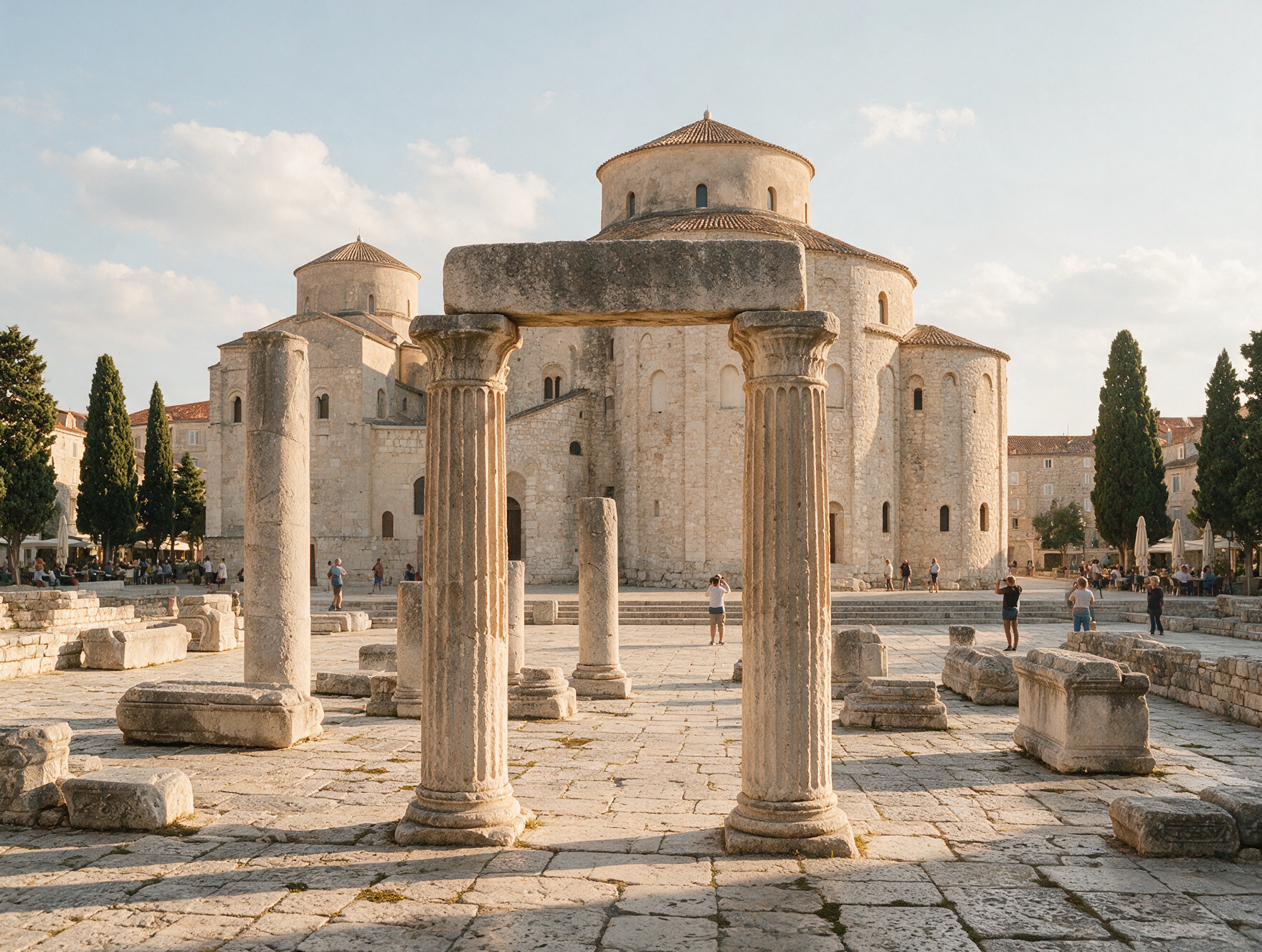
Start early, before the day-trip buses from Split or Plitvice arrive. Zadar’s Roman Forum, built between the 1st century BC and the 3rd century AD, is genuinely one of the best-preserved ancient forums on the Adriatic, and in the early morning light with almost nobody else around, it’s easy to actually take in the scale of it rather than photograph it around other people’s heads. The Church of St. Donatus, the circular 9th-century Byzantine-style church that dominates the forum, is worth a slow look even if you’re not usually a church-and-ruins traveler — its acoustics are notable enough that it occasionally hosts classical concerts in summer.
Midday: Getting Lost in the Old Town
Zadar’s old town sits on a peninsula, compact enough to walk end to end in twenty minutes but layered enough that it rewards wandering without a fixed route. Narrow stone streets open unexpectedly onto small squares; Romanesque and Venetian architecture sits stacked on top of Roman foundations, sometimes visible in the same wall. This is the part of the day to have no real plan — the honest opinion is that Zadar’s old town works better as an aimless wander than a checklist of named sights, since a lot of what makes it interesting is architectural texture rather than individual monuments.
Lunch by the Five Wells Square
Trg Pet Bunara, the Five Wells Square, makes a good midday stop — a row of five stone wells built in the 16th century as the city’s water supply during Ottoman sieges, now a quiet public square with a handful of good lunch spots nearby. It’s a five-minute walk from the forum, and a natural pause point before the afternoon’s main event.
Late Afternoon: The Sea Organ
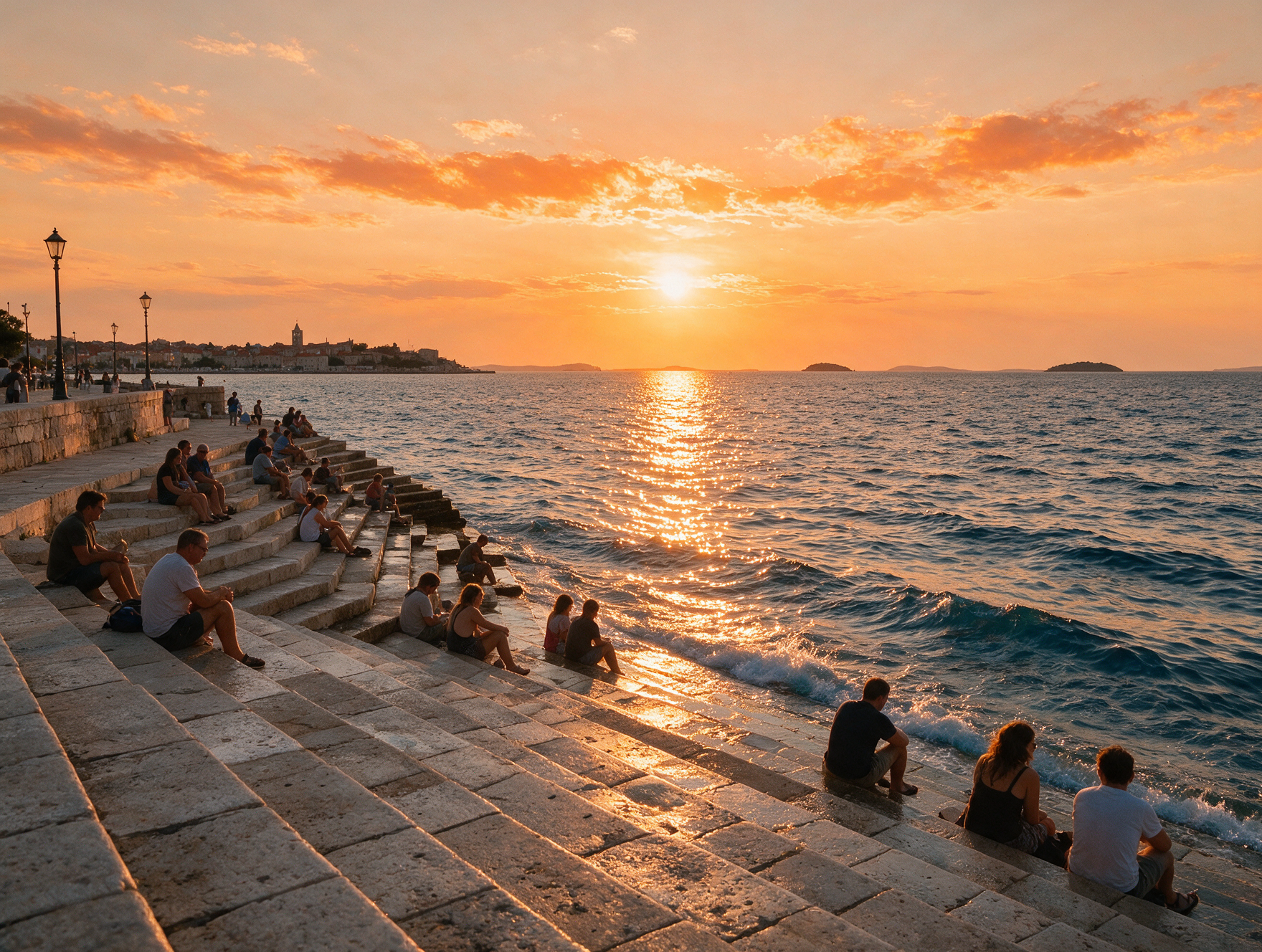
Head to the waterfront by mid-to-late afternoon for the Sea Organ, architect Nikola Bašić’s genuinely inventive piece of sound art: a series of broad stone steps leading down into the sea, with hidden resonant chambers and pipes beneath that use the motion of the waves to produce a low, constantly shifting, almost musical drone. There’s no performance schedule — it’s simply always playing, driven by whatever the sea is doing that day, which is part of what makes it feel different from a typical tourist attraction. Sit on the steps for a while before moving on to the next stop; this isn’t a five-minute photo, it rewards sitting still and actually listening.
Sunset: Greeting to the Sun
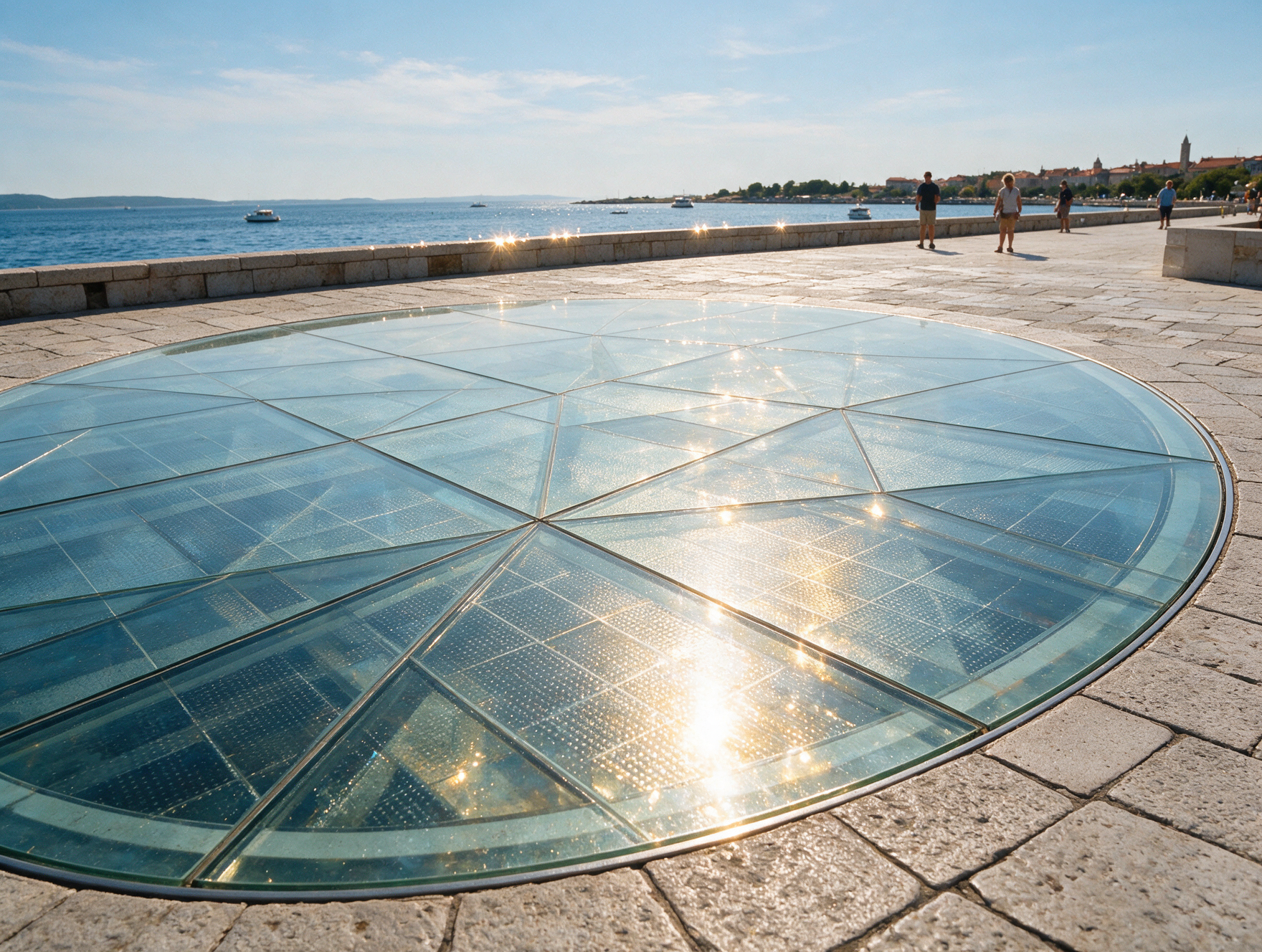
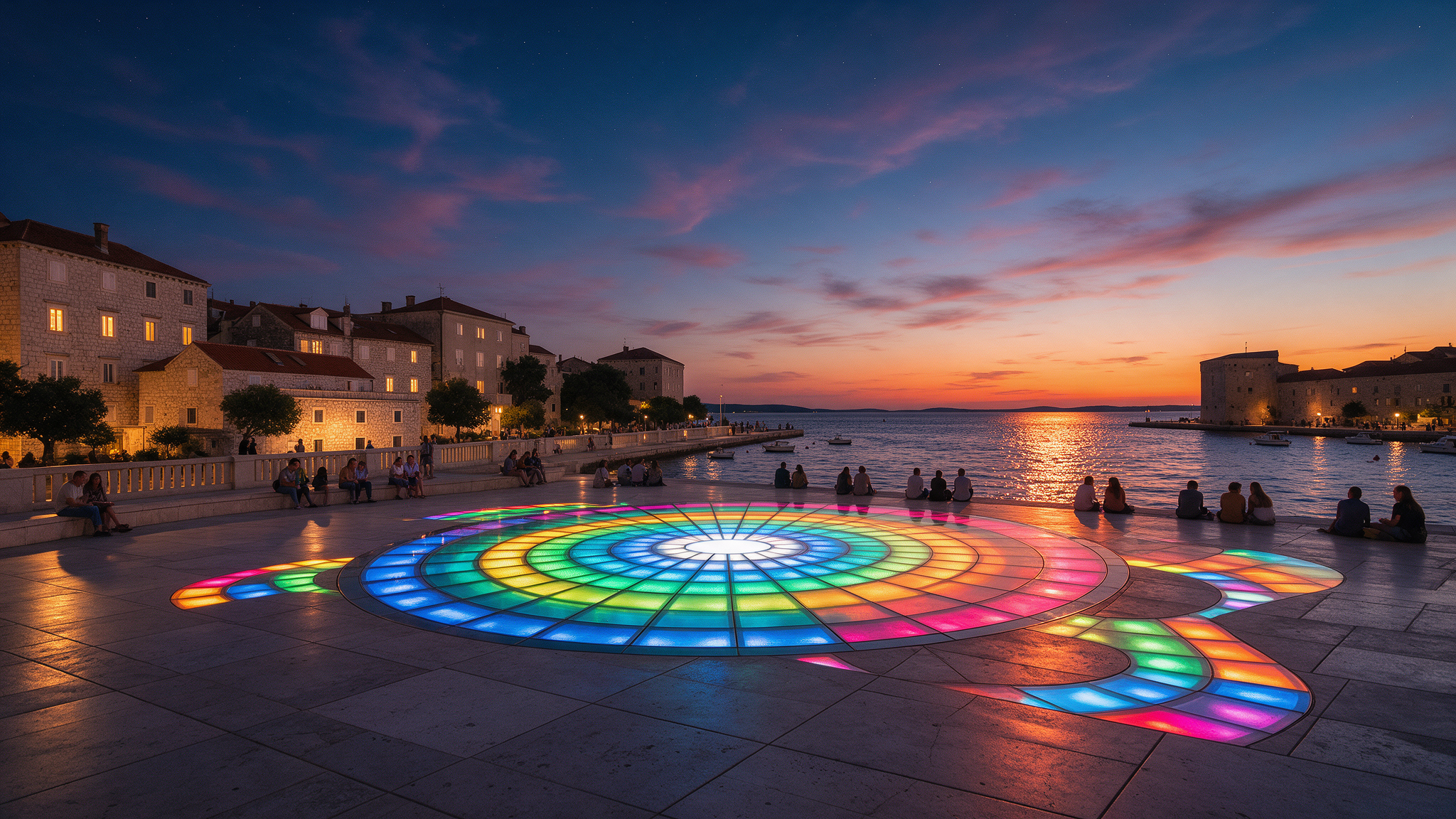
A short walk along the waterfront from the Sea Organ, Bašić’s second installation, Greeting to the Sun (Pozdrav Suncu), is a 22-meter circle of 300 multi-layered glass plates set into the pavement. During the day, the plates quietly absorb solar energy; after dark, they release it as a genuinely spectacular illuminated light show synced with the same rhythm that powers the Sea Organ nearby. The best time to be here is just after sunset, when the display is at its most visible against a darkening sky — not during the sunset itself, which is a detail a lot of first-time visitors get backwards. Locals treat this stretch of waterfront as an evening gathering spot rather than purely a tourist stop, which is a fair signal that it’s worth the wait.
A mistake to avoid
Don’t leave right as the sun dips below the horizon, thinking the show is over. The Greeting to the Sun light display is genuinely better in the ten to fifteen minutes after sunset than during it — that’s when the glass circle’s lighting actually becomes visible against the dark.
Evening: Dinner on the Riva
Close the day with dinner along Zadar’s Riva, the waterfront promenade connecting the Sea Organ and Greeting to the Sun back toward the old town center. Seafood dominates most menus here, unsurprisingly, and a number of restaurants have outdoor seating facing directly onto the water where you can still hear the Sea Organ’s low drone in the background while you eat — a nice, understated way to close out a day that started at a 2,000-year-old forum and ended with a light show powered by the sea itself.
Getting to Zadar and Getting Around
Zadar has its own airport with direct and connecting flights from several European hubs, and it sits roughly midway along the coastal route between Split and Plitvice Lakes, making it a natural stop if you’re doing a longer Croatia itinerary rather than a single-city trip. The old town itself is fully walkable and car-free at its core, so once you’ve arrived, this entire day plays out on foot.
Best Time of Year for This Day
Late spring and early autumn give you the clearest skies for the sunset without peak-summer crowds packing the Riva shoulder to shoulder. Summer evenings are busier but also longer, giving you more daylight to stretch the Forum-to-sunset sequence across without rushing any one stop.
Why Give Zadar a Full Day Instead of a Drive-Through
A lot of Croatia itineraries treat Zadar as a bathroom-and-coffee stop between Split and Plitvice Lakes, and that’s a genuine missed opportunity. The honest comparison: Zadar’s Roman Forum rivals anything in Split for historical weight, but without the cruise-ship crowds, and its waterfront art installations have no real equivalent anywhere else on the Adriatic coast. If your itinerary already has you driving past Zadar on the way to Plitvice, breaking that drive with an overnight here rather than pushing straight through is one of the higher-value changes you can make to a standard Croatia route.
If You Have an Extra Day: Nin and the Kornati Islands
Nin, a small historic town about 20 minutes north of Zadar, has its own Roman-era ruins, a genuinely tiny church claimed to be one of the smallest cathedrals in the world, and shallow lagoon beaches that are noticeably warmer than the open sea — a good add-on for families. Further out, boat tours to the Kornati Islands National Park, an archipelago of over 140 mostly uninhabited limestone islands, run from Zadar in season and make for a full-day trip if you want to pair your city day with something more purely coastal and remote.
A Fun Fact Worth Knowing
Nikola Bašić, the architect behind both the Sea Organ and the Greeting to the Sun, deliberately positioned the two installations along the same stretch of waterfront so they’d function as a connected pair — the Sea Organ providing a constant ambient soundtrack while the Greeting to the Sun handles the visual side after dark, both drawing their “material” from the same natural forces (waves and sunlight) rather than electricity generated elsewhere. It’s one of the few tourist attractions anywhere that’s genuinely powered by the thing it’s celebrating.
What This Day Costs
This is one of the more affordable full days you’ll build into a Croatia trip — the Forum, the Sea Organ, and the Greeting to the Sun are all free to visit, with the only real costs being the Church of St. Donatus’s modest entry fee, lunch, and dinner. A seafood dinner for two along the Riva runs roughly €50–80, similar to Split’s mid-range pricing. If you add a boat tour to the Kornati Islands or Nin as a second day, budget separately for that, since a half-day boat trip typically starts around €40–60 per person depending on the operator and season.
A Few Practical Notes for This Day
Wear shoes you can comfortably stand and sit in for long stretches — between the Forum’s uneven Roman paving stones and the Sea Organ’s stone steps, this is a day better suited to trainers than sandals if you’re doing all of it on foot. Zadar’s old town has plenty of cash and card acceptance at established restaurants, though smaller stalls near the market areas skew more cash-friendly. If you’re visiting between November and March, note that the Church of St. Donatus and some Forum-area sites keep shorter winter hours, so it’s worth checking ahead rather than assuming summer opening times apply year-round.
FAQs
What is the Sea Organ in Zadar?
A sound art installation designed by architect Nikola Bašić — stone steps leading into the sea with hidden pipes beneath that use wave motion to produce a continuous, naturally shifting musical drone.
When is the best time to see the Greeting to the Sun light show?
Just after sunset, in the ten to fifteen minutes once the sky has started to darken — the installation’s lighting is more visible then than during the sunset itself.
Is one day enough to see Zadar?
Yes, a single well-planned day covers the Roman Forum, old town, Sea Organ, and Greeting to the Sun comfortably, though Zadar also works well as a two- or three-night base for day trips to Plitvice Lakes and nearby islands.
Is Zadar worth visiting compared to Split or Dubrovnik?
Zadar sees far fewer visitors than Split or Dubrovnik despite having comparably significant Roman and Venetian-era sites, which makes it a genuinely quieter alternative for travelers who’ve already done the more famous stops.
Can you swim near Zadar’s old town?
There are small swimming spots along the peninsula’s edge, though most visitors head slightly further out of the old town center for proper beaches.
Is Zadar a good base for visiting Plitvice Lakes?
Yes — Zadar sits roughly a two-and-a-half to three-hour drive from Plitvice Lakes National Park, making it a reasonable base or a natural stop on a route between the park and the coast.
What are the Kornati Islands?
An archipelago of more than 140 mostly uninhabited limestone islands off the coast near Zadar, protected as a national park and reachable by boat tour, popular for their dramatic cliffs and clear water.
Zadar is easy to underrate on a first pass through Croatia, mostly because Dubrovnik and Split get the bigger reputation. A day built around the Forum, the Sea Organ, and the Greeting to the Sun tends to change that opinion fast. If you’d like Zadar built properly into a longer Croatia itinerary rather than skipped as a drive-through stop, that’s exactly the kind of route Get Tripped plans into its custom Croatia trips — pairing it naturally with Plitvice Lakes nearby. Get in touch to start planning.