Germany 7 Days Travel Itinerary: A First-Timer’s 7 Nights / 8 Days Route
The first time I mapped out a Germany trip for a couple who’d never been, they wanted five cities in eight days. I talked them down to four. That one change — cutting a city, not adding one — is probably the single most useful piece of advice in this entire itinerary, and it’s the first thing worth knowing before you build your own Germany 7 days travel itinerary.
Germany rewards travelers who move slower than the map suggests they could. The trains are fast — genuinely, remarkably fast — but fast trains create a temptation to cram in one more stop, and that’s how you end up seeing everything through a train window and nothing up close. This route covers Frankfurt, Cologne, the Black Forest, Munich, a full day trip to Neuschwanstein Castle, and Berlin, in a loop that actually makes geographic sense. It’s built for a first-timer who wants the real highlights without the exhaustion of a checklist trip, and it’s priced and paced for a comfort-forward traveler, not a backpacker doing six cities on night trains.
Table of Contents
- Route Overview: Why This Order
- Best Time to Visit Germany for This Route
- Day 1: Arrive in Frankfurt
- Day 2: Frankfurt to Cologne
- Day 3: Cologne to the Black Forest
- Day 4: Black Forest — Triberg and Titisee
- Day 5: Black Forest to Munich
- Day 6: Neuschwanstein Castle Day Trip
- Day 7: Munich to Berlin
- Day 8: Berlin and Departure
- Where to Stay, City by City
- What This Trip Actually Costs
- Getting Around: Trains, Tickets, and Booking Ahead
- Mistakes Worth Avoiding
- FAQs
Route Overview: Why This Order
This custom Germany itinerary runs Frankfurt → Cologne → Black Forest → Munich → Berlin, and it’s not arbitrary. Frankfurt is where most direct flights from India land (Lufthansa flies nonstop from Delhi, Mumbai, and Bengaluru), so it’s the natural start. From there you move west and north to Cologne — under an hour and a half by ICE — then south down the Rhine valley line to the Black Forest, then east to Munich, then north to Berlin.
The honest caveat: this route backtracks a little. Frankfurt to Cologne to the Black Forest to Munich isn’t a perfectly straight line on a map, and a purist would tell you to skip Cologne and go straight down to the Black Forest. I still think Cologne earns its half-day — the cathedral is worth the detour, and it breaks up what would otherwise be a very long first rail leg. If you’re tight on time or have done Germany before, cutting Cologne and adding a second night in the Black Forest is a completely reasonable trade.
For departure, I’d book an open-jaw flight — into Frankfurt, out of Berlin — rather than a round trip through one city. It usually costs about the same on Lufthansa or a one-stop itinerary via Doha or Istanbul, and it saves you a four-hour train ride back across the country on your last day. If your agent books you round trip into Frankfurt only, budget an extra travel day or take the Munich–Berlin leg and reverse it at the end instead.
Best Time to Visit Germany for This Route
Late April through early October is the real window for this itinerary. May and June give you long daylight (sunset past 9 PM in June), blooming Rhine valley vineyards, and comfortable 18-22°C days. September is arguably the best month of all for this specific loop — the Black Forest is turning color, Munich’s beer gardens are still in full swing, and Berlin’s outdoor terraces are usable into the evening.
If your Munich dates land between mid-September and early October, know that Oktoberfest 2026 runs September 19 to October 4 in Munich. That changes everything about the Munich leg — hotel prices roughly double, Marienplatz gets loud, and you’ll want to book the Theresienwiese grounds and any tent reservations weeks ahead, not on arrival. If Oktoberfest overlaps your trip, read our full Oktoberfest 2026 Munich guide before you finalize this itinerary — it’ll change how you plan Days 5 and 6 below.
December has its own case: German Christmas markets (Nuremberg, Cologne, and Frankfurt’s own Römerberg market) run late November to December 23, and if that’s your priority, this same route works with warmer clothing and shorter museum hours. What I’d genuinely avoid is January through March — Neuschwanstein’s winter hours are shorter (10 AM-4 PM instead of 9 AM-6 PM), days are grey and short, and the Black Forest’s appeal is mostly about green hills and lake swims, neither of which exist in February.
Day 1: Arrive in Frankfurt
Most direct flights from India land at Frankfurt Airport (FRA) in the late morning or early afternoon. Immigration at FRA can run 45 minutes to over an hour depending on how many wide-bodies land at once, so don’t book anything for your first afternoon that has a fixed start time. The airport train station is inside the terminal — a regional train (S-Bahn line S8 or S9) gets you to Frankfurt Hauptbahnhof in about 12 minutes, or a taxi runs roughly €40-50 into the city center.
Frankfurt gets dismissed as “just a banking city,” and the skyline does look more like Singapore than Bavaria. But the Altstadt (old town) around Römerberg was meticulously rebuilt after WWII bombing, and the half-timbered square at golden hour is genuinely pretty — just don’t expect medieval authenticity, most of it is reconstruction from the 1980s-2018.
Spend the afternoon walking Römerberg, then cross the Eiserner Steg footbridge to Sachsenhausen for dinner — this is Frankfurt’s apple wine (Ebbelwei) district, and Apfelwein Wagner is the classic, unpretentious spot locals actually go to, not a tourist reconstruction of one. Order the Handkäse mit Musik if you’re willing to try a genuinely divisive regional cheese.
Pacing note: if your flight was rough or landed late, skip Sachsenhausen and just eat near your hotel. You have seven more days — don’t spend day one fighting jet lag to prove a point.
Day 2: Frankfurt to Cologne
Spend the morning finishing Frankfurt — the Städel Museum if you like art, or just a coffee at one of the Kleinmarkthalle stalls, a covered market that’s been there since 1954 and is a far better breakfast stop than anything near the main tourist strip.
Take an early-afternoon ICE from Frankfurt Hauptbahnhof to Köln Hauptbahnhof — the fast trains on this line cover it in about an hour and four minutes, one of the more genuinely impressive train rides in Europe because you’re doing close to 300 km/h through the Rhine gorge for stretches of it. Book on bahn.de at least a few days ahead for the Sparpreis fares, which can run as low as €19-29 versus €70+ for a walk-up flexible ticket.
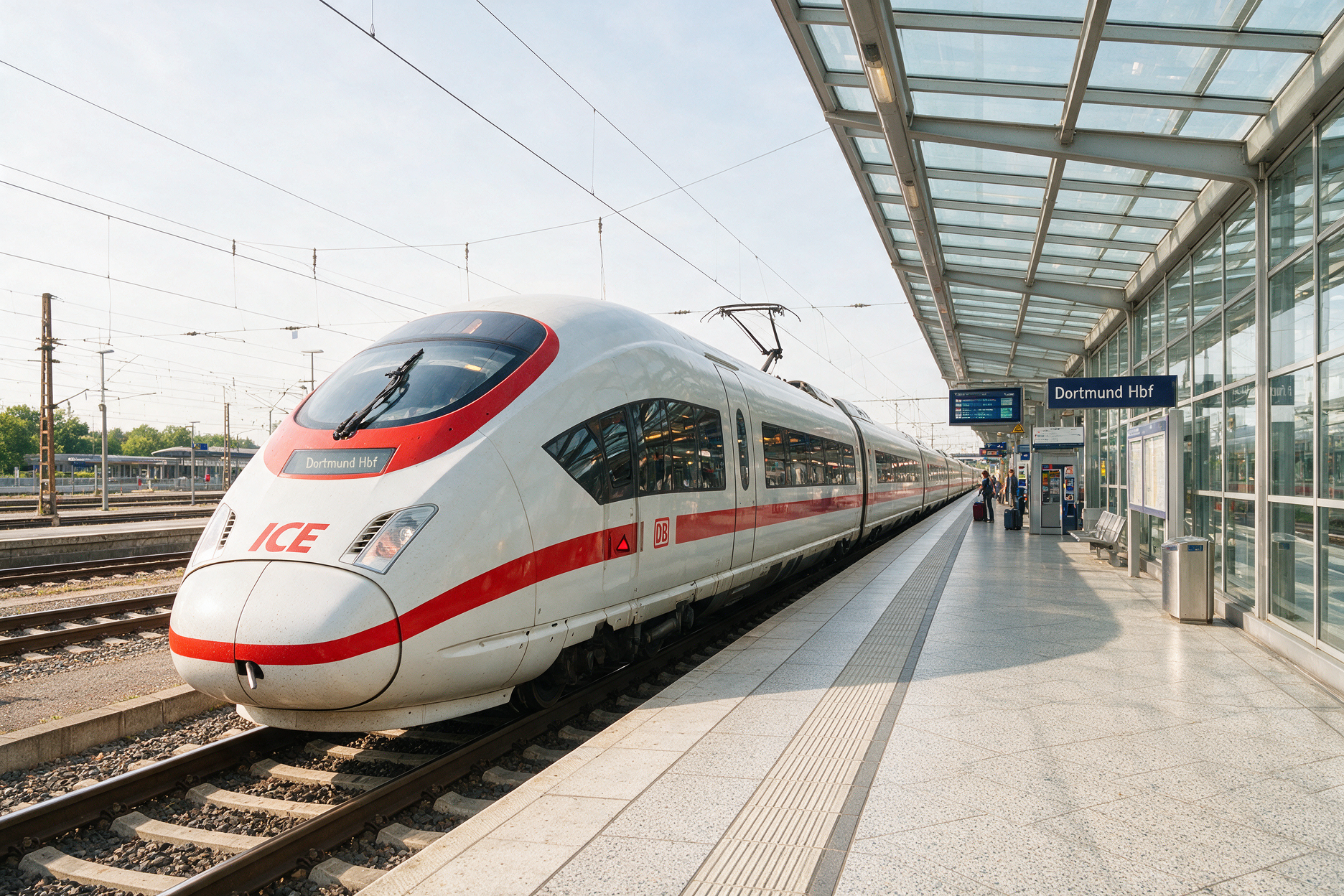
Cologne Cathedral (Kölner Dom) sits directly across from the train station exit — you genuinely cannot miss it, the twin spires are visible from the platform. Entry to the cathedral floor is free; climbing the south tower (533 steps, no elevator) costs a separate ticket and gets you a real view over the Rhine, but it’s a genuine workout and not worth it if you’re already tired from travel.

Spend the evening in the Altstadt along the Rhine promenade, and try a Kölsch at one of the traditional breweries like Früh or Peters — it’s served in small 200ml glasses specifically so it stays cold, and the waiters (Köbes) will keep bringing them until you put a coaster on top of your glass. Overnight in Cologne.
Day 3: Cologne to the Black Forest
This is the longest travel day of the trip, and I won’t pretend otherwise. Getting from Cologne to the Black Forest means an ICE down the Rhine Valley line with a change at Mannheim, landing you in Freiburg im Breisgau after roughly three hours total, sometimes closer to three and a half depending on the connection. It’s a comfortable ride — the Rhine Valley line is scenic in stretches — but it is a full morning committed to trains.
Base yourself in Freiburg, the unofficial capital of the Black Forest and a genuinely likeable university town in its own right, not just a jumping-off point. It has its own quirk worth knowing: little stone-lined water channels called Bächle run through the Altstadt streets, fed by the Dreisam river, and stepping in one is supposedly bad luck that means you’ll marry a local. Take that as you will.
Arrive by early-to-mid afternoon and use the rest of the day to walk Freiburg itself — the Münster (cathedral) with its market square, and Schlossberg hill for a free view over the red rooftops if you don’t mind a 20-minute uphill walk. Dinner: look for a Flammkuchen (a thin, Alsatian-style flatbread with crème fraîche, onion, and bacon) at one of the wine taverns near the Martinstor gate — this region borders Alsace and the food leans that direction, lighter and more butter-forward than Bavarian food further east.
Day 4: Black Forest — Triberg and Titisee
This is a full day trip by regional train, and it’s the day I’d protect most fiercely if something else on the itinerary needs to get cut for time. Take a regional (not ICE) train from Freiburg to Titisee first — about 50 minutes through the Höllentalbahn (“Hell Valley Railway”), one of the steeper standard-gauge rail lines in Germany, climbing through pine forest and past waterfalls.
Titisee is a glacial lake town that gets touristy fast once the tour buses arrive around 11 AM — go for a walk along the lakeshore, maybe a short pedal boat ride if the weather’s warm, but don’t expect solitude. Then continue on to Triberg, home of Germany’s highest waterfall (163 meters, in stages) and the spiritual home of the cuckoo clock. The waterfall walk takes about 30-45 minutes round trip and costs a small entry fee (a few euros); it’s genuinely worth it, especially after rain when the flow is stronger.
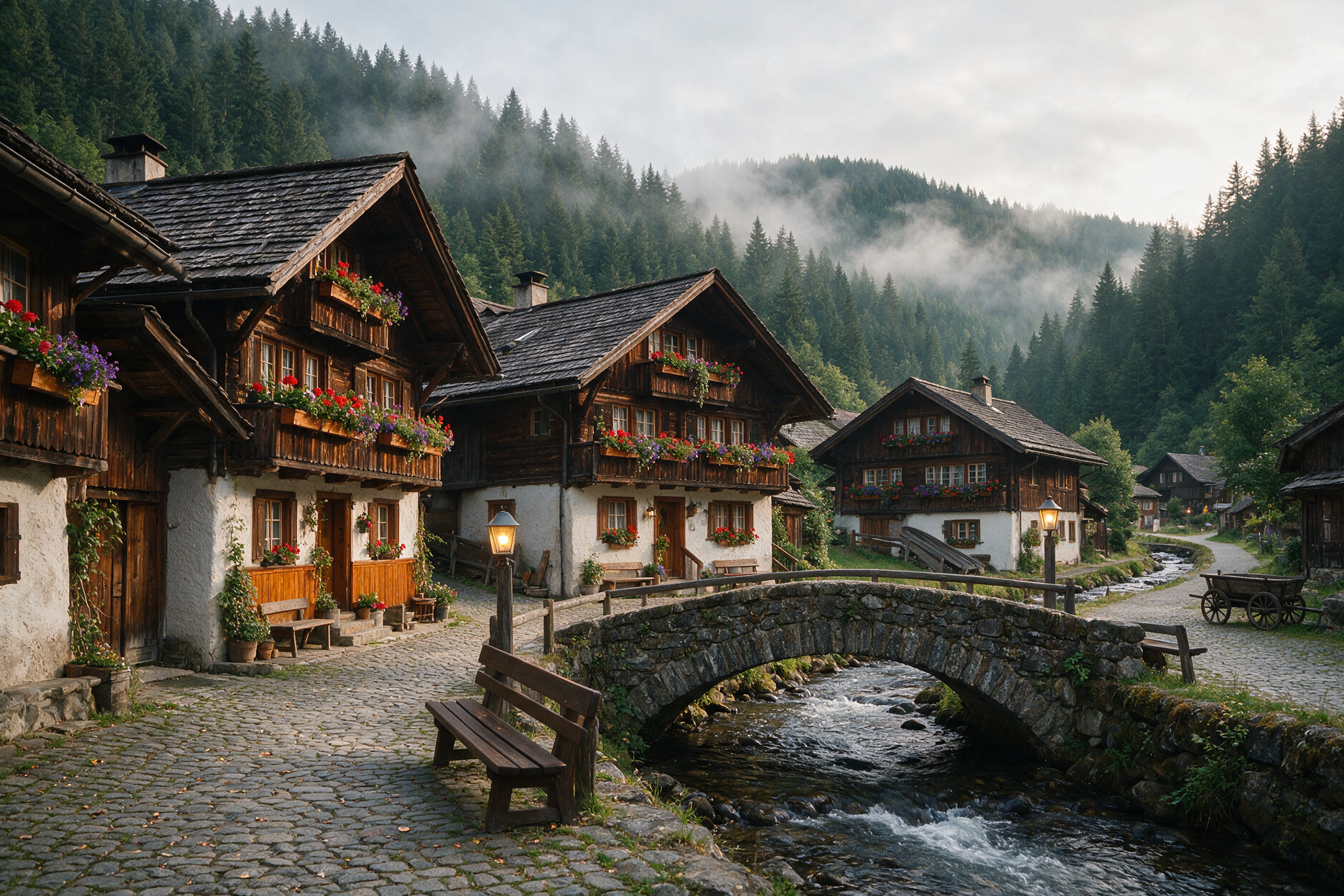
Honest opinion: the cuckoo clock shops in Triberg are half genuine craft, half tourist trap, and it’s not always obvious which is which. If you want a real one, look for shops that will show you the mechanism and tell you which valley workshop made it — a €30 clock from a shop with a hundred identical ones on the wall is a souvenir, not a Black Forest cuckoo clock. Head back to Freiburg by early evening.
Day 5: Black Forest to Munich
Freiburg to Munich runs about three to three and a half hours by train, typically with one change (often at Stuttgart or Mannheim depending on the day’s schedule) — check bahn.de for the exact connection on your travel date rather than assuming a fixed route, since Deutsche Bahn’s long-distance network has been shifting toward more fixed-interval timetables through 2026.
Arrive in Munich by early afternoon. Drop bags and head straight to Marienplatz — the Glockenspiel in the New Town Hall tower performs at 11 AM and noon daily (plus 5 PM March-October), so time your arrival if you want to catch it, though honestly the building itself is more impressive than the 12-minute mechanical show. Walk through Viktualienmarkt, Munich’s permanent food market, for a late lunch — a Weisswurst (white sausage, traditionally eaten only before noon, though nobody enforces this on tourists) with a pretzel and a Helles beer is the textbook Bavarian lunch.
Spend the evening at the Englischer Garten if the weather holds — it’s larger than Central Park, and the Chinese Tower beer garden is a proper self-service outdoor beer garden experience, bring cash. If your dates land inside the September 19-October 4 Oktoberfest window, this is also when you’d swap in a Theresienwiese evening instead — see our Oktoberfest 2026 guide for tent booking specifics, because walking up without a reservation on a Friday or Saturday night means you may not get a seat at all.
Day 6: Neuschwanstein Castle Day Trip
This is the day worth the early alarm. Neuschwanstein Castle sits near Füssen, about two hours from Munich by regional train (the direct-ish Bayern-Ticket-eligible regional service, not ICE — there’s no high-speed line out here, and most journeys involve one change). Trains run roughly every hour, and the earliest realistic departure gets you to Füssen by mid-morning.
From Füssen station, a local bus (lines 73 or 78) covers the roughly 10 minutes to Hohenschwangau village, where the ticket center is. The mistake almost everyone makes here: assuming you can just buy a ticket on arrival. In peak season (May-September) same-day tickets frequently sell out by late morning. Book your Neuschwanstein entry slot online in advance through the official Hohenschwangau ticket center — as of 2026 pricing, adult entry runs €21 for Neuschwanstein and €23.50 for the neighboring Hohenschwangau Castle (where “mad” King Ludwig II actually grew up), with a small booking fee for online reservations.
From the ticket center it’s a steep 30-40 minute walk uphill to the castle itself, or you can take a shuttle bus or horse-drawn carriage partway up (both cost extra and both have long queues in summer — the walk is often faster). Once inside, tours are guided, timed, and brisk — about 30 minutes through a fraction of the rooms, since the castle was never fully finished before Ludwig II died in 1886 under still-disputed circumstances.
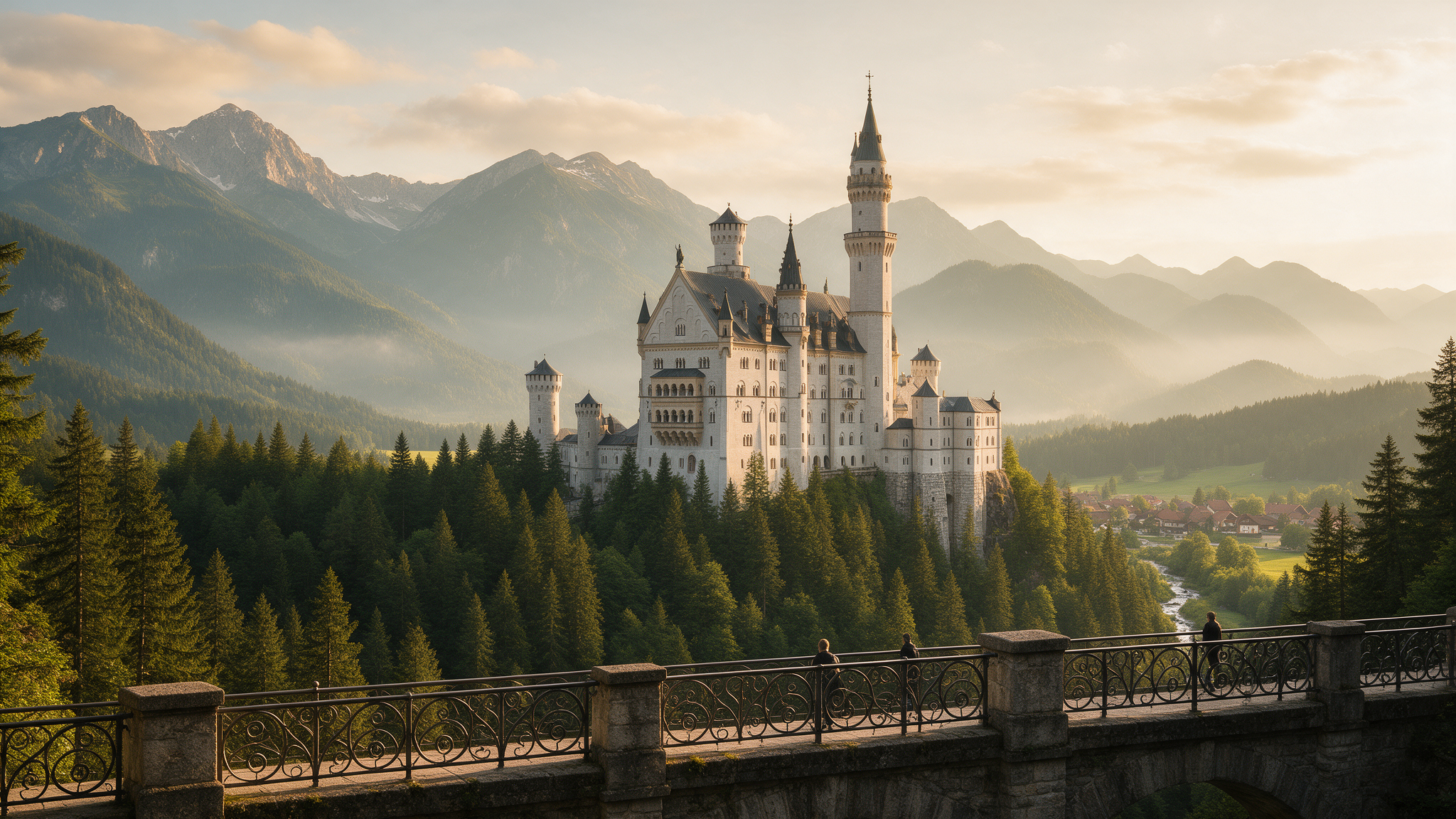
The single best photo spot is Marienbrücke, a pedestrian bridge suspended over a gorge with the classic postcard view of the castle. It’s a five-minute walk from the castle entrance but gets packed shoulder-to-shoulder by midday in summer — if photography matters to you, go there immediately before or after your tour slot, not in the middle of the afternoon. Note: the bridge occasionally closes in high wind or snow, so have a backup viewpoint in mind (the Tegelbergbahn cable car station offers a similar angle from further away).
Summer 2026 opening hours run 9 AM to 6 PM (through October 15); winter hours are 10 AM to 4 PM. Budget the whole day for this — trying to add Munich sightseeing on either end of a Neuschwanstein trip is how people end up rushing both. Head back to Munich by evening train.
Day 7: Munich to Berlin
The ICE from Munich to Berlin is the longest single train ride of the trip — the fastest services do it in around 3 hours 53 minutes, though most run closer to 4 hours with the standard stopping pattern through Nuremberg and Leipzig. Take a mid-morning departure so you land in Berlin by early-to-mid afternoon with the day still ahead of you.
This is genuinely a different Germany than everywhere you’ve been so far. Munich and the Black Forest feel like Bavarian postcards; Berlin feels like a city that’s still visibly working through the 20th century, in a way that’s more interesting than uncomfortable. Spend the afternoon walking from Brandenburg Gate down Unter den Linden, then to the Memorial to the Murdered Jews of Europe (free, open-air, a few minutes from the Gate) — give it real time rather than a five-minute walkthrough, it’s not designed to be rushed.
For dinner, skip the touristy stretch right at Brandenburg Gate and head into Prenzlauer Berg or Kreuzberg instead — either neighborhood has better, cheaper food than anything near the major monuments, and a currywurst stand is a legitimate dinner option here, not a cop-out.
Day 8: Berlin and Departure
Your last morning — keep it tight since check-out and departure logistics eat into the day. The East Side Gallery, a preserved stretch of the Berlin Wall covered in murals, is a 20-30 minute walk-through and doesn’t require much planning. If you booked the Reichstag dome (free, but you must reserve a specific time slot days in advance through the German Parliament’s site — walk-ups are routinely turned away), that’s a better use of a last morning than another museum, since the 360-degree view over the government quarter puts the whole trip in context.
Berlin Brandenburg Airport (BER) is about 30-40 minutes from the city center by the Airport Express regional train. If you booked the open-jaw flight I mentioned earlier, this is where it pays off — you fly out from here instead of backtracking to Frankfurt. Build in at least three hours before an international departure; BER has had a rocky reputation for queues since opening.
Where to Stay, City by City
This itinerary is built around comfortable, well-located stays rather than budget dorms — a premium first Germany trip should feel easy to navigate, and location matters more than almost anything else for that.
- Frankfurt: stay near the Altstadt or Westend for walkability; mid-range runs roughly €150-220/night for a solid 4-star, luxury properties near the river run €300+.
- Cologne: the Altstadt or the area right around the Hauptbahnhof — you’re only there one night, so proximity to the station and cathedral saves time. Mid-range €130-190/night.
- Freiburg/Black Forest: stay in Freiburg itself rather than a smaller village — it gives you restaurant options in the evening and easy regional-train access for the day trip. €120-180/night mid-range; a proper Black Forest spa hotel (several exist just outside town) runs considerably more but is a lovely splurge if you have the budget and the time.
- Munich: Altstadt-Lehel or around Maxvorstadt for museum access; expect €180-280/night mid-range, and note that Oktoberfest-period pricing can run two to three times higher with minimum-stay requirements.
- Berlin: Mitte for proximity to the main sights, or Prenzlauer Berg for a more local, café-heavy neighborhood feel with an easy train ride into the center. €140-220/night mid-range.
What This Trip Actually Costs
For a couple traveling comfortably (mid-range hotels, some sit-down meals, not counting international flights), a realistic per-day figure lands around €180-280 per person for accommodation, food, and local transport, before the fixed costs below. Luxury travelers layering in higher-end hotels, private transfers, and a driver-guide day at Neuschwanstein should budget closer to €400-600 per person per day.
- International flights from India: economy round-trip typically runs ₹55,000-90,000 depending on season and how far ahead you book; premium economy and business obviously scale up from there.
- Rail travel for this whole route: booking each ICE leg a few weeks ahead on bahn.de, total point-to-point rail for one person across all seven days typically runs €120-220 if you catch Sparpreis fares, versus €300+ buying flexible tickets at the counter.
- Neuschwanstein tickets: €21 per adult for the castle (2026 pricing), plus a small online booking fee.
- Daily food: €40-70 per person per day for a mix of casual and one nicer dinner.
This is one of the genuine advantages of booking through Germany tour packages from India rather than piecing everything together solo — a good operator locks in hotel rates, pre-books the Neuschwanstein slots that sell out, and bundles the rail passes, which for a first-timer is worth the planning fee alone.
Getting Around: Trains, Tickets, and Booking Ahead
Everything in this itinerary runs on Deutsche Bahn. Buy tickets through bahn.de directly rather than third-party resellers — the official site shows real-time platform changes and lets you rebook if a connection is delayed, which matters more in Germany than the country’s efficient reputation suggests; delays happen, especially on longer routes with a change involved. Book long-distance ICE legs at least 1-2 weeks ahead for the cheapest Sparpreis fares, which are non-changeable but can be a third of the flexible fare.
For local trips (Titisee-Triberg, Munich-Füssen), regional day tickets like the Bayern-Ticket can cover a group cheaply if everyone’s traveling together on the same regional trains. Trains are the spine of this itinerary and genuinely pleasant to ride — clean, on time more often than not, and a much better way to see the countryside than flying between cities.
Mistakes Worth Avoiding
- Adding a fifth city. Hamburg, Dresden, and the Rhine castles are all wonderful and none of them fit in eight days alongside this route. Save them for the next trip.
- Booking Neuschwanstein tickets on arrival. Peak-season slots sell out by mid-morning. Book online before you leave India.
- Underestimating the Munich-Füssen day. It eats the whole day including travel time — don’t stack anything else onto it.
- Ignoring Oktoberfest dates if traveling in late September. Hotel prices and crowd levels shift dramatically; plan around it, don’t get surprised by it.
- Booking a same-city round-trip flight. An open-jaw Frankfurt-in, Berlin-out ticket usually costs about the same and saves a full travel day.
FAQs
Is 7 nights / 8 days enough time for Germany?
Yes, for this specific route — Frankfurt, Cologne, the Black Forest, Munich (with Neuschwanstein), and Berlin. It’s enough time to see each place properly without racing between train stations, provided you resist adding extra cities. Trying to also fit Hamburg or the Rhine Valley castles into the same eight days is where this kind of Germany 7 days travel itinerary starts to fall apart.
Do Indian passport holders need a visa for Germany?
Yes — Indian citizens need a Schengen visa for Germany, applied for through VFS Global or the German visa application center, generally recommended 4-6 weeks ahead of travel given appointment availability. Requirements and processing times shift, so confirm current details with the German Embassy or your travel operator before booking non-refundable tickets.
What’s the best time to visit Germany for this itinerary?
Late April to early October, with June and September as the strongest individual months for weather and daylight. September has the added consideration of Oktoberfest (Sept 19-Oct 4, 2026), which is a draw for some travelers and a crowd-and-price factor to plan around for others.
Can this be done as a Germany family holiday package instead of independent travel?
Yes — this exact route adapts well to a guided or semi-guided family trip. Swap some of the walking-heavy days (Black Forest, Neuschwanstein) for private transfers instead of regional trains if traveling with young kids or elderly parents, and build in an extra half-day of downtime given kids tire faster on multi-city rail itineraries.
Should I book Berlin and Munich tour packages instead of doing it independently?
It depends on your comfort with logistics. Independent travel on this route is very doable — German trains and English signage make it more approachable than many other European countries. But a packaged version bundles pre-booked Neuschwanstein slots, vetted hotels, and local transfers, which removes the two biggest failure points (sold-out castle tickets and mistimed train connections) for a first-time visitor.
Is the Romantic Road a better way to see Neuschwanstein than a Munich day trip?
The Romantic Road bus route covers Neuschwanstein along with towns like Rothenburg ob der Tauber and Würzburg, and it’s a lovely alternative if you have more than eight days. For this specific itinerary’s timeframe, though, a focused day trip from Munich is more efficient — the full Romantic Road takes 2-3 additional days to do properly and would require cutting either Cologne or the Black Forest.
What’s the biggest planning mistake first-time Germany travelers make?
Trying to see too many cities. The second most common: assuming German trains are so reliable that a tight connection is fine — book at least 20-30 minutes of buffer between any train change, especially at bigger stations like Mannheim or Stuttgart where platforms can be a genuine 10-minute walk apart.
Ready to See This Version of Germany?
This route works because it respects both the geography and the pace a first Germany trip actually needs — enough ground covered to feel like you’ve seen the country’s range, not so much that you spend it all on trains. If you’d rather have someone else lock in the Neuschwanstein slots, the hotel rates, and the rail connections while you focus on the trip itself, explore Get Tripped’s Germany destination page for our curated Germany tour packages from India, or get in touch and we’ll build a custom Germany itinerary around your dates, your pace, and whether Oktoberfest, Christmas markets, or quiet summer evenings on the Rhine are what you’re actually after.