By 8:30pm on a July evening, the water on Lake Titisee turns the colour of steeped black tea, the paddle boats have mostly come in, and the promenade that was elbow-to-elbow with day-trippers at 4pm has gone quiet enough that you can hear the pines creak. This is the Black Forest most people never plan for — not the cuckoo-clock shops and the cake stalls, but the hour after them, when the light turns the lakes copper and the ridgelines go soft and blue.
The Black Forest (Schwarzwald, if you want the name that actually appears on the road signs) isn’t a nightlife destination and it was never going to be one. There’s no bar crawl here, no rooftop scene. What it has instead is genuinely dramatic terrain — glacial lakes tucked into forested bowls, a summit that clears 1,400 metres, a waterfall that drops further than any other in the country — and almost all of it looks better in the last two hours of daylight than at any other point in the day. This guide is built around six specific places to be for golden hour and sunset, with real timing, access notes, and the caveats nobody puts on a postcard.
If you’re building a full Germany trip around this region rather than a single day, our Germany 7-day travel itinerary slots the Black Forest in as a 2-3 day leg between the Rhine and Bavaria, and it’s worth reading before you lock your route.
In this guide
- Lake Titisee — golden hour on the water
- Schluchsee — the quieter lake sunset
- Mummelsee — misty, legend-soaked, and up high
- Feldberg summit — the highest sunset in the Black Forest
- Triberg Waterfalls at dusk
- Merkur Mountain, Baden-Baden
- How to plan a Black Forest golden-hour trip
- FAQs
Lake Titisee: golden hour on the water
Titisee is the lake most first-time visitors to the Black Forest end up at, mainly because it’s the easiest to reach and the postcards don’t lie about how good it looks. It’s a genuine glacial lake, formed roughly 12,000 years ago when a retreating glacier left this basin behind, and it sits almost exactly between Freiburg and Donaueschingen — about 35-40 minutes by regional train from Freiburg on the Höllentalbahn line, which is itself one of the more scenic rail routes in southern Germany, climbing through the Höllental (Hell Valley) gorge before dropping into the lake basin.
For golden hour specifically, skip the main promenade in front of the souvenir stalls — it faces the wrong way for most of the year and it’s where every tour bus parks its passengers between 2pm and 5pm anyway. Walk (or cycle; there’s a flat path around most of the lake) to the quieter eastern and southern shoreline near Bruderhalde and Lotharpfad, where the water opens up west toward the sinking sun and there’s usually room to actually sit down. If you want the view from the water itself, the lake cruise boats run into the early evening in high season, and the last crossing is genuinely one of the better ways to watch the light change without doing any walking at all — check the current timetable at Hochschwarzwald’s official Titisee page before you go, since sailings shift by season.
Honest caveat: Titisee in the middle of the day, especially July and August, is one of the more crowded spots in the entire Black Forest. Golden hour is genuinely the antidote — the day-trip coaches are usually pulling out by 6pm, and the lake you get at 8pm in June is a completely different experience from the one at 1pm.
Schluchsee: the Black Forest’s quieter golden hour
If Titisee feels like it’s on every tour itinerary because it is, Schluchsee is the lake locals tend to mention when you ask where they’d actually go themselves. It’s the largest lake entirely within the Black Forest, held back by a dam that raised its water level in the 1930s, and it’s ringed by forest on nearly every side rather than by shopfronts. The shoreline path on the eastern side, near Aha and the Strandbad, faces open water toward the west, which makes it a straightforward, uncomplicated sunset spot — no scrambling for position required.
A local tip that doesn’t make most top-10 lists: the short stretch of shoreline near the Fischbach inlet, on the lake’s southern arm, is shallower and warmer, and in early evening the water is often glassy enough to give you a near-perfect reflection of the tree line. Bring a picnic rather than expecting much in the way of restaurants right on the water — most of the sit-down dining is a short walk back into Schluchsee village.
Getting here without a car is more work than Titisee: it’s connected by the Dreiseenbahn (“Three Lakes Railway”) from Titisee, a scenic single-track line that also serves Feldberg-Bärental, so it pairs naturally with a Feldberg day if you’re relying on public transport.
Mummelsee: misty water and a mermaid legend
Mummelsee sits at 1,036 metres on the Schwarzwaldhochstraße (the Black Forest High Road), and it looks the part of a place with a folklore attached to it — small (just 3.7 hectares, with an 800-metre shoreline), dark, ringed by spruce, and prone to mist even when the rest of the ridge is clear. The legend, still told locally, is about water spirits called the Mümmlein who were said to rise from the lake at night to dance in the meadows; one story has a lake maiden falling for a farmer’s son from nearby Seebach and staying past the hour she was due back in the water, with tragic results. You don’t need to buy the legend to feel why it exists — at dusk, with mist sitting on the surface, the lake genuinely looks like somewhere a story like that would start.

Because it sits directly on the high road, this is an easy stop to fold into a driving day rather than a destination in itself — most visitors give it 30-45 minutes, which is about right for a short walk around the shore plus photos. The lakeside restaurant and the small chairlift up to the Hornisgrinde (the highest point in the northern Black Forest) both close earlier than you’d expect, so if you want the golden-hour version of Mummelsee rather than the midday coach-tour version, plan to arrive with at least an hour of light left and don’t count on being able to eat there afterward.
Fun fact worth knowing before you go: the lake’s German name comes from “Mummeln,” the local word for the white water lilies that used to grow there, not from the legend itself — the ghost story attached itself to an already-named lake.
Feldberg summit: the highest sunset in the Black Forest
At 1,493 metres, Feldberg is the highest point in the Black Forest and, for that matter, the highest peak in Germany outside the Alps and Bavaria. The Feldbergbahn cable car covers the climb in a few minutes from the Feldberg-Rinken base station, and on a genuinely clear evening — particularly in the cooler months, when a temperature inversion can put you above a sea of cloud with the Vosges, the Swabian Jura and, on the best days, the Alps all visible at once — this is as good as sunset gets anywhere in the region.
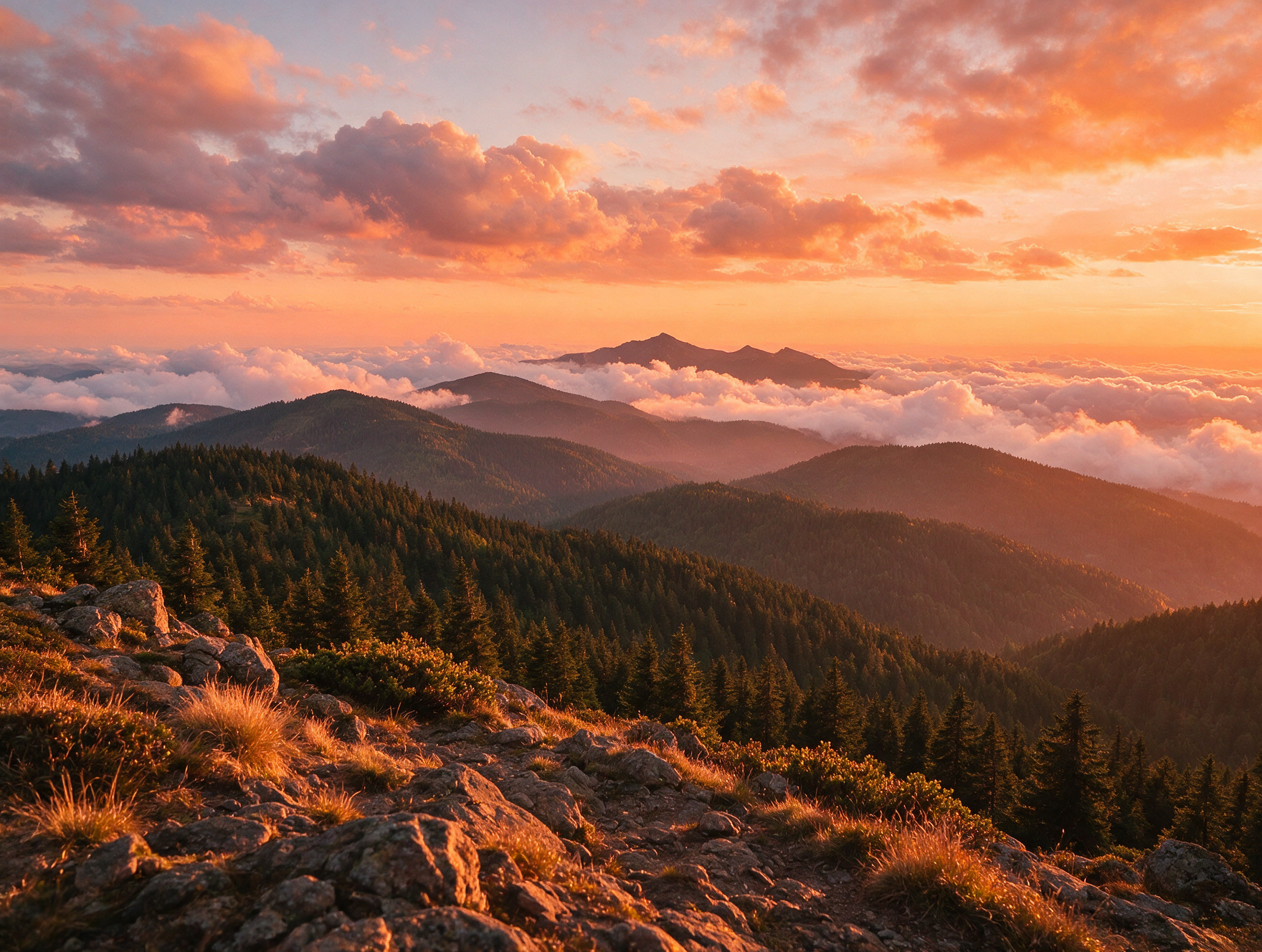
The mistake to avoid here: don’t assume the last cabin down runs late enough to catch actual sunset, especially outside peak summer. Cable car schedules on Feldberg shift with the season and with weather closures, so check the day’s timetable directly with Feldbergbahn’s official site before you commit to a summit sunset plan, and have a backup. If the lift has already stopped for the day, the hike up from Feldberg-Bärental or around the Feldsee takes roughly 60-90 minutes depending on route and fitness, which is exactly what a fair number of locals do on clear summer evenings instead of paying for the lift — just carry a headlamp for the walk back down, because the path is unlit and the forest gets properly dark once the sun’s gone.
Layer up regardless of the season. Even in August, the summit is routinely 8-10 degrees cooler than Freiburg down in the valley, and the wind picks up noticeably once the sun starts dropping.
Triberg Waterfalls at dusk
Triberg’s claim to fame — Germany’s highest waterfall, dropping 163 metres over seven cascades — is the kind of fact that undersells the actual experience of standing at the base of it with spray hitting your face. What most day-trip itineraries miss is that the falls stay open into the evening and are illuminated until 10pm, which means you can time a visit for the exact window when the forest canopy starts losing direct light but the water is still lit well enough to shoot properly. It’s a genuinely different atmosphere from the midday version, when tour groups move through in blocks and the paths near the entrance can feel more like a queue than a walk in the woods.

Practical texture: entry is ticketed (expect roughly €9 for an adult summer ticket, less in winter when only the lower section is open), and it’s cash-and-card friendly at the gate. The trail climbs in stages, so budget 45-60 minutes if you want to walk all the way to the top rather than just the first viewpoint. Spring meltwater and the days right after heavy rain are when the flow is most dramatic, though the falls run year-round.
Merkur Mountain, Baden-Baden
If your Black Forest time is bookended by Baden-Baden — a reasonable choice, since it’s the most polished base town on the region’s northern edge — Merkur Mountain is the easiest golden-hour add-on you’ll find anywhere in this guide, no advance planning required. The funicular runs daily from 10am to 10pm, departing roughly every 15 minutes, and the base station is a short bus ride (10-15 minutes) from the spa-town centre. At 668 metres, Merkur isn’t a dramatic climb by Black Forest standards, but the summit platform looks out over the Rhine Valley toward the Vosges Mountains in France, and on a clear evening that means watching the sun go down across two countries’ worth of ridgeline.
This is the spot in this guide that needs the least planning: no cable-car-schedule anxiety, no hike as backup, no worrying about last trains. Ride up an hour or so before sunset, walk the short summit path, and take the funicular back down once it’s properly dark — it keeps running until 10pm, so you’re not racing the last car the way you are at Feldberg. Confirm current hours before you go at Baden-Baden’s official tourism site, since seasonal maintenance closures do happen.
Planning a Black Forest golden-hour trip
The free things to do in Germany we’ve covered elsewhere apply well here — most of what’s in this guide costs nothing beyond a train or cable-car ticket, which makes the Black Forest an efficient region to slot into a wider Germany itinerary without blowing your evening budget on entertainment.
Best time to visit the Black Forest for sunset light: Late April through early October gives you the longest evenings and the best odds of clear skies, with June and July stretching sunset past 9pm. If you’re planning around Germany’s seasons and what to pack, note that even peak summer evenings at elevation (Feldberg, Merkur) run noticeably cooler than the valley towns, so a light jacket earns its space in the bag regardless of month.
How many days to give it: Three full days lets you cover Titisee and Schluchsee together (they’re on the same rail line), a Feldberg evening, and either Mummelsee or Triberg depending on which direction you’re heading. Two days is workable if you’re willing to prioritise two spots properly rather than rushing five.
Getting around without a car: The region is more public-transport-friendly than its reputation suggests, largely thanks to the Konus guest card that most Black Forest accommodations issue free of charge, covering regional buses and trains across the whole area for the length of your stay. That said, the smaller villages and the more remote viewpoints (parts of Schluchsee’s quieter shoreline, some Feldberg trailheads) are genuinely easier with a rental car, especially if you’re chasing a specific sunset window rather than working around a timetable. Our Germany public transit guide covers how the regional and national rail systems fit together if you’re planning to go car-free for the whole trip.
For Indian travellers building this into a longer Germany trip, the Black Forest works well as a slower, scenic counterweight to Berlin and Munich — most custom Germany itineraries we put together for clients treat it as 2-3 unhurried days rather than a single rushed day trip, since half the point is being somewhere with nowhere else to be when the light starts changing.
FAQs: Black Forest sunset and golden-hour spots
What’s the best time of year to see sunset in the Black Forest?
Late spring through early autumn (roughly May to early October) gives you the longest daylight and the best odds of clear evening skies. June and July have the latest sunsets, often past 9pm, which gives you a comfortable window to reach a viewpoint after dinner rather than rushing straight from lunch.
Do you need a car to reach these spots?
Not for all of them. Titisee and Schluchsee are connected by train (the Höllentalbahn and Dreiseenbahn lines), and Baden-Baden’s Merkur Mountain is a short bus ride from town. Mummelsee sits on a public bus route along the Schwarzwaldhochstraße. Feldberg is reachable by train and connecting bus but is considerably easier with a car if you’re timing things around a specific sunset.
Is the Black Forest doable as a day trip from Freiburg?
Yes, for Titisee, Schluchsee, or Feldberg individually — all three are within roughly 40-60 minutes of Freiburg by train. Trying to combine more than two of the spots in this guide in a single day, though, usually means sacrificing the actual golden-hour payoff for time spent in transit.
Does the Feldberg cable car run late enough for sunset?
It depends on the season and the day’s schedule, which does shift. Always check Feldbergbahn’s current timetable before planning a summit sunset, and treat the Feldsee or Bärental hiking routes as your backup if the lift has already stopped running for the day.
Is Mummelsee worth visiting just for the legend, or is the scenery enough on its own?
The scenery holds up regardless of whether the folklore interests you — a small, dark, forest-ringed lake at over 1,000 metres with mist that rolls in on cool evenings is a striking stop either way. The legend is a nice extra layer, not the main event.
What should I bring for a Black Forest sunset outing?
A layer warmer than you think you’ll need — elevation and evening temperature drops are real even in summer — plus a headlamp or phone flashlight if you’re hiking rather than relying on a lift or car, and cash for smaller ticket booths that don’t always take cards smoothly.
Which spot is best for photography specifically?
Feldberg summit for wide panoramic shots, especially on temperature-inversion evenings; Lake Titisee’s eastern shore or a lake cruise for water reflections; and Triberg’s illuminated falls for long-exposure water shots once dusk sets in.
Can I combine a Black Forest sunset stop with a Rhine or Alsace trip?
Yes — Baden-Baden’s Merkur Mountain in particular works well if you’re routing between the Black Forest and Strasbourg or the Alsace wine region, since the summit view already looks out toward France.
Getting the timing right
None of this requires specialist gear or an early-riser’s schedule — sunset planning is, by definition, an evening person’s kind of research. What it does require is picking one or two spots rather than trying to chase all six in a single trip, checking the specific day’s cable car or boat timetable rather than trusting a general rule, and building in a backup for the one lift or crossing that might not run late enough. Do that, and the Black Forest’s version of an “evening out” — a lake going copper, a summit clearing above the clouds, a waterfall lit against the dark — holds up against anywhere else in Germany.
If you’d rather have this mapped out for you — timings, base towns, and the rest of a Germany route built around it — Get Tripped’s Germany trip planning puts together custom Germany itineraries for exactly this kind of region-hopping trip, and our team can work Black Forest golden-hour stops into anything from a focused Germany-only trip to a longer multi-country route.