Most first-time visitors to Cologne spend forty minutes photographing the twin spires of the Kölner Dom, buy a fridge magnet outside, and catch the next train to Amsterdam. That’s a shame, because the cathedral is the least interesting thing about how Cologne actually lives. Ten minutes’ walk from the plaza, you’re in neighborhoods where nobody is selling you a magnet — just a 0.2-litre glass of Kölsch, a mural three storeys tall, or a converted crane house with a view of barges heading up the Rhine.
Get Tripped builds custom Germany itineraries for Indian travellers who want more than a cathedral selfie, and Cologne is one of the stops we get asked to “add a real day to” more than almost anywhere else on a Germany trip. This is our list of five hidden gems of Cologne that reward that extra day — the Belgian Quarter, Ehrenfeld, a proper brauhaus night, the Rheinauhafen crane houses, and a riverside village most tour buses never reach.
In This Guide
- 1. The Belgian Quarter (Belgisches Viertel)
- 2. Ehrenfeld’s Street Art and Nightlife Scene
- 3. A Real Brauhaus Night: Kölsch, Köbes, and the Kranz
- 4. The Kranhäuser at Rheinauhafen
- 5. Rodenkirchen — Quiet Rhine Mornings Away from the Crowds
- Best Time to Visit Cologne
- Planning the Rest of Your Germany Trip
- FAQs
1. The Belgian Quarter (Belgisches Viertel)
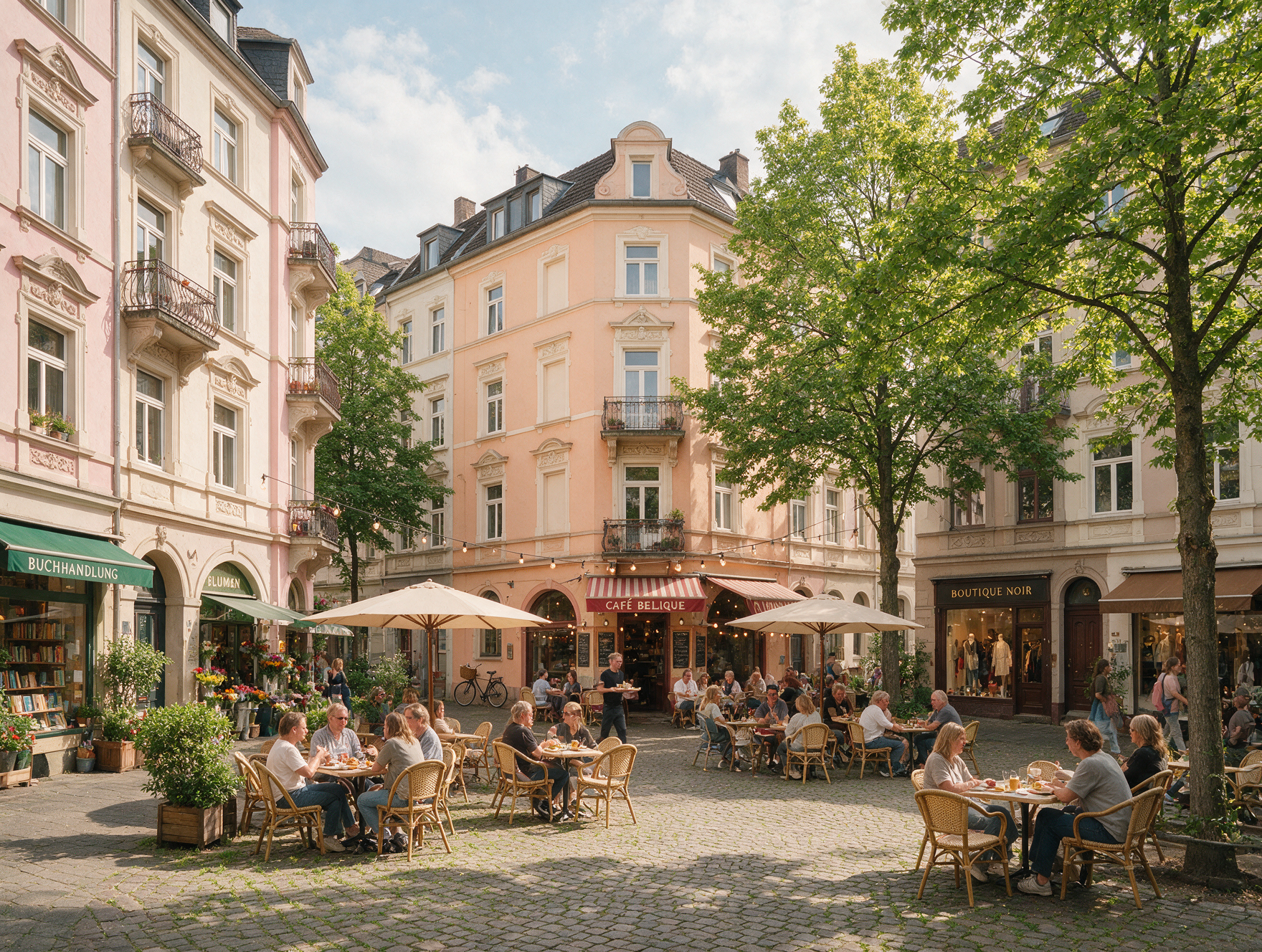
The Belgian Quarter isn’t a secret exactly — locals have known about it for decades — but almost no first-time visitor to Cologne makes it here, because it’s not on the walk between the Dom and the river. It’s a fifteen-minute tram ride west, and it’s where Cologne actually shops, eats brunch, and buys birthday presents for people it likes.
The streets are named after Belgian and Dutch towns (Brüsseler Platz, Antwerpener Straße), a quirk left over from the neighborhood’s 19th-century expansion, and the architecture is Wilhelminian-era apartment blocks with the occasional Art Nouveau flourish — wide, leafy, and a deliberate contrast to the cramped medieval lanes of the Altstadt. Aachener Straße and Venloer Straße carry most of the restaurant and café density, but the real finds are one block off them: independent bookshops, goldsmiths, small fashion ateliers run by the designer at a sewing machine in the back, and record stores that still take vinyl trade-ins.
Brüsseler Platz itself is the social center — a small square around St. Michael’s Church where people sit on the church steps with a beer from the corner kiosk because none of the surrounding bars have outdoor seating left by 7pm on a warm evening. That’s the honest caveat: come on a Friday in summer and you’ll be standing, not sitting. Come on a Tuesday afternoon instead and you’ll get a café table and the neighborhood at a walking pace.
Local tip: Skip the well-reviewed brunch spots directly on Brüsseler Platz and walk two streets over to the smaller cafés on Roonstraße — same quality, a third of the wait, and you’re steps from the Roonstraße Synagogue, one of the few Cologne synagogues to survive the war largely intact.
2. Ehrenfeld’s Street Art and Nightlife Scene
Ehrenfeld was a factory district — heavy machinery, textile mills, the kind of neighborhood built to house workers close to the plants they worked in. When that industry left through the late 20th century, the empty halls didn’t get demolished; they got colonized by artists, then clubs, then the kind of small tech and design studios that need cheap square footage and don’t mind exposed brick.
What’s left is Cologne’s most interesting few square kilometers for anyone who’s already seen the Altstadt twice. Murals cover entire building sides along the railway embankment near Venloer Straße — not commissioned tourist-board street art, but the kind that shifts and gets painted over every few months, so what you see is genuinely current. The club strip along the tracks (Sonic Ballroom, Live Music Hall among them) runs electronic and live music most nights of the week, and c/o pop, Cologne’s international music festival, is based here every year.
Venloer Straße mixes Turkish grocers, fair-trade fashion boutiques, and discount stores in a way that reads as unplanned because it is — this is a real working neighborhood, not a curated one, and that’s exactly the texture that makes it worth an afternoon. Push past Subbelrather Straße into Neuehrenfeld and the mood changes again: tree-lined 19th-century streets, quieter, almost suburban.
A mistake to avoid: don’t come to Ehrenfeld expecting a polished “arts district” with wayfinding signs and a gift shop. It’s genuinely rough around the edges in places, and that’s the point — go in daylight first if you want to get your bearings before a nightlife visit.
3. A Real Brauhaus Night: Kölsch, Köbes, and the Kranz
Here’s a fact most visitors miss entirely: Kölsch isn’t just “the local beer,” it’s a legally protected style — by regional agreement, it can only be brewed within Cologne and a handful of surrounding towns. That’s part of why the city treats it less like a drink and more like a civic institution.
The ritual matters as much as the beer. Kölsch is served in a slim 0.2-litre glass called a Stange — small on purpose, so it never gets warm — and it arrives whether you ordered another round or not. A Köbes (the brewery’s traditional waiter, historically dressed in a blue jacket, black trousers, and a leather coin pouch) circulates the room with a ring-shaped tray called a Kranz, refilling glasses and marking a tally line on your cardboard coaster for every one you drink. Nobody hands you a bill after each round; you settle up, and the coaster, at the end of the night. The only way to stop the refills is to physically place your coaster on top of your empty glass — say nothing, and the next Stange lands on your table within minutes.
For the real version of this, skip the brauhaus directly facing the cathedral — it’s fine, but it’s built for tour groups on a schedule. Gaffel runs one of the city’s best-known Kölsch breweries and its Hausbrauerei is a solid, less rushed option in the old town. For something older and rougher, Brauhaus Sion near the fish market has operated on the same spot since 1511, and Päffgen on Friesenstraße has been pouring for well over a century in a room that still looks like it.
Honest caveat: Kölsch is a light, easy-drinking style — closer to a pale ale than a lager in production method, brewed warm and then cold-conditioned — and it’s genuinely easy to lose count of how many Stangen you’ve had, since each one disappears in about four sips. Watch your coaster.

4. The Kranhäuser at Rheinauhafen
Rheinauhafen started life as the Werthchen, a narrow river island widened into a working harbor that opened in 1898 and shipped freight along the Rhine for most of the 20th century. When container shipping moved elsewhere, the harbor sat mostly empty until a major redevelopment reopened it in its current form in 2014.
The three Kranhäuser — literally “crane houses” — are the reason to walk down here now. Each building cantilevers out at roughly 40 metres from a slim, fully glazed stair tower, a deliberate architectural echo of the harbor cranes that used to work this stretch of river. Six of the original cranes are still preserved along the promenade, including the Hercules crane from 1897, sitting incongruously next to glass-and-steel apartments that would look at home in Rotterdam.
At the harbor’s edge, the Chocolate Museum houses one of the more comprehensive cocoa exhibitions anywhere, spread across roughly 4,000 square metres, with a working chocolate fountain that’s worth timing your visit around if you’re travelling with kids. The promenade itself is lined with cafés that actually face the water — a rarity in a city where the riverside is more often a road than a walkway — and the medieval Bayenturm tower anchors the southern end as a reminder that this was once the edge of the fortified city.
Fun fact worth knowing before you go: the Kranhäuser are residential and office buildings, not museums — you can admire them from the promenade and from the water on a river cruise, but you can’t go inside unless you know someone who lives there.

5. Rodenkirchen — Quiet Rhine Mornings Away from the Crowds
Every Cologne itinerary tells you to walk the Rhine promenade near the Altstadt. Fair enough — it’s scenic, and it’s also where every river cruise, tour group, and stag party in the city converges after 11am. For an actual quiet morning by the water, take the tram or a twenty-minute bike ride south to Rodenkirchen instead.
It doesn’t read as part of the same city. Rodenkirchen was its own village before Cologne annexed it in the early 20th century, and it’s kept a village center’s scale: a market square, a parish church, low buildings, and a riverside path where the loudest thing most mornings is a rowing club launching boats before the heat sets in. The Rodenkirchener Brücke, a 1941 suspension bridge rebuilt after wartime damage, frames the view north back toward the city — a genuinely good photo that isn’t the cathedral.
Riverside beer gardens here serve the same Kölsch as the tourist-facing brauhauser downtown, at the same prices, to a crowd that’s almost entirely local. It’s the version of “Rhine views with a drink in hand” that doesn’t involve a queue.
Local tip: Go before 10am if you want the towpath to yourself, or early evening for the beer gardens — midday in high summer draws families and it loses the quiet that makes it worth the trip out.
Best Time to Visit Cologne
The best time to visit Germany’s Rhineland generally falls in the shoulder months, and Cologne is no exception. Late April through June and September into early October give you long daylight, mild temperatures, and riverside terraces without the peak-summer crush. Germany trips planned between April and October tend to line up best with outdoor neighborhood-hopping — the Belgian Quarter’s café tables and Rodenkirchen’s towpath are both weather-dependent in a way the museums and brauhauser aren’t.
Germany’s summer holidays in July and August bring the warmest weather and the longest evenings for beer garden sessions, but also the highest hotel rates and the biggest crowds around the cathedral itself — plan your Belgian Quarter and Ehrenfeld days for this window and save cathedral viewing for early morning. If your travel dates land in February, check whether they overlap with Cologne Carnival (Fastelovend): in 2027, Weiberfastnacht falls on February 4 and Rosenmontag on February 8, and the city essentially shuts down for a six-day street party that’s spectacular if that’s what you came for, and genuinely difficult to navigate — packed hotels, closed shops — if it isn’t.
Planning the Rest of Your Germany Trip
Cologne rarely stands alone on a Germany itinerary from India — it’s usually a two- or three-night stop within a longer loop that includes Berlin, Munich, or the Rhine Valley further south. If you’re building a custom Germany itinerary, Cologne pairs naturally with a Rhine river segment on one side and a fast train to Berlin or Munich on the other; our Germany 7 Days Travel Itinerary shows how a week splits realistically across cities without turning into a check-the-box sprint.
A few practical notes we get asked about constantly when Indian travellers are planning Germany trip costs and logistics: Germany requires a Schengen visa for Indian passport holders, and processing times shift seasonally, so it’s worth applying well ahead of a July-August or Carnival-season trip — our Germany Visa Guide for Indian Travelers covers the current document checklist. Cologne’s public transport (trams, U-Bahn, and regional trains) is efficient enough that a car isn’t necessary within the city, and our Germany Public Transit Guide is useful if you’re combining Cologne with day trips to Bonn or Düsseldorf.
On food: Cologne’s brauhaus culture (Himmel un Ääd, Rheinischer Sauerbraten, Halver Hahn) is worth building a meal or two around, and our Germany Food Trail covers where German food is genuinely worth ordering versus where you’re better off with the Indian restaurants near the main station, which exist in decent numbers if you need a night off from schnitzel. If your trip runs into winter, our guides to Munich’s Christmas Markets and the Oktoberfest 2026 Munich guide are worth reading before you lock dates, since both shift hotel pricing across the whole country. And if budget allows a few extra days, our Free Things to Do in Germany roundup covers no-cost stops that work well alongside a family holiday pace.
Get Tripped puts together custom Germany itineraries, family holiday packages, and small-group guided tours for Indian travellers who want this level of specificity built into their trip from day one, rather than a generic Berlin-Munich-Rhine loop with Cologne squeezed in as a half-day cathedral stop.
FAQs
Is Cologne worth visiting beyond the Cathedral?
Yes — and honestly, the Cathedral alone is a half-day at most. The Belgian Quarter, Ehrenfeld, and a proper brauhaus evening are where Cologne’s actual character shows up, and most visitors who skip them leave with a thinner impression of the city than it deserves.
How many days do I need in Cologne?
Two full days covers the cathedral plus two or three of the hidden gems in this guide at an unrushed pace. Three days lets you add Rodenkirchen or a day trip to Bonn without feeling rushed.
What is a Köbes and why does he keep bringing me beer?
A Köbes is the traditional brauhaus waiter who circulates with a Kranz tray and refills your Kölsch glass automatically, marking a tally on your coaster each time. To stop the refills, place your coaster flat on top of your empty glass — that’s the universally understood signal.
Is Cologne safe for solo and family travellers?
Cologne is a large, well-policed European city and generally safe for both solo travellers and families, including in the evening in the neighborhoods covered here. Standard city precautions apply around the main train station and during Carnival, when crowd density is at its highest.
Do I need a separate visa for Cologne if I already have a Schengen visa for Germany?
No — a Schengen visa issued for Germany covers Cologne and the rest of the Schengen area for the visa’s validity period. Indian passport holders should still check current processing timelines, since these shift with seasonal demand.
When is Cologne Carnival, and should I plan my trip around it?
Cologne Carnival (Fastelovend) 2027 runs from Weiberfastnacht on February 4 through Ash Wednesday on February 10, with the Rose Monday parade on February 8. It’s worth experiencing once if costumed street parties appeal to you, but hotel prices spike and many shops close, so it’s not the easiest window for a first, relaxed visit to the city.
What’s the best time of year for outdoor neighborhood exploring like the Belgian Quarter or Rodenkirchen?
Late April to June and September to early October give the most comfortable temperatures for walking and outdoor café seating, with July and August adding heat, crowds, and higher prices in exchange for the longest evenings.
Can I do Cologne as a day trip from Amsterdam or Brussels, or does it need an overnight stay?
Cologne works as a rushed day trip from either city by fast train, but a day trip only really covers the Cathedral and the old town. Everything in this guide — the Belgian Quarter, Ehrenfeld, a real brauhaus night — needs at least one overnight to do properly.
Cologne’s hidden gems don’t need a guidebook detour or a local friend to find — just a plan that budgets time for them instead of routing straight from the train station to the cathedral steps and back. Get Tripped builds custom Germany itineraries around exactly this kind of detail, whether you’re adding Cologne to a Berlin-Munich loop or building a slower, Rhine-focused week from scratch. Talk to our Germany travel specialists about a custom itinerary, family holiday package, or guided small-group tour that puts places like the Belgian Quarter and Rodenkirchen on the map alongside the Dom.