Germany Food Trail: What to Actually Eat Across Berlin, Bavaria and Beyond
The first thing that hits you at a Berlin currywurst stand isn’t the taste. It’s the smell — sweet paprika and hot grease drifting up from a griddle that’s been going since before you woke up, mixing with cold morning air under a rattling U-Bahn line. You order, you wait maybe four minutes standing at a narrow steel counter with no chairs, and you eat with a tiny wooden fork because that’s just how it’s done. Nobody explains this to you. You figure it out by watching the person ahead of you in line.
That’s the honest starting point for a Germany food trail: this is not a country of long, lingering restaurant meals as the default mode. It’s a country of stand-up counters, market halls, beer gardens with communal benches, and bakeries that sell out of the good stuff by 10 a.m. Get Tripped’s Germany destination page covers six places worth building a trip around — Berlin, the Neuschwanstein and Füssen area, Munich, Cologne, the Black Forest, and Frankfurt — and each one eats differently enough that treating Germany as “sausage and beer” everywhere is a real disservice to the food. This guide goes place by place: what to eat, where real people are still eating it, what’s overhyped, what mistake to avoid, and how much it actually costs.
Table of Contents
- Berlin: Currywurst, Döner and Late-Night Everything
- Neuschwanstein & Füssen: Countryside Food Realities
- Munich: Weisswurst, Beer Halls and the Viktualienmarkt
- Cologne: Kölsch Culture and the Rhineland Table
- Black Forest: Triberg, Freiburg and Baden-Baden
- Frankfurt: Apfelwein, Handkäse and the Kleinmarkthalle
- Costs, Tipping and Paying the Bill
- FAQs
Berlin: Currywurst, Döner and Late-Night Everything
Berlin’s food identity runs on two things sold from a hole in a wall: currywurst and döner. Both were basically invented here (the döner-in-bread version, anyway — Turkish-German cooks in Kreuzberg get the credit), and both are best eaten standing up, slightly too hot, off a paper tray.
Must-try dish: Currywurst — a grilled pork sausage, sliced, doused in curried ketchup and dusted with more curry powder than seems reasonable. Curry 36 near Mehringdamm keeps a queue going most of the day and does the job well, but the one locals still bring up unprompted is Konnopke’s Imbiss, tucked under the elevated U2 tracks at Eberswalder Straße since 1930 — the rattle of trains overhead while you eat is half the experience.
An honest caveat: Mustafa’s Gemüse Kebap in Kreuzberg has a line that can run 30-45 minutes deep, fed largely by its own internet fame at this point. It’s good. It is not so transcendent that it justifies losing half an hour of a short trip. Walk two streets over and pick whichever döner stand has a line of actual Berliners, not tour groups — you’ll eat sooner and just as well.
Coffee run: The Barn, with locations scattered through Mitte and Prenzlauer Berg, roasts its own beans and takes filter coffee seriously in a city where, for years, decent coffee was hard to find outside a hotel lobby. Order a filter, not a flat white, if you want to taste what they’re actually good at.
Ice cream pick: Fräulein Frost in Kreuzberg (Friedelstraße) rotates seasonal and plant-based flavors alongside the classics — expect queues on warm evenings, but they move fast, and the flavor list changes often enough that a second visit a few days later isn’t repetitive.
Late-night eats: Berlin’s döner and currywurst stands genuinely don’t stop for anyone. Plenty around Kreuzberg and Neukölln stay open past midnight, which matters if you’ve just come off a late train or an evening walk through the city’s greatest hits.
This is also a decent point to slot in a note for anyone building a longer itinerary: things to do in Berlin go well beyond food — the Wall, the museums, the neighborhoods — but the food is what will actually stick in your memory a year later.
Neuschwanstein & Füssen: Countryside Food Realities
Here’s the part nobody warns you about: Neuschwanstein Castle sits up a hill in the middle of Bavarian farmland, and the food options directly around Hohenschwangau village are limited and, frankly, built for buses on a schedule rather than people who want to linger. It’s fine for a quick bite between the castle shuttle and your next stop, but don’t expect a memorable meal right at the base of the castle.
The better move is to eat properly in Füssen itself, the town about four kilometers away, before or after the castle visit. Sit-down Bavarian kitchens in the old town — the Schlosskrone hotel’s restaurant is one long-standing option — serve the same core dishes you’ll find in Munich (roast pork, dumplings, schnitzel) without the crush of a beer-hall-sized crowd.
Must-try dish: Kässpatzen — Bavarian egg noodles baked with mountain cheese and topped with crispy fried onions. It’s the regional answer to mac and cheese, and after a few hours of walking castle grounds in the cold, it’s exactly what you want.
Coffee run: Look for a bakery-café (Bäckerei) in Füssen’s compact old town rather than a chain — most sell fresh pretzels and strong coffee from the same counter, and a window table looking onto the pedestrian street is a good way to spend twenty minutes before the drive back.
A mistake to avoid: Don’t plan your only meal of the day around the castle grounds themselves — food service there is thin, prices reflect the captive audience, and the good stuff is a short drive or walk away in town.
Munich: Weisswurst, Beer Halls and the Viktualienmarkt
Munich is where German food stereotypes are mostly true, and mostly earned. The Viktualienmarkt, the city’s permanent food market a few minutes from Marienplatz, is the best single hour of eating you can schedule in Bavaria — stalls selling roast pork, pretzels the size of your face, cheese, and produce, all wrapped around a beer garden where you buy a stein and sit at shared wooden tables with strangers.
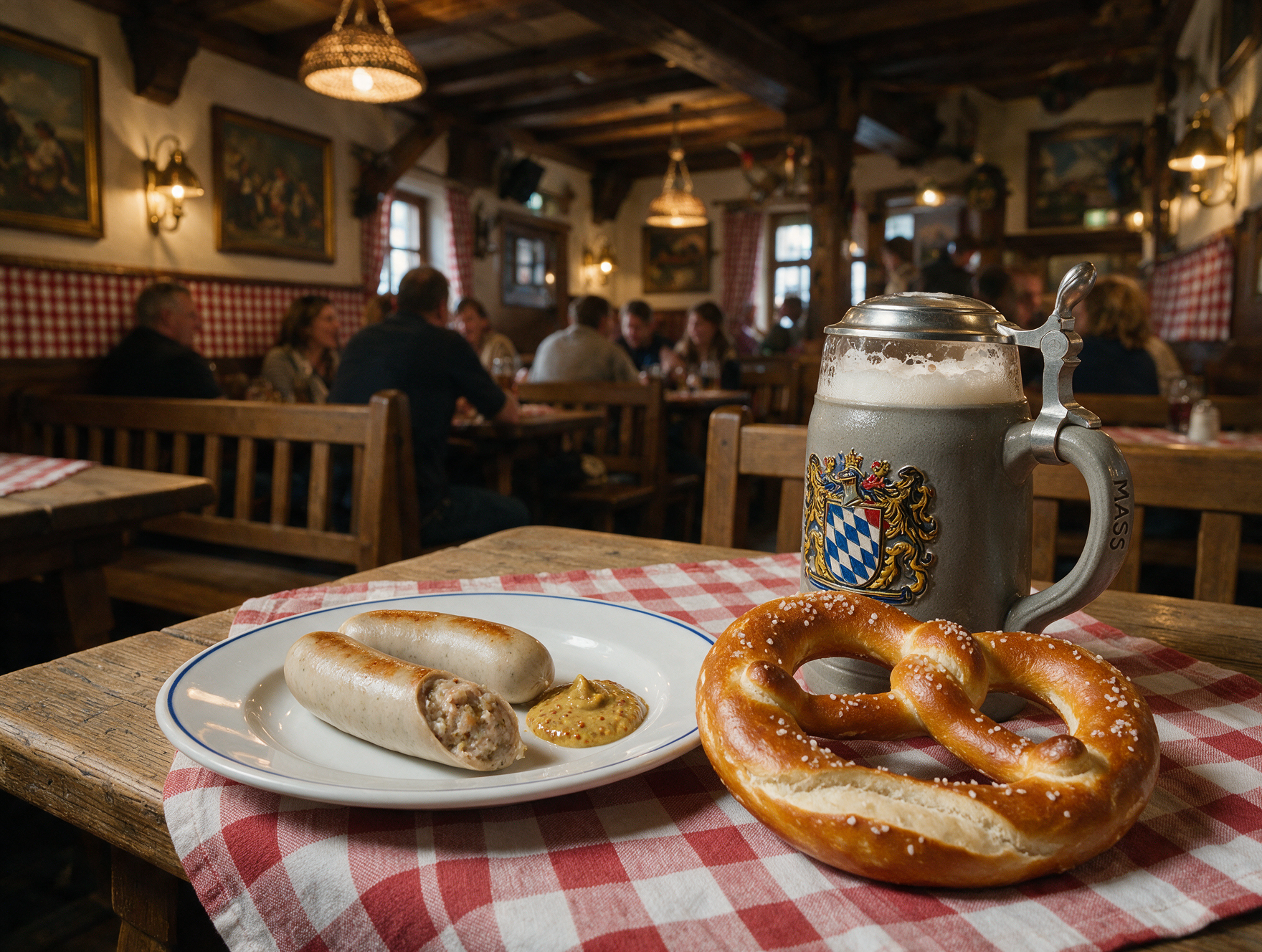
Must-try dish: Weisswurst — a pale veal-and-pork sausage, traditionally peeled from its casing (never bitten straight through) and dipped in sweet mustard, eaten with a pretzel. There’s a real local rule here worth knowing: weisswurst is a breakfast food, traditionally eaten before the church bells ring at noon, back when it had to be consumed fresh before refrigeration was reliable. Ordering it at 4 p.m. won’t get you thrown out anywhere touristy, but a waiter at an old-school spot might raise an eyebrow.
An honest opinion: Hofbräuhaus is loud, packed with tour groups, and absolutely worth one visit for the sheer theater of it — a thousand-seat hall, a brass band some evenings, liter steins carried six at a time. It is not where you go for a quiet dinner or the city’s best food. Go once for the experience, then eat your other Munich meals at the Viktualienmarkt or a neighborhood Wirtshaus instead.
Coffee run: Man Versus Machine, a specialty roaster on Müllerstraße, is where Munich’s coffee people actually go — a sharp contrast to the beer-hall version of the city, and a good reset before an afternoon of walking.
Late-night eats: The Glockenbachviertel neighborhood has the city’s better after-midnight options — Middle Eastern grills, wraps, and pizza slices for the walk home after a long beer garden evening.
If Oktoberfest timing lines up with your trip, the beer-hall food culture above is really a preview of the main event — Get Tripped’s Oktoberfest 2026 Munich guide goes deep on tent reservations, roast chicken stalls, and how to actually get a table.
Cologne: Kölsch Culture and the Rhineland Table
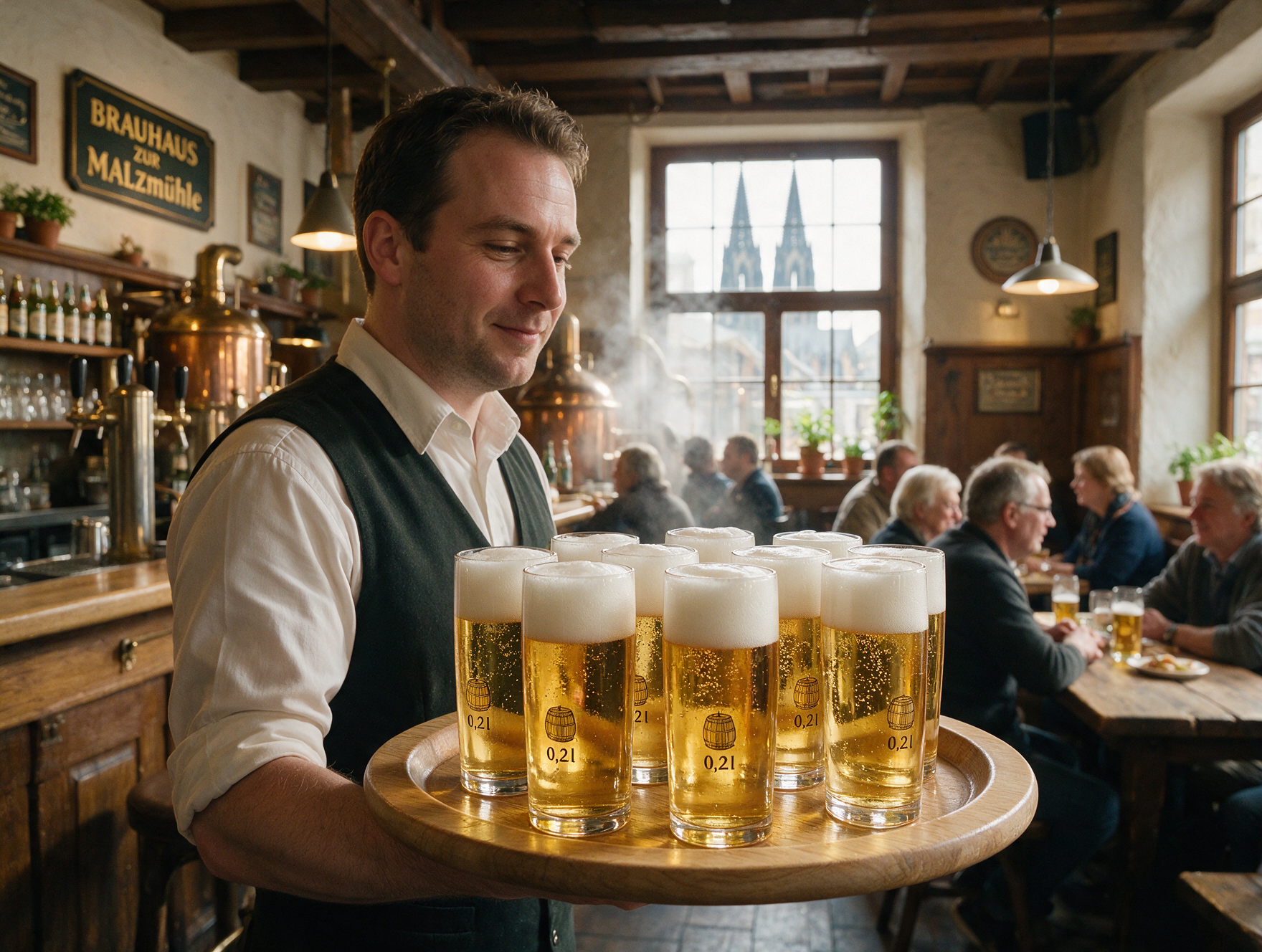
Cologne eats around its own beer, and the ritual matters as much as the drink. Kölsch is served in small, narrow 0.2-liter glasses called Stangen, delivered by a waiter (Köbes) who keeps bringing fresh ones — placed directly on your table — until you put a beer mat on top of your glass to signal you’re done. Nobody asks if you want another; you just keep getting one.
Must-try experience: A proper brauhaus. Früh am Dom, right by the cathedral, and Peters Brauhaus a few streets away both brew their own Kölsch on-site and serve Rhineland classics — Himmel und Ääd (blood sausage with mashed potato and apple sauce), Sauerbraten, and Halve Hahn, which despite the name isn’t chicken at all — it’s a rye roll with aged Gouda, mustard and pickle.
An honest caveat: Früh am Dom sits directly beside the cathedral, so it pulls a heavy tourist crowd at lunch. The beer and food are genuinely good, not a tourist-trap letdown, but go slightly off peak hours if you want a table without a wait.
Late-night eats: Kwartier Latäng, the student quarter near the university, keeps kitchens open later than the cathedral-adjacent restaurants and has a younger, more mixed food scene — good for a casual bite after dark that isn’t just another brauhaus.
Cologne is also a genuinely good base for day trips along the Rhine, which fits neatly if you’re already thinking about places to visit in Germany beyond the obvious Berlin-Munich circuit.
Black Forest: Triberg, Freiburg and Baden-Baden
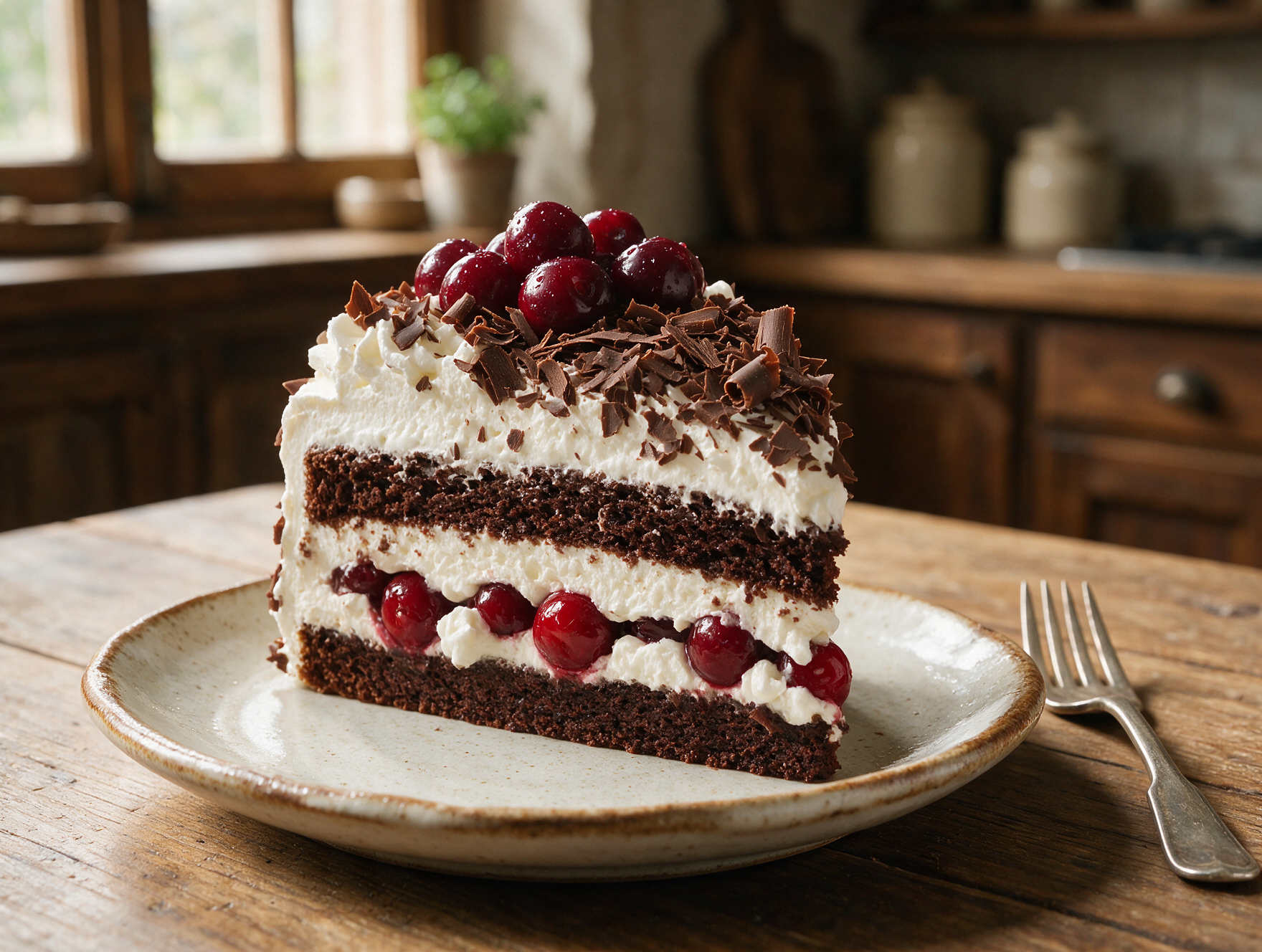
The Black Forest region is where dessert becomes the main event. This is the birthplace of Schwarzwälder Kirschtorte — Black Forest cake — layers of chocolate sponge, whipped cream, sour cherries and a genuinely aggressive amount of Kirschwasser (cherry brandy) soaked into the sponge. Done properly, it should taste boozy enough that you notice, which is exactly why it’s not really a kids’ dessert despite how it’s marketed abroad.
Must-try, Triberg: Café Schäfer, a small family-run bakery on Hauptstraße that has been making the cake since the 1800s and displays the original handwritten recipe on its walls. It’s touristy in the sense that everyone who visits Triberg ends up here, but the cake itself earns the reputation — dense, properly boozy, not the sweetened, cherry-syrup version most bakeries outside Germany serve.
Must-try, Freiburg: The Lange Rote, a foot-long grilled sausage sold at the daily market around Freiburg Minster (Münstermarkt) — a proper Freiburg specialty rather than a generic bratwurst, and one of the better cheap, standing-up lunches anywhere on this trail.
Must-try, Baden-Baden: Café König, a historic konditorei that’s been serving cake and coffee in the spa town for decades — a good stop if Baden-Baden’s thermal baths are also on your list, since a slice of cake afterward feels appropriately earned.
Coffee run: Any of the small-town bakery-cafés in Freiburg’s old town double as your coffee stop — order alongside a pastry rather than as a standalone, since that’s genuinely how it’s consumed here.
A mistake to avoid: Don’t try to see Triberg, Freiburg and Baden-Baden in a single rushed day if food is part of the point. Each town’s real specialty needs you to actually sit down for twenty minutes, not snap a photo and drive on — this is a region better covered over two or three unhurried days, ideally with a rental car for the mountain roads between towns.
Frankfurt: Apfelwein, Handkäse and the Kleinmarkthalle
Frankfurt gets treated as a layover city more than a destination, which means most travelers miss what’s genuinely a distinct food culture built around apple wine.
Must-try dish: Handkäse mit Musik — a small round sour-milk cheese marinated in vinegar, oil and raw onions, served with dark rye bread. The “music” in the name is a joke about what the raw onion does to you a few hours later. It’s polarizing even among Germans; try a small portion before committing to it as a full meal, and don’t expect an all-day vegetarian spread built around it — this is a single sharp-flavored starter, not a main course for everyone at the table.
Must-try drink: Apfelwein (Ebbelwoi in local dialect) — a tart, still apple cider served in a distinctive grey stoneware jug called a Bembel and poured into ribbed glasses. Sachsenhausen, the neighborhood south of the river, is the traditional place to drink it — Adolf Wagner and Ebbelwoi Unser are both long-running taverns doing the classic version alongside Frankfurt’s other signature dish, Grüne Soße (a cold green herb sauce over boiled eggs and potatoes).
Food market: The Kleinmarkthalle, a covered market a short walk from the old town, is the best place to graze — cheese counters, sausage stalls, and a genuinely international mix of produce that reflects how cosmopolitan Frankfurt actually is behind its banking-city reputation.
Coffee run: Wacker’s Kaffee on Kornmarkt has been roasting and serving coffee since 1914 — a proper old-school Frankfurt institution, standing-room counter included, rather than a modern specialty spot.
Late-night eats: Sachsenhausen’s apple wine taverns tend to serve food well into the evening, so a late dinner here after a day of sightseeing or a work trip dinner is an easy, reliable option.
Costs, Tipping and Paying the Bill
A few things that apply across all six places and are worth knowing before you land, especially if you’re budgeting a Germany trip cost from India that includes daily food spend on top of flights and hotels:
- Street food and market stalls: roughly €4-8 per item (currywurst, döner, a Lange Rote, a pretzel).
- A proper sit-down meal at a beer hall or brauhaus: €15-25 per person with a drink.
- Cake and coffee at a konditorei: €6-10 for a slice and a coffee — worth budgeting for daily if the Black Forest is on your route.
- Cash vs. card: Germany has genuinely modernized on this front in the last few years, and most restaurants and cafés now take cards without a fuss. Smaller Imbiss stands, market stalls and some old-school Kneipen still prefer cash or have a minimum card spend, so carry some euros as backup — it saves an awkward moment at a currywurst counter.
- Tipping: not obligatory, but expected in the 5-10% range at sit-down restaurants. The mistake most first-time visitors make is leaving cash on the table like in the US — in Germany, you tell the server the total you want to pay (including tip) when they hand you the card machine or come to collect cash, rather than leaving it behind.
Indian Food in Germany for Tourists
If you’re two weeks into a trip and craving something familiar, Indian food in Germany for tourists is genuinely easy to find in the bigger cities — Berlin, Munich and Frankfurt all have well-reviewed Indian restaurants, generally clustered in central or student neighborhoods, that adjust spice levels for German palates by default but will happily turn the heat back up if you ask directly. It’s not a substitute for the local specialties above, but it’s a reliable backup on a day when your stomach wants something familiar.
FAQs
What is the best time to visit Germany for food?
Late November through most of December adds Christmas markets to the mix — mulled wine (Glühwein), roasted chestnuts and grilled sausages sold from wooden stalls in nearly every town square. Outside of that window, September and October give you the best combination of decent weather and Oktoberfest-adjacent food culture in Munich, while spring (April-May) is quieter and easier for market visits without the crowds.
Is German food very meat-heavy?
Yes, traditionally — sausages, pork roasts and beer hall fare dominate the classics covered in this guide. Vegetarian options exist and have expanded a lot in bigger cities, but if you’re planning around vegetarian availability specifically, it deserves its own dedicated research rather than assuming every beer hall has a full plant-based menu.
Do I need to speak German to order food?
No. English is widely spoken in restaurants and market stalls in all six places covered here, especially in Berlin, Munich and Frankfurt. Learning to say “ein Bier, bitte” and “danke” goes a long way toward a friendlier interaction, though.
How much should I budget per day for food in Germany?
For a comfortable, curated trip rather than a bare-bones one, plan on roughly €40-60 per person per day covering a market breakfast, a proper sit-down lunch or dinner, and a coffee or cake stop — more in Munich during Oktoberfest season, less in smaller towns like Triberg or Füssen.
Is currywurst available everywhere in Germany or just Berlin?
You’ll find it as a menu item in most German cities, but Berlin is where it was popularized and where the quality and tradition run deepest. Treat it as a Berlin specialty even though it travels well.
What’s a common mistake first-time visitors make with German food and drink?
Ordering weisswurst in the afternoon in a traditional Munich establishment, tipping by leaving cash on the table instead of telling the server the amount, and assuming every beer hall or brauhaus will have extensive vegetarian options. All three are easy to avoid once you know them.
Before You Go
Six places, six distinct food identities — that’s really the point of this guide. Berlin’s stand-up street food, Munich’s beer-hall theater, Cologne’s ritualized Kölsch culture, the Black Forest’s cake obsession, and Frankfurt’s apple wine taverns don’t overlap much, which is exactly why a trip built around more than one city works so well. A good Germany travel guide should get you to the right table in each place, not just the right landmark.
Get Tripped’s Germany tour packages from India are built to cover this ground properly — enough time in each city to actually sit down for the meals that matter, rather than a rushed photo-stop itinerary. Whether you’re planning a couple’s trip around Christmas markets and Black Forest cake or looking at Germany family holiday packages that balance castle visits with kid-friendly beer garden afternoons, our travel specialists can build the route around the food as much as the sights. Book your Germany holiday with Get Tripped and let us handle the logistics while you handle the currywurst.