Netherlands Food Trail: Coffee Runs, Cheese, Haring, and the Best Dutch Eats Across 6 Cities
Dutch food has a reputation problem. For decades, it sat at the bottom of European culinary conversations — boiled potatoes, grey stews, bread with butter and that’s your lunch. Some of that is fair. The winter staples of stamppot and snert (pea soup) are genuinely hearty rather than refined. But the food culture around those staples — the cheese shops, the stroopwafel vendors, the rijsttafel tradition imported from Indonesia, the late-night fries stands with an absurd number of sauce options — is something else entirely. This food trail covers the best of what to eat across Amsterdam, Rotterdam, Giethoorn, Zaanse Schans, Utrecht, and Keukenhof area, from street food to the must-try dishes you should track down before you leave.
Table of Contents
- Dutch Food Staples: What to Know
- Amsterdam: Coffee Culture, Markets, and Late Nights
- Rotterdam: Markthal and the City’s Bold Food Scene
- Giethoorn: Simple Food, Stunning Setting
- Zaanse Schans: Dutch Cheese and Old-School Treats
- Utrecht: Student City, Underrated Eats
- Keukenhof Area: What to Eat Around the Tulip Garden
- Ice Cream in the Netherlands
- Dutch Coffee Culture
- Late-Night Eats
- Practical Tips for Indian Food Travelers
- FAQs
Dutch Food Staples: What You Should Actually Try
Before getting into the city-by-city trail, here’s the core Dutch food vocabulary — the things every visitor should eat at least once, and what they actually taste like rather than the description you get from tourist pamphlets.
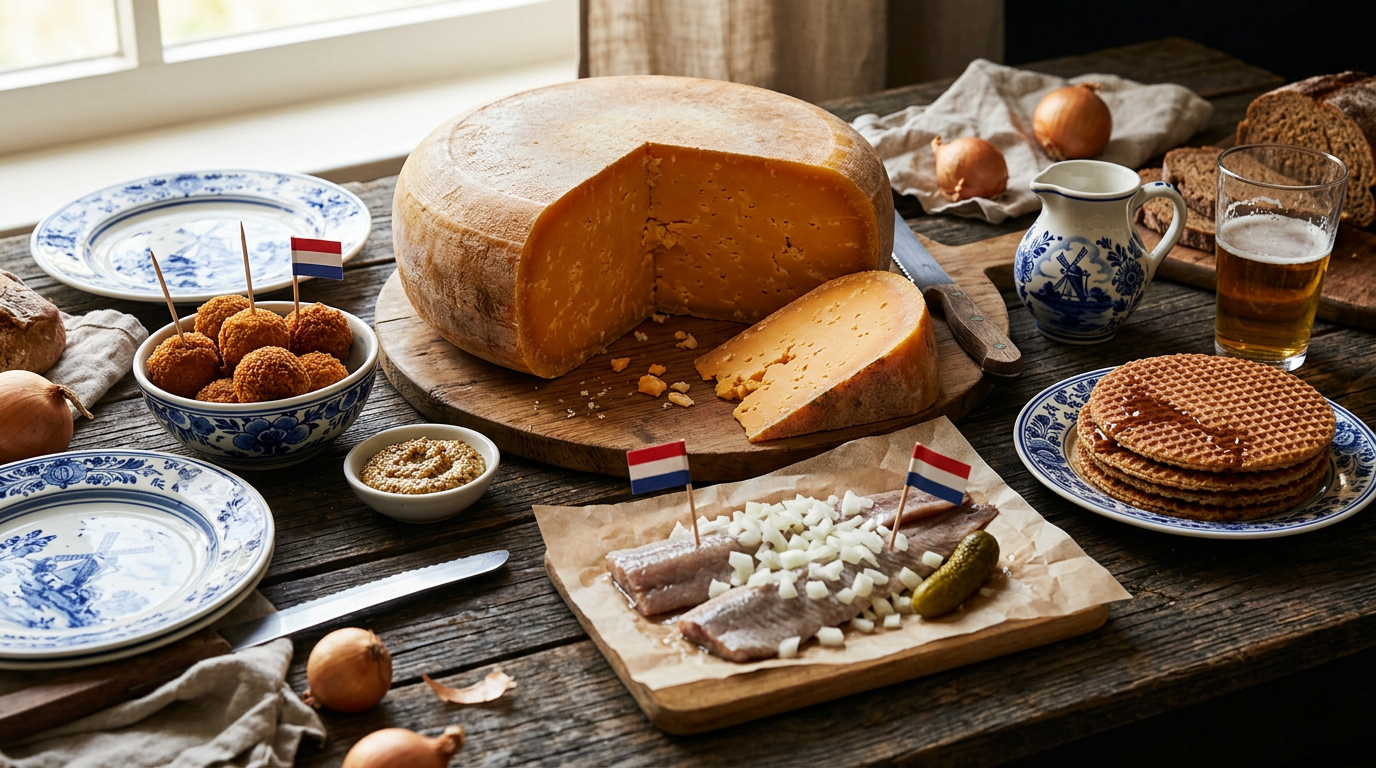
Stroopwafel: Two thin waffle cookies with a caramel-syrup filling. The best version: fresh, still warm, from a market stall. Place it over your coffee cup for 30 seconds to soften the caramel. The supermarket packaged version works in a pinch but isn’t the same thing.
Bitterballen: Crispy fried balls with a creamy, savoury filling (usually beef ragout). The classic Dutch bar snack. They come with mustard for dipping and require a small strategy to eat — bite carefully, the filling is molten. These are not vegetarian.
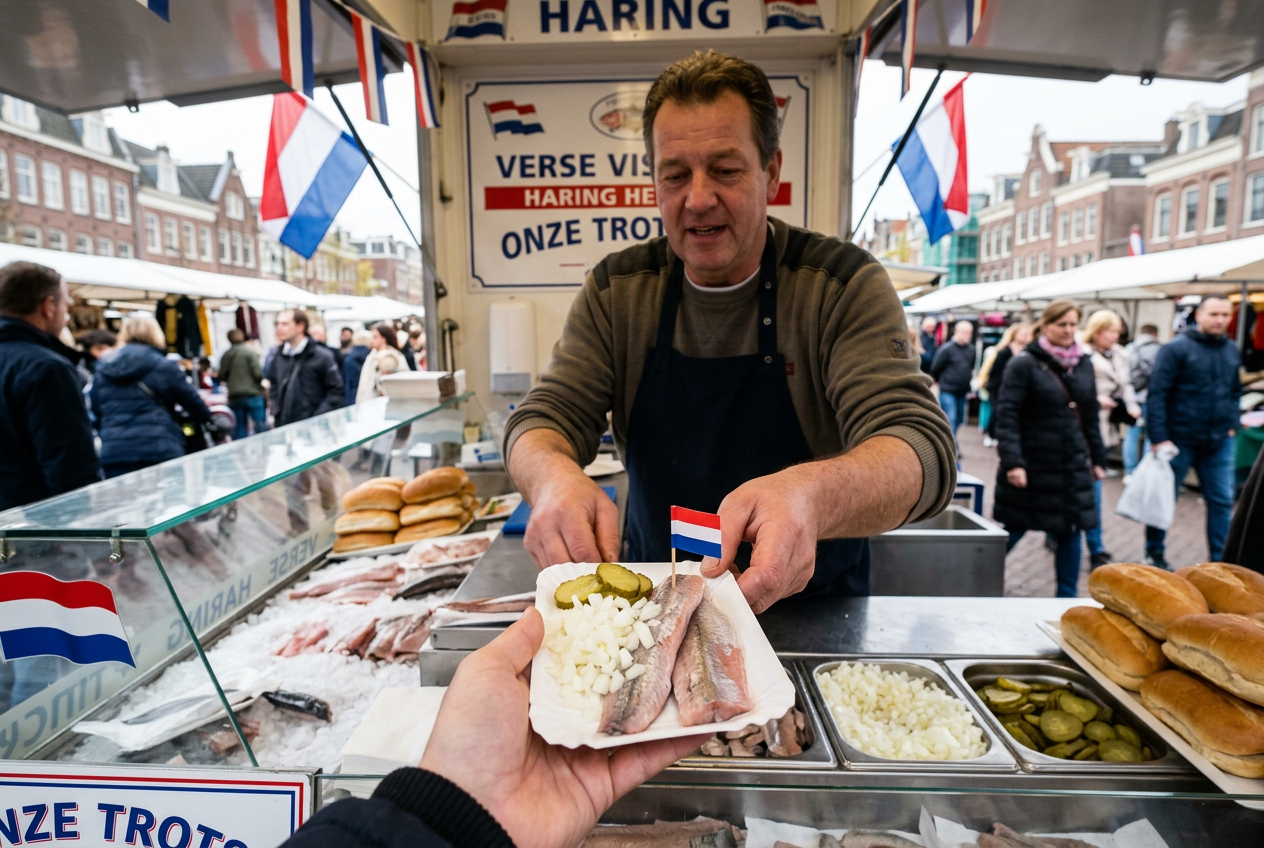
Haring (Hollandse Nieuwe): Raw herring, lightly cured in salt, usually served with raw onion and pickles. The traditional way: hold the fish by the tail, tip your head back, and eat. Broodje haring (herring on a soft roll) is the more practical version. Herring season runs May to July when the new catch is freshest; outside that window you’re eating stored fish, still fine but not at its peak.
Kibbeling: Battered, deep-fried white fish pieces — lighter and less greasy than it sounds, usually served with remoulade sauce. Excellent at markets and fish stalls.
Dutch pancakes (Pannenkoeken): Thinner than American pancakes but thicker than French crêpes, and served with an extraordinary range of toppings — bacon, apple and syrup, Gouda cheese, or powdered sugar. Poffertjes are the mini version, fluffy and served with butter and icing sugar.
Appeltaart: Dutch apple pie — a tall, spiced apple filling in a shortcrust pastry shell, often with an almond cream layer. Usually served with whipped cream. Very different from the American style.
Rijsttafel: Not originally Dutch, but the Indonesian-Dutch rice table is one of the Netherlands’ most distinctive dining experiences. A rijsttafel spreads 15–25 small dishes around a central rice — various curries, satays, sambals, and vegetables. It was brought back from Indonesia during Dutch colonial rule and became firmly embedded in Dutch food culture. Many Indonesian restaurants in the Netherlands are multigenerational family businesses and are taken seriously.
Dutch cheese: Gouda and Edam are the exports, but the actual cheese landscape in the Netherlands is more interesting — aged gouda (old cheese, with crystals forming inside), young gouda (mild and creamy), smoked versions, and herbed wheels. Try before you buy from proper cheese shops rather than tourist markets.
Amsterdam: Coffee Culture, Markets, Late-Night Eats
Coffee
Amsterdam’s café (brown café, or bruine kroeg) culture runs deeper than its coffee culture, but specialty coffee has arrived in the last decade. White Label Coffee (Jacob Obrechtstraat 54) is a small-batch roaster in Oud-Zuid with serious technique. Bocca Coffee (Kloveniersburgwal 34) in the city centre has been roasting since 2001 and was one of the country’s early third-wave shops. For something local and unpretentious: any brown café will have a koffie verkeerd (the Dutch equivalent of a flat white, literally “wrong coffee” — coffee with milk).
Must-Try Markets
Albert Cuyp Markt (De Pijp neighbourhood, Mon–Sat) is the Netherlands’ largest street market and the best place to eat your way through Dutch street food: kibbeling, stroopwafels, haring, fresh fries, Dutch cheese, herbed olives, and surinamese food (the Surinamese community has had enormous influence on Dutch food culture). Budget €10–15 for a thorough market lunch.
Noordermarkt (Jordaan, Saturdays) is smaller and more artisan — organic produce, natural wine, homemade jams. The Saturday morning square fills with locals; worth combining with a coffee at one of the neighbouring cafés.
Must-Try Restaurants
Winkel 43 (Noordermarkt 43) is known for its appeltaart — it’s genuinely among the best in the city, served with fresh whipped cream, and always has a queue. Worth it. De Kas (Kamerlingh Onneslaan 3) is a farm-to-table restaurant in a converted greenhouse, with vegetables from the garden you can see from your table. It’s a full meal rather than a quick bite, and reservations are essential. For rijsttafel: Blue Pepper (Nassaukade 366) offers a Modern Indonesian spread consistently rated among the best in Amsterdam.
Late-Night Eats
FEBO deserves mention: it’s a chain of Dutch fast-food automats where you insert coins and open a window to retrieve bitterballen, kroketten, or frikandellen (a Dutch meat snack that defies clean description). The quality is what you’d expect from a vending machine, but the experience of eating from a wall at 1am in Amsterdam is authentically Dutch. Find them all over the city centre. For better late-night food, the Rembrandtplein area has restaurants and shawarma stalls open past midnight.
Rotterdam: Markthal and the City’s Food Scene
Rotterdam has a more adventurous food culture than Amsterdam in some ways — partly because the city’s post-war reconstruction attracted more international communities, and partly because it’s always been a port city with a wider ingredient supply. The food scene reflects that.
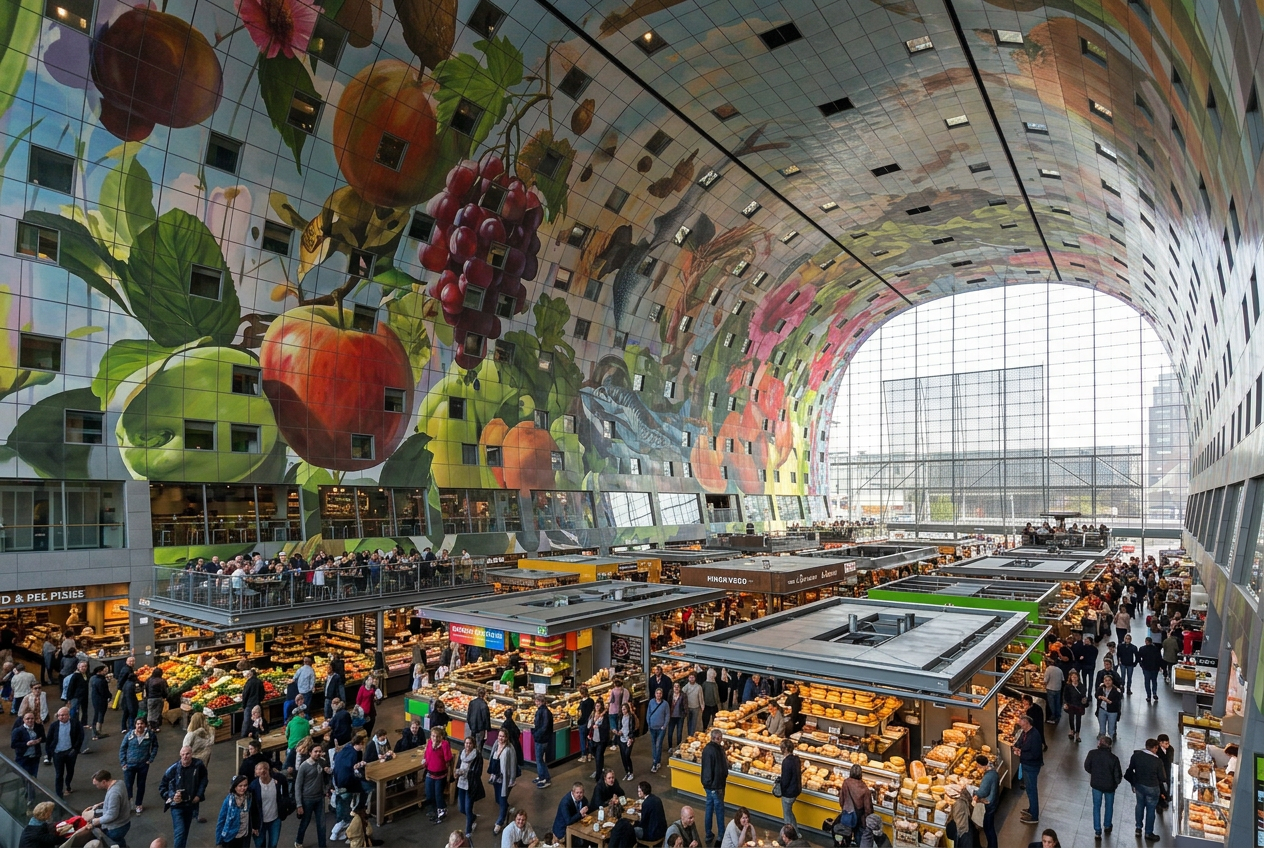
Markthal (Dominee Jan Scharpstraat 298) is architecturally spectacular and culinarily useful. The market hall has 100+ food stalls and vendors across two floors — look for the poffertjes stall, the cheese wheels, the Dutch licorice (drop) vendors, and the Turkish and Surinamese food counters. Lunch at the Markthal is easy and good; don’t bother with the upstairs restaurants during peak hours.
Fenix Food Factory (Veerlaan 19D, in the Katendrecht neighbourhood) is a food hall in a former warehouse on the Maas riverfront, with local producers and street food vendors. Less tourist-facing than the Markthal and worth the extra 15 minutes to get there. The view of the Erasmusbrug from the adjacent waterfront is free.
Witte de Withstraat and the Meent are Rotterdam’s main restaurant strips — good options across cuisines, strong Dutch-Indonesian options. For the best broodje haring: Vishandel Troost (Nieuwe Binnenweg) is a local favourite for fish sandwiches.
Giethoorn: Simple Food, Singular Setting
Giethoorn is a village of about 2,600 people, and its restaurant scene reflects that. The main canal road has several restaurants and cafés aimed at day visitors, with standard Dutch and international menus. The setting — canalside terrace, thatched roofs across the water, the occasional punt drifting past — does a lot of the work.
Restaurant De Lindenhof (Beulakerweg 77) is Giethoorn’s most serious restaurant, with Michelin recognition and a menu built on local produce. It’s expensive (€50–80 per person for dinner) and requires a reservation, but it’s genuinely exceptional cooking. For something more casual, the cafés along the main route do Dutch standards (Dutch pancakes, bitterballen, koffie) at reasonable prices. Don’t expect culinary fireworks from the casual options here — the experience is the village, not the food.
Zaanse Schans: Cheese, Mustard, and Old Dutch Recipes
Zaanse Schans is primarily a heritage site, and the food options are designed around the visitor experience. The cheese farm (Catharina Hoeve) does free tastings — try several aged levels of Dutch Gouda, buy what you like. The bakery museum sells traditional Dutch cookies and spiced breads. The mustard mill sells stone-ground mustard made on site. These are genuinely good products, not just tourist souvenirs.
For lunch: the main visitor area has a restaurant and several snack options — Dutch pancakes, stroopwafels, haring rolls. It’s fine rather than memorable. The real food highlight at Zaanse Schans is the cheese and the chance to understand how Dutch cheese is traditionally made and aged — it reframes the supermarket cheese you’ve been eating.
Utrecht: Student City, Underrated Food
Utrecht has a university-city food culture — which means a mix of cheap, creative, and international options across a small centre. The canal-level wharves (werfkelders) along the Oudegracht are where the most atmospheric eating happens.
Broodje Bert (Voorstraat 68) is a local institution for sandwiches (broodjes) — fresh bread, Dutch fillings, made to order. Queue for it on a weekday lunchtime. Café Olivier (Achter Clarenburg 6a) is a beer café and restaurant in a converted church, with an enormous selection of Belgian beers and good food. Noa Noa (Oudegracht 158) is a canalside spot at the wharves level — sit at the water’s edge if the weather cooperates.
For Indonesian food: Utrecht has several restaurants from the multigenerational Indonesian-Dutch community. Blauw (Springweg 64) does a rijsttafel that’s consistently rated among the best in the country outside Amsterdam — a full spread of 20+ dishes, worth booking well ahead if you can arrange it on your Utrecht evening.
Keukenhof Area: What to Eat Around the Tulip Garden
Keukenhof garden has its own cafés and restaurants inside (the Oranje Nassau and De Watertoren cafés), but they’re expensive and crowded during peak season. The food is unremarkable. A better strategy: eat before you arrive (Lisse town centre has several cafés), or bring food into the garden — there are picnic areas inside. Alternatively, the small town of Sassenheim nearby has local bakeries and cafés that serve the village more than the tourist trade and are therefore calmer and cheaper.
If you’re taking the bus from Schiphol: there are good food options at the airport before you depart, and Schiphol has better dining than you’d expect from an airport.
Ice Cream in the Netherlands
Dutch ice cream (ijs) is excellent — artisan gelato shops appeared in the Netherlands in the 1990s, mostly Italian-run, and the standard is high. In Amsterdam: IJscuypje (various locations, including one near Vondelpark) makes seasonal flavours with local ingredients. In Utrecht: the city centre has several gelato shops along the main shopping streets. At Keukenhof: there are ice cream stands inside the garden.
Soft-serve (slagroomijs) from street stalls is a different thing — lighter, airier, usually served in a cone with a swirl. It’s everywhere in summer and costs €2–3. Good rather than great, but very Dutch.
Dutch Coffee Culture
The Dutch drink a lot of coffee — the Netherlands consistently ranks among Europe’s highest per-capita coffee consumers. The traditional Dutch coffee is a small, strong cup served black (similar to espresso but filter-brewed). The koffie verkeerd (literally “wrong coffee” — white coffee, milk-forward) is the common local version of a latte. Brown cafés serve coffee alongside jenever and beer; they’re not coffee shops in the sense you might be thinking. For specialty coffee, Amsterdam has a growing scene; outside Amsterdam, the options thin out. Major chains like Starbucks and McCafé are present in city centres if you need something familiar.
Late-Night Eats in Dutch Cities
Amsterdam has the most extensive late-night food scene: kebab and shawarma shops around Rembrandtplein and Leidseplein stay open past 1am, as do FEBO automats. Rotterdam’s Witte de Withstraat area has late-night options. Utrecht is a university city — the student area near the Janskerkhof and around Voorstraat has fast food and cafés open until midnight on weekends. Giethoorn and Zaanse Schans are entirely closed by 7–8pm; eat before you go or plan to eat back in Amsterdam.
Practical Tips for Indian Food Travelers
Vegetarian and vegan: Amsterdam is excellent for plant-based eating. Rotterdam and Utrecht have good options. Giethoorn, Zaanse Schans, and Keukenhof are limited — most restaurants serve meat-heavy menus, though standard Dutch pancakes (pannenkoeken) and cheese dishes are vegetarian. See our Netherlands vegetarian and vegan food guide for specific restaurant recommendations by city.
Indian food in the Netherlands: Amsterdam has several Indian restaurants in the city centre and south — quality varies, but the Surinamese restaurants serve food with Indian-origin ingredients (curry dishes, roti, dal) brought by the Surinamese-Indian diaspora, and are often better than the Bollywood-themed tourist traps near Leidseplein.
Tipping: Tipping is appreciated but not mandatory in the Netherlands. 5–10% at sit-down restaurants is standard; rounding up the bill at a café is common. No obligation at takeaway or market stalls.
Water: Dutch tap water is excellent quality and widely drunk — no need to buy bottled water. Ask for tap water (kraanwater) at restaurants; most will provide it, though some charge €1–2.
Payment: Card (contactless, Mastercard/Visa) is very widely accepted, more so than cash. Many market stalls and smaller vendors are card-only. Carry a small amount of cash (€20–30) for markets and emergencies, but you can largely get by without it.
FAQs: Eating in the Netherlands
What is the most famous Dutch food?
Stroopwafels, Dutch cheese (Gouda and Edam), and haring are the most globally recognized. Inside the Netherlands, bitterballen and Dutch pancakes are arguably more everyday-loved.
Is the Netherlands good for vegetarians?
Amsterdam is excellent. Utrecht and Rotterdam have good options. Smaller towns like Giethoorn are more limited but manageable. See our full vegetarian guide for restaurant names and details.
What is rijsttafel?
An Indonesian-Dutch dining tradition: 15–25 small dishes (curries, satays, sambals, vegetables, rice) served together. It originated during Dutch colonial rule in Indonesia and has been part of Dutch food culture for over a century. The best rijsttafel restaurants in Amsterdam and Utrecht take it seriously.
Can I find Indian food in the Netherlands?
Yes, particularly in Amsterdam. The Surinamese food tradition also has strong Indian-origin dishes (roti, dal, curries) that may feel familiar. Quality varies — ask locals rather than trusting tourist-area restaurants near the main squares.
What’s the best market for food in Amsterdam?
Albert Cuyp Markt (De Pijp, Monday to Saturday) for the best everyday-market experience. Noordermarkt (Saturdays, Jordaan) for organic and artisan produce. Haarlemmerplein market (Wednesdays) for free cheese tasting.
Explore the Netherlands with Get Tripped
Food is better when you know where to look — and so is travel. If you’d like to build a Netherlands trip that balances the food trail with the sights, the canal cruises with the quiet village mornings, Get Tripped can design it. View Netherlands tour packages from India or reach us on WhatsApp at +918080907607.