Netherlands Public Transit Guide: Trains, Trams and Ferries for Indian Travelers
The Netherlands has one of the best public transport systems in the world, and understanding how it works saves significant time and money compared to figuring it out on the ground. This guide covers everything you need to know about getting around by NS train, tram, metro, bus, and ferry — from Amsterdam to Rotterdam, Zaanse Schans to Giethoorn, and every destination in between. If you’re travelling from India, the OV-chipkaart system will be unfamiliar but takes about five minutes to get right.
Dutch public transport is run by multiple operators under a unified payment system. NS (Nederlandse Spoorwegen) operates the national rail network. GVB operates Amsterdam’s trams, metro, and buses. RET operates Rotterdam’s metro, trams, and buses. U-OV operates Utrecht’s buses. Regional buses filling the gaps between train stations are operated by companies like Arriva, Connexxion, and EBS.
All of these use the same payment infrastructure: the OV-chipkaart (the transit smart card) or contactless bank/credit card payment. You don’t need a separate ticket for each operator — load credit onto one card and use it everywhere. This is the core thing to understand.
One important distinction: NS trains and local transit (trams, metro, buses) are priced separately. A single OV-chipkaart covers both, but you check in and check out on each leg separately. Miss checking out and you’ll be charged a penalty fare.
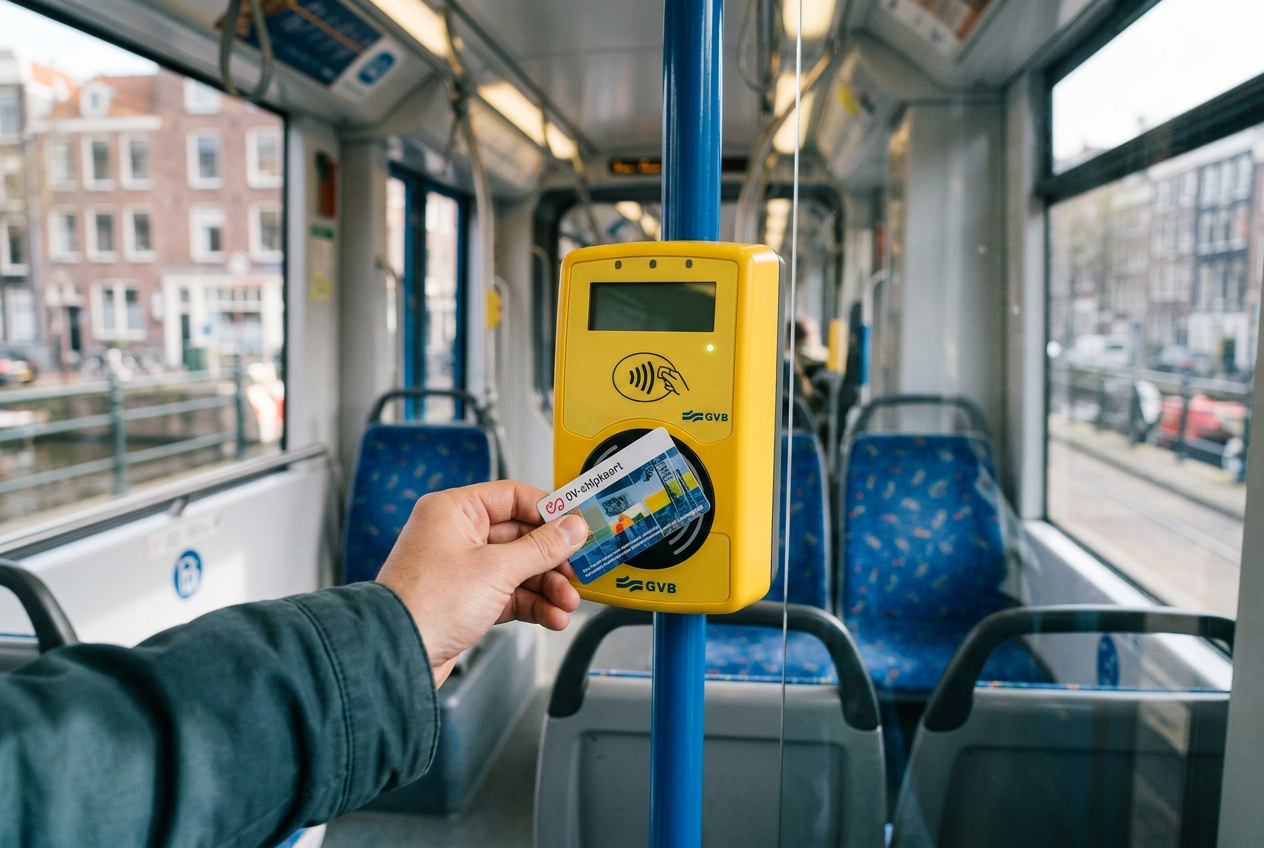
Tap in and out every time — forgetting to check out is the most common transit mistake
The OV-Chipkaart: Your Transit Card
The OV-chipkaart is a reloadable smart card that works on all Dutch public transport. For tourists, there are two relevant options:
Anonymous OV-chipkaart (Anonieme OV-chipkaart) — no name, no registration required, available from yellow ticket machines at any NS station. Costs EUR 7.50 as a card deposit (refundable). Load credit as needed. This is the right option for most visitors — buy it at Schiphol on arrival, load EUR 50, and you’re set for a week in the Netherlands.
Contactless bank card — since 2020, you can tap in and tap out with a Visa or Mastercard contactless bank card on most NS trains and GVB trams and metros in Amsterdam. This is convenient but doesn’t work on all regional buses, and may incur international transaction fees from your bank. If your Indian bank card has contactless, test it at a GVB gate on arrival before relying on it exclusively.
How to use it: Always check in (tap on the yellow reader) before boarding and check out (tap again) when you exit. This applies to trains, trams, buses, and metros. The system charges for the distance travelled between check-in and check-out. If you forget to check out, you’re charged the maximum fare for that operator.
NS Trains: Intercity and Sprinter
NS operates two classes of train relevant to tourists:
Intercity (IC) trains — the faster category, stopping at major stations. Amsterdam Centraal to Rotterdam Centraal is 40 minutes on the Intercity Direct (requires a EUR 3.40 supplement on top of the base fare). Amsterdam to Utrecht is 30 minutes.
Sprinter trains — stop at every station, slightly slower. Good for shorter regional hops. Amsterdam to Zaandam (for Zaanse Schans) is 20 minutes on the Sprinter.
First class (1e klas) and second class (2e klas) compartments exist on all IC trains. First class is significantly quieter and more comfortable; the price difference is roughly 50%. Worth it on longer routes. The carriage class is marked at the doors.
Seat reservations are not required on Dutch trains — you board any available seat in the right class. During peak hours (7–9am, 5–7pm on weekdays), trains can be crowded. Outside these windows, finding a seat is never an issue.
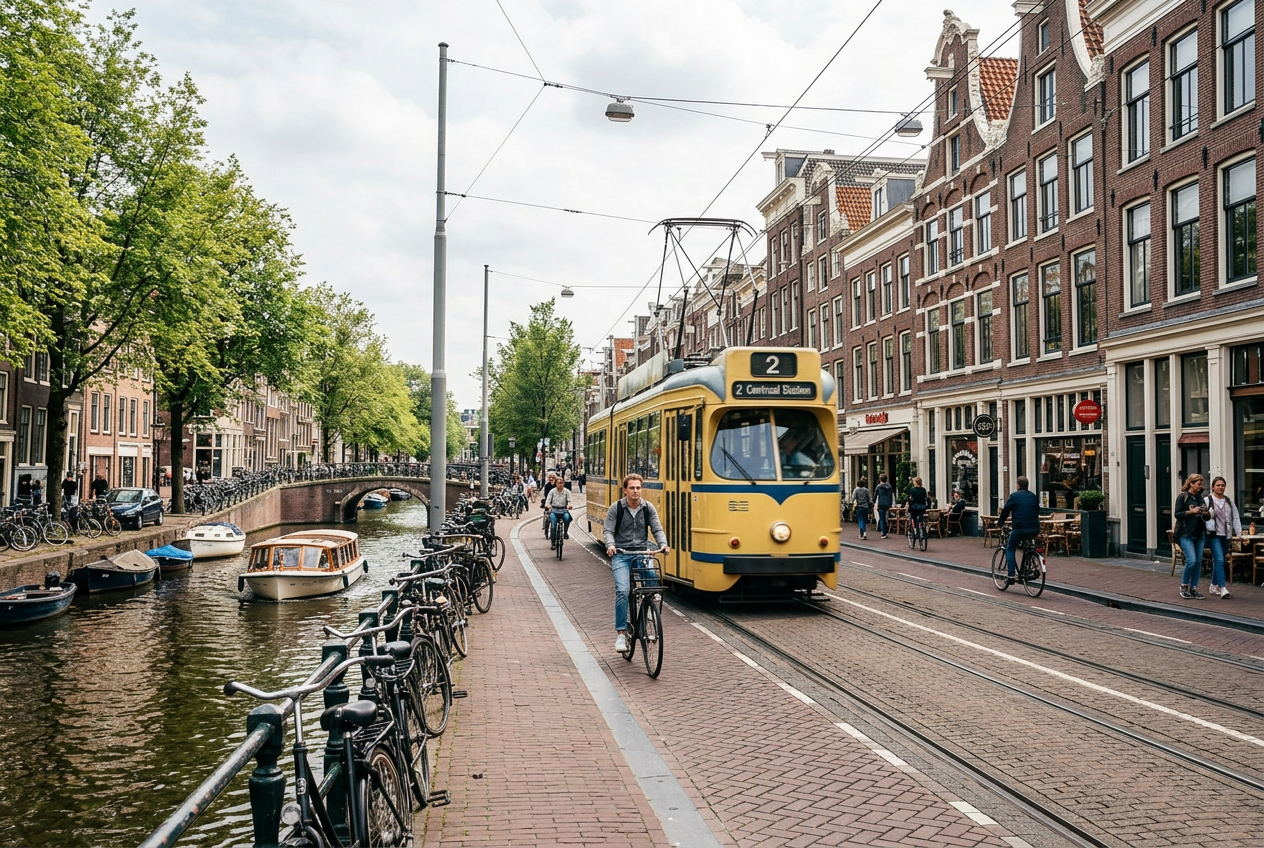
Amsterdam’s GVB tram network — OV-chipkaart or contactless bank card, no cash on board
Getting Around Amsterdam
Amsterdam’s GVB network is excellent and covers every corner of the city. The tourist-relevant lines:
Trams are the main way to move around the city centre. Line 2 (Nieuw Sloten – Centraal Station) covers the museum district; Line 5 goes along the main tourist spine. All trams require an OV-chipkaart or contactless payment at the reader near the doors — there’s no cash on board.
Metro lines 51, 52, 54 connect the centre to outlying neighbourhoods. For most tourist itineraries, the metro is less useful than trams — the city centre is small enough to walk across in 30 minutes.
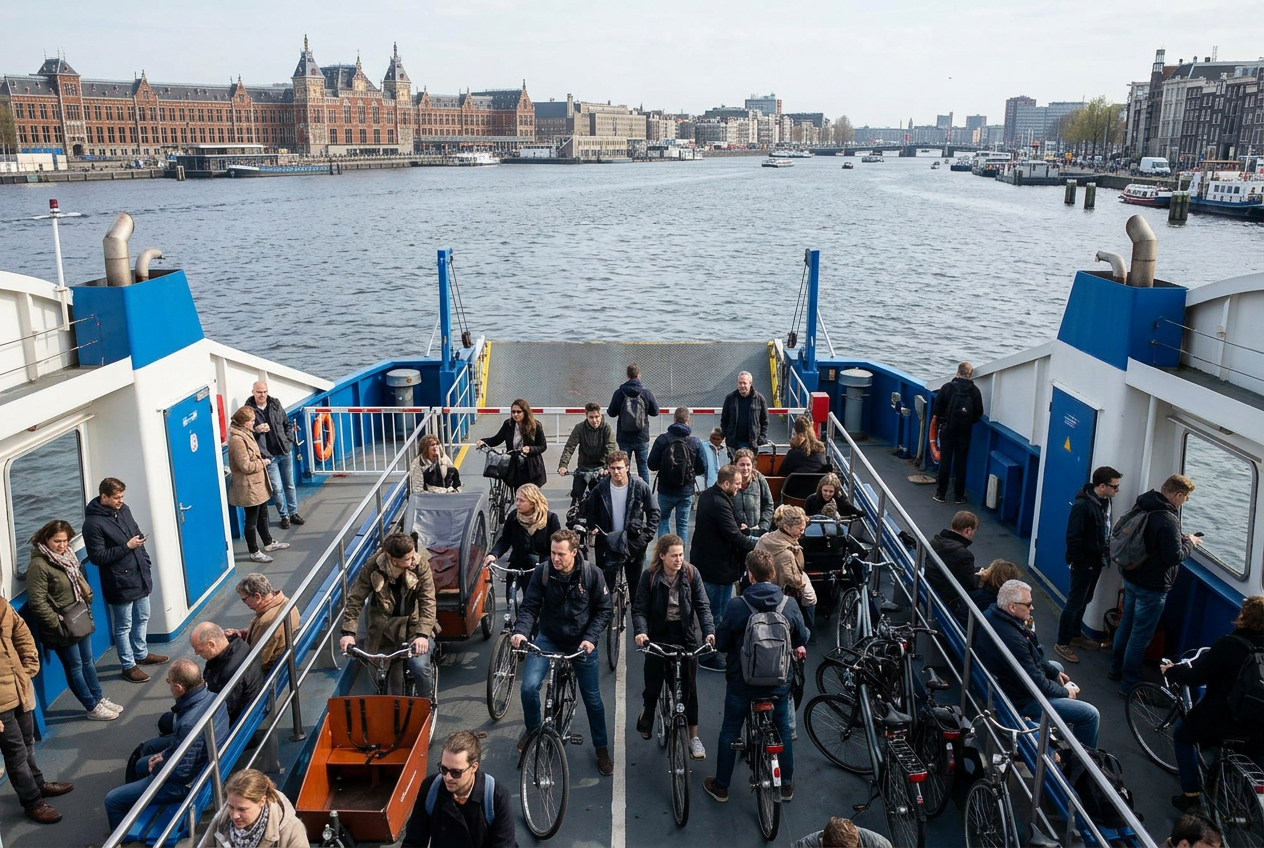
Ferries across the IJ waterway (behind Centraal Station) are free and run constantly. The ferry to Amsterdam Noord (NDSM wharf) is one of the most useful — takes 15 minutes to a neighbourhood most tourists miss. No OV-chipkaart needed; just walk on.
Cycling in Amsterdam is excellent but requires confidence in the cycling culture before you start. The tourist rental shops near Centraal Station rent bikes by the hour or day (EUR 10–25/day); helmet rental is optional since most Dutch cyclists don’t wear one, but recommended for visitors unfamiliar with the traffic dynamics.
Key Routes for the Standard Netherlands Itinerary
Amsterdam Centraal → Zaandam (Zaanse Schans): NS Sprinter, 20 minutes, runs every 15 minutes. Walk 15 minutes from Zaandam station or take the local bus to Zaanse Schans entrance. Leave early to avoid tour groups.
Amsterdam Centraal → Rotterdam Centraal: NS Intercity Direct, 40 minutes (EUR 3.40 supplement applies on this route, payable separately on the NS app or at machines). Runs frequently throughout the day. No seat reservation needed.
Rotterdam Centraal → Zwolle (for Giethoorn): NS Intercity, approximately 1.5 hours. From Zwolle, take Connexxion bus 70 or 72 to Giethoorn (30–45 minutes). Check NS journey planner for current bus timetable — the connection varies by day.
Amsterdam Centraal → Utrecht Centraal: NS Intercity, 30 minutes, very frequent service (every 10–15 minutes). One of the most-used rail corridors in the Netherlands.
Amsterdam Centraal/Schiphol → Keukenhof: Connexxion bus 858 runs directly from Schiphol to Keukenhof during the garden’s open season (mid-March to mid-May). Buy the combination ticket (bus + garden entry) at Schiphol or online. From Amsterdam Centraal, take the train to Schiphol first (10 minutes).
The free IJ ferry behind Centraal Station runs every few minutes to Amsterdam Noord
Schiphol Airport: Arrival and Departure
Schiphol has its own train station directly below the terminal — one of the few major international airports with this. The NS train to Amsterdam Centraal runs every 10 minutes and takes 15–20 minutes (EUR 5.30 single). The same train continues to Rotterdam, Utrecht, and Eindhoven, so if your hotel is in one of those cities, you can ride directly from Schiphol without changing.
At arrival, buy your OV-chipkaart at the yellow NS ticket machines before exiting arrivals — they’re immediately visible, accept debit and credit cards, and have English-language interfaces. Load EUR 20–30 to start; you can reload at any station or Albert Heijn supermarket.
At departure, check Schiphol’s website for security queue times. The airport recommends arriving 3 hours before international flights. The train from Amsterdam Centraal to Schiphol is 15 minutes — build in buffer for delays.
What Transit Actually Costs
NS train fares are distance-based and charged per kilometre. Rough estimates:
Amsterdam–Utrecht: EUR 7–8 single (second class)
Amsterdam–Rotterdam (Intercity Direct): EUR 16–17 single including supplement
Amsterdam–Zwolle: EUR 18–20 single
Schiphol–Amsterdam Centraal: EUR 5.30 single
GVB trams and metro in Amsterdam: EUR 1.08 base + EUR 0.167/km. A short tram ride across the city costs EUR 2–4.
Budget EUR 150–200 for all train travel across a 7–8 day Netherlands itinerary covering Amsterdam, Rotterdam, Giethoorn/Zwolle, and Utrecht. This is not cheap by Indian standards, but the network is excellent and alternatives (taxis, rental cars) cost significantly more.
Apps and Planning Tools
NS app (available on Android and iOS, English language) — real-time train times, disruptions, journey planner, and OV-chipkaart balance checking. Essential download before your trip.
9292 app — covers all Dutch public transport, not just NS trains. Better for planning multi-modal journeys combining trains, trams, and buses.
GVB app — real-time tram and metro tracking for Amsterdam specifically. Useful for seeing when the next tram actually arrives rather than the schedule time.
All apps are free. The NS app doesn’t require an account for journey planning; account registration is needed for buying advance tickets.
Tips and Common Mistakes
Always check out. This is the most common mistake — forgetting to tap out when leaving a tram or train. If you forget and notice later, you can dispute penalty charges through the NS customer service app, but it requires effort.
The Intercity Direct supplement catches people. The Amsterdam–Rotterdam route via the high-speed corridor costs an extra EUR 3.40 (Thalys supplement). It’s not automatically charged to your OV-chipkaart — you need to buy it separately at a machine or on the NS app. Skip this and you may get a fine from an inspector.
Download the NS app before you land. Checking timetables at Schiphol on slow roaming is frustrating. Download and open it at home first.
Station names matter. Some cities have multiple stations (Amsterdam has Centraal, Zuid, Sloterdijk, Bijlmer). “Amsterdam” almost always means “Amsterdam Centraal” in navigation, but confirm when booking accommodation near other stations.
Sunday timetables differ. Trains run less frequently on Sunday mornings. If you have an early connection (e.g., Giethoorn on a Sunday), check the specific Sunday timetable the night before.
Frequently Asked Questions
Can I use a contactless Indian debit card on Dutch transit?
Contactless payment works on most NS trains and Amsterdam GVB trams/metro if your card supports international contactless transactions. Regional buses and some smaller operators require the OV-chipkaart. Buy an anonymous OV-chipkaart at Schiphol as a backup.
Is there a transit day pass for the Netherlands?
NS offers an unlimited day travel pass (Dagkaart) for EUR 50–75 depending on the zones covered. It’s worth it only if you’re making 3+ train journeys in a single day. For most itineraries, pay-per-journey on the OV-chipkaart is cheaper.
How do I get from Schiphol to Amsterdam Centraal?
NS train from Schiphol Station (directly below the terminal) to Amsterdam Centraal — 15–20 minutes, EUR 5.30, runs every 10 minutes. No booking required.
Is there a direct bus to Zaanse Schans?
Take the NS train to Zaandam station (20 minutes from Amsterdam Centraal), then walk 15 minutes or take bus 391 to the Zaanse Schans entrance. The direct “tourist bus” from Amsterdam is slower and more expensive.
How do I get to Giethoorn from Amsterdam?
NS train from Amsterdam Centraal to Zwolle (1 hour 20 minutes), then Connexxion bus 70 or 72 to Giethoorn (30–45 minutes). Allow 2.5 hours total for the journey. Check the NS app for the specific bus connection on your travel date.
Plan Your Netherlands Trip with Get Tripped
Dutch public transport is reliable, well-networked, and genuinely efficient — once you understand the check-in/check-out system and have an OV-chipkaart in your pocket, getting around feels effortless. Start planning your Netherlands tour package from India with Get Tripped, and we’ll handle the logistics so you’re not figuring out bus supplements on the platform.
Amsterdamamsterdam tramGetting Around NetherlandsGVB AmsterdamNetherlandsNetherlands from Indianetherlands trainNetherlands TransitNS TrainOV ChipkaartPublic Transport NetherlandsSchiphol AirportTravel Tips Netherlands