Getting Around the Netherlands: A Complete Public Transit Guide for Indian Travelers (2026)
The Netherlands has the kind of public transit network that makes you wonder why everywhere else can’t get it right. Trains run on the minute, buses go where trains don’t, and in Amsterdam a single OV-chipkaart handles trams, metros, buses, and the free IJ ferries. For Indian travelers used to booking Ola and figuring out autos at every turn, the Dutch system takes about one day to get the hang of — and then it’s genuinely one of the most convenient ways to move through any country in Europe. This guide covers everything: how the OV-chipkaart works, the trains between cities, getting to Giethoorn and Keukenhof, and whether you can tap your international Mastercard directly on the reader (you can, in Amsterdam).
Table of Contents
- The OV-Chipkaart: The Netherlands’ Transit Card
- Getting Around Amsterdam
- Schiphol Airport to Amsterdam City Centre
- Intercity Trains: NS Rail Network
- Getting Around Rotterdam
- Getting Around Utrecht
- Getting to Giethoorn
- Getting to Zaanse Schans
- Getting to Keukenhof
- Cycling: The Dutch Way
- Day Passes and Travel Cards
- Contactless and Card Payments on Transit
- Transit Tips for Indian Travelers
- FAQs
The OV-Chipkaart: The Netherlands’ Transit Card
The OV-chipkaart (pronounced “oh-vay chip-kart”) is the standard transit card used across the Netherlands. It works on trains, trams, metros, buses, and most ferries. There are two versions:
- Personal OV-chipkaart: Registered to your name, can be blocked and refunded if lost. Requires a Dutch bank account to register online. Not practical for tourists.
- Anonymous OV-chipkaart: The tourist version. Buy it at any NS train station ticket machine or ticket window. Costs €7.50 for the card itself (non-refundable). Load credit (minimum €20 recommended) onto it at ticket machines or service counters.
How it works: tap in when you board any transit vehicle, tap out when you exit. The fare is deducted automatically. If you forget to tap out, you’re charged the maximum fare for that line — sometimes significantly more than the actual journey cost. This catches visitors off-guard, so make tapping out a habit from day one.
The card requires a minimum balance of €4 to board a train (the system reserves this as a minimum deposit against the journey). For trams and buses in Amsterdam, the minimum check-in balance is €0.80. Keep the card topped up — machines at all major stations accept cash and card.
Getting Around Amsterdam
Amsterdam’s public transit is run by GVB and covers four main modes:
Metro
Four lines (50, 51, 52, 53, 54) covering the main city and connecting Schiphol to Centraal Station via line 52 (North–South line). Useful for the airport connection and reaching neighborhoods south of the centre. Runs from roughly 06:00 to 00:30 on weekdays, until 01:00 on weekends.
Tram
The most useful surface transport in central Amsterdam. 15 lines cover the canal ring, Museumplein, Vondelpark, Jordaan, De Pijp, and most tourist areas. Trams are frequent (every 5–12 minutes on major routes) and comfortable. Line 2 covers Leidseplein and the Vondelpark. Line 12 goes to the Rijksmuseum and Van Gogh Museum area. Line 1, 7, and 17 cover different parts of the canal ring.
Bus
GVB buses serve outer neighborhoods that trams don’t reach. Night buses (N-lines) run from roughly 00:30 to 06:00 when regular services stop.
IJ Ferries
Four free ferries cross the IJ waterway between Centraal Station (rear dock) and Amsterdam Noord. The Buiksloterweg and Ijplein ferries run every 7–15 minutes, 24 hours. No OV-chipkaart needed — just walk on. Amsterdam Noord has become a worthwhile destination in itself (EYE Film Museum, A’dam Tower, NDSM Wharf), so the ferry is both practical and worth taking as an experience.
GVB Day Pass
If you’re spending multiple days using GVB within Amsterdam, a 24-hour (€9.50), 48-hour (€16.50), 72-hour (€21), 96-hour (€26) or 168-hour (€36) unlimited GVB pass covers all trams, buses, and metros within the city. These can be bought at GVB service counters at Centraal Station or at ticket machines. The pass doesn’t cover NS national trains or regional buses outside the GVB zone.
Schiphol Airport to Amsterdam City Centre
Schiphol Airport (AMS) is exceptionally well-connected to Amsterdam. The airport railway station is directly below the terminal — follow the signs from Arrivals to Schiphol Plaza and then to the train hall.
By Train (Recommended)
Direct trains run to Amsterdam Centraal every 10–15 minutes. Journey time: 15–20 minutes. Cost: approximately €5.70 one-way (OV-chipkaart) or slightly more for a single-use ticket. Trains also connect Schiphol directly to Rotterdam Centraal (25 min), The Hague (25 min), and Utrecht Centraal (35 min) — if your hotel is in any of those cities, you can skip Amsterdam Centraal entirely.
By Bus
Several buses connect the airport to various Amsterdam neighborhoods if the train doesn’t serve your hotel area. Connexxion and EBS run regional services. Buy tickets at the bus stop machines or use OV-chipkaart.
By Taxi or Ride-Share
Fixed-rate official taxis from Schiphol to central Amsterdam cost roughly €50–60 and take 20–45 minutes depending on traffic. Uber is available at Schiphol (Car drop-off area, follow signs). The taxi is only worth it if you have a lot of luggage, an early-morning or late-night arrival when trains are sparse, or are going somewhere the train doesn’t easily reach.
Intercity Trains: NS Rail Network
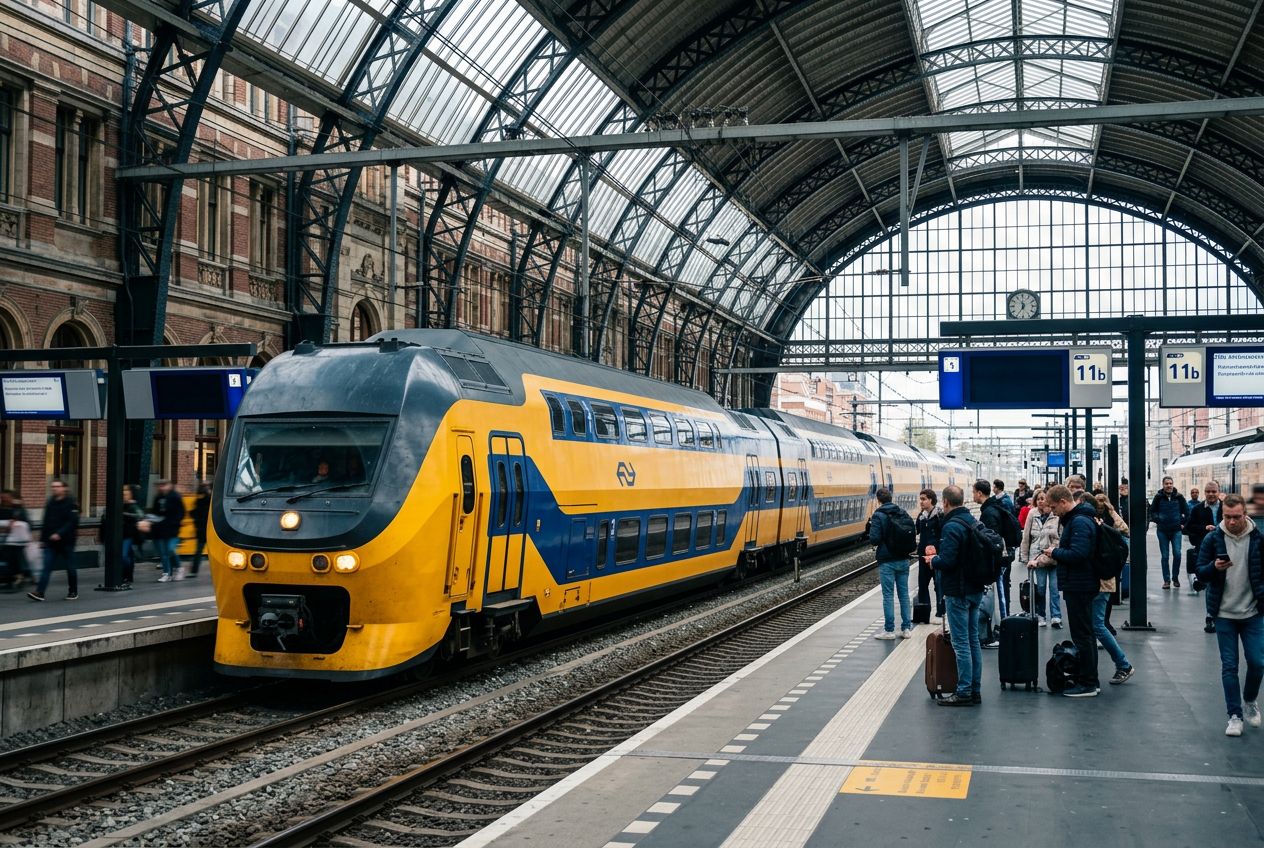
Nederlandse Spoorwegen (NS) runs the national rail network. For the standard Netherlands itinerary — Amsterdam, Rotterdam, Utrecht, day trips — trains are the fastest and most comfortable way to move between cities.
Key Routes and Times
| Route | Frequency | Journey Time | Approx Fare |
|---|---|---|---|
| Amsterdam → Rotterdam | Every 10–15 min | 40 min (Intercity Direct) / 1 hr (IC) | €17–20 |
| Amsterdam → Utrecht | Every 10 min | 27 min | €8 |
| Amsterdam → Zaandam (Zaanse Schans) | Every 10–15 min | 17 min | €3.90 |
| Amsterdam → Haarlem | Every 10 min | 15 min | €4.50 |
| Rotterdam → Utrecht | Every 10 min | 40 min | €12 |
| Rotterdam → The Hague | Every 5–10 min | 25 min | €6 |
Fares above are approximate second-class single fares using OV-chipkaart. Buy single-use tickets at yellow NS ticket machines (card accepted, no foreign transaction fees) or use the NS app (available for iOS and Android, pay by card, includes real-time platform information). Intercity Direct trains to Rotterdam have a supplement of €2.60; slower IC trains on the same route have no supplement.
Booking Tips
NS trains don’t require advance booking for ordinary travelers — trains are frequent and seats are rarely fully booked on domestic routes. For weekend mornings and Friday evenings, trains to and from Amsterdam can fill up, but you’re unlikely to be turned away. For international trains (Eurostar to London, Thalys to Paris, ICE to Germany), book well in advance.
Getting Around Rotterdam
Rotterdam’s urban transit is run by RET and uses the same OV-chipkaart. The city has:
- Metro: Four lines (A, B, C, D, E) covering the main districts. Central station is Rotterdam Centraal (a spectacular building in itself). The metro reaches Erasmusbrug, Beurs (city centre), and suburban areas.
- Tram: Lines 21, 23, 24, 25 covering central Rotterdam and Delfshaven.
- Water Taxi: A fast speedboat service crossing the Nieuwe Maas waterway. Pricier than the ferry (€4–8) but faster and a fun experience. The Waterbus is a slower, cheaper ferry connecting Rotterdam to Dordrecht — useful if you’re day-tripping further south.
The Markthal, Cube Houses, and waterfront are all walkable from Rotterdam Centraal within 15–20 minutes, or one metro stop on Line D (Beurs station). Rotterdam is a very walkable city for its main attractions.
Getting Around Utrecht
Utrecht’s historic centre is compact and largely pedestrianized. The main train station (Utrecht Centraal) is massive — it connects directly to the Hoog Catharijne shopping mall which leads into the city centre. Most of Utrecht’s main attractions (Dom Tower, canals, Miffy Museum) are within a 15-minute walk from the station. Local buses run by U-OV use the OV-chipkaart for the outer neighborhoods.
Getting to Giethoorn
Giethoorn has no train station. It requires a combination of train and bus:
- Train from Amsterdam Centraal to Steenwijk station (NS, every 30–60 min, 1h20min, approx €25)
- Bus 70 from Steenwijk station to Giethoorn (Dominee Hylkemaweg stop) — roughly 15 minutes, every 60 minutes on weekdays. Check 9292.nl for current schedules before you go, as bus frequency varies by season and weekday vs. weekend.
Alternatively, some travelers drive (1.5 hours from Amsterdam, parking available outside the village) or take a guided day tour from Amsterdam, which handles all transport. This is worth considering: Giethoorn is a small village and the tour transport isn’t significantly more than DIY transit cost once you factor in a possible taxi from Steenwijk if you miss the bus.
Return: last bus from Giethoorn to Steenwijk on weekdays is typically around 18:00–19:00. Check 9292.nl for the exact last bus on your travel date — missing it means a taxi to Steenwijk (€15–20).
Getting to Zaanse Schans
Zaanse Schans is significantly easier to reach than Giethoorn:
- Train from Amsterdam Centraal to Zaandam station (NS, every 10 min, 17 min, approx €3.90)
- Bus 391 from Zaandam station to Zaanse Schans (10 min, frequent) — OV-chipkaart accepted
Total travel time door-to-door from Amsterdam Centraal: roughly 35–45 minutes. The whole thing costs under €10 return. Alternatively, train to Koog-Zaandijk station (one stop after Zaandam, 23 min from Amsterdam) and walk 15 minutes to the windmills — this avoids the bus entirely and the walk through the town is pleasant.
Getting to Keukenhof
Keukenhof garden is open only from late March to mid-May (exact dates vary by year — check keukenhof.nl before booking). Transport options during the open season:
Option 1: Keukenhof Express Bus (Easiest)
Connexxion runs the Keukenhof Express (Bus 858) from Amsterdam Centraal (Stationsplein) to Keukenhof during the open season, every 30 minutes. Journey time: 50–60 minutes. A combination ticket (bus + garden entry) can be bought at the GVB Tourist Office at Centraal Station or online. This is the simplest option.
Option 2: Train + Bus from Leiden or Schiphol
Take a train to Leiden Centraal or Schiphol, then Bus 858 to Keukenhof. This is useful if you’re combining Keukenhof with a stop in Leiden or coming directly from the airport.
Option 3: Cycling from Lisse
During tulip season, bike rental is available in the Lisse area and cycling to and around the bulb fields is a popular activity. Lisse is a 15-minute cycle from the main Keukenhof car park area. Not practical if you’re carrying day bags or coming from a distance, but worthwhile if you’re basing yourself in Haarlem or Leiden for the night.
Cycling: The Dutch Way
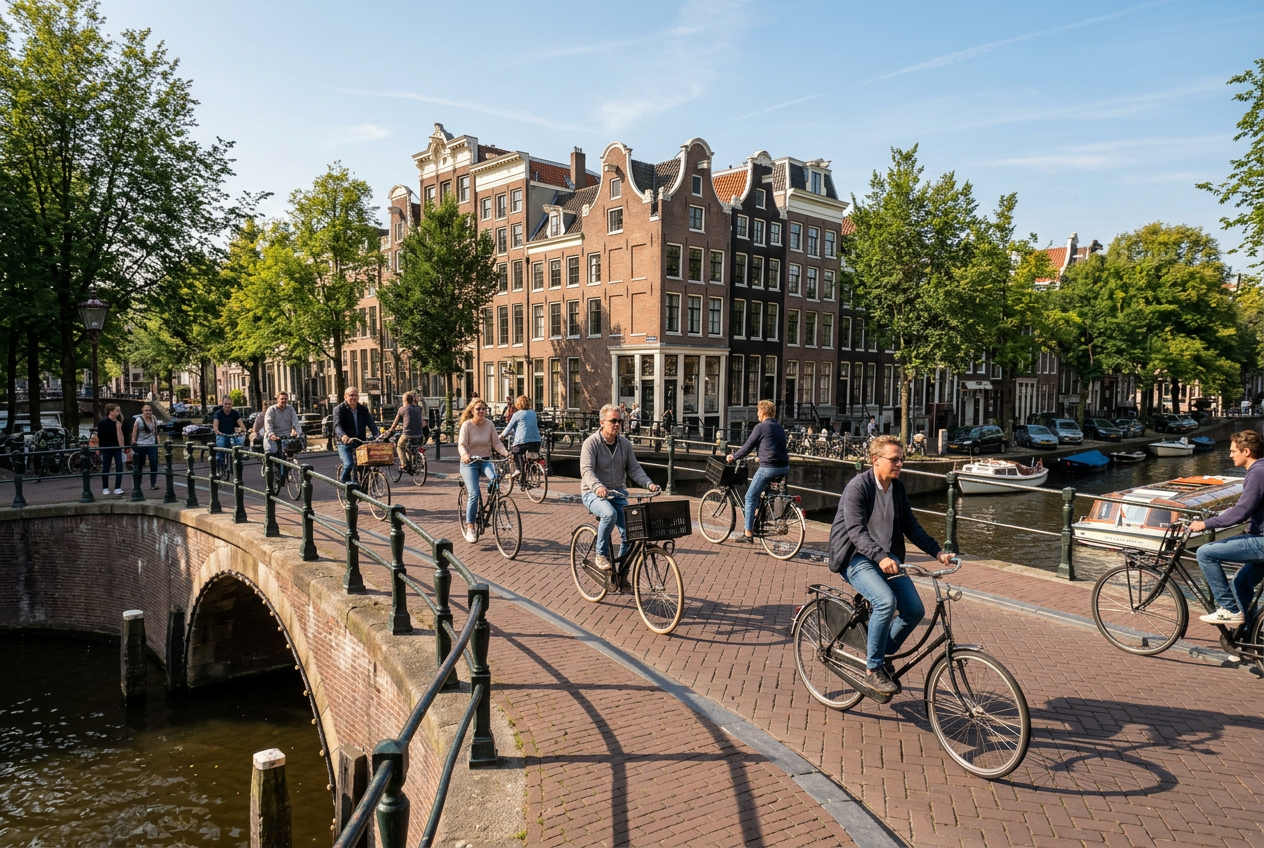
Cycling in the Netherlands is not just tourist activity — it’s the primary transport mode for millions of Dutch people. The cycling infrastructure (dedicated lanes, separate traffic signals, bike parking everywhere) is genuinely world-class. For visitors, renting a bike is worth doing at least for one day, especially in Amsterdam, Giethoorn, and the tulip fields around Keukenhof.
Bike Rental in Amsterdam
Dozens of rental shops near Centraal Station. Prices: €10–15 per day for a basic city bike, €18–25 for multi-gear bikes. OV-fiets (the national bike-share scheme) is available at all major train stations but requires registration with an OV-chipkaart account — not practical for most tourists on short visits.
Rules for cycling in the Netherlands: Ride in bike lanes (the red-paved lanes), not on roads or footpaths. At intersections, follow bike-specific traffic signals. Dutch cyclists don’t wear helmets (it’s not required by law, and culturally unusual), but you can and should if it makes you comfortable. No cycling after drinking — fines apply.
Amsterdam’s city center canals make navigation slightly confusing at first. Download Google Maps or CityMapper before you go and use cycling directions, not driving — they route you on bike lanes and are accurate.
Day Passes and Travel Cards
Amsterdam & Region Day Ticket
Covers all GVB transport within Amsterdam plus Connexxion buses to nearby towns (Zaandam, Haarlem, some suburbs). Valid for unlimited travel for 24 hours. Available at GVB service points and machines.
Holland Travel Ticket
NS sells a day ticket (€57 in 2026) giving unlimited second-class train travel across the entire Netherlands, plus unlimited GVB/RET/HTM/U-OV urban transit in Amsterdam, Rotterdam, The Hague, and Utrecht. Valid one full calendar day. Useful only if you’re doing multiple city hops in a single day — otherwise the per-journey OV-chipkaart fares are cheaper.
OV Day Pass
NS also sells day passes for specific regions (e.g., Amsterdam Day Pass covering trains within the Amsterdam metro area). Check the NS website or ticket machines for current offerings — the product lineup adjusts periodically.
Contactless and Card Payments on Transit
Amsterdam and Rotterdam now support contactless bank card payments directly on transit — tap your Mastercard or Visa debit/credit card instead of an OV-chipkaart. As of 2026, this works on GVB trams, buses, and metros in Amsterdam, and on RET trams, buses, and metros in Rotterdam. The fare is identical to the OV-chipkaart rate.
Important: RuPay cards (including RuPay international) are not listed as accepted on GVB or RET readers as of 2026. Standard Visa and Mastercard contactless works. Check with your Indian bank whether your card has international contactless enabled — many Indian bank cards work, but some require enabling international transactions first.
NS national trains do not yet accept contactless bank card tap-on/tap-off as of 2026. For trains, you need an OV-chipkaart or a ticket from the machine (card payment at the machine works fine). This may change — check ns.nl for the latest.
Transit Tips for Indian Travelers
- Get the OV-chipkaart on day 1: Buy it at the NS service desk at Schiphol or Amsterdam Centraal right after arrival. Load €30–40 to cover your first few days without needing to top up constantly.
- Always tap out: This cannot be stressed enough. Forgetting to tap out charges the maximum fare for the line. Set a reminder on your phone if needed — “did I tap out?” should become a reflex.
- 9292.nl and the NS app: 9292.nl gives door-to-door routing using all public transport including buses, ferries, and trams. Download it or bookmark it. The NS app is better for train-only journeys with real-time platform info.
- Validate at the right reader: On some trams, there are readers at multiple doors. Touch the reader on the door you’re entering, not any reader in the vehicle.
- Luggage on trains: NS trains don’t charge for luggage. Large suitcases go in the overhead rack or at the end of the car near the doors. Rush hour trains (07:30–09:00, 17:00–19:00 weekdays) can be packed — if you have heavy bags, travel off-peak.
- Sunday schedules: Some regional bus services run on reduced Sunday schedules. If visiting Giethoorn on a Sunday, check bus 70 timings in advance — the gap between buses can be 2 hours.
- Strike alerts: The Netherlands has occasional transport strikes (NS train strikes happen several times a year, typically with 48 hours’ notice). Subscribe to NS service alerts or check X/Twitter for `@NS_online` during your trip.
FAQs: Netherlands Transit for Indian Travelers
Do I need an OV-chipkaart to travel in the Netherlands?
Not strictly — you can buy single-use tickets at NS machines for trains and get day passes for urban transit. But the OV-chipkaart is cheaper per journey and far more convenient. If you’re spending 5+ days, buy one at the airport on arrival.
Can I use Google Pay or Apple Pay on Dutch transit?
Some GVB validators in Amsterdam accept contactless payments, and Google Pay and Apple Pay linked to Mastercard/Visa should work at those readers. However, support varies by reader and situation. The OV-chipkaart remains the most reliable option.
Is Uber available in the Netherlands?
Yes. Uber operates in Amsterdam and Rotterdam. Prices are generally higher than local taxis for airport transfers but competitive within the city for shorter trips. Available on the standard Uber app.
How do I get from Amsterdam to Rotterdam fastest?
The Intercity Direct train via Schiphol Airport takes 40 minutes (requires a €2.60 supplement on top of the standard fare). The standard IC train takes about 65 minutes without the supplement. Both run frequently.
Is Giethoorn worth the journey from Amsterdam?
If you’re set on seeing it, yes — but allow most of a day. The train+bus journey takes roughly 1.5 hours each way. Many visitors take a guided day tour from Amsterdam which bundles transport and a boat ride, often for €60–80, which is comparable to DIY costs once you add a boat rental (€15–25/hour) in the village.
Can I carry a bicycle on NS trains?
Yes, in designated bike compartments, for €7.50 extra per journey (day tickets available for unlimited bike carriage). Not permitted during rush hour on some lines. E-bikes with removable batteries that weigh under 30kg are allowed.
Plan Your Netherlands Trip with Get Tripped
Navigating Dutch transit for the first time — especially with luggage, an itinerary across 4–5 cities, and a day trip to Giethoorn — is manageable but can be stressful to coordinate. A curated Netherlands tour from India through Get Tripped handles all inter-city transport, day trip logistics, and hotel positioning so you’re never stranded at a bus stop waiting 90 minutes for the next service to arrive. Explore Netherlands tour packages or reach us at +918080907607 on WhatsApp.