On September 19, 2026, at exactly noon, Munich’s mayor will swing a wooden mallet twice into a keg tapped at the Schottenhamel tent, shout “O’zapft is!”, and the 191st Oktoberfest will officially begin. It sounds like theatre because it is one — but the beer, the brass bands, and the roughly seven million people who’ll pass through the Theresienwiese over the following sixteen days are very real.
If Oktoberfest has been sitting on your travel list for a few years, 2026 is the year to stop scrolling and start booking. Tent reservations for the well-known names open months ahead and are already moving as you read this. Flights from Delhi and Bengaluru fill up fast once the festival dates overlap with European autumn breaks. This isn’t a “visa rules for Germany” post — it’s a planning guide built around the one thing that actually decides whether your Oktoberfest 2026 trip works: timing, and getting a seat at the table before the good ones disappear.
Table of Contents
- Why Oktoberfest 2026 Is Worth Planning For Right Now
- The Exact 2026 Dates and What’s Different This Year
- How Tent Reservations Actually Work
- When to Book Your Flights and Hotel
- Getting to Munich From India: Flights and Visa
- Where to Stay in Munich for Oktoberfest
- What a Day at Oktoberfest Actually Looks Like
- What Oktoberfest 2026 Actually Costs
- The Smart Day Trip: Neuschwanstein and the Bavarian Countryside
- Safety and Practical Tips
- Mistakes to Avoid
- FAQs
Why Oktoberfest 2026 Is Worth Planning For Right Now
Oktoberfest isn’t a “someday” trip. It runs on a fixed sixteen-day calendar, and everything downstream — tent tables, city-centre hotel rooms, direct flight seats — gets locked up months ahead by German, Austrian, Swiss and Italian travellers who plan a year out. If you’re reading this in mid-August, you’re already behind the locals but still ahead of the average Indian traveller, who typically starts looking in September, by which point most weekend tables at the big tents are gone and hotel rates near the Theresienwiese have tripled.
Outbound demand from India to Europe for autumn 2026 is climbing too, and Munich sees a sharp spike in searches every August as the festival approaches. Get ahead of that curve and you get better flight fares, a wider hotel choice, and an actual shot at a tent reservation instead of a walk-in queue and crossed fingers.
The Exact 2026 Dates and What’s Different This Year
Oktoberfest 2026 runs from September 19 to October 4, 2026 on the Theresienwiese grounds in Munich — sixteen days, and officially the 191st edition of the festival, according to the official Oktoberfest website.
- September 19 — Opening day. The Einzug der Wiesnwirte (parade of landlords and breweries) winds through the city in the morning, followed by the ceremonial keg-tapping at noon, when the mayor declares “O’zapft is!” and the first Maß is poured for the minister-president of Bavaria.
- September 20 — The Trachten- und Schützenzug, a costume and riflemen’s parade with thousands of participants in traditional dress, marches through central Munich — genuinely worth seeing even if you’re not a beer tent person that day.
- September 22 and 29 — Family Days, when fairground ride prices are reduced, aimed at making the festival more affordable for families with children.
- October 4 — Closing day, marked with a traditional gun salute at the Bavaria statue.
New for 2026: the official Oktoberfest team is offering an all-inclusive package bundling a tent reservation, guided tour, souvenir beer mug and Ferris wheel access into one booking — a useful shortcut if you don’t want to chase individual tent reservation forms (details on the official site).
Fun fact: Oktoberfest didn’t start as a beer festival. The first one, in October 1810, was a horse race celebrating the wedding of Crown Prince Ludwig and Princess Therese of Saxony-Hildburghausen. Munich’s citizens liked it enough to repeat it annually, and the beer tents came later. In 2023, the festival drew a record 7.2 million visitors who got through roughly 7.4 million litres of beer between them.
How Tent Reservations Actually Work
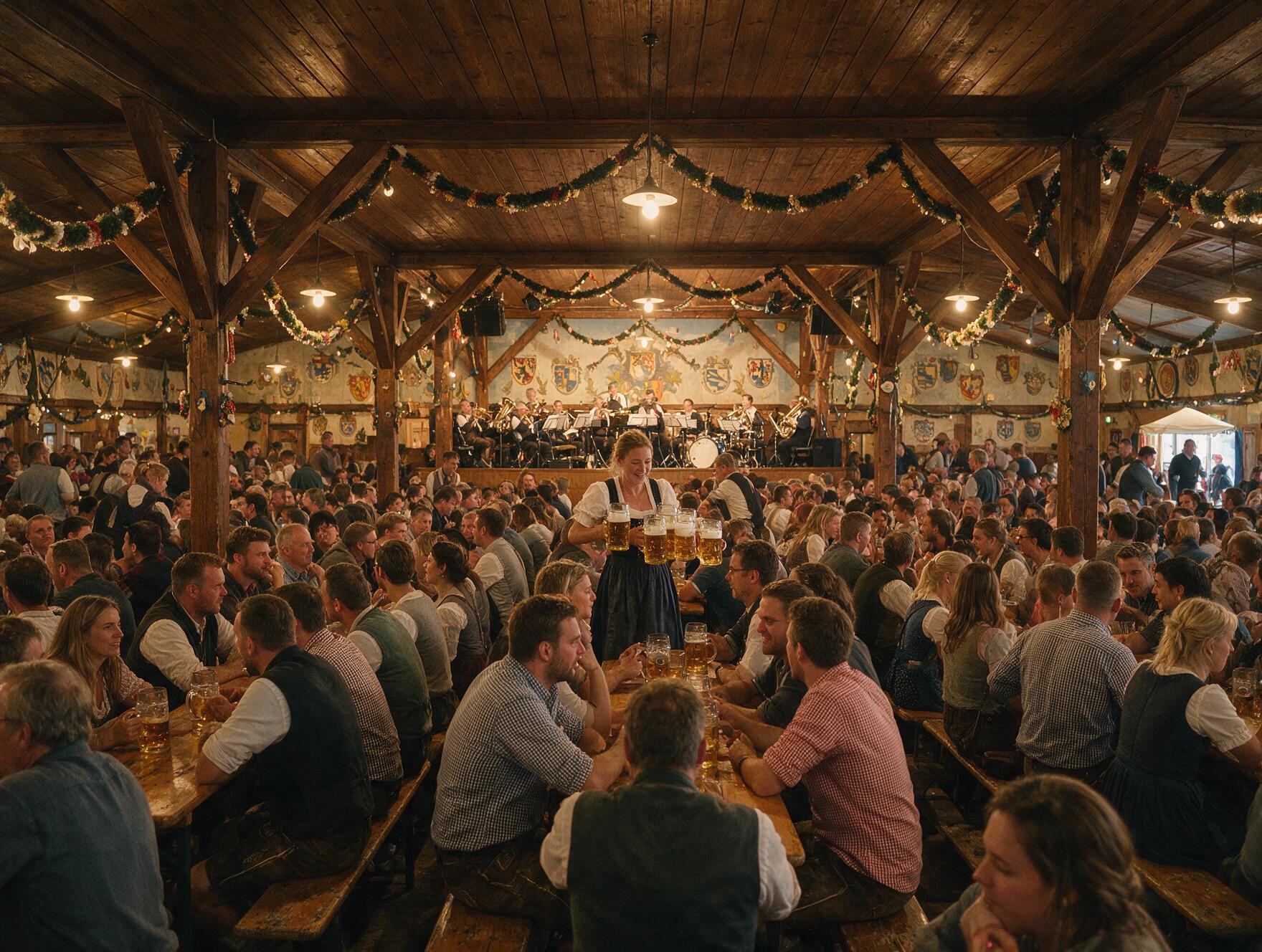
Here’s the part most first-timers get wrong: Oktoberfest has no central ticketing system. The Theresienwiese is public ground and walking onto it costs nothing. What you’re actually trying to secure is a table inside one of the fourteen large tents, each independently run by a different Munich brewery or restaurateur, each with its own reservation process — mostly in German, mostly opening in spring.
The mechanics, per the official Oktoberfest reservations page: individual tent websites open booking windows around April or May, tables are typically sold in units of eight to ten people, and while the reservation itself is free, you prepay a food-and-drink voucher — usually around €350 per table — covering a minimum consumption of roughly two Maß of beer and half a roast chicken per person. Confirmation comes by email, payment by bank transfer or card, and you collect physical tokens and wristbands closer to your date.
If you’re reading this now, in August, most weekend evening slots at the marquee tents for 2026 are already gone or going. That’s not a reason to give up on Oktoberfest — it’s a reason to use one of these three routes instead:
- The official resale portal — Oktoberfest-Booking.com lets people who booked tables they can no longer use trade them legitimately, which is a safer bet than buying from strangers on social media.
- A bundled package through Munich Tourism or a specialist operator — these combine hotel, tent reservation, guided orientation and sometimes the day-trip below into one booking, useful if you don’t have a group of eight or a German-speaking contact to chase forms.
- Walk-in seating — every tent holds a portion of its seats for people who simply turn up. Weekday lunch (roughly 10 a.m. to 3 p.m.) is genuinely your best shot; arrive when doors open and you’ll likely find shared bench seating without a reservation.
Local tip, not a top-ten-list one: ask a Munich local which tent they’d actually go to and most won’t say Hofbräu or Löwenbräu — those are the Instagram-famous ones, heavy with tour groups and stag parties. Locals gravitate to the Augustiner-Festhalle, where beer still comes from wooden kegs tapped by hand and the tent has run largely unchanged since 1928, with a loyal base of regulars who treat it like a second living room. Hacker-Festzelt and Schützenfestzelt come up often too — better brass-band music before 5 p.m. and noticeably fewer stag parties. If you only get one tent reservation, point it there.
When to Book Your Flights and Hotel
The honest answer, given today’s date, is now. Hotel rates within walking distance of the Theresienwiese routinely triple during the festival compared to a normal September week, and rooms that are €100 a night in June can hit €400–500 by the time September arrives. Flights follow the same curve — Lufthansa’s direct India–Munich routes fill steadily through August and September as festival travellers, Bavarian diaspora returning home, and regular business traffic compete for the same seats.
Smart-spending tip: if your dates are flexible by a day or two, flying and checking in midweek (Tuesday to Thursday) rather than bracketing a weekend can meaningfully cut both airfare and hotel rates, since demand concentrates hard around Fridays and Saturdays. The festival itself is calmer midweek too, so it’s a better experience, not just a cheaper one.
Getting to Munich From India: Flights and Visa
Flight Routes
Two Indian cities have nonstop Lufthansa service to Munich: Delhi (flight LH763, roughly 8h20m, daily) and Bengaluru (flight LH765, roughly 9h15m). Mumbai has no nonstop option — expect a one-stop routing via Frankfurt, Delhi, Doha or Istanbul on Lufthansa, Air India, Qatar Airways or Turkish Airlines, adding three to five hours.
Economy round-trip fares during the Oktoberfest window run meaningfully higher than shoulder-season pricing, so budget on the higher end and book early. Business class runs roughly three to four times the economy fare. Check live fares directly on Lufthansa’s Delhi–Munich route page or Bengaluru–Munich route page, since festival-season pricing moves week to week.
The Schengen Visa, Briefly
Germany requires a Schengen (Type C) short-stay visa for Indian passport holders, applied for through VFS Global. This isn’t the focus of this guide, but a few facts worth knowing: the standard adult visa fee is €90, current appointment wait times for Germany from Delhi run around two to four weeks, and Germany’s own processing after submission is among the fastest of the major Schengen consulates — typically five to ten working days once your file is in. With this year’s festival starting September 19, if you haven’t applied yet, book your VFS appointment immediately — slots release early each morning and go quickly in festival season. Standard requirements apply: valid passport, travel insurance with minimum €30,000 coverage, proof of accommodation and return flights, and financial documentation. For the latest procedural detail, check the official German Missions in India visa page.
Where to Stay in Munich for Oktoberfest
Where you sleep matters more during Oktoberfest than almost any other trip to Munich, because getting back to a hotel across town at 11 p.m. through festival-density crowds is nobody’s idea of fun.
- Theresienwiese-adjacent (Schwanthalerhöhe, Ludwigsvorstadt) — the premium choice, a five-to-fifteen-minute walk to the grounds. This is where proximity is genuinely worth paying for.
- Altstadt (Old Town) — a strong middle ground: Munich’s historic centre, walkable to the Marienplatz, Frauenkirche and good restaurants, with easy U-Bahn access to the festival.
- Luxury picks: Hotel Bayerischer Hof, a five-star Old Town institution with five restaurants and rooftop views, and Hotel Vier Jahreszeiten Kempinski on Maximilianstraße for a quieter, more classical luxury stay.
- Mid-range picks: Hotel Senator and Platzl Hotel, both walkable to the festival entrance with reliable comfort and breakfast included; Eurostars Book Hotel and Arthotel Munich, both known for soundproofed rooms — genuinely useful information during a festival where the neighbourhood doesn’t quieten down until close to midnight.
Transit tip: from Munich Airport, take the S-Bahn (S1 or S8) directly to Munich Hauptbahnhof — about 40 minutes, roughly €13–17.50 a ticket, and more reliable than a taxi during festival traffic, which can run €60–95 and take longer. Once in the city, skip taxis to the grounds entirely: Theresienwiese sits directly on the U4/U5 lines, and surrounding streets close to cars during peak evening hours anyway. Budget extra time at the U-Bahn exits near the grounds — crowd control during peak hours (roughly 6–9 p.m.) can turn a two-minute walk into twenty.
What a Day at Oktoberfest Actually Looks Like
Entry to the Theresienwiese grounds is free — you only pay for what you eat, drink and ride. The 2026 opening hours, per the official schedule, are 10 a.m.–11:30 p.m. Monday–Thursday, 10 a.m.–midnight Friday, 9 a.m.–midnight Saturday, and 9 a.m.–11:30 p.m. Sunday. Inside the large tents, beer and live music stop at 10:30 p.m. most nights (smaller food tents run to 11 p.m.), except Käfer Wiesn-Schänke and Kufflers Weinzelt, which stay open until 1 a.m. and lean more upscale — wine and champagne territory rather than beer-hall roar.
Food and Beer
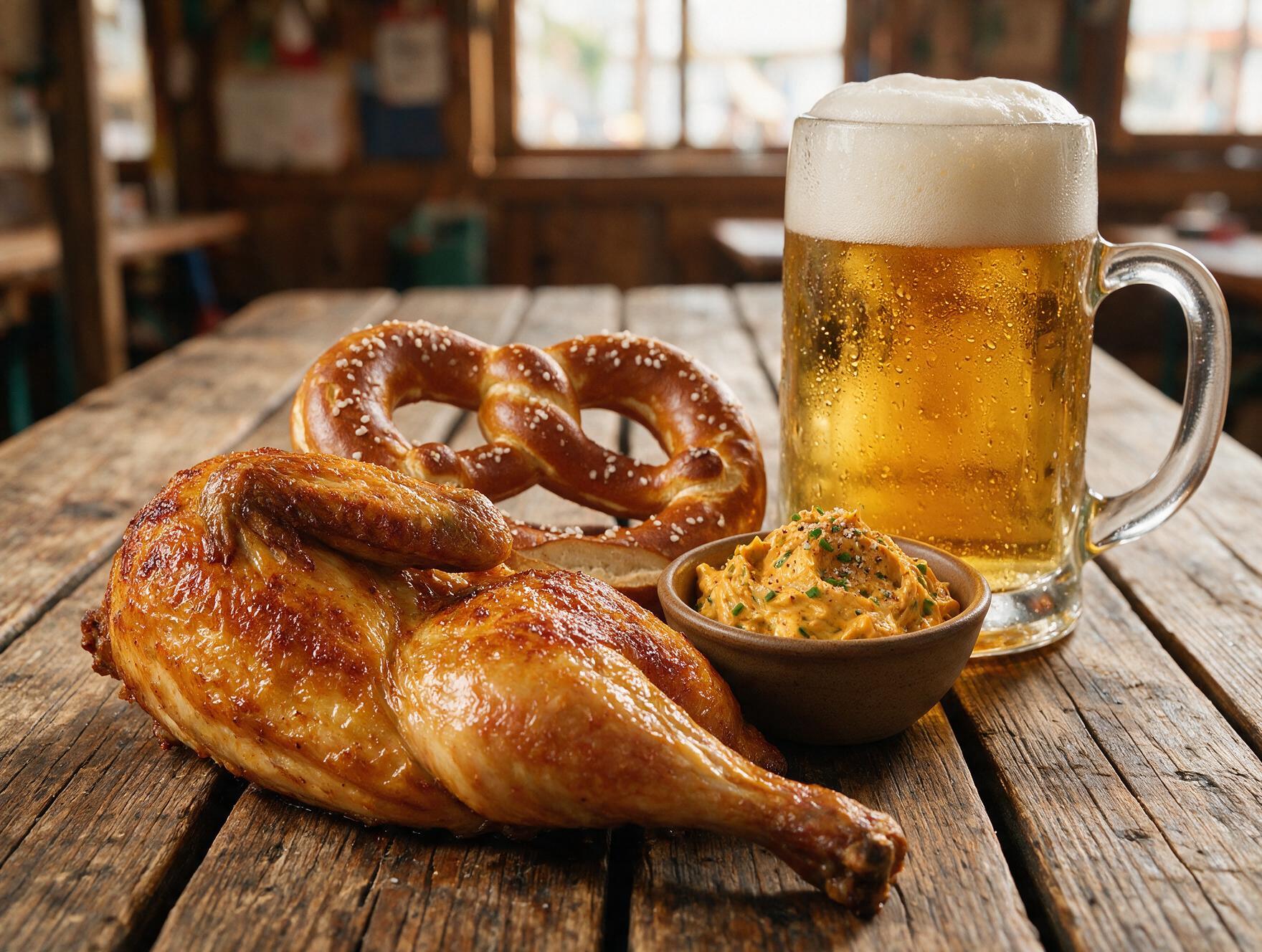
Only beer brewed within Munich’s city limits — by Augustiner, Hacker-Pschorr, Hofbräu, Löwenbräu, Paulaner and Spaten — is allowed at Oktoberfest, part of why it still feels rooted in the city rather than generic. Official 2026 prices for a Maß (one litre) range from €14.80 to €15.90 depending on the tent, per Oktoberfest.de’s beer price page — Augustiner-Festhalle sits at the cheaper end. Food-wise, expect roast chicken (Hendl), pork knuckle (Schweinshaxe), dinner-plate-sized pretzels, obatzda (a spiced cheese-butter spread, better than it sounds), and Steckerlfisch — whole fish grilled on a stick, a good lighter option than roast pork at 1 p.m.
Dirndl, Lederhosen and Dress Norms
Wearing a dirndl or lederhosen as a visitor isn’t cultural appropriation here — it’s the norm, and locals generally appreciate the effort. Rental shops near the Theresienwiese offer decent quality for roughly €40–80 a day, while buying one that will actually last runs €150–400 depending on fabric and tailoring. Outside the tents, casual clothing is completely fine; nobody enforces a dress code. Inside, though, standing on the wooden benches (never the tables) to toast is normal, expected, and part of the fun — just don’t do it in heels.
For families: the two Family Days (September 22 and 29) bring down fairground ride prices, and the festival’s own family guidance points visitors toward earlier hours — before roughly 6 p.m., the mood in most tents is closer to a big beer garden than a nightclub, which is the easier window for children. The Oide Wiesn, the historical section with vintage carousels and calmer, folk-focused entertainment, is worth the small separate entry fee if you’re travelling with kids.
For couples: Käfer Wiesn-Schänke feels less like a beer hall and more like an upscale restaurant that happens to be inside a tent — a better fit if you want a proper sit-down dinner over the shoulder-to-shoulder bench experience.
For solo travellers: the communal long-table seating means you will end up talking to strangers whether you planned to or not — it’s one of the easiest festivals in Europe to attend alone and not feel it. Weekday lunch is your easiest window to walk in solo without a reservation.
What Oktoberfest 2026 Actually Costs
Real numbers, not “cheap” framing — Oktoberfest is not a budget event even by Munich’s own standards, and a premium trip should be planned with that in mind.
- Beer: €14.80–€15.90 per Maß (litre), officially capped for reasonableness but set by each tent individually.
- Tent table minimum spend: around €350 for a table of eight to ten, covering the required food-and-drink vouchers.
- Meals outside the tents: a solid mid-range dinner in Munich runs roughly €25–45 per person; a proper fine-dining evening, €80 and up.
- Hotels during the festival: mid-range properties typically run €250–450 a night; five-star stays €600–1,200+ a night, both well above off-season rates.
- Flights: plan for peak-season economy pricing rather than off-season fares, and book as early as possible given how close the dates already are.
Put together, a comfortable five-to-six-day Munich and Oktoberfest trip for one person — mid-range flights, a good hotel, one tent reservation, a day trip and proper meals — lands somewhere in the ₹1.8–2.5 lakh range, climbing past ₹3.5–5 lakh for a luxury version with five-star stays, private guiding and premium tent seating. Treat these as planning ranges, not quotes.
The Smart Day Trip: Neuschwanstein and the Bavarian Countryside

Munich is a good base for exactly the kind of day trip a premium traveller wants: Neuschwanstein Castle, the fairy-tale royal residence that inspired more than a few theme-park castles, paired with Linderhof Palace and the alpine town of Oberammergau. A full-day guided trip departs Munich around 8:30 a.m., runs roughly ten and a half hours, and starts from about €76 per person, with castle entry (around €42) usually paid separately — details via Munich Tourism’s official day trip page. For couples or families who’d rather skip the group-tour pace, a private car and driver for the day is a comfortable alternative.
Schedule it right: this is a full-day commitment, so don’t stack it on the same day as your one big tent reservation — pick a weekday when you’re not planning to be at Oktoberfest that evening, and treat it as a deliberate contrast to the beer-tent noise.
Photography tip: if Neuschwanstein is on your list, get to the Marienbrücke bridge behind the castle as early in the visit window as you can — the classic postcard shot gets crowded with tour groups from around 11 a.m. onward. At Oktoberfest itself, the best shot of the grounds is from near the Bavaria statue at dusk, roughly fifteen to twenty minutes after the tent lights come on but before the evening crowds peak — you get the illuminated tents and Ferris wheel without fighting for space.
Safety and Practical Tips
Oktoberfest is a heavily managed event with visible security, medical tents and a functioning lost-and-found system, and Munich is a genuinely safe city by any standard. The real risks are mundane: pickpocketing in dense crowds and on packed S-Bahn platforms, and the ordinary hazards of a lot of beer moving through a lot of people. Keep valuables in a crossbody bag or front pocket, eat before you start drinking, and pace yourself — a Maß is a full litre, not a pint, and it sneaks up on people unused to the volume.
Munich in September runs mild by Indian standards — daytime highs around 19°C, dropping to roughly 9°C at night, with about twelve rainy days across the month and around six hours of sunshine on an average day. Pack layers and a light rainproof jacket rather than assuming warm days will hold through the evening; the grounds and some tent areas are semi-open, and a cold, damp evening feels very different from a warm afternoon.
Currency is the euro. Cards, including contactless, are widely accepted at hotels, restaurants and most tent counters, but carry roughly €50–100 in cash for smaller food stalls, rides and Oide Wiesn vendors, some of which still don’t take cards. eSIMs from providers like Airalo or Holafly activate easily before you land, and Munich has strong 5G throughout the city and festival grounds — one less thing to think about than hunting for a SIM counter at the airport. The EU-wide emergency number is 112.
Mistakes to Avoid
- Waiting until September for a tent reservation. By the time most Indian travellers start searching, weekend slots at the well-known tents are gone. Move now, or use the walk-in and package routes above.
- Assuming the festival costs money to enter. The grounds are free. Tables, food and beer are what add up — don’t overbudget for “tickets” that don’t exist.
- Booking a hotel far from the centre without checking last transit connections. Queues at the Theresienwiese U-Bahn stations can run 30–45 minutes on a busy night after tent closing time.
- Wearing new leather shoes or heels. Between cobblestones, straw and spilled beer, comfortable closed shoes matter more than the outfit.
- Stacking your tent reservation and Neuschwanstein day trip on the same day. They’re both full commitments — space them out.
- Leaving the Schengen visa appointment for “next week.” With wait times of two to four weeks in Delhi and the festival under five weeks away, this is the one item here with an actual deadline.
FAQs
When is Oktoberfest 2026?
Oktoberfest 2026 runs from September 19 to October 4, 2026, on the Theresienwiese grounds in Munich — the 191st edition of the festival.
Is Oktoberfest free to enter?
Yes. General entry to the Theresienwiese grounds is free. You only pay for tent tables (via a food-and-drink voucher), beer, food and fairground rides once inside.
Do I need a reservation to attend Oktoberfest?
No, but you do need one if you want guaranteed seating at a specific big tent, especially on evenings and weekends. Walk-in seating is available at all tents, particularly on weekday lunchtimes, on a first-come basis.
How much does a beer cost at Oktoberfest 2026?
Officially, a Maß (one litre) costs between €14.80 and €15.90 depending on the tent, roughly 2–3% higher than 2025 prices.
Do Indian citizens need a visa for Oktoberfest in Germany?
Yes. Indian passport holders need a Schengen (Type C) visa to visit Germany, applied for through VFS Global. The fee is €90 for adults, and current appointment wait times from Delhi run around two to four weeks, so apply as early as possible.
What is the best time to visit Oktoberfest to avoid the biggest crowds?
Weekday afternoons, particularly the first week of the festival before the two weekends hit peak attendance, are noticeably calmer than Friday and Saturday evenings.
Can tourists wear a dirndl or lederhosen at Oktoberfest?
Yes, and it’s the norm rather than an exception — most visitors, local and international, dress up. Rental shops near the festival grounds offer good-quality options for the day.
How many days should I plan for a Munich Oktoberfest trip from India?
Five to six days works well: this allows one to two days at the festival itself, a day trip to Neuschwanstein or the Bavarian countryside, and enough buffer for the long flight and jet lag on both ends.
Book It Before the Tents Do
Oktoberfest 2026 has a start date, an end date, and a shrinking window of good tables, good flights and good hotel rooms in between. None of that changes because you’re not ready yet — it just means the version of the trip you get depends on how soon you move. Get the reservation, the flight and the room sorted now, and September 19 becomes a date you’re counting down to rather than one you missed.
At Get Tripped, we’ve helped Indian travellers put together exactly this kind of trip before — the tent table that isn’t a guess, the hotel that’s actually walkable, the visa timeline that doesn’t cause last-minute panic, and a day trip to Neuschwanstein that doesn’t eat into your one evening at Augustiner. If you’d like help turning “I want to go to Oktoberfest” into an actual itinerary, reach out to our team and we’ll build it around your dates, your group size and how you want to experience it — comfortable, well-planned, and genuinely fun rather than a scramble.