By 7:40pm, the queue outside Bar Las Golondrinas already spills onto the cobblestones of Calle Antillano Campos, and nobody in it looks like they’re in a hurry. Inside, someone is being handed a plate of punta de solomillo before they’ve even found a spot to lean their elbow against the bar. This is Triana on a weeknight — no line-up sheet, no host, just a shared understanding that you order, you eat standing up, and you make room for the next person the second you’re done. A day in Seville builds toward moments exactly like this one, and it starts about twelve hours earlier, at a gate that opens at 9:30 sharp on the other side of the river.
Seville doesn’t reward a checklist. It rewards a day that moves at the city’s own pace — palace in the cool of the morning, shade and stillness through the brutal middle hours, then bar to bar to bar as the light goes gold and the temperature finally lets go. This is that day, hour by hour, with the real prices, the real booking windows, and the mistakes worth skipping.
What’s in This Guide
- When to actually have this day
- Morning: the Real Alcázar before the heat lands
- Getting lost in Barrio Santa Cruz
- Midday: where Seville hides from the sun
- Evening: a tapas crawl through four bars
- Night: flamenco that isn’t staged for tour buses
- Getting to Seville from India: flights and visa
- Where to stay, if you’re building a full trip
- Money, SIM cards and what to wear
- FAQs
When to Actually Have This Day
Seville in July and August is not a mild inconvenience — it’s a different city, one where the streets empty out by 11am and shopkeepers pull down their shutters until evening. Daytime highs regularly clear 36°C, and the Real Alcázar’s gardens turn into a greenhouse by noon. You can still do this day in summer, but you’ll be doing it in survival mode, not enjoyment mode.
The window that actually works is mid-March through early May, and again from mid-September into October. Expect daytime temperatures in the low-to-mid 20s°C, cool enough mornings for the Alcázar to feel comfortable, and evenings warm enough that nobody’s rushing indoors. One caveat: late April brings Feria de Abril, a week-long festival of flamenco dresses, sherry and horse-drawn carriages that’s genuinely spectacular but also triples hotel prices and turns the whole city into one long party — wonderful if that’s what you’re after, chaotic if you wanted a quiet day of sightseeing. A Tuesday in early October, outside any festival week, is close to ideal: warm without punishing, and the summer crowds have thinned.
Whatever week you pick, build the day around the heat rather than against it. Mornings for anything that involves walking in direct sun, a long indoor or shaded break in the middle, evenings and nights for the tapas crawl and flamenco. Fighting that rhythm is the single most common way visitors end up cutting the day short.
Morning: the Real Alcázar Before the Heat Lands
Get to the Puerta del León gate by 9:15am. The palace opens at 9:30, and the first thirty minutes inside are genuinely different from the rest of the day — the Patio de las Doncellas is nearly empty, the light through the Mudéjar archways is still soft, and you can actually hear the fountains instead of a hundred overlapping tour guides.
Standard entry runs €15.50 at the door or €16.50 booked online (the extra euro is a booking fee, not a markup for convenience — it’s the same ticket). Book through the official site at alcazarsevilla.org rather than a reseller; you’ll pick your own entry slot and skip the door queue entirely, which by mid-morning in spring can run past an hour. If you want to see the royal family’s private upper apartments — the Cuarto Real Alto, still used for state visits — add that on for €5.50, but book it at the same time as your main ticket. It sells out on its own, separately from general admission, and isn’t available as a walk-up add-on.
How far ahead to book depends on the season: a week or two is usually fine in autumn and winter, but April and May regularly need four to six weeks of lead time, and Feria week can sell out three months out. If you’re set on a specific date, don’t leave this one to the last minute.
Give yourself two and a half to three hours — the palace interior alone is dense with detail (the ceramic tilework in the Salón de Embajadores is worth stopping for longer than feels reasonable), and the gardens behind it are large enough to genuinely lose an hour in, especially the Jardín de las Damas and the shaded Galería de Grutesco. One honest note: by 11am, tour groups start arriving in real numbers and the main courtyards get loud. If quiet matters more to you than flexibility, the 9:30 slot is worth protecting.
Fun fact worth knowing before you go
The Alcázar isn’t a Moorish ruin dressed up for tourists — it’s a working royal palace, and the Spanish royal family still stays there on visits to Seville. The Mudéjar style you’re looking at (Islamic decorative techniques used by Christian kings after the Reconquista) makes it architecturally distinct from the Alhambra in Granada, even though the two get compared constantly. It’s also been a filming location for Game of Thrones’ Dorne scenes, which is either a selling point or an eye-roll depending on who you’re traveling with.
Getting Lost in Barrio Santa Cruz
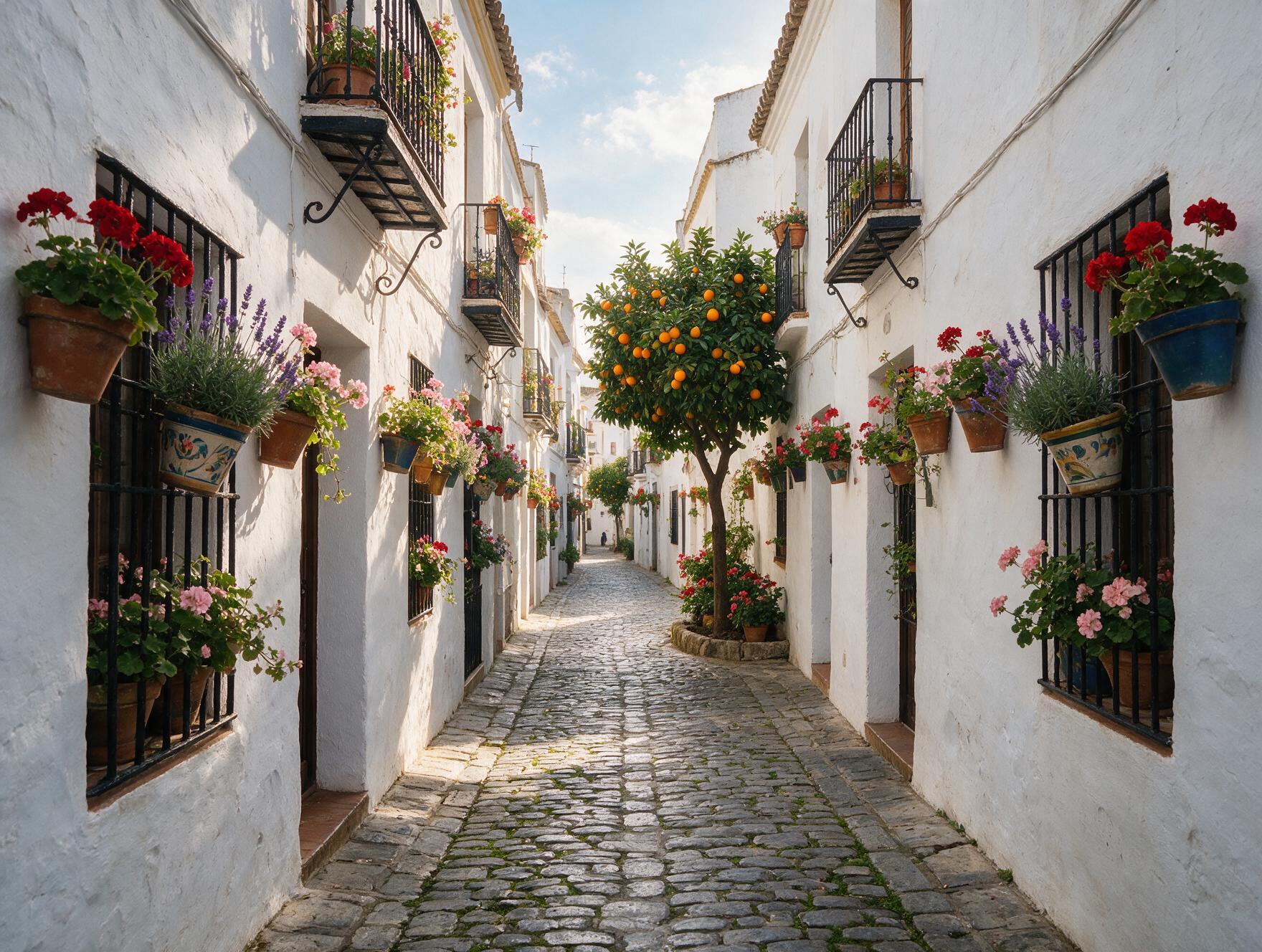
Walk out of the Alcázar’s Patio de Banderas exit rather than back the way you came, and you’re immediately in Barrio Santa Cruz — Seville’s old Jewish quarter, occupied by a thriving Sephardic community until the expulsions and forced conversions of 1391 and 1492 emptied it out. The street layout hasn’t changed much since: alleys narrow enough that balconies from opposite sides nearly touch, whitewashed walls to bounce light rather than absorb heat, and dead ends that exist specifically because they made the quarter easier to defend.
Don’t try to navigate it with a map. Let Calle Judería, Calle Susona and the tiny Plaza de Doña Elvira pull you along instead — this is a fifteen-minute walk that easily becomes forty-five once you start looking at doorways instead of a phone screen. Calle Susona is named after a Jewish woman whose tragic story — she reportedly betrayed her own father’s plot against the Christian authorities out of love for a Christian nobleman, then spent her life in guilt-ridden penance — is marked with a ceramic tile skull at the spot where her house once stood, a small, slightly eerie detail almost nobody stops for.
By late morning it’s already getting hot, which is your cue to start thinking about shade rather than one more monument.
Midday: Where Seville Actually Hides From the Sun
This is the part of the day most itineraries skip, and it’s the part that makes the rest of it work. Sevillanos don’t fight the midday heat — they disappear from it, and a smart visitor does the same. Between roughly 2pm and 5pm, aim for one of two things: a long, unhurried lunch in a shaded patio, or genuine downtime back at your hotel.
If you want to stay out, head toward the Metropol Parasol — locally called Las Setas (“the mushrooms”) for its honeycomb wooden canopy in Plaza de la Encarnación. The rooftop walkway costs a modest €3-5 and gives you shade, a breeze, and a rooftop view over the old town that most visitors save for evening but that works just as well at 3pm when the crowds are thin and you’re mostly there to cool off and get your bearings. If you’d rather sit down properly, the surrounding streets around Alameda de Hércules have plenty of shaded terraces where a two-hour lunch with a bottle of chilled fino sherry is entirely normal, not indulgent.
One mistake to actively avoid: scheduling anything strenuous — a walking tour, the Cathedral and Giralda climb, another museum — in this window. You’ll be doing it at 34-36°C in July/August or a still-uncomfortable high-20s even in shoulder season, competing with every other visitor who didn’t plan around the heat, and you’ll be tired for the part of the day that actually matters: the evening.
Evening: A Tapas Crawl Through Four Bars
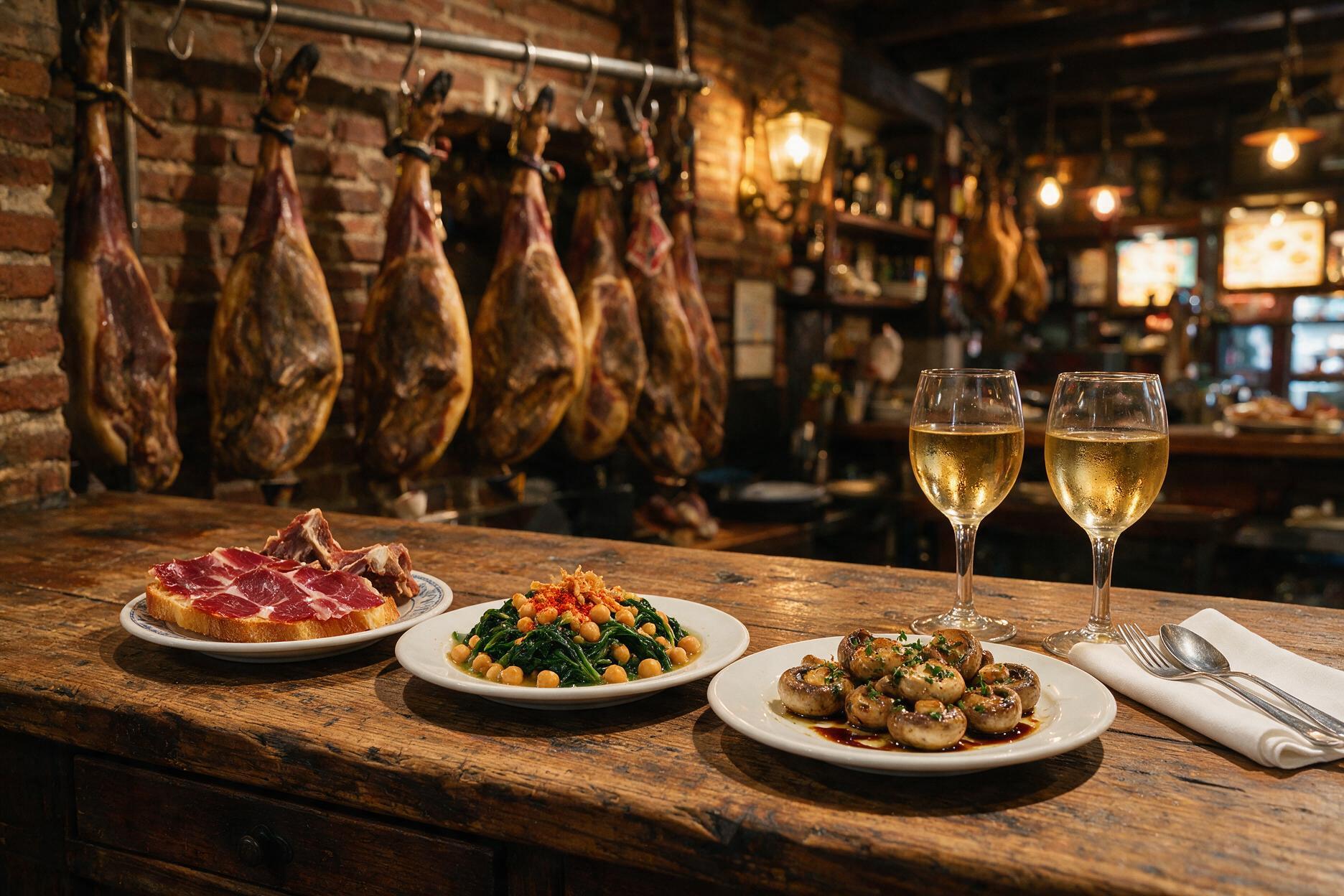
Tapas in Seville isn’t a tasting menu — it’s a verb. You go to one bar, you order two things, you eat standing at the counter or on the pavement outside, and you move on before you’ve fully settled in. Trying to do it all in one sitting at one restaurant misses the entire point.
Start around 7pm in Barrio Santa Cruz at Las Teresas on Calle Santa Teresa, a bar that’s been pouring sherry and carving jamón since 1870 — the legs still hang from the ceiling behind the bar. Order the hand-carved jamón ibérico and the espinacas con garbanzos (spinach with chickpeas, a genuinely Sevillano dish that almost never shows up on a “top 10 tapas” list dominated by patatas bravas). Expect €3-7 a plate.
From there, walk ten minutes to Bodega Santa Cruz (also known locally as Las Columnas) — loud, standing-room-only, full of university students, and exactly the atmosphere you want for round two. This isn’t the place for a refined bite; it’s the place to feel the city’s actual pulse. Order montaditos (small filled rolls) and a caña of cold beer, and don’t expect table service.
Cross the river into Triana next — a fifteen-minute walk or a short taxi over the Puente de Isabel II — for Bar Las Golondrinas, a tiny, unmarked-looking place locals actually go to, on Calle Antillano Campos. Sit downstairs at the bar rather than upstairs; the upstairs dining room is fine but noticeably more tourist-facing, while downstairs is where the punta de solomillo (grilled pork tenderloin medallions on bread) and champiñones a la plancha (garlic mushrooms in a bright green alioli) come out fastest and cheapest — around €2.50-5 a plate.
Finish, if you’ve still got room, at Bodeguita Romero near El Arenal, family-run since 1939, for what regulars will tell you is the best montadito de pringá in the city — a sandwich built from slow-cooked pork, chorizo and morcilla, around €3.50. If it’s full (it often is), Casa Morales two streets over has been pouring wine from towering clay tinajas since 1850 and makes a fine backup, or a fifth stop if you’re not done yet.
One tourist-trap warning: avoid anywhere within a hundred metres of the Cathedral with a laminated, five-language menu and a photo of every dish. It’s not that the food there is inedible — it’s that you’re paying tourist prices for food a third as interesting as what’s two streets over. The good bars have chalkboard menus in Spanish only and don’t need photos to sell the jamón.
Night: Flamenco That Isn’t Staged for Tour Buses
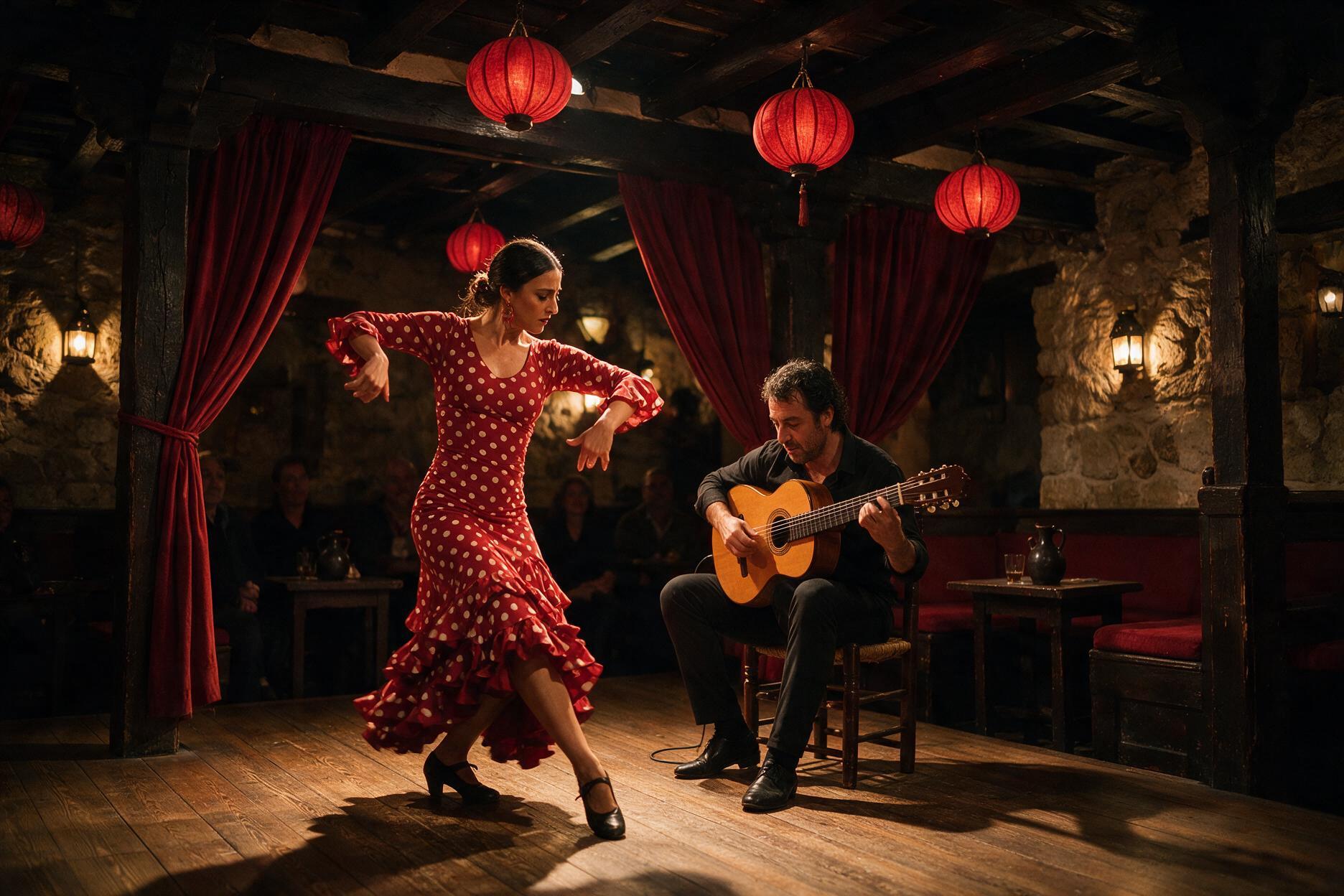
By 9:30 or 10pm, head to flamenco — and it’s worth knowing upfront that not all “flamenco shows” in Seville are equal. A lot of what’s sold to tourists near the Cathedral is polished and pleasant but disconnected from where the art form actually lives.
Casa de la Memoria, on Calle Cuna, is a genuine cultural centre rather than a dinner-show venue — small, intimate, and focused on flamenco as a serious art form rather than a spectacle, with professional dancers, singers and guitarists performing close enough that you can hear the dancer’s breathing between phrases. Shows run nightly and tickets should be booked a day or two ahead through their site, since the room is deliberately kept small.
If you want something rawer and free, walk to La Carbonería on Calle Levíes instead — a bar with no sign outside (you genuinely need to know it’s there), named for its past life as a coal yard (“carbón” is Spanish for coal). It’s one of the few places left in Seville where flamenco still happens the way it did before it became a tourist product: unscheduled, unpolished at the edges, sometimes just a guitarist and a singer who showed up and started. There’s no cover charge — you’re expected to buy drinks instead, which is a fair trade for what you’re getting.
Honest caveat: La Carbonería’s spontaneity cuts both ways. Some nights it’s transcendent; other nights it’s a quiet bar with recorded music and no flamenco at all. Casa de la Memoria guarantees a show at a fixed time; La Carbonería guarantees an experience, not a schedule. If you only have one night in Seville and flamenco is non-negotiable, book Casa de la Memoria. If you have two nights, do both.
Getting to Seville From India: Flights and Visa
There’s no direct flight from Delhi, Mumbai or Bengaluru to Seville, and there isn’t likely to be one soon — Seville’s airport is a regional one, not a long-haul hub. The realistic routing is one or two stops through a major European or Gulf hub — Madrid, Frankfurt, Amsterdam, Istanbul or Doha are the common connections — with total journey time typically running 12-17 hours depending on layover length. Round-trip economy fares from India generally land somewhere in the ₹55,000-95,000 range depending on season and how far ahead you book, with shoulder-season and off-peak fares at the lower end.
A routing worth considering: fly into Madrid, then take the AVE high-speed train to Seville rather than a connecting flight. It’s a comfortable 2.5-hour ride through the Spanish countryside, runs frequently, and is genuinely one of the more pleasant parts of the journey — a much better use of a layover than another cramped short-haul flight.
Indian passport holders need a Schengen Type-C tourist visa to enter Spain. The visa fee itself is €90, plus a BLS International service charge (Spain’s visa applications from India are processed through BLS centres in 11 Indian cities), bringing the realistic total closer to ₹11,000-12,000 per applicant. Standard processing is 15-30 calendar days, though it can stretch to 45 in complex cases, so apply at least 6-8 weeks ahead of travel — and 8-12 weeks if you’re traveling in the April-September peak window. You’ll need proof of funds (Spain’s requirement, at roughly €122/day, runs higher than several other Schengen countries), travel insurance with a minimum €30,000 medical coverage, and a clear day-by-day itinerary. Spain’s approval rate for Indian applicants sits around 84%, among the more accessible Schengen destinations — but “accessible” still means a genuine paperwork process, not a formality to leave until the week before you fly.
This is exactly the kind of planning Get Tripped’s Spain trip packages are built to handle end-to-end, from visa documentation to the Madrid-Seville routing, so you’re not piecing together five different booking sites at 1am.
Where to Stay, If You’re Building a Full Trip Around This Day
If Seville is a stop on a longer Spain itinerary rather than a single day, staying inside or right beside Barrio Santa Cruz puts the Alcázar, Cathedral and evening tapas crawl all within walking distance. Hotel Alfonso XIII — a genuine Seville institution built in 1928, all carved wood ceilings and tiled courtyards, now run under the Anantara luxury banner — is the obvious splurge and worth it for at least one night if a proper hotel experience matters to your trip. For couples wanting boutique charm without the flagship price tag, several restored 18th and 19th-century townhouses in Santa Cruz and the neighbouring Casco Antiguo have been converted into mid-range boutique hotels, with roof terraces looking straight at the Giralda.
Solo travelers and anyone who wants a more local, less tourist-dense base should look at Triana, across the river — a five-to-ten-minute taxi from the old town but a genuinely different neighbourhood feel, with its own tapas scene and ceramic workshops that predate the tourist trade by centuries. It’s also simply cheaper for a comparable level of comfort, without sacrificing the mid-range-to-upscale standard Get Tripped travelers expect.
Money, SIM Cards and What to Wear
Spain uses the euro, and cards are accepted almost everywhere, including most small tapas bars — but carry some cash regardless, since a handful of the more old-school spots (Las Golondrinas among them, on busy nights) still run faster on cash for small orders. Contactless is genuinely universal for anything over a few euros.
For connectivity, an eSIM bought before you land (Holafly, Airalo and similar providers all cover Spain) is the simplest option and avoids hunting for a physical SIM on arrival. If you’d rather buy locally, Movistar, Vodafone and Orange all sell tourist SIMs at the airport and at Corte Inglés department stores in the city centre.
For the walk itself: comfortable closed shoes over sandals, since Santa Cruz’s cobblestones are uneven and the Alcázar’s gardens involve a fair bit of gravel path. A hat and a refillable water bottle matter more than sunscreen alone — Seville’s public fountains are drinkable and plentiful, so refilling isn’t a problem. Light, breathable fabric over anything synthetic; even in shoulder season, you’ll be walking in direct sun for a solid two to three hours before lunch.
FAQs
Is one day enough to see Seville?
One day is enough for this specific experience — the Alcázar, Santa Cruz, a proper tapas crawl and flamenco — and it’s a genuinely full, satisfying day. It’s not enough to also fit in the Cathedral climb, Plaza de España and a day trip, which is why most travelers extend Seville into two or three days if it’s not just a stopover on a longer Spain trip.
Do I need to book Real Alcázar tickets in advance?
Yes, strongly recommended, and required if you want the 9:30am opening slot or the Cuarto Real Alto royal apartments add-on. Door tickets exist but queues can run past an hour in spring, and the royal apartments aren’t sold at the door at all.
How hot does Seville actually get in summer?
Daytime highs regularly pass 36°C in July and August, sometimes higher. It’s one of the hottest major cities in mainland Europe. If you’re not committed to a summer date for other reasons, shoulder season (March-May or September-October) is a far more comfortable window for a full walking day.
Is flamenco in Seville touristy or authentic?
Both exist side by side. Large dinner-and-show venues near the main tourist sites lean polished and tourist-oriented. Smaller cultural venues like Casa de la Memoria and unstructured bars like La Carbonería sit much closer to flamenco’s actual roots — book the former for a guaranteed show, and treat the latter as a bonus, not a sure thing.
What’s the best way to get from Barrio Santa Cruz to Triana for the tapas crawl?
It’s a flat, scenic fifteen-minute walk across the Puente de Isabel II bridge, or a five-minute taxi if you’d rather save your legs for the bar-hopping ahead.
Do I need a visa to visit Spain from India?
Yes — a Schengen Type-C tourist visa, applied for through BLS International centres in India. Budget €90 plus service charges, apply 6-8 weeks ahead (longer in peak season), and make sure your travel insurance meets the €30,000 minimum coverage requirement.
Can I do this day as a couple, solo, or is it better in a group?
It genuinely works for all three, with small adjustments. Couples tend to linger longer over the midday lunch break and the Las Teresas sherry list; solo travelers often find the bar-hopping format easier to strike up conversation than a sit-down restaurant would allow. Groups of four or more should call ahead at Las Golondrinas and Bodeguita Romero, since both are genuinely tiny.
What should I do if I only have a few hours, not a full day?
Prioritize the Real Alcázar in the morning and one proper tapas stop in the evening over trying to compress the whole day — Seville rewards depth over a rushed checklist, and a half-hearted version of all five stops is worse than doing two of them properly.
One Day, Worth Building a Trip Around
What makes a day in Seville work isn’t any single stop — it’s the shape of the day itself: quiet monument in the cool morning air, real shelter from a heat that doesn’t negotiate, then a slow unwinding through bars and finally music that Seville has been making for itself long before anyone thought to sell tickets to it. Get the order right and the city does most of the work for you.
If this is the kind of day you want waiting for you in Spain, Get Tripped’s Spain trip packages can handle the parts that eat up planning time — visa documentation, the Madrid-Seville routing, boutique stays in Barrio Santa Cruz or Triana, and a flamenco booking that doesn’t leave you standing outside a sold-out door. Get in touch and we’ll build the rest of the trip around this one day, not the other way around.