The first thing that throws you off about Yerevan is the color. Every travel photo of the Caucasus prepares you for grey Soviet concrete, and instead you land in a city built almost entirely from tuff — a volcanic stone that runs rose, honey, and dusty apricot depending on the hour and the quarry it came from. Locals call it the Pink City. By 6pm, when the low sun hits Republic Square, you understand why.
Yerevan doesn’t get much airtime in Indian travel conversations yet. It sits quietly behind Georgia, behind Central Asia, behind the usual Europe shortlist. That’s changing, and it should — this is a walkable, coffee-obsessed, wine-and-brandy capital older than Rome, sitting in the shadow of a mountain that isn’t even inside its own borders anymore. Here’s what one full day actually looks like, hour by hour, with the practical details folded in rather than bolted on at the end.
Quick Overview
- Morning: Coffee and the Republic Square “stone carpet,” then the walk up Northern Avenue
- Midday: Vernissage open-air market for carpets, silver, and backgammon boards
- Afternoon: The Cascade Complex — 572 steps or an escalator, plus an open-air sculpture garden
- Late afternoon: A proper brandy tasting at the Ararat/Yerevan Brandy Company museum
- Evening: A slow khorovats (Armenian barbecue) dinner with local wine
- Night: Republic Square’s musical fountains, then one last coffee
- If you have extra time: A half-day out to Garni Temple and Geghard Monastery
- Also covered: Visa rules for Indian passport holders, flight routing, where to stay, money and SIM cards, and safety notes
Morning: Coffee, the Stone Carpet, and a City Waking Up
Yerevan wakes up slowly and drinks its coffee seriously. Armenian coffee is closer to Turkish or Greek coffee than to an espresso — thick, unfiltered, brewed in a small copper pot called a jazzve, served with the grounds settled at the bottom and, if you ask nicely, someone will read your fortune in the pattern they leave behind. It is not a gimmick performed for tourists. Older Yerevantsis genuinely do this for each other.
Start on or near Northern Avenue, the pedestrian boulevard that connects Republic Square to the Opera House. It is lined with cafés that spill tables onto the pavement from around 8am, and it is the easiest place in the city to get your bearings. From there, walk five minutes to Republic Square itself.
Republic Square was designed by architect Alexander Tamanyan as the centerpiece of his 1920s master plan for Yerevan, and the ensemble of five buildings around it — the History Museum, the National Gallery, Government House, the old Post Office, and the Marriott hotel — is still built entirely from that pink and yellow tuff. The southern half of the square is paved in a pattern that, from above, deliberately mimics a traditional Armenian rug. At street level you will mostly miss it. If your hotel room or a rooftop café nearby has any height to it, look down before you leave the area — it is worth the two minutes.
Come back here in the evening. The musical fountains only run from late March through early November, with evening shows typically starting around 9pm, and daytime Republic Square is a fraction as interesting as Republic Square after dark.
Getting to Yerevan and the current visa situation for Indian passport holders
This is worth getting right before you book anything, because the rules changed in early 2026 and a lot of older blog posts are now out of date.
The standard route for Indian citizens is Armenia’s e-visa, applied for online through the official e-Visa portal — no invitation letter needed. There are two common options: a 21-day visitor e-visa (roughly $8) and a 120-day visitor e-visa (roughly $39), with processing usually taking up to three business days. Children under 18 travel free.
There is also a temporary exemption running through 1 July 2026 letting Indian citizens who hold a valid residence permit from certain other countries (the Gulf, the US, the EU/Schengen area) enter visa-free for up to 180 days. That applies to residence-permit holders specifically, not to Indian passport holders by default — if you’re flying in from India on an Indian passport, plan on the e-visa, and confirm your exact scenario on the official portal before you book, since this kind of temporary rule tends to shift without much notice.
On flights: there is no direct India–Yerevan route yet. The realistic options are one-stop connections through Gulf hubs — Qatar Airways via Doha, flydubai via Dubai, or Air Arabia via Sharjah — from Delhi, Mumbai, and Bengaluru, with total journey times of roughly 8–11 hours including the layover. Fares move a lot with season and booking window; budget roughly ₹30,000–₹55,000 return in economy, and check Qatar Airways’ Yerevan route page directly rather than an aggregator screenshot, since fares shift daily.
Best time to visit
Late April to early June and September to mid-October are the sweet spots — warm days, cool evenings, fountains and outdoor cafés running in full swing. July and August push into the mid-to-high 30s°C and the city feels airless by afternoon; winters run genuinely cold at altitude, though a clear freezing morning is also when Ararat looks sharpest against the sky. If your day falls in summer, front-load the walking into the morning and save the brandy tasting and Cascade climb for after 5pm.
Midday: Getting Lost, On Purpose, at Vernissage Market
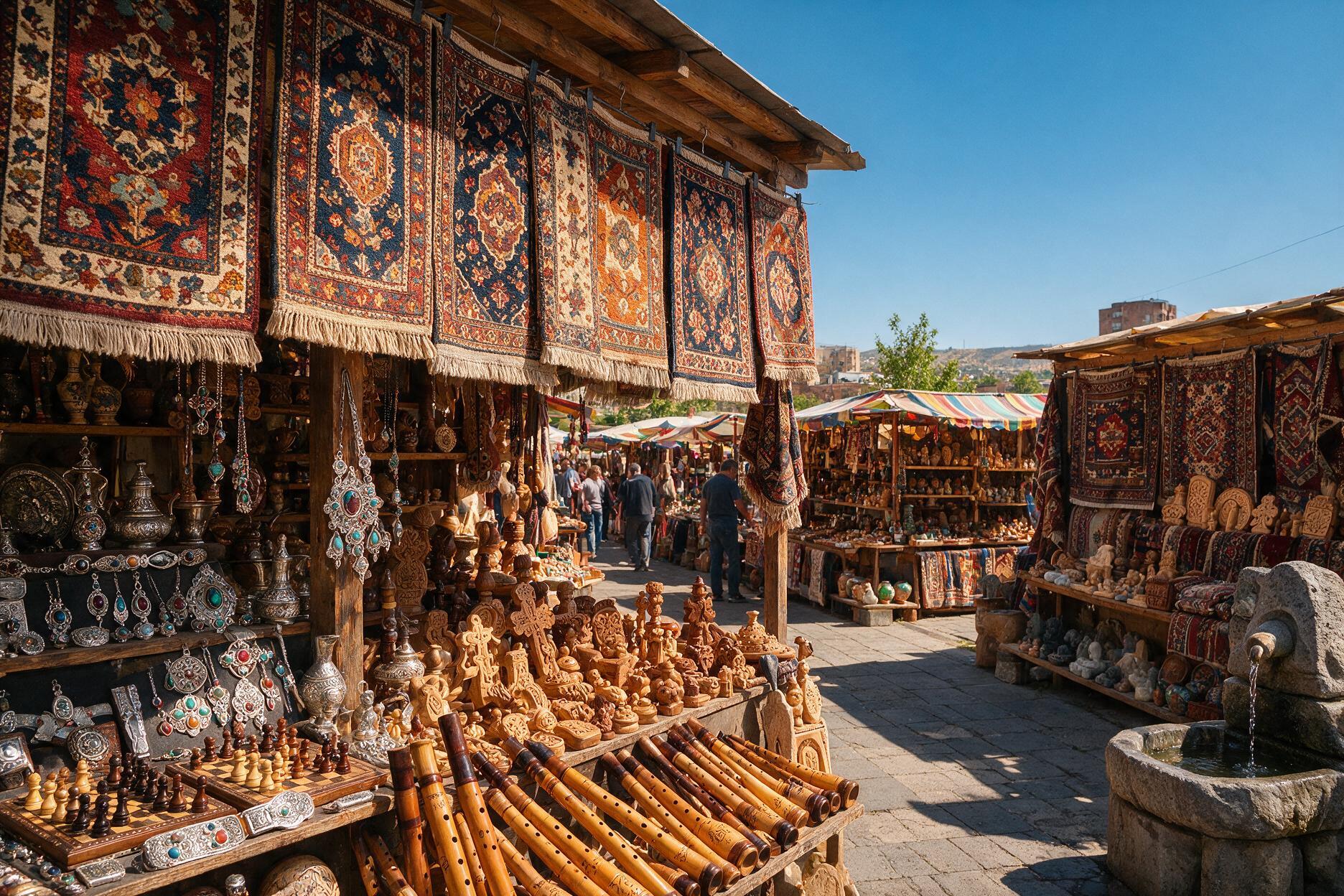
By late morning, head to Vernissage Market, a sprawling open-air market on Aram and Buzand streets that has been running in one form or another since Armenian artists began setting up informal stalls here in the late 1980s. It has moved locations a few times since, but the spirit has stayed the same: hand-carved wooden chess and backgammon sets, thick wool carpets, Soviet-era medals and cameras, silver jewelry, and duduk (the Armenian reed flute) alongside genuinely questionable souvenir magnets.
The market technically runs daily, but Saturday and Sunday mornings are when it is actually worth visiting — stalls double or triple in number and the vendors who only show up on weekends bring out better stock. If you are here on a weekday, you will still find carpets and jewelry, just a thinner selection.
Mistake to avoid: don’t accept the first price on anything with a hand-carved or woven item. Bargaining is expected and mild — nobody is trying to fleece you, but the listed price usually has 15–25% of padding built in for exactly this. A flat “no thank you” and a slow walk away is often all it takes to get a better number.
Hidden-gem tip: most visitors stick to the main aisles closest to the street. Walk one row deeper and you will find the stalls run by the carvers and weavers themselves rather than resellers — ask who made a piece, and if the answer is “me,” the price is usually fairer and the quality is usually better.
Afternoon: Climbing the Cascade
From Vernissage, it is a 15–20 minute walk north to the Cascade Complex, the giant tiered limestone staircase that has become Yerevan’s unofficial symbol. It was conceived in the 1970s as a monumental stairway linking downtown to the Monument neighborhood above, was left unfinished for years after the Soviet collapse, and was eventually completed and reopened with funding from the Cafesjian Family Foundation, which also filled its terraces with an outdoor contemporary sculpture garden.
Officially there are 572 steps on a gentle outdoor climb, but you don’t have to take them — a free indoor escalator runs the same route, air-conditioned in summer, and most locals use it without a second thought. Still walk at least the outdoor terraces, because that’s where the sculpture garden lives: Fernando Botero’s oversized bronze cat and his “Woman Smoking a Cigarette,” a stainless-steel lion by Ji Yong-ho welded from old tires, and pieces by Jaume Plensa and Joana Vasconcelos scattered across the landings. It plays more like an open-air modern art museum than a staircase.
At the top, the fifth terrace gives you the best skyline view in the city, and on a clear day — mornings and right after rain tend to be clearest — you can see Mount Ararat rising in the distance. It is worth saying plainly: Ararat is not in Armenia. The mountain sits just across the closed border in Turkey, and has done since a 1921 treaty redrew the region. It remains the national symbol on Armenia’s coat of arms anyway, visible but unreachable, which is either poignant or slightly absurd depending on your mood that day. Either way, it is the single best photo you will take in Yerevan, so budget your visit for late afternoon light rather than harsh midday sun.
Photography tip: shoot from the fourth or fifth terrace looking back down the staircase toward the city rather than only shooting outward toward Ararat — the symmetry of the steps with Yerevan spreading out below reads far better than a flat mountain shot, especially an hour or two before sunset when the tuff buildings pick up warm light.
Late Afternoon: A Brandy Lesson at the Ararat Factory
Armenia’s brandy — technically “cognac” only in the loosest sense, since Armenia isn’t in the Cognac region of France, but locally and historically just called Armenian brandy or cognac — is a genuine point of national pride, and the Yerevan Ararat Brandy Company / ARARAT Museum on Admiral Isakov Avenue is the place to actually understand why, not just drink it.
The museum runs daily from 10am to 7pm and offers a few tour tiers. The standard package (around 4,500 AMD, roughly ₹950 at current rates) walks you through the aging cellars and ends with a tasting of the three-star and seven-year “Ani” brandies. A more advanced tasting (around 10,000 AMD) moves up to 10-, 15-, and 20-year-old vintages, and there is also a flavored-brandy tasting for anyone who wants apricot or coffee notes alongside the classic pour. Book a slot in advance if you can, especially in peak season — walk-ins happen but aren’t guaranteed a spot on the next tour.
You will almost certainly hear the story that Winston Churchill loved this brandy so much that Stalin had 400 bottles shipped to him every year after the 1945 Yalta Conference. It is a great story and it is mostly legend — Churchill historians who have checked the Churchill Archives Centre have found no record of any such annual shipment, and Churchill’s own wine merchant lists Hine brandy and Pol Roger Champagne as his real staples. What is true is narrower and still fun: Churchill did compliment Armenian brandy served to him at Yalta in 1945. The rest got embellished somewhere along the way, and honestly, the brandy does not need the myth — it holds up fine on its own.
Smart-spending tip: the standard tasting package is genuinely enough for most people. Unless you already know your way around aged spirits, the jump to the premium tiers buys you older labels more than a meaningfully different experience for a casual visitor.
Evening: Khorovats, Wine, and the Case for Slow Dinners
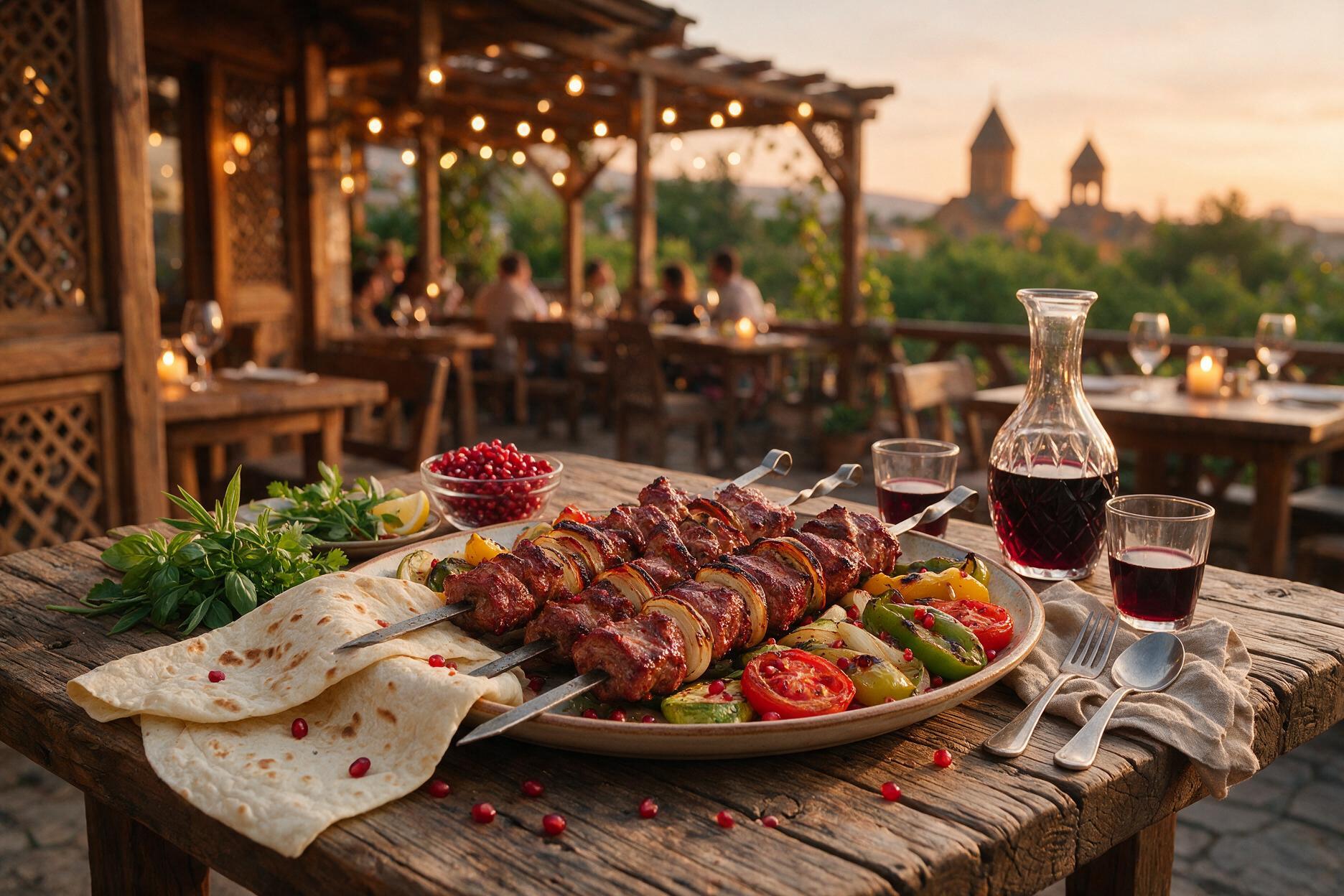
Dinner in Yerevan should be khorovats — Armenian barbecue, usually pork, lamb, or chicken marinated simply and grilled over wood coals, served with grilled tomatoes and peppers, fresh herbs, and stacks of lavash to wrap it all in. It’s a communal, unhurried meal by design; nobody in Yerevan eats khorovats fast, and you shouldn’t either. Restaurant terraces around the city center and along Saryan Street handle this well, with outdoor grills often visible from the street so you can see your dinner before it arrives.
Pair it with Armenian wine rather than defaulting to the brandy again — this is a country with a legitimate claim to being the world’s oldest wine-producing region. In 2011, archaeologists excavating the Areni-1 cave in Armenia’s Vayots Dzor province uncovered a fully intact winemaking facility — a wine press, fermentation vats, and storage jars — dated to roughly 4100 BCE, the oldest known winery site on earth, predating Egyptian and Georgian wine evidence by centuries. Modern Armenian wine, mostly built around the indigenous Areni grape, has improved sharply in the last decade, and a good khorovats restaurant will usually have a few bottles worth asking about by the glass. Get Tripped builds private wine-tasting add-ons for trips like this the same way it does for Tuscany’s Chianti region — worth asking your travel specialist about if wine is a big part of why you’re making this trip.
Note for couples: ask for a corner table on an outdoor terrace after 7pm — service slows down deliberately for the dinner crowd, and it is one of the more romantic, unforced settings in the city without anyone trying to sell you a “romantic experience.”
Note for solo travelers: khorovats restaurants are used to solo diners, and sitting at the bar or a small table near the grill is normal, not awkward — it is also the best seat for watching the cooks work.
Night: Singing Fountains and One More Coffee
End the day back at Republic Square for the musical fountains, which run seasonally from late March through early November with evening shows generally between around 9pm and 11pm, synced to everything from classical pieces to Armenian folk and the occasional pop track, lit against the floodlit facades of the surrounding tuff buildings. It is free, it draws a real mixed crowd of locals and tourists rather than feeling staged for visitors, and 20–30 minutes here is enough.
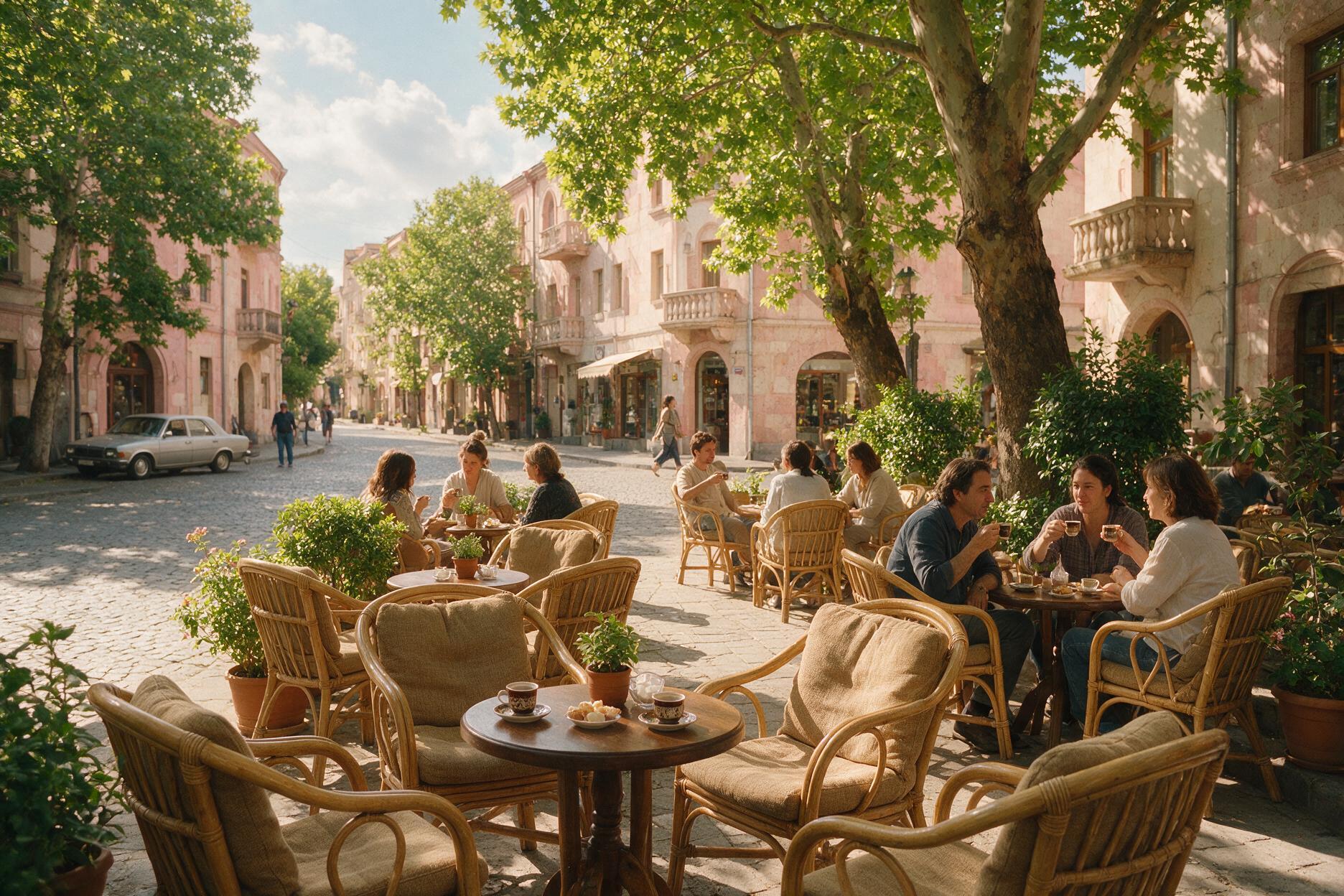
From there, one more coffee on Saryan Street or Northern Avenue is the right way to close the day — most cafés stay lively well past 10pm, and this is where Yerevan’s café culture actually shows itself: groups of friends, laptops closed, in no hurry to leave.
If You Have One More Half-Day: Garni and Geghard
If your trip allows a second half-day — and it is worth arranging one if it does — go east to Garni Temple and Geghard Monastery. This is genuinely one of the better half-day trips out of any Caucasus capital, and it does not need to be crammed into your single day in the city; treat it as an honest bonus rather than something to rush.
Garni is Armenia’s only surviving Greco-Roman colonnaded temple, built in the 1st century AD and rebuilt after a 1679 earthquake using the original stones. Geghard Monastery, roughly 40 kilometers away and about an hour’s drive, is partly carved directly into the cliff face and holds UNESCO World Heritage status. Garni sits en route to Geghard, so most drivers combine them naturally — budget an hour at Garni, closer to two at Geghard if you want to sit with the acoustics inside, since locals sometimes sing in the rock-cut chambers and the natural reverb is worth waiting for.
A private driver or small-group half-day tour covering both sites runs about five hours door to door — enough to fit into a departure-day morning, or a genuine second day if you have one.
The Practical Bits: Where to Stay, Money, SIM Cards, and Safety
Where to stay: Base yourself around Republic Square or Northern Avenue — everything in this itinerary is walkable from either. The Republic Square Marriott puts you inside a Tamanyan-era building on the square itself, rooms generally from around $150/night. On Northern Avenue, North Avenue Hotel sits between the square and the Opera House from around $100/night including breakfast. For something quieter, guesthouses around Koghbatsi Street near Republic Square — older buildings, a more residential feel — are a solid mid-range option without losing the central location this itinerary needs.
Currency and payments: Armenia uses the Armenian dram (AMD). Cards — Visa and Mastercard — are widely accepted in restaurants, hotels, and shops, but Vernissage vendors and smaller stalls often prefer cash, so carry some dram for the market. ATMs are plentiful around Republic Square and Northern Avenue. There’s no UPI equivalent live here, so bring a card that handles international transactions well and keep some cash as backup.
SIM and eSIM: Viva-MTS and Ucom are the two major carriers, both with kiosks at Zvartnots Airport and shops on Mashtots Avenue. If you’d rather skip the kiosk queue after a long flight, Airalo and similar eSIM providers activate on landing over the same local networks — the trade-off is no local phone number, which occasionally matters for taxi apps.
Safety: Armenia consistently ranks among the safer countries globally for travelers, according to the official Armenia tourism board, including solo and women travelers, with low violent crime rates and a city center that stays comfortably walkable at night. Ordinary precautions apply — watch your bag in crowded market areas, use licensed taxis or ride-hailing apps rather than unmarked cars, and exchange currency at banks or official exchange points rather than informally. The one region to actively avoid without specific reason and local guidance is the border area near Nagorno-Karabakh, which sits well outside anything in this itinerary and outside most standard Yerevan trips entirely.
Note for luxury travelers: everything in this day works just as well at a slower, more curated pace — a private guide through Vernissage who can vouch for which stalls are selling genuine antique pieces versus reproductions, a reserved tasting room at the brandy museum instead of a group slot, and a private driver for the Garni–Geghard half-day rather than a shared minivan. None of it requires reinventing the itinerary, just upgrading how you move through it.
FAQs
Do Indian citizens need a visa for Armenia?
Yes, in almost all cases. Indian passport holders flying from India need an e-visa, applied for in advance through Armenia’s official e-Visa portal — either a 21-day visa (around $8) or a 120-day visa (around $39), typically processed within three business days. A temporary exemption through July 2026 allows visa-free entry for Indians holding a residence permit from select other countries, but it doesn’t apply to most travelers flying directly from India on an Indian passport, so check your specific eligibility on the official portal before booking.
Is there a direct flight from India to Yerevan?
Not currently. You will connect through a Gulf hub — Doha on Qatar Airways, Dubai on flydubai, or Sharjah on Air Arabia are the most common routings from Delhi, Mumbai, and Bengaluru — with total journey times generally between 8 and 11 hours including the layover.
How many days do you actually need in Yerevan?
One full day covers the city’s core sights comfortably at the pace in this guide — Republic Square, Vernissage, the Cascade, a brandy tasting, and a proper khorovats dinner. If you can add a second day, use it for the Garni–Geghard half-day and a slower second pass through the city rather than trying to compress everything into one day.
Can you see Mount Ararat from Yerevan?
Yes, on clear days, especially in the early morning or right after rain when the air is less hazy. The best vantage points in the city are the upper terraces of the Cascade Complex. The mountain itself sits across the border in Turkey and is not accessible from Armenia, but it remains the country’s most recognized symbol.
Is Yerevan expensive for Indian travelers?
It sits comfortably mid-range by international standards — meaningfully cheaper than most Western European capitals for food and mid-range hotels, with the flight typically being the single largest cost given the lack of a direct route. A good khorovats dinner with wine for two, a brandy museum tasting, and a mid-range hotel night together generally cost less than an equivalent evening in a major Gulf city.
Is Yerevan safe for solo and women travelers?
Generally yes. Armenia ranks among the safer countries globally, and Yerevan’s central areas stay walkable and comfortable well into the evening. Standard precautions — licensed transport, awareness in crowded markets, official currency exchange — cover most of what you need.
What is Armenian brandy, and is it the same as cognac?
It’s a grape brandy aged in oak, produced in and around the Ararat valley using a method historically close to the French cognac process, though it cannot legally be called “cognac” since that name is protected to the Cognac region of France. Locally it is simply called Armenian brandy or, informally, cognac. The Yerevan Ararat Brandy Company’s museum on Admiral Isakov Avenue is the most accessible place to taste and learn the difference.
Is Armenia really the birthplace of wine?
It has a strong, evidence-backed claim to it. The Areni-1 cave in Armenia’s Vayots Dzor province contains the oldest known complete winemaking facility in the world, dated to around 4100 BCE, with a wine press, fermentation vessels, and storage jars all found intact. Modern Armenian wine, built mostly around the indigenous Areni grape, has seen real quality improvements in recent years and is worth ordering by the glass with dinner.
Conclusion
Yerevan doesn’t announce itself the way some capitals do. There’s no single monument doing all the marketing work — instead it’s a stack of smaller, specific things that add up fast: a stone carpet you only notice if you look down, a mountain you can see but never reach, a brandy story that turns out to be half-true, a market row where the person selling you a chess set carved it themselves. One good day here — walked at a reasonable pace, with a proper tasting and a proper dinner built in — is enough to understand why people who visit the Caucasus once tend to start planning how to come back.
If a day in Yerevan sounds like the kind of travel you want more of, it also happens to sit naturally at the start or end of a longer Caucasus route — Tbilisi and Batumi in Georgia pair easily with it on the same trip. Get Tripped can build that out as a proper Armenia or Caucasus itinerary around your dates, your pace, and how much of it you want curated versus left open — browse Get Tripped’s curated experiences or reach out and we’ll put one together.