Tiger’s Nest Monastery gets photographed from the same viewpoint by every single visitor who climbs up to it, because there’s only one viewpoint. You’ll stand there with forty other people, all shooting the same angle of Paro Taktsang clinging to its cliff, and it’s a genuinely stunning building. Thimphu, Bhutan’s capital, is a pleasant one-day stop with a giant Buddha statue on a hill and a clock tower square where you can buy yak wool scarves. Neither of these things is a bad reason to visit Bhutan. They’re just the entire itinerary for about 80% of the travelers who go.
Bhutan only lets in a controlled number of visitors a year, and it caps that number partly by charging a daily Sustainable Development Fee — which we’ll get into properly below, because it works differently for Indian travelers than almost anyone assumes. What that policy has quietly done is keep Bhutan’s less obvious valleys empty even by Bhutan’s already-uncrowded standards. Punakha, a two-and-a-half-hour drive past Thimphu, gets a fraction of Paro’s footfall. Haa Valley, less than an hour from Paro’s own airport, only opened to foreign visitors in 2002 and still barely registers on most itineraries. Bumthang, Bhutan’s spiritual heartland, sits far enough east that most tour groups quietly drop it to save two days of driving.
This is where we’d point you instead — not because Tiger’s Nest isn’t worth seeing (it is, go early, go on a weekday), but because Bhutan’s actual character lives in these valleys, and a week built around three or four of them gives you a far truer picture of the country than a rushed Paro-Thimphu loop ever will.
Quick Overview
- The obvious route: Paro (Tiger’s Nest) and Thimphu — worth a day or two, not the whole trip
- Punakha Valley: Punakha Dzong at the river confluence, the prayer-flag suspension bridge, rice terraces — 2.5 to 3 hours from Paro over Dochula Pass
- Haa Valley: Bhutan’s least-visited valley, opened to tourism only in 2002, ancient twin temples and nomadic herder culture — under 2.5 hours from Paro
- Phobjikha (Gangtey) Valley: A glacial valley that hosts endangered black-necked cranes every winter (late October to mid-February) — 4 to 5 hours from Paro
- Bumthang (Jakar): Bhutan’s spiritual and textile heartland, four sub-valleys, Bhutan’s oldest temples — 8 to 10 hours by road or a short domestic flight
- Sustainable Development Fee for Indians: INR 1,200 per person per night, not the USD 100 rate foreign nationals pay
- Entry for Indians: passport or Voter ID Card, no visa required
- Best overall window: March-May and September-November, with November added for the crane season in Phobjikha
The Obvious Route, and Why It’s Only Half the Trip
Paro Taktsang — Tiger’s Nest — sits on a granite cliff 900 meters above the valley floor, and the hike up takes most people three to four hours round trip including a stop at the cafeteria viewpoint. Go. It earns the reputation. Just go before 8am, because by mid-morning the trail fills with tour groups moving at the pace of the slowest member, and the switchbacks aren’t wide enough to pass comfortably.
Thimphu is worth a night, mainly for the weekend market (Thursday evening through Sunday) where farmers sell yak cheese, red rice, and dried chilies, and for the National Memorial Chorten, where you’ll see more actual Bhutanese people — mostly older residents doing their morning kora, walking clockwise circuits while spinning prayer wheels — than at almost any other single site in the country.
The mistake is stopping there. A five- or six-night trip that never leaves the Paro-Thimphu corridor sees maybe 15% of what the country has to show. The dzongs get less crowded, the food gets more interesting, and the conversations with local guides get noticeably more candid the further east you go.
Punakha Valley: Where Bhutan’s History Actually Happened
Punakha is roughly 72 km from Thimphu and about 125 km from Paro, and the drive from Paro takes around four hours, most of it over the Dochula Pass at 3,100 meters. On a clear morning — and mornings are your best shot at clear — Dochula gives you a full panorama of the eastern Himalayan range, with 108 memorial chortens built along the ridge in 2005. Stop here on the way in. Don’t plan on the same view on the way back; cloud tends to roll in by early afternoon.
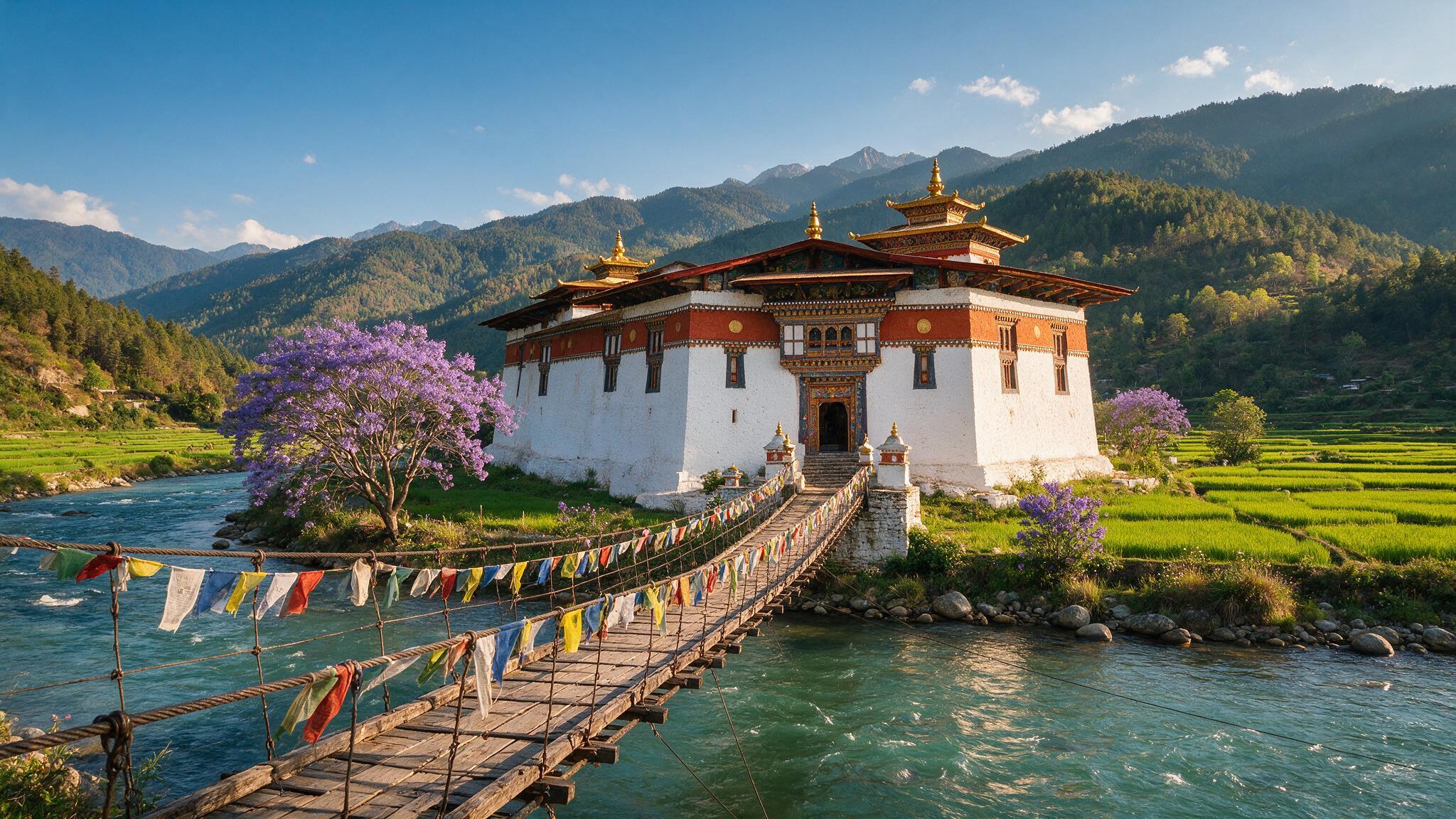
Punakha Dzong is the reason to make the drive. Built in 1637 at the confluence of the Pho Chhu (father river) and Mo Chhu (mother river), it’s officially called Pungthang Dewa Chhenbi Phodrang — the Palace of Great Happiness — and it served as Bhutan’s capital until 1955. It’s still the winter residence of the Je Khenpo, the head of Bhutan’s central monastic body, and the monks physically relocate here from Thimphu each winter — a detail most visitors never hear because they’re rushing through on a day trip. The whitewashed walls rising straight out of the river, with jacaranda trees blooming lavender against them in spring, make this the most photographed dzong in Bhutan, at a fraction of Tiger’s Nest’s foot traffic.
Right below the dzong is the Punakha suspension bridge, one of the longest of its kind in the country, strung with thousands of prayer flags that never really stop moving. Walk it in the late afternoon when the light comes in low across the Mo Chhu and the flags backlight orange and red. On the far side, short walking trails cut through rice terraces and small villages where farmers are usually out working the paddies from June through the September harvest — a scene that has nothing to do with Bhutan’s monastery-and-mountain postcard image and everything to do with how most Bhutanese actually live.
Honest caveat: Punakha sits at a much lower elevation than Paro or Thimphu — around 1,200 meters versus over 2,300 — which means it’s genuinely hot and humid in the June-to-August monsoon months. If you’re picturing crisp Himalayan air, plan your Punakha visit for October through April instead.
Haa Valley: Bhutan Kept This One Closed Until 2002
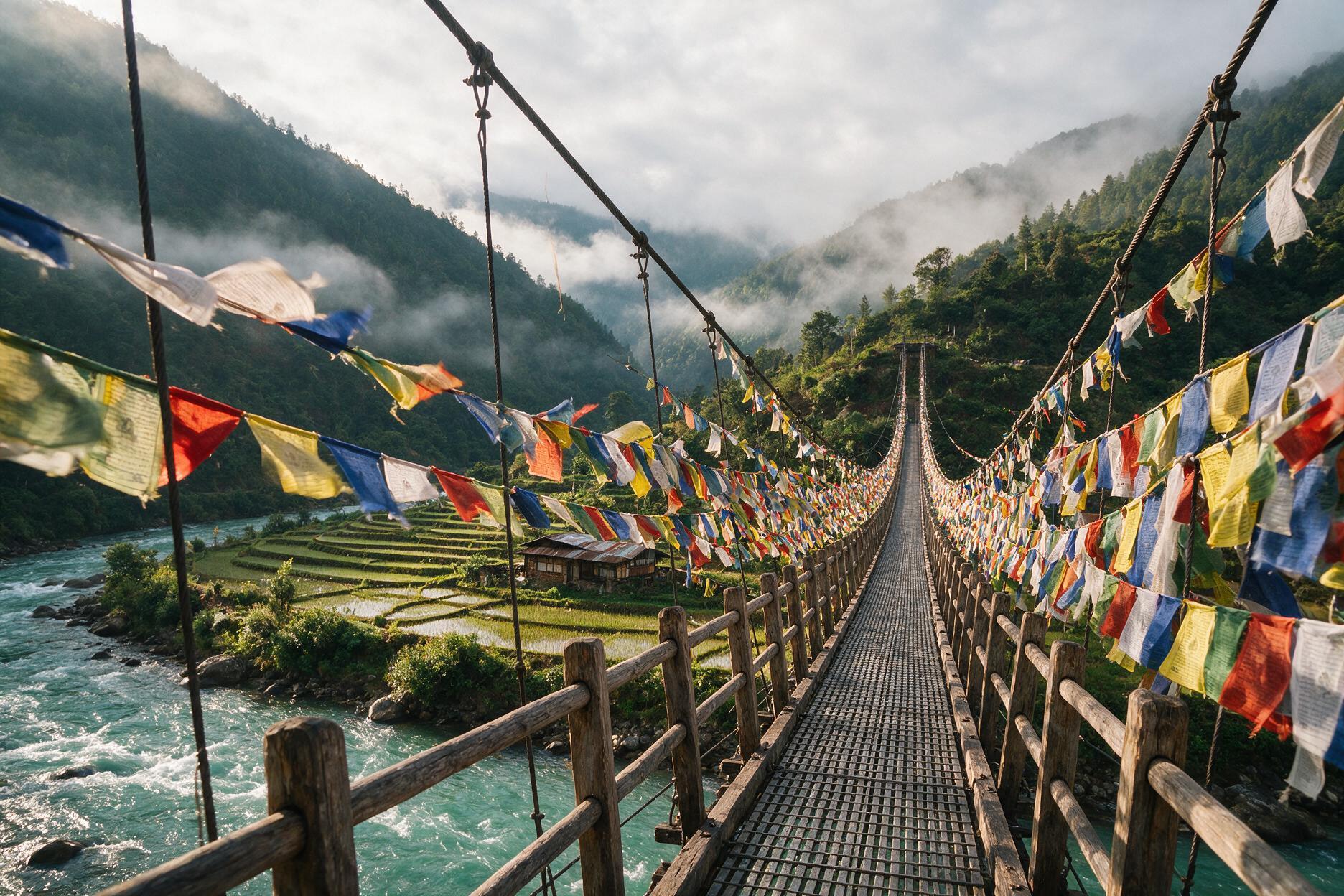
Haa is the smallest of Bhutan’s twenty districts, and it’s the one that stayed off-limits to foreign tourists the longest — it only opened in 2002, decades after Paro and Thimphu. It sits just under two and a half hours from Paro International Airport over the Chele La Pass, at 3,988 meters the highest motorable pass in Bhutan, and on a clear day you get a direct line of sight to Mount Jomolhari, one of Bhutan’s most sacred peaks.
What you find in Haa isn’t a headline monument — it’s two 7th-century temples, Lhakhang Karpo (the White Temple) and Lhakhang Nagpo (the Black Temple), sitting quietly at the foot of the Meri Puensum mountains, usually with nobody else around. The valley’s real draw is slower than that: Haa has stayed a working valley of semi-nomadic herders and barley farmers, largely because tourism arrived so late here. Farmhouse stays are the way to experience it — you eat what the family eats, which in Haa leans more on dairy and buckwheat than the rice-forward diet of the western valleys, a holdover from its old trade route connections to Tibet and Sikkim.
Honest caveat: Haa has genuinely limited accommodation. This is not a place to show up without a booking, and it’s not the valley for a traveler who wants a wide choice of restaurants or shops in the evening — the payoff is quiet, not convenience. If your idea of a good trip includes options, treat Haa as a day trip or single overnight rather than a base.
Phobjikha (Gangtey) Valley: A U-Shaped Glacial Valley With Wintering Cranes
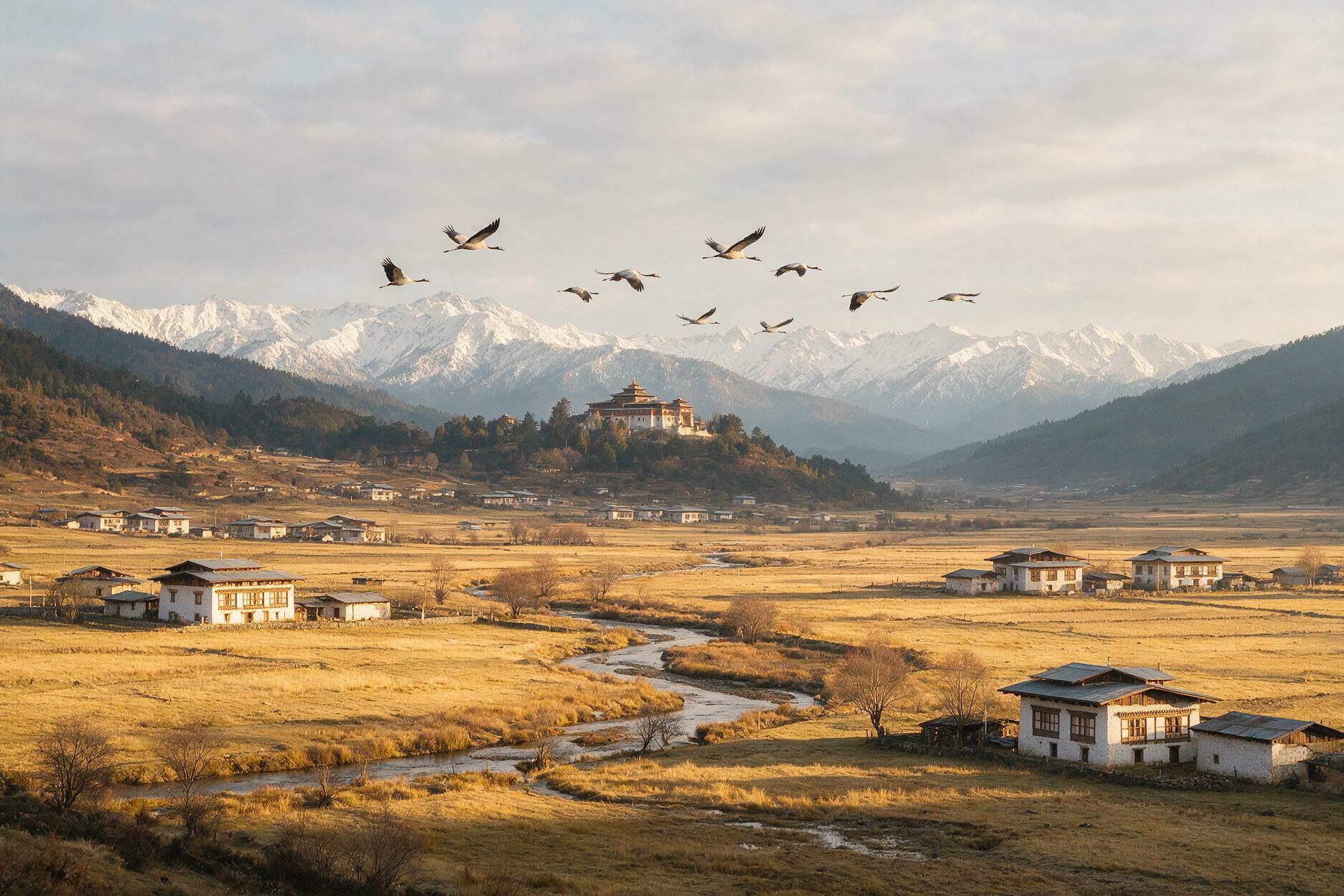
Phobjikha is roughly four to five hours from Paro and about three hours from Punakha, which makes it a natural next stop if you’re already heading east. It’s a broad, glacier-carved valley with no electricity lines run overhead near Gangtey Monastery — the local community voted to keep power lines underground specifically to protect the cranes’ flight paths, which tells you something about how seriously this place takes its winter visitors.
Those visitors are black-necked cranes, an endangered species that migrates from the Tibetan Plateau and winters in Phobjikha from late October through mid-February. The Royal Society for Protection of Nature runs a Black-Necked Crane Information Centre right in the valley with telescopes set up for viewing without disturbing the birds. If your dates line up, the Black-Necked Crane Festival is held every November 11th in the courtyard of Gangtey Goenpa, with local children performing crane dances that are genuinely charming rather than staged for tour buses.
Gangtey Monastery itself sits on a small hill overlooking the whole valley and is one of the few Nyingma Buddhist monasteries in Bhutan not built as part of a dzong. The walk from the monastery down through the valley floor — the “Gangtey Nature Trail,” a gentle 1.5-hour loop through dwarf bamboo and past scattered farmhouses — is one of the easiest, most rewarding short hikes in the country, flat enough for most fitness levels.
Honest caveat: if cranes aren’t your specific reason for going, visit outside crane season (March through September) and you’ll find Phobjikha a lovely, quiet valley but without its signature draw — the marshland just looks like grassland. Time this one deliberately.
Bumthang: Bhutan’s Spiritual Heartland, If You Have the Days for It
Bumthang is the furthest of these four, roughly 268 km and 8 to 10 hours by road from Thimphu through Trongsa — or a short domestic flight from Paro to Bathpalathang Airport in Jakar when weather cooperates, which cuts the trip dramatically. This is the district most tour groups skip on a standard week-long itinerary, purely because of the driving time, and it’s exactly why it stays undercrowded.
Bumthang isn’t one valley but four — Choekhor, Tang, Chumey and Ura — and it’s considered Bhutan’s spiritual center. Jambay Lhakhang, believed to date to the 7th century, is one of the oldest temples in the entire Himalayan region, built (according to local legend) by Tibetan King Songtsen Gampo in a single day to pin down a giant demoness across the region. Kurjey Lhakhang, nearby, marks the spot where Guru Rinpoche is said to have left a body imprint in rock, and the complex includes a tree believed to have grown from his walking staff.
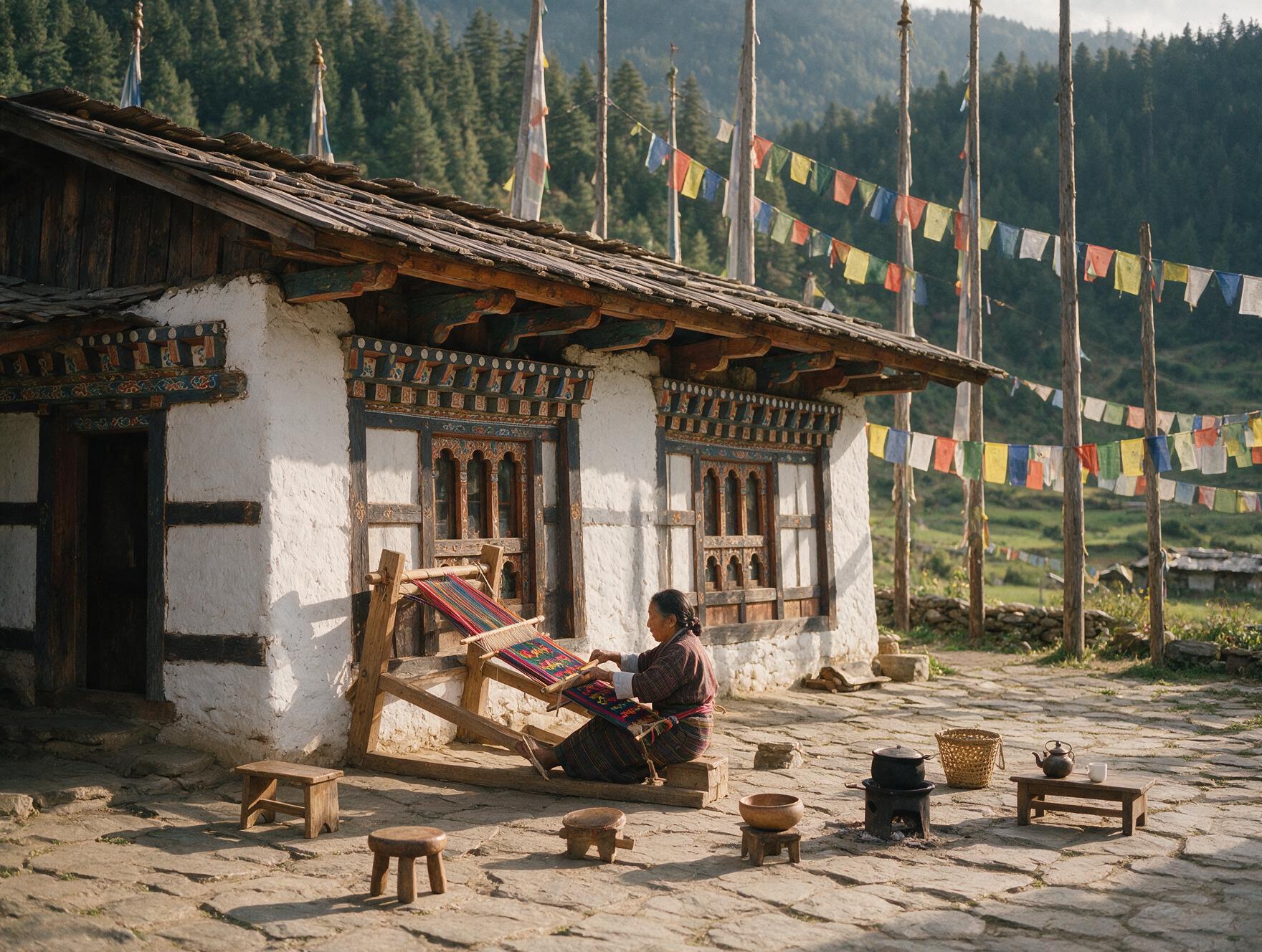
The Chumey valley is where Bhutan’s distinctive Yathra textiles are woven — thick handspun wool cloth, naturally dyed, worked on wooden looms you can watch in small family workshops. Bumthang honey, sold in jars along the main Jakar road, and the Red Panda Weissbier brewery (Bhutan’s first) are both worth a stop, and neither shows up in the average “top 10 Bhutan” list because getting here takes real commitment.
Honest caveat: this is only worth the drive on a trip of eight nights or more. On a five- or six-night trip, adding Bumthang means cutting time everywhere else, and that trade rarely pays off. Save it for a return trip, or a trip built specifically around central Bhutan.
Entry Requirements and the SDF for Indian Travelers
This is the part most Indian travelers get wrong before they’ve even booked flights, so it’s worth being precise about it.
Indian nationals do not need a visa to enter Bhutan. What you need is an entry permit, plus either a valid passport (minimum six months’ validity) or a Voter Identity Card. Children under 18 need a birth certificate. The permit is processed through your tour operator or hotel, or via the online portal run by Bhutan’s Department of Immigration, and it’s normally sorted before you land — don’t expect to arrange it on arrival with no prior paperwork.
On cost: Bhutan charges a Sustainable Development Fee, and the headline figure of USD 100 (recently the discounted rate through August 2027, down from a standard USD 200) that circulates online applies to non-Indian foreign nationals — not to you. Indian travelers pay INR 1,200 per person, per night, in Indian Rupees, not USD or Bhutanese Ngultrum. Children aged 6 to 12 pay half that (INR 600), and children under 6 pay nothing. This is the number to budget against, not the dollar figure most general travel sites quote — verify it directly with your operator, the Department of Immigration, or the Tourism Council of Bhutan before you finalize a budget, since Bhutan has revised this fee structure more than once in the past few years.
Indian travelers can also enter overland via Phuentsholing in West Bengal, the crossing most used by travelers from Kolkata, Siliguri, and the northeast. The same permit and SDF rules apply whether you fly into Paro or cross by road.
Getting There From India
Paro is Bhutan’s only international airport, served by Drukair (Royal Bhutan Airlines) and Bhutan Airlines. Kolkata is the busiest Indian gateway, with the shortest flight time (around 1 hour 20 minutes) and the most frequent service. Delhi has a direct route too, roughly 2.5 hours in the air. Guwahati offers a quick 45-minute hop, and Bagdogra (serving Siliguri and Darjeeling) has direct flights as well. Gaya runs a seasonal route, typically November through February, aimed at pilgrims visiting Bodh Gaya. There’s no current direct route from Mumbai — travelers from western India generally connect through Delhi or Kolkata.
One thing worth knowing before you book: the approach into Paro is one of the more technical landings in commercial aviation, threading between mountain ridges, and only a small number of pilots are certified to fly it. Flights are more weather-dependent than most routes you’re used to, so build a buffer day into your itinerary rather than a same-day onward connection, especially in the monsoon months.
Where to Stay: Mid-Range to Genuine Luxury
Bhutan’s high-end hospitality scene is unusually strong for a country this size, and several of these valleys are exactly where the best properties are.
Amankora runs five lodges across the country — Paro, Thimphu, Punakha, Gangtey, and Bumthang — architecturally distinct at each stop, and the Punakha and Gangtey lodges put you inside the valleys this piece is arguing for, not just passing through. Six Senses Bhutan operates similarly, with lodges in Punakha and Bumthang built around local materials and hot-stone bathing traditions. COMO Uma has properties in Paro and Punakha, generally a notch below Aman and Six Senses on price while still delivering a genuine luxury standard.
Below that tier, well-run boutique hotels and heritage farmhouse conversions exist in every valley here, including Haa and Bumthang — comfortable rooms, home-cooked meals, none of the backpacker-hostel compromises. Given how remote Haa and Bumthang are, book accommodation before you finalize your route; room counts in both are genuinely small. It’s the same comfort-forward, no-compromise standard Get Tripped curates across its other experiences — private, well-chosen, never backpacker-tier.
Food Worth Actually Seeking Out
Ema datshi — chilies stewed in a yak or cow cheese sauce — is Bhutan’s national dish, and it’s spicier than most first-time visitors expect; ask for it mild if you want to taste anything else on the plate. Red rice, grown at altitude and slightly nutty, shows up at nearly every meal. In Bumthang, buckwheat replaces rice in a lot of home cooking — buckwheat noodles (puta) and pancakes (khule) are specific to the region and rarely appear on menus further west. Suja, Bhutan’s butter tea, is an acquired taste; try a small cup once rather than committing to a full pour.
A Photography Note
The single best light in Bhutan’s valleys is the hour after sunrise, not sunset — cloud tends to build through the day and by 3 or 4pm the mountains you photographed clearly that morning are often gone behind haze. If you’re chasing a specific shot — Dochula Pass, the Punakha bridge, Chele La — plan to be there before 9am. It’s a genuinely early start, and it’s the difference between a clear frame and a grey one.
A Mistake to Avoid
Don’t try to cover Paro, Thimphu, Punakha, Phobjikha, and Bumthang in under eight days. Bhutan’s road network is mountainous and slow — distances that look short on a map take hours — and a schedule that’s too tight means you spend more time in the vehicle than in any of these valleys. Four days for Paro and Thimphu combined with Punakha is a comfortable, realistic trip. Add Phobjikha and you want six or seven days minimum. Bumthang genuinely needs eight-plus.
Currency, Cash, and Connectivity
Bhutan’s currency, the Ngultrum (BTN), is pegged 1:1 with the Indian Rupee, and INR is accepted almost everywhere except the ₹500 and ₹2,000 notes, which some places won’t take — carry smaller denominations plus some Ngultrum from an ATM. Cards work at hotels and shops in Paro, Thimphu, and Punakha, but rural Haa and Bumthang are far more cash-dependent, so don’t count on a card at a farmhouse stay or village shop. India and Bhutan have a working BHIM-UPI link, useful in urban centers, but treat it as a backup outside the main towns.
Indian mobile SIMs generally do not get automatic roaming in Bhutan the way they might elsewhere; a local Bhutanese SIM (Bmobile or TashiCell) is cheap and easy to pick up at Paro airport or in Thimphu, and hotel wifi is reliable in the western valleys but noticeably patchier the further east you go.
Who This Trip Actually Suits
Couples and honeymooners get real value here — Bhutan’s controlled tourist numbers already keep the valleys quiet, so you’re rarely sharing a viewpoint with fifty other people, and the Amankora/Six Senses circuit is genuinely built for a slower, private pace.
Luxury and design-minded travelers will find Bhutan’s high-end lodges architecturally serious in a way that’s rare at this altitude — luxury built around rammed-earth walls and hot-stone baths, not an amenity checklist.
Families with older children or teenagers can manage the Phobjikha nature trail and gentler dzong visits comfortably; the altitude and driving distances suit kids ten and up better than very young children, and Punakha’s lower elevation makes it an easier stop than Paro or Thimphu if altitude is a concern.
A Fact Worth Knowing
Bhutan is the only country in the world that’s carbon negative — its forests absorb more carbon dioxide than the country produces, verified by National Geographic and cited widely in climate literature. That’s not incidental to how the country runs tourism — it’s the same philosophy, prioritizing Gross National Happiness and long-term ecological balance over raw visitor volume, that keeps the SDF in place and keeps these valleys from turning into the crowded version of themselves.
FAQs
Do Indians need a visa for Bhutan?
No. Indian nationals need a valid passport (minimum six months’ validity) or a Voter Identity Card, plus an entry permit, but not a visa. The permit is usually arranged through your tour operator or hotel before travel.
How much is the Sustainable Development Fee (SDF) for Indian travelers?
INR 1,200 per person, per night, as of current rates — separate from and lower than the USD-denominated fee (currently a discounted USD 100/night, standard rate USD 200) that applies to non-Indian tourists. Children aged 6-12 pay half (INR 600); children under 6 are exempt. Confirm the current figure with your operator before booking, since Bhutan has adjusted this structure more than once in recent years.
Can Indians travel to Bhutan by road?
Yes. The main land crossing is at Phuentsholing in West Bengal, commonly used by travelers from Kolkata, Siliguri, and Northeast India. The same permit and SDF requirements apply as air travel.
Which Indian cities have direct flights to Bhutan?
Kolkata (the busiest route, roughly 1 hour 20 minutes), Delhi (around 2.5 hours), Guwahati (about 45 minutes), and Bagdogra all have direct Drukair or Bhutan Airlines service to Paro. Gaya runs a seasonal route, typically November to February. There’s currently no direct route from Mumbai.
When is the best time to see the black-necked cranes in Phobjikha?
The cranes arrive in late October and stay through mid-February, with the Black-Necked Crane Festival held every year on November 11th in Gangtey. Outside that window, Phobjikha is still a beautiful valley but without its signature wildlife draw.
How many days do I need to see Bhutan beyond Paro and Thimphu?
A minimum of six to seven days lets you comfortably add Punakha and Phobjikha to a Paro-Thimphu base. Bumthang, being much further east, realistically needs eight days or more for the whole trip to feel unrushed.
Is Bhutan expensive for Indian travelers compared to other destinations?
The SDF (INR 1,200/night) is a real, mandatory cost on top of hotel, food, and transport, but since it’s charged per traveler per night rather than bundled into a fixed daily package the way it once was, Indian travelers now have more flexibility to pick their own accommodation tier — from solid mid-range hotels to Amankora and Six Senses — instead of being locked into one tariff.
Is Bhutan safe, and is altitude a concern?
Bhutan is consistently rated among the safer countries for travelers in the region, with very low crime rates. Altitude is a mild factor in Paro and Thimphu (2,300-2,400 meters) and more noticeable at Dochula Pass or Chele La (3,100-3,988 meters), but most travelers adjust fine over a few days; Punakha, at a lower 1,200 meters, is a gentler stop if you’re concerned.
The Bottom Line
Tiger’s Nest and Thimphu are a fine two days. They’re not the whole country, and Bhutan’s tourism policy has more or less guaranteed that the valleys past them stay this uncrowded on purpose. Punakha gives you the single most photogenic dzong in Bhutan without the crowds. Haa gives you a valley that was still closed to outsiders twenty-odd years ago. Phobjikha gives you a rare wildlife spectacle timed to a specific season. Bumthang gives you Bhutan’s actual religious center, if you have the days to reach it. Pick two or three of these based on how much time you have, and you’ll come back with a version of Bhutan that most visitors never see.
If you’d rather not build this route yourself — sorting permits, SDF calculations, which lodge pairs well with which valley, and how many driving hours actually separate them — that’s exactly the kind of trip our team at Get Tripped puts together for a living. We can build you a Bhutan itinerary around the valleys that match how you actually want to travel, comfort-forward and curated, without the logistics falling on you. Reach out and tell us how many days you have, or browse more Get Tripped destinations for what else pairs well with a Bhutan trip.