The first time our team helped a client with a France visa application, the France consulate section at VFS asked for a day-by-day itinerary with restaurant names in it. Not just “Paris, 3 nights” — actual restaurants. That single detail tells you most of what you need to know about applying for a France Schengen visa for Indians: it’s thorough, it’s a little exacting compared to some of its Schengen neighbours, and it rewards travellers who show up prepared rather than winging it at the counter.
France receives more Schengen visa applications from Indian travellers than any other member state, and the approval numbers back up the idea that a well-prepared file sails through — recent years have seen roughly 83-84% of Indian applications approved. The rejections that do happen are almost always about documentation gaps, not the destination being difficult. This guide walks through exactly what the French consulate wants, what it costs in 2026, how long to budget, and the small mistakes that trip up otherwise strong applications.
Table of Contents
- Do Indian travellers need a visa for France?
- Which France Schengen visa do you need?
- Document checklist
- France visa fees for Indians (2026)
- Step-by-step application process
- Processing time and when to apply
- Mistakes that get applications delayed
- FAQs
Do Indian travellers need a visa for France?
Yes. Indian passport holders need a Schengen visa to enter France for tourism, and France sits inside the Schengen Area, so this one visa also lets you cross into the other 28 Schengen countries during its validity. If your trip is only France, apply through France’s own consular network rather than a neighbouring country’s — the rule of thumb is you apply where you’ll spend the most nights, or your first port of entry if the nights are evenly split.
One genuinely useful update for 2026: following the France-India talks in February, Indian nationals no longer need an airport transit visa to pass through the international zone of a French airport en route to a third country. That’s a real quality-of-life change if your itinerary connects through Paris on the way to, say, the Caribbean or West Africa — though if you’re leaving the transit area for any reason, the normal visa rules still apply.
Which France Schengen visa do you need?
Most leisure travellers apply for a Short-Stay Schengen Visa (Type C), valid for up to 90 days within any 180-day window. Within that category, France can issue single-entry, double-entry, or multiple-entry visas — and if you’ve travelled to Schengen before with a clean record, it’s worth explicitly requesting a multiple-entry visa valid for a longer period (sometimes up to a year, occasionally longer for frequent, well-documented travellers) rather than assuming you’ll only get single-entry. The visa officer decides based on your travel history, but it costs nothing extra to ask.
Document checklist
France applies what several visa agents describe as the highest financial scrutiny among Schengen states, which mostly just means: don’t leave gaps. Here’s the full list.
Core documents
- Passport valid for at least 3 months beyond your planned departure from Schengen, issued within the last 10 years, with at least 2 blank pages
- Completed visa application form, generated through the France-Visas portal
- One recent passport photograph (35x45mm, white background, taken within 6 months)
- Travel medical insurance covering at least EUR 30,000, valid across the entire Schengen area for the full trip duration
- Confirmed round-trip flight reservation (a hold or dummy booking, not necessarily a paid ticket — but it needs to show real dates)
- Proof of accommodation for every night of the trip — hotel bookings or a signed attestation d’accueil if you’re staying with a host
- Bank statements for the last 3-6 months, bank-stamped
- Income tax returns for the last two assessment years
- Salary slips for the last three months (or a business ownership proof and financials if self-employed)
- A cover letter explaining the purpose of travel and a rough day-by-day plan
- Civil status documents where relevant — marriage certificate for couples travelling together, for instance
The France-specific detail people miss
Where France tends to differ from some other Schengen consulates is the expectation of a genuinely detailed itinerary — not “Paris 4 nights, Nice 3 nights” but actual named hotels, a sense of what you’ll be doing each day, and sometimes even restaurant bookings for a couple of days. You don’t need reservations at every single meal, but a cover letter that reads like you’ve actually planned the trip, rather than assembled documents around a vague idea of visiting France, makes a visible difference to how the file reads.
France visa fees for Indians (2026)
Budget roughly ₹11,000-11,500 per adult for the standard route: the consular fee runs about EUR 90 (₹8,000-8,200 depending on the exchange rate on the day), plus the VFS Global service charge of around ₹3,200. Children between 6 and 11 pay a reduced consular fee (roughly ₹4,000), and children under 6 are exempt from the consular fee entirely, though VFS service charges still apply. None of this is refundable if the visa is refused, which is exactly why a clean, complete file matters more than a fast one.
Optional extras — courier return of your passport, a premium lounge slot at the VFS centre, SMS updates — add a few hundred to a few thousand rupees on top, and none of them are required.
On the financial-proof side, France calculates a daily minimum you need to show you can cover: roughly EUR 65/day if you’ve already booked accommodation, dropping to about EUR 32.50/day if you have a formal host letter, and rising to around EUR 120/day if you have neither. For a 10-day trip with hotels booked, that’s a modest number — the bigger ask is consistency: three to six months of bank statements that don’t show a sudden lump-sum deposit right before you apply.
Step-by-step application process
- Check requirements on France-Visas. The official portal’s Visa Wizard confirms exactly which documents apply to your situation before you commit to anything.
- Complete the online application and print the signed form.
- Book your VFS appointment through the Démarches Simplifiées digital booking system — this is now entirely online, no walk-ins.
- Attend your VFS appointment with original documents plus photocopies. France runs 14 VFS centres across India — Delhi (recently relocated in early 2026), Mumbai, Bengaluru, Chennai, Hyderabad, Kolkata, Pune, Ahmedabad, Chandigarh, Jalandhar, Kochi, Jaipur, Goa, and Puducherry — and unlike some Schengen countries, you’re not locked into your state of residence; you can apply at whichever VFS centre is convenient.
- Give biometrics — ten fingerprints and a digital photo, required if you haven’t submitted them for a Schengen visa in the last 5 years.
- Pay the fee at the centre — cash, card, and UPI are all accepted.
- Track your application through the VFS portal, then collect your passport once a decision is made.
Processing time and when to apply
The official standard is 15 calendar days, and that generally holds true outside peak season. From June through September, though, processing routinely stretches to four to six weeks as consulates across Europe deal with the summer surge. Our practical advice: apply 4-6 weeks ahead of travel if you’re going in the shoulder or winter months, and 6-8 weeks ahead if you’re travelling in peak summer. You can apply up to 6 months before your trip, so there’s rarely a good reason to cut it close.
Mistakes that get applications delayed
A few patterns show up again and again in the applications that get sent back for more documents rather than refused outright — which is its own kind of frustrating, since it just adds weeks:
- Booking and paying for flights before the visa is approved. Confirmed itinerary holds are fine and often free to obtain; you don’t need to buy the ticket yet.
- A cover letter that reads like a template. Visa officers process thousands of these. A cover letter with real dates, real hotel names, and a plausible day-by-day flow reads very differently from one that’s clearly copy-pasted.
- Bank statements with a large, unexplained recent deposit. If a relative transferred you money for the trip, a simple letter explaining that avoids a flag.
- Missing the itinerary-to-insurance date match. Your travel insurance needs to cover the exact dates on your itinerary, including any days you might spend in other Schengen countries en route.
- Under-preparing for a first-time Schengen application. If this is your first Schengen visa, expect slightly more scrutiny than a traveller with a clean visa history — pad your timeline accordingly.

Once your visa’s stamped, the France side of border entry is fairly painless — immigration at Charles de Gaulle or Nice moves quickly for Schengen-visa holders, and you generally won’t be asked to re-produce every document you submitted, though it’s smart to carry printed copies of your hotel bookings and return flight in your hand luggage just in case.
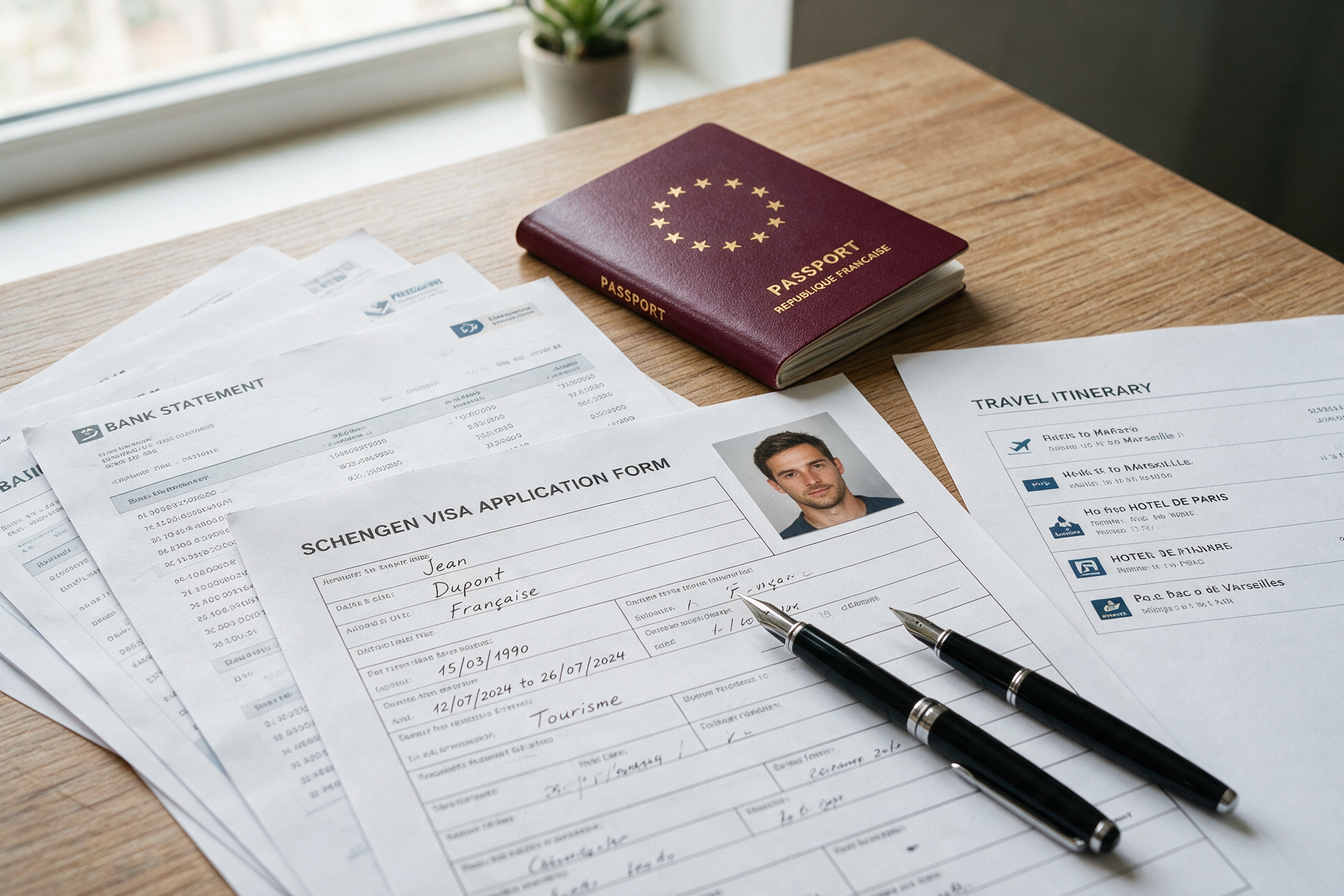
If pulling together a financially airtight file and a genuinely convincing day-by-day itinerary sounds like a lot to manage solo, this is exactly the kind of groundwork a good travel agency earns its fee on — building the itinerary that both convinces the consulate and is actually the trip you want to take, rather than two separate documents pretending to be one.

FAQs
How long does the France visa process take for Indians?
Standard processing is 15 calendar days, but budget 4-6 weeks in the off-season and 6-8 weeks from June to September, when volumes across Europe spike.
Can I apply for a France visa from any city in India?
Yes. France is one of the few Schengen countries that lets you apply at any of its 14 VFS centres nationwide, regardless of which state you live in.
Do I need to buy my flight tickets before applying?
No — a confirmed but unpaid itinerary reservation is enough. Many travel agents and airlines can issue these holds free of charge specifically for visa applications.
What’s the minimum bank balance required for a France visa?
There’s no single fixed number, but consulates expect your statements to comfortably cover roughly EUR 65/day of your trip (with accommodation booked), shown consistently over 3-6 months rather than as a one-time deposit.
Is a France Schengen visa the same as visas for other Schengen countries?
It’s the same visa category (Type C Schengen visa) and it does let you travel across the Schengen Area, but you apply through the consulate of the country where you’ll spend the most time or first enter — so if France is your main destination, you apply through the French system specifically.
Do children need a separate visa application?
Yes, every traveller needs their own application and photo, though the consular fee is reduced for children aged 6-11 and waived for those under 6.
What happens if my France visa gets rejected?
You can reapply with a stronger file, and in some cases appeal the decision through the consulate. Most rejections for Indian applicants trace back to incomplete financial documentation rather than an outright ineligibility, so addressing the specific reason given (it’s stated in the refusal letter) usually resolves it on a second attempt.
Planning the trip itself
Getting the visa right is half the job — the other half is building an itinerary genuinely worth those 90 days of eligibility. If you’re mapping out how many days to spend between Paris, the Riviera, and beyond, our France 7 nights, 8 days itinerary is a solid starting frame, and our France travel guide has the full destination overview, including where to stay and what each region is actually like on the ground.
Get Tripped Travels puts together custom France itineraries built specifically to make this paperwork straightforward — real hotel bookings, a day-by-day plan that holds up to consular scrutiny, and a trip you’d actually want to take once the visa’s approved. If you’re ready to start building yours, get in touch with our France specialists and we’ll handle the planning end to end.