Eight days in Jordan sounds generous until you actually sit down with a map. Petra wants two full days, Wadi Rum is a four-hour drive from anywhere else worth being, and the Dead Sea is the kind of place where the first hour is a novelty and the second is when you realize you should’ve booked the spa afternoon too. Seven nights is the number that keeps coming up in our planning calls at Get Tripped, and after running this route more times than I can count, it’s because it’s the shortest trip that doesn’t force you to cut Petra down to a rushed half-day.
This is the itinerary we build most often for Indian travelers heading to Jordan: Amman, Petra, Wadi Rum, and the Dead Sea, with a day built in for Aqaba’s Red Sea coast if you want to swap out the spa day for snorkeling instead.
Table of Contents
- The route at a glance
- Day 1 – Arrival in Amman
- Day 2 – Amman city day
- Day 3 – Drive south via the King’s Highway
- Day 4 – Petra, day one
- Day 5 – Petra, day two, then on to Wadi Rum
- Day 6 – Wadi Rum to the Dead Sea
- Day 7 – Dead Sea
- Day 8 – Departure
- What this costs
- If you’d rather swap something out
- FAQs
The route at a glance
Amman → King’s Highway (Madaba, Mount Nebo, Kerak Castle) → Petra (2 nights) → Wadi Rum (1 night, desert camp) → Dead Sea (2 nights) → back to Amman for departure. It’s a loop that never backtracks, which matters more than it sounds — Jordan’s roads are good but distances are real, and nobody wants to drive the Desert Highway twice in one trip just because the itinerary zigzagged.
Day 1 – Arrival in Amman
Most flights from India land into Queen Alia International Airport in the evening (Royal Jordanian runs direct Mumbai-Amman service four times a week, on an A320neo, landing you in roughly 4.5-5 hours — genuinely one of the easier long-haul-adjacent routes out of India). Clear immigration, grab a pre-arranged taxi or Careem into the city (30-40 minutes, roughly 15-20 JOD), and call it a night. Don’t schedule anything for this evening. You’ll be tired in a way that sneaks up on you, and Amman’s downtown restaurants run late anyway — Hashem, the downtown institution that’s been serving falafel and hummus since 1952, stays open well past midnight if you land hungry.
Day 2 – Amman city day
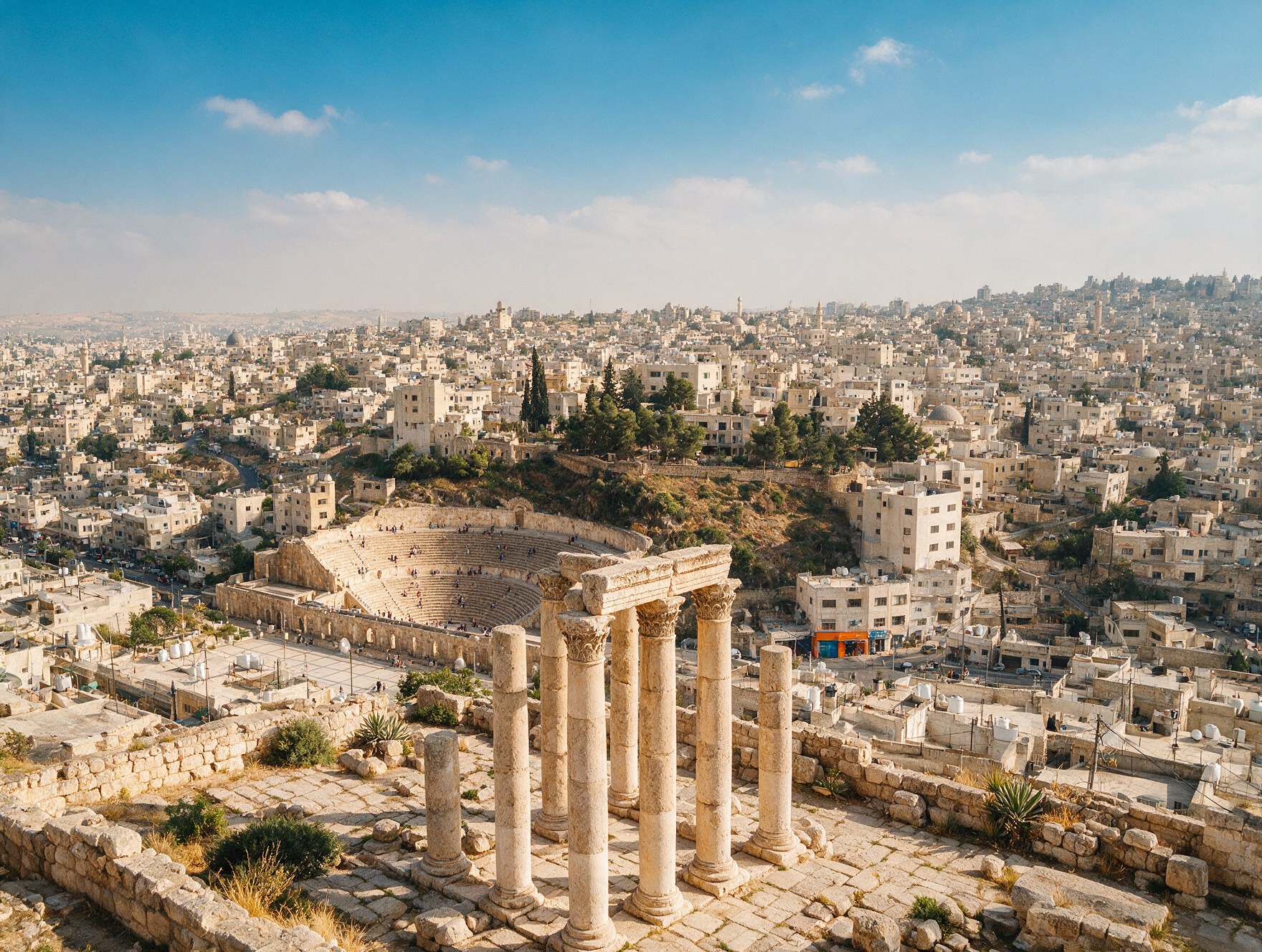
Spend the morning at the Citadel (Jabal al-Qal’a), which sits on the highest of Amman’s seven hills and gives you the best orientation view of the city you’ll get all trip — the Roman Theatre below, the white limestone sprawl of downtown, minarets catching the light. From there it’s a short walk or five-minute taxi down to the Roman Theatre itself and the souks of downtown (Al Balad), where the spice stalls alone are worth forty minutes of wandering even if you buy nothing.
In the afternoon, walk Rainbow Street — Amman’s best-known strip for cafés, small galleries and a genuinely good sunset view from the terrace at Wild Jordan, looking out over Lweibdeh. Have dinner at Sufra, which does Jordanian food in a converted villa with an open terrace; the eggplant-based mutabbal here is better than at most places charging twice as much for the same dish.
Day 3 – Drive south via the King’s Highway
Skip the Desert Highway today and take the King’s Highway instead — it’s slower (about 4-5 hours total driving with stops versus 3 hours flat), but it’s also the only way to see Madaba’s Byzantine mosaic map of the Holy Land inside St. George’s Church, climb Mount Nebo for the view Moses reportedly had of the Promised Land, and walk the ramparts of Kerak Castle, a Crusader fortress that’s far less crowded than anything in Petra and genuinely dramatic in its own right. Arrive in Wadi Musa (Petra’s gateway town) by early evening and have dinner looking toward the hills — most of the hotel-adjacent restaurants here do a solid mezze spread, and after a day on winding mountain roads, that’s really all you want.
Day 4 – Petra, day one
Enter at opening time, which matters more in Petra than almost anywhere else on this trip — by 10am the Siq, the narrow canyon walkway that delivers you to the Treasury, is a slow-moving crowd of tour groups, and the famous first-glimpse-of-the-Treasury moment gets a lot less magic with fifty other phones raised at the same angle. The walk through the Siq alone takes 25-30 minutes. Spend the day working through the Street of Facades, the Royal Tombs, and the Great Temple, and don’t rush it — this is one full day and it will still feel too short.
A caveat, honestly: the heat inside the Siq in summer is genuinely punishing by midday, with almost no shade and stone that radiates warmth back at you. If you’re visiting June through August, do the Treasury walk at opening and save the uphill tombs for late afternoon instead.
Day 5 – Petra, day two, then on to Wadi Rum
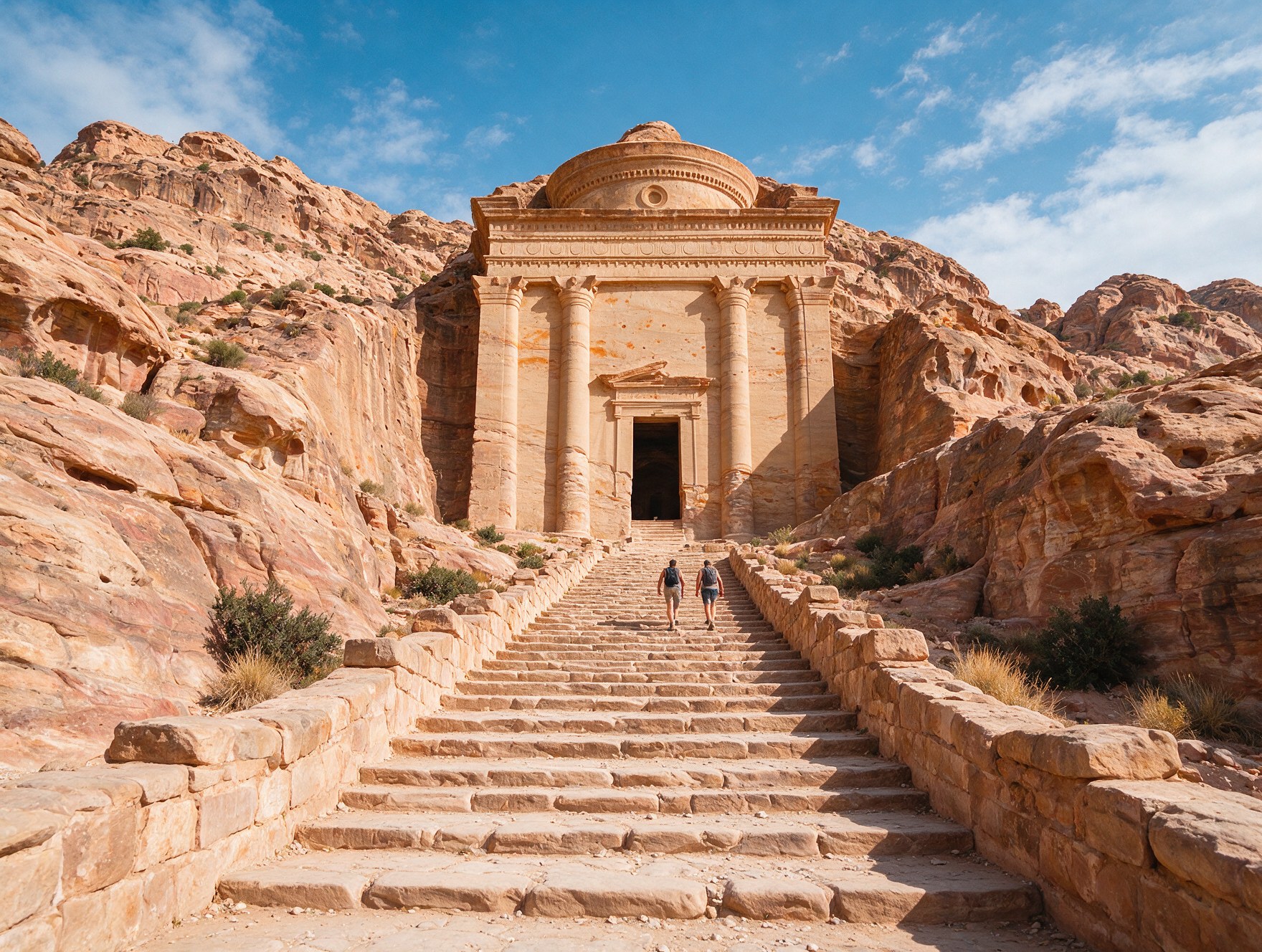
This is the day most people skip if they only bought a one-day Jordan Pass, and it’s the day I’d argue matters most: the hike up to the Monastery (Ad-Deir), roughly 800-900 rock-cut steps depending on who’s counting, rewarded with a structure larger than the Treasury and a fraction of the crowd. Go early, bring more water than feels necessary, and if your knees complain on the way down, the donkey operators at the base are a legitimate option, not just a tourist trap — just agree the price before you get on.
By early afternoon, head south to Wadi Rum (roughly 1.5-2 hours by car from Wadi Musa). Check into a Bedouin desert camp, take a jeep tour through the rock formations at Khazali Canyon and Lawrence’s Spring as the light goes gold, and eat dinner cooked zarb-style — buried under sand and hot coals, which sounds like a gimmick until you taste how evenly it cooks the lamb and vegetables. Sleep under a sky with essentially zero light pollution; this is one of the best stargazing spots anywhere in the Middle East, Bedouin camp or otherwise.
Day 6 – Wadi Rum to the Dead Sea
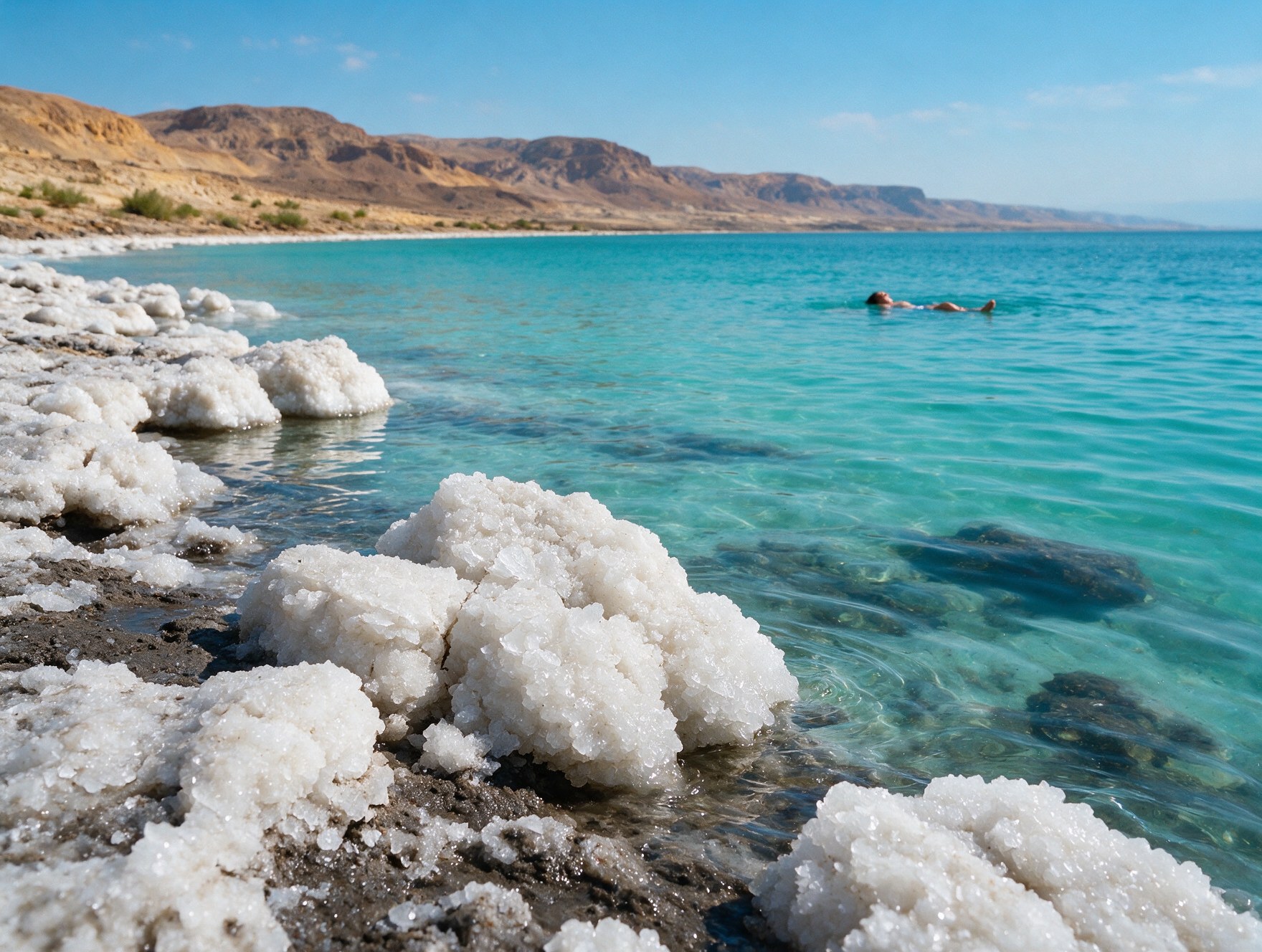
Catch sunrise over the desert before you leave — it’s a different landscape entirely in that first light, all long shadows and warm rock. Then it’s a longer transfer day, roughly 3.5-4 hours north to the Dead Sea depending on your exact camp location and route. Arrive by afternoon and get in the water before dinner; the mineral concentration here (close to ten times that of regular seawater) means you float without trying, which is a strange, genuinely funny sensation the first time, less so once the salt finds a paper cut you forgot about.
Day 7 – Dead Sea
A full, deliberately slow day. Most of the good resorts here (Kempinski, Hilton Dead Sea, Mövenpick) offer day access to their pools and private beach even if you’re not staying there, along with the Dead Sea mud treatments that are genuinely worth doing once — the mineral mud dries tight on your skin in the sun, and rinsing it off afterward leaves your skin feeling noticeably different, not just spa-marketing different. This is also the day to build in if you’d rather swap toward Aqaba instead (see the variations section below).
Day 8 – Departure
The Dead Sea sits about an hour from Queen Alia International Airport, which makes this an easy final morning — a slow breakfast, one last float if your flight’s in the afternoon, then back to Amman for your return flight.
What this costs
For a mid-range version of this exact route — private driver rather than self-drive, 3-4 star hotels and one proper desert camp night — budget roughly ₹1,20,000-₹1,50,000 per person including flights and the Jordan Pass. Push toward boutique hotels in Petra, a premium Wadi Rum camp with an en-suite tent, and Dead Sea resort stays, and that climbs toward ₹2,00,000+ per person. Either way, Petra entry and your visa fee are already folded into the Jordan Pass cost if you’re staying the required three nights, which this itinerary comfortably clears.
If you’d rather swap something out
Families with younger kids often trade one Dead Sea night for a night in Aqaba instead — the Red Sea here is calmer, there’s actual swimming and snorkeling over coral reefs rather than just floating, and it breaks up the trip with something more active. Couples on a slower trip sometimes add a ninth night and a detour to the Dana Biosphere Reserve between Petra and Wadi Rum, which trades a few hours of driving for a genuinely quiet hiking day with almost nobody else around — worth it if you’ve done Jordan’s big sights before and want the version fewer people see.
Where to stay, stop by stop
In Amman, the Jabal Amman and Abdoun neighborhoods put you closest to Rainbow Street and the better restaurant scene; mid-range options here run comfortable rather than basic, and properties like the Amman Marriott or boutique guesthouses in Jabal Amman both work well depending on whether you want a pool or more local character. In Petra, stay in Wadi Musa itself rather than further out — the Mövenpick Resort Petra sits essentially at the site entrance, which matters on the mornings you want to beat the crowds into the Siq. Wadi Rum means a desert camp, full stop; choose one with en-suite tents (several camps now offer “bubble” tents with glass domes for stargazing from bed) if comfort matters more to you than full Bedouin authenticity. At the Dead Sea, the resort strip around Sweimeh (Kempinski, Mövenpick, Hilton) is where almost everyone stays, and the differences between them come down to beach frontage and spa quality more than location.
Notes for different kinds of travelers
Solo travelers will find this itinerary works well with a private driver shared across a small group tour, which brings the per-person transfer cost down significantly versus booking a solo private car for the whole week. Wadi Rum camps are also genuinely sociable for solo travelers, since dinner is served communally regardless of how you booked.
Couples should consider upgrading at least one night — a Petra boutique hotel with a canyon view, or a Wadi Rum luxury bubble tent — since this is consistently the itinerary where honeymoon and anniversary trips land, and the desert sunset-and-stars combination does a lot of the romantic heavy lifting on its own.
Families with kids under ten should budget extra time at each stop rather than treating this as a fixed 7-night sprint; the Monastery hike on Petra’s second day in particular is long for young legs, and it’s fine to let that be a half-day rather than a full one. The Dead Sea float is reliably a hit with kids, incidentally, in a way that surprises a lot of parents.
Luxury travelers can run essentially this same route with meaningful upgrades at every stop — a private Petra guide who can time your entry to the exact minute crowds thin out, a premium Wadi Rum camp with private plunge pools now offered at a couple of operators, and spa-day add-ons at the Dead Sea resorts that turn Day 7 into something closer to a retreat than a stopover.
Photography notes along the route
The single best photography window on this entire itinerary is the Treasury at Petra in the first twenty minutes after the site opens, when the low sun angle lights the rose-colored facade without the crowd of tripods and tour groups that build up by mid-morning. In Wadi Rum, blue hour (the 20-30 minutes after sunset, before full dark) photographs better than the sunset itself, with the rock formations holding warm color against a deepening sky. At the Dead Sea, bring a waterproof phone case or pouch if you want photos of the actual floating moment — it’s a genuinely fun shot, and regular phones don’t appreciate the salt concentration.
FAQs
Is 7 nights enough for Jordan?
Yes, for the core route of Amman, Petra, Wadi Rum and the Dead Sea, 7 nights (8 days) is comfortable and includes two full days in Petra, which most shorter itineraries have to cut.
How many days should I spend in Petra?
Two full days minimum if you want to see both the Treasury/Royal Tombs circuit and hike to the Monastery. One day means choosing between them.
Can I do Jordan without a rental car?
Yes — most Get Tripped itineraries use a private driver for exactly this route, since JETT buses don’t reliably connect Wadi Rum or the Dead Sea, and self-driving the mountain roads around Petra isn’t something we’d recommend for a first visit.
Should I visit Aqaba or the Dead Sea?
If you have time for both, do both. If you’re choosing one, pick the Dead Sea for the novelty-float experience and spa culture, or Aqaba if you’d rather snorkel and want a more active day.
What’s the best order to see Petra, Wadi Rum and the Dead Sea?
Petra first (it’s the furthest point if you’re routing via the King’s Highway from Amman), then Wadi Rum, then loop back north to the Dead Sea on your way to the airport — which is exactly this itinerary’s structure, and avoids backtracking.
Is this itinerary suitable for families?
Mostly yes, with one caveat: the Monastery hike on Petra’s second day is a real climb, not a stroll, so plan for a slower pace or skip that specific hike with younger children while still enjoying the Treasury and Royal Tombs.
Before you go
This route is the backbone of most of Get Tripped’s Jordan packages, built around the Jordan Pass math, a private driver who knows which Petra entrance avoids the mid-morning crowds, and a desert camp we’ve actually vetted rather than picked off a booking site. See our full Jordan travel guide or get in touch and we’ll adjust this exact itinerary around your dates.