Right around 5pm in November, the sun over the Dead Sea doesn’t set in front of you — it drops behind the hills on the West Bank side, across the water, and the whole sea turns the color of hammered copper for a while before the light fades to violet. If you’re floating at that moment, on your back, salt water holding you up without any effort on your part, it’s the kind of fifteen minutes that makes the whole detour from Amman worth it. Most first-time visitors plan their Dead Sea day around the midday float and miss this part entirely — they’re already checking out of the spa by the time the good light starts.
The Dead Sea sits roughly 430 metres below sea level, the lowest point on dry land anywhere on Earth, and its water carries a salt concentration of around 34% — almost ten times saltier than the ocean. That’s the whole reason you float here without trying: the water is simply too dense for your body to sink into. It’s also why the evenings here work differently from a beach holiday anywhere else. There’s no nightlife strip, no boardwalk bars. What there is instead is a string of resort terraces along the Jordanian shore at Sweimeh, each one facing west, each one built around the idea that the best part of the day happens after the heat breaks.
This guide covers where that evening actually happens on the Jordanian side — the resort pools and terraces worth timing your sunset around, the mud rituals that feel different once the sun is low, a quieter stretch of beach most tour groups skip, and what to actually know before you float. If you’re weighing this against the rest of a Jordan itinerary, the Dead Sea usually anchors the final leg after Petra — and a number of our 7-night Jordan itineraries and Petra and Dead Sea tour packages are built around exactly that rhythm.
Table of Contents
- Why Evening Is the Best Time at the Dead Sea
- Getting There From Amman
- Where to Stay: The Sweimeh Resort Strip
- Best Resort Pools and Terraces for Sunset
- A Quieter Stretch of Shoreline
- Why You Float: The Science (and a Mistake to Avoid)
- Evening Mineral Mud Rituals
- Rooftop Lounges and Terrace Bars
- Stargazing Once the Resort Lights Dim
- Best Time of Year for Dead Sea Evenings
- Couples, Families, and Luxury Seekers
- Practical Notes for Indian Travelers
- FAQs
- Final Thoughts
Why Evening Is the Best Time at the Dead Sea
The Dead Sea basin traps heat. Even in the cooler months, afternoons can get uncomfortably warm, and the water itself sits around body temperature for much of the year — pleasant, but not the dramatic cold-plunge contrast you might expect. Evening changes the equation. The temperature drops, the harsh overhead sun softens into something you can actually look at, and the water starts picking up color instead of just glare. Resort pool decks that feel ordinary at 2pm turn into something else entirely once the light goes gold.
There’s a practical angle too: day-trippers from Amman tend to clear out by late afternoon, which means the beach and pool areas are noticeably calmer for anyone staying overnight at a resort. If you’ve only got one evening on this coast, this is the difference between elbow-to-elbow and having a stretch of terrace to yourself.
Getting There From Amman
The Dead Sea resort area is a genuinely easy add-on to an Amman stay — it’s about a 45-minute drive from the capital down Highway 65, dropping roughly 800 metres in elevation as the road winds down through the hills. The descent itself is part of the experience: you start in Amman’s hill-country climate and end up in what feels like a different country’s weather by the time you reach the shore.
Most travelers combine this with Amman city time and a Petra leg — it’s one of the more efficient legs of a Jordan 7 days travel itinerary, usually slotted right before or after the Petra drive. Our 7-night Jordan itinerary walks through how the Dead Sea fits alongside Amman and Petra, and our day in Amman guide is worth reading before you head down.
Transit tip: private transfer is the easiest way to do this stretch — the road is well-paved but has some sharp switchbacks, and most resorts can arrange airport-to-Dead Sea transfers directly so you skip Amman traffic if you’re flying in and heading straight down. Renting a car yourself is doable, but letting someone else handle that descent after a long flight is one less thing to think about — the sort of logistics our custom Jordan itinerary planning handles so you’re not improvising transfers on arrival.
Where to Stay: The Sweimeh Resort Strip
Almost everyone who stays overnight at the Dead Sea does it in Sweimeh, the stretch of shoreline that holds nearly all of the coast’s hotels. This isn’t a town in the traditional sense — it’s a resort strip, and that’s the point. The properties here, including the Hilton Dead Sea Resort & Spa, the Mövenpick Resort & Spa Dead Sea, the Dead Sea Marriott Resort & Spa, the Kempinski Hotel Ishtar Dead Sea, the Crowne Plaza Jordan Dead Sea Resort & Spa, and the Holiday Inn Resort Dead Sea, are all built around the same basic layout: rooms set back from the water, a tiered garden or pool terrace stepping down toward the shore, and a private beach frontage with direct lake access.
Get Tripped books across this strip from mid-range to luxury — this coast doesn’t really have a backpacker tier, since the whole model here is resort-based. If sunset-watching real estate is your priority, ask specifically about west-facing rooms when booking; not every room on a resort’s footprint gets the same view.
Best Resort Pools and Terraces for Sunset
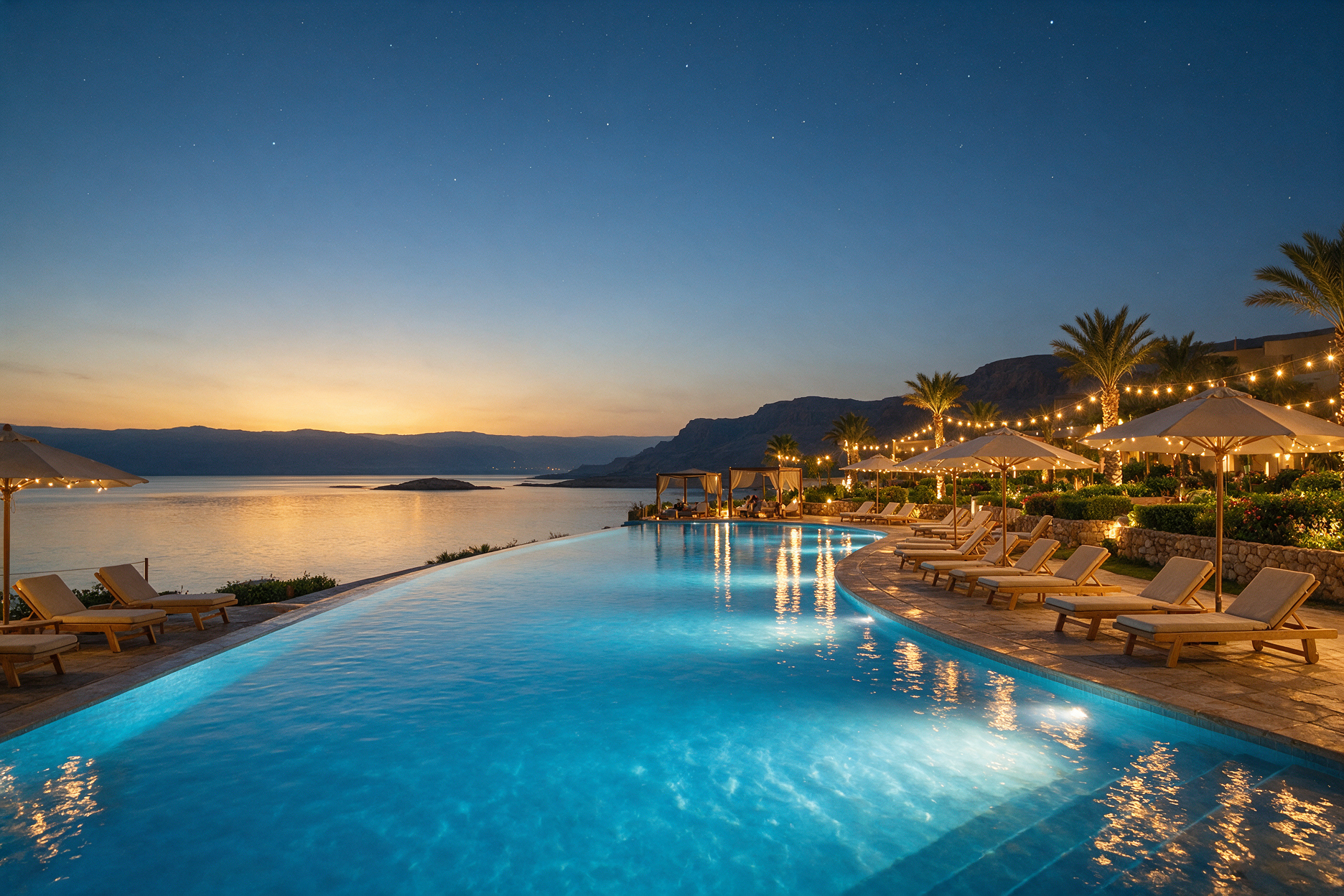
Nearly every resort on this coast has at least one infinity-edge or elevated pool angled toward the water, and the reason is obvious the first time you see it: the far shore — the hills on the Israeli-Palestinian side — sits directly across from Sweimeh, which means the sun goes down almost exactly where you’re looking if you’re facing the water from a west-facing terrace. The pools positioned on the upper tiers of a property, above the private beach rather than at beach level, tend to have the cleanest sightline, since the beach-level pools are sometimes partly screened by cabanas or palm plantings.
What actually makes a good sunset pool here isn’t infinity edges or Instagram geometry — it’s simply an unobstructed west-facing position and a bar or lounge nearby that doesn’t rush you out. Ask at check-in which pool tier on the property catches sunset best; staff at these resorts answer this question daily and will point you to the right terrace without you having to guess.
Photography tip: the best light isn’t the moment the sun actually touches the horizon — it’s the ten minutes after, once the sun has dropped behind the far hills and the sky holds a deep pink-to-violet gradient while the water keeps a flat, mirror-like calm. Shoot toward the water with the pool’s infinity edge or a lounger silhouette in the foreground rather than including the sky as the main subject; the water’s reflected color is usually more interesting than the sky itself at this latitude.
A Quieter Stretch of Shoreline (and a Viewpoint Most Tours Skip)
Two things worth knowing if you want evening without a crowd. First: the Dead Sea Panoramic Complex, on the descent road between Amman and Sweimeh, has a terrace and small museum built specifically as a viewpoint over the sea — most day-tour buses stop here briefly on the way down for photos, but almost nobody stays for sunset, since by then the tour groups are already down at a resort pool. If your schedule allows a short stop on the way down rather than straight through, it’s a genuinely different vantage point: elevated, looking down over the whole basin rather than out across it at water level.
Second, if you’re not staying at a resort with private beach access, the public Amman Tourist Beach does allow evening access and clears out considerably once the day-trip crowds leave in late afternoon — it won’t match a private resort beach for amenities, but it’s a legitimate way to get a quieter stretch of shoreline at dusk without a room booking tied to it. Resort guests get the better version of this by default, since private beaches are restricted to hotel guests, but it’s worth knowing the public option exists if your trip is structured differently.
Why You Float: The Science (and a Mistake to Avoid)
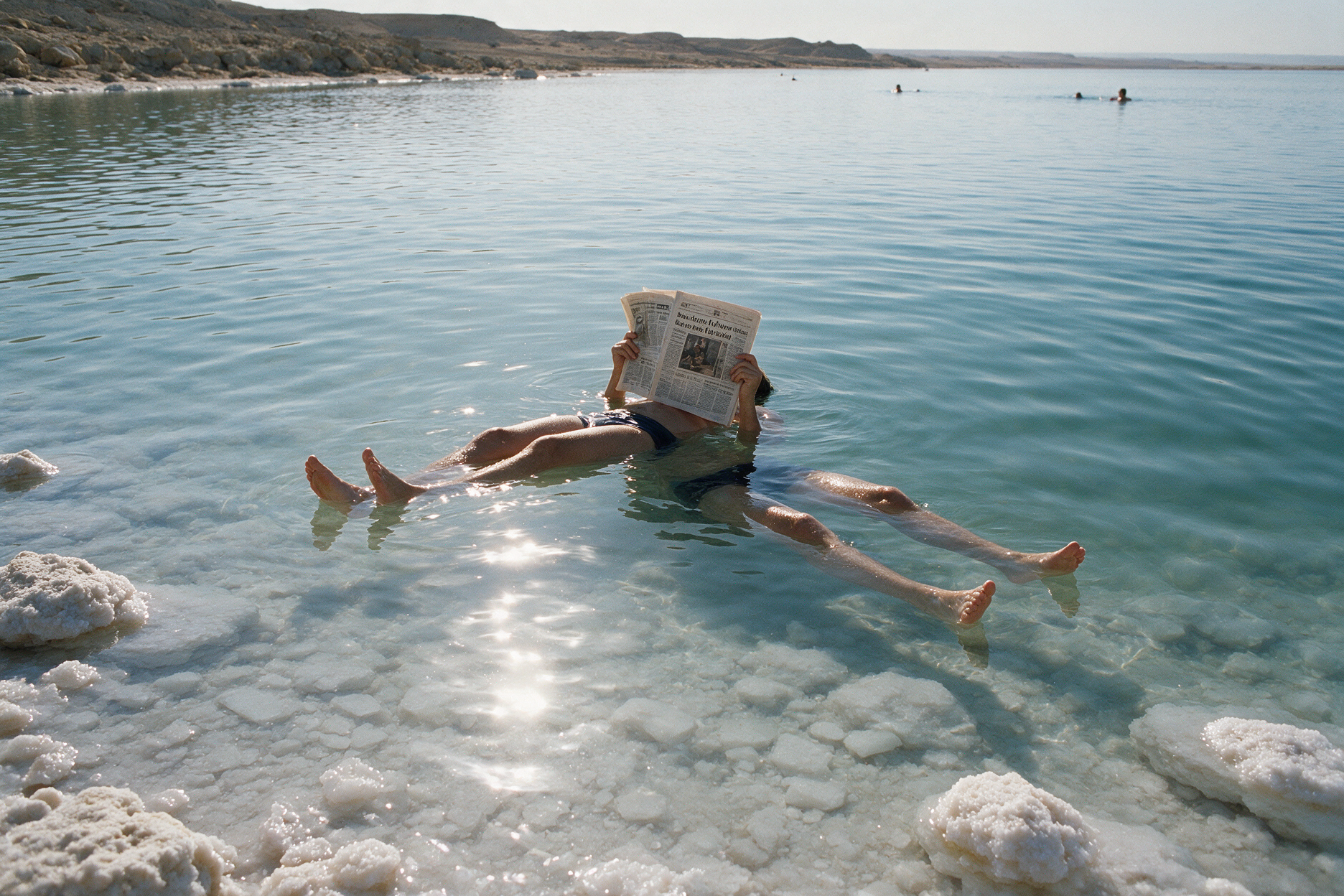
The float isn’t a trick of buoyancy aids or shallow water — it’s density. At roughly 34% salinity, Dead Sea water is dense enough that an average human body, which is only slightly denser than plain water, floats on the surface here almost without effort. You don’t swim in it so much as sit back into it, the same way you’d lean into a reclined chair.
The water is genuinely harsh, though, and this is where most first-timers make a mistake. Don’t shave for at least 24–48 hours before you go in — any fresh razor nick will sting sharply the moment it touches this water, and so will any small cut or scrape you didn’t notice you had. Keep your face dry and tilted back; getting the water in your eyes causes real burning pain, not just mild discomfort, because of how concentrated the minerals are. Most resorts cap a single float session at around 10–15 minutes for exactly this reason — the water pulls moisture out of skin fast, and longer sessions do more harm than good. Ease in backward, sit down first, then lean back slowly rather than trying to swim in normally; normal swimming strokes don’t really work here and tend to splash water toward your face.
Smart-spending tip: you don’t need to buy bottled Dead Sea mud or salt products at the resort gift shop at Jordanian resort prices — the same products are sold at pharmacies and souvenir shops in Amman and at Queen Alia International Airport’s duty-free for noticeably less, and they’re the same source material either way.
Evening Mineral Mud Rituals
Daytime mud application is the classic photo — the thick, near-black clay smeared on and left to dry in direct sun. In the evening, most resorts run a gentler version: the mud goes on while you’re seated on the beach or a treatment terrace, you let it set for a shorter window in the cooling air rather than full sun, then rinse off in the sea or a freshwater shower before dinner. It’s less about the sunbaked look and more about the mineral soak, and a number of travelers find it more comfortable than the midday version simply because there’s no risk of overheating while it sits.
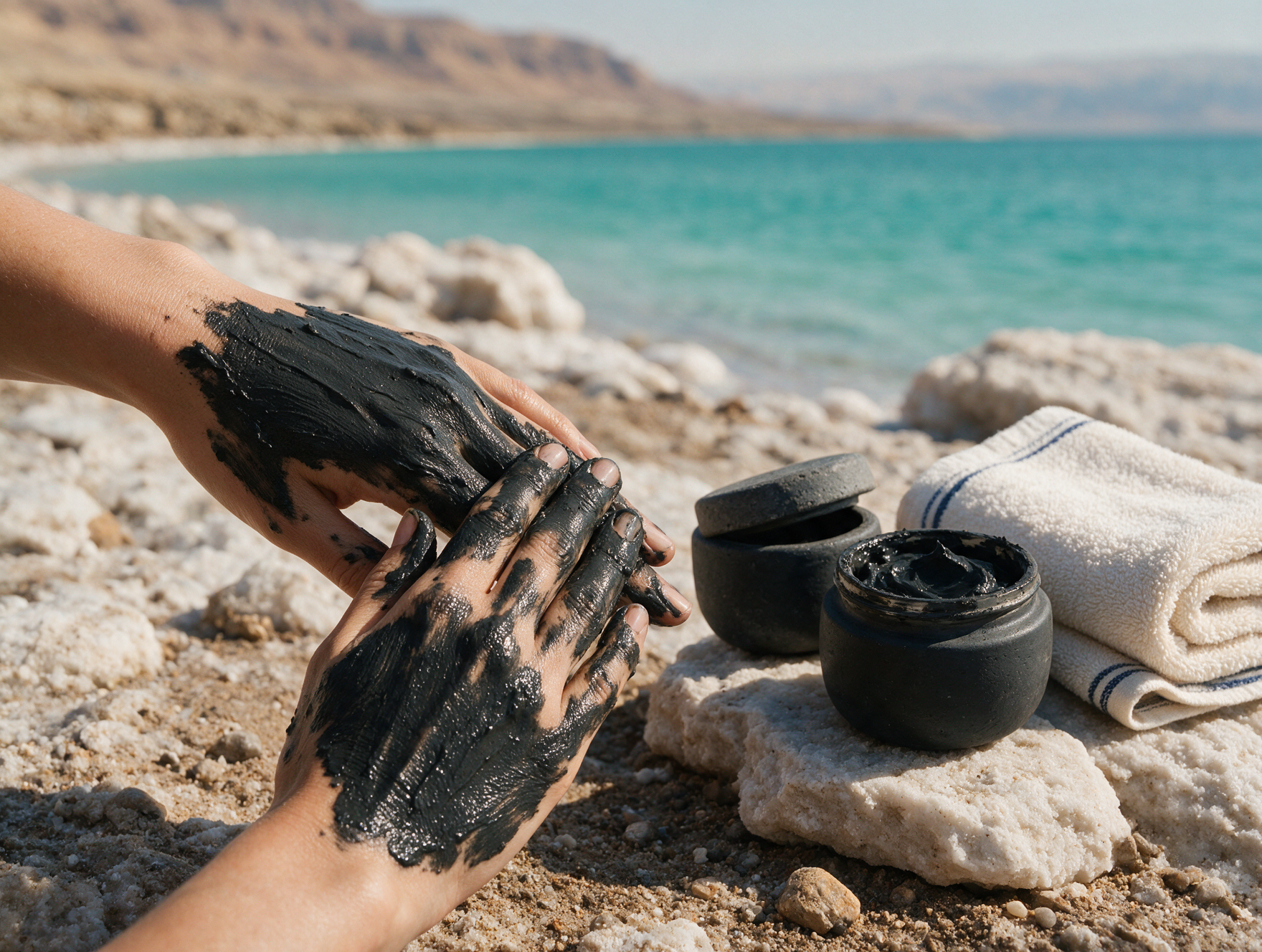
If you want to time this for the evening rather than midday, ask your resort’s spa desk when you check in — not every property runs the mud station after a fixed hour, and some only staff it during daylight, so confirming on arrival saves a wasted trip down to the beach after dinner.
Rooftop Lounges and Terrace Bars
This isn’t a nightlife destination in the usual sense — there’s no strip of bars to hop between, and Jordan’s a conservative country generally, so what’s on offer is resort-contained. What you will find at most of the larger properties is an elevated lounge or terrace bar, usually one level up from the pool deck, built specifically to catch the same west-facing view as the pools below. These work well for a slower second half of the evening: a drink in hand once the mud and float are done, watching the sky finish its colors before the stars take over. A few properties run a shisha lounge or terrace grill in the same spot, which tends to be the most social version of the evening if that’s what you’re after. Check your specific resort’s listed hours directly, since terrace bar service can wind down earlier on weeknights outside peak season.
Stargazing Once the Resort Lights Dim
Once pool lighting and terrace lanterns dim down later in the evening, the Dead Sea basin’s isolation starts to show. There’s minimal large-scale urban light pollution directly around Sweimeh compared to Amman, and the basin’s position — walled in by hills on both sides — blocks a lot of ambient glow from reaching the shoreline itself. It’s not a dedicated dark-sky reserve, but on a clear, moonless night away from the brightest pool areas, the stretch of beach past the main lit walkways gives a genuinely good view of the sky, especially in the drier winter months when haze is lower. Bring a light jacket — the basin cools off noticeably once the sun’s fully down, even though the daytime heat makes that hard to believe.
Best Time of Year for Dead Sea Evenings
This is one of the places in Jordan where season matters more than most. Summer (June through September) is brutally hot here even after dark — the basin holds heat, and a Dead Sea evening in July can still sit in the mid-30s°C well after sunset, which takes the edge off the whole experience. If you’re weighing a summer holiday in Jordan or a trip in the June to October window, Petra and Amman are more forgiving than the Dead Sea basin specifically during that stretch.
The better call, and generally the answer to best time to visit Jordan as a whole, is spring (March–May) or autumn (September–November), when daytime highs are manageable and evenings actually cool down enough to enjoy sitting outside. Winter (December–February) works too and is mild by Indian winter standards, though evenings can get genuinely cold by the water, so pack accordingly if you’re going Dead Sea-side in January.
Couples, Families, and Luxury Seekers
Couples: this is one of the more naturally romantic evenings in Jordan without any effort required — a west-facing terrace table, a slow float at golden hour, and a mud ritual that doubles as a shared activity rather than a solo spa treatment. Several resorts on this strip lean into honeymoon bookings specifically and can arrange a terrace dinner table timed to sunset if you ask when booking.
Families: floating is genuinely fun for kids old enough to follow the “keep your face dry” rule (most resorts set a minimum age or require close supervision for younger children in the sea itself), and the pool decks are a safer, chlorinated alternative for anyone not ready for the real sea. Evening is also just easier with kids here than midday, heat-wise.
Luxury seekers: the Kempinski Ishtar and the Marriott lean toward more elaborate spa programs and private cabana setups, where the evening ritual gets a fuller treatment — multi-step mud and mineral programs rather than a quick self-serve station. Worth booking the spa slot in advance, since evening slots are the ones everyone else wants too.
Practical Notes for Indian Travelers
Jordan issues a visa on arrival for Indian passport holders at major entry points including Queen Alia International Airport, which makes this an easier add to a Jordan or combined Egypt and Jordan tour package from India than many Indians initially assume — do confirm current fees and documentation with the airline or a travel consultant before you fly, since on-arrival visa rules can be adjusted without much notice.
On safety: Jordan is consistently rated among the more stable, tourist-friendly countries in the region, and the Dead Sea resort strip is a contained, well-run tourism zone — about as reassuring an answer to is Jordan safe for Indian tourists as you’ll find anywhere in the country. Normal travel precautions apply, nothing beyond that.
On cost: resort stays here sit in the mid-range to luxury band, and that’s reflected in Jordan trip cost from India estimates — expect this to be one of the pricier per-night legs, offset by it usually being just one or two nights. Cards work fine at resorts; smaller vendors skew more cash-friendly.
If you’d rather not plan the visa, transfers, and resort selection piece by piece, this is exactly the kind of leg we build into Jordan vacation packages and Jordan family holiday packages — the logistics of getting the timing right (which resort, which room tier, which night) is most of the work, and it’s worth having that handled rather than guessing from a hotel aggregator site.
FAQs
Is the Jordanian side of the Dead Sea better than the Israeli side for evenings?
They’re the same body of water, but the experience differs by shoreline. The Jordanian side at Sweimeh is almost entirely resort-based, with private beaches attached to each hotel, which makes evening access straightforward if you’re staying there. It’s less about one side being objectively “better” and more about which shore your itinerary and visa situation puts you on — for most Indian travelers combining Petra and Amman, the Jordanian side is the natural fit.
Do I need to be a resort guest to watch the sunset over the Dead Sea?
No — the Dead Sea Panoramic Complex viewpoint on the Amman–Sweimeh road and the public Amman Tourist Beach are both open to non-guests. That said, resort guests get the better version: a private beach, a pool terrace, and no need to leave right after the light fades.
How long should I actually float each time?
Most resorts and guides recommend capping it at around 10–15 minutes per session. The water’s mineral concentration is tough on skin with extended exposure, and there’s little benefit to staying in longer than that — short sessions with a rinse in between work better than one long float.
Can I shave before going to the Dead Sea?
Not right before. Leave at least 24–48 hours between shaving and floating — fresh razor nicks sting intensely in this water, even ones too small to notice otherwise.
Is it safe to float in the Dead Sea at night?
Most resorts restrict sea access to daylight and early evening hours for safety and staffing reasons, rather than allowing floating after full dark. Evening pool access typically runs later, so plan your float for the hour or two around sunset rather than after the beach officially closes.
What should I pack for a Dead Sea evening?
Water shoes (the salt crystal formations near shore are sharp), a light jacket or wrap for once the sun’s down and the temperature drops, and swimwear you’re comfortable might get mineral-stained. Leave good jewelry in the room — the salt corrodes metal.
How many nights should I spend at the Dead Sea?
One or two nights is standard and enough to get a full evening cycle — float, mud, sunset terrace, and a stargazing walk — without it crowding out Petra and Amman time on a typical week-long trip.
Is the Dead Sea suitable for people with health conditions?
The high mineral content affects skin and can interact with blood pressure and certain skin conditions, so it’s worth a quick check with your doctor before the trip if you have any ongoing concerns, same as you would before any mineral spa treatment.
Final Thoughts
The Dead Sea’s evening hours are the part of the itinerary that photos undersell — everyone’s seen the newspaper-floating shot, but almost nobody shows the hour after, when the resort pool decks empty out, the far hills go dark, and the whole basin quiets down into something closer to a private spa than a tourist stop. If you’re building out a Jordan trip and wondering where to anchor a slower, resort-based night between Amman and Petra, this is it.
Get Tripped puts together Petra and Dead Sea tour packages and full Jordan tour packages from India that handle the visa, the transfers down from Amman, and the resort selection on this strip, so the only decision left on your end is which terrace to watch the sunset from. If you’d rather build it stop by stop yourself, start with our Jordan destination page and our Jordan hidden gems guide for what else belongs on the route, and check our visa guide for Indian travelers before you book flights.
Ready to build your Jordan itinerary around the Dead Sea’s evenings? Get in touch with Get Tripped for a custom Jordan itinerary or to book your Jordan holiday — we’ll handle the resort picks, the transfers, and the timing so you land on that terrace right as the light turns gold.