Our guide cut the jeep’s headlights about four kilometres past the Wadi Rum Visitor Centre, and for a second the desert went completely black — no streetlight, no glow on the horizon, nothing between us and what felt like every star that exists. That blackout is the moment most people remember when they talk about Wadi Rum. But it’s the last hour of a day that’s just as striking in full sun: red dunes, granite-and-sandstone domes that are older than most of the planet’s mountain ranges, and a silence that most of our guests tell us they’ve genuinely never experienced before, not even in rural India.
If you’re building a Jordan 7 days travel itinerary, Wadi Rum isn’t a box to tick between Petra and the Dead Sea — it’s the one night most travellers rank above everything else afterward. This is a real, hour-by-hour account of a day and night here: what you’ll actually do, what it costs, which camp tier makes sense for who, and the two or three things we’d tell a friend to avoid. We’ll also point out where the “Wadi Rum” of Instagram (budget tent, shared bathroom, 40 people around one fire) differs from the version we book for most Get Tripped travellers — private bubble tents, a camp with its own kitchen, a jeep that isn’t shared with three other families.
Table of Contents
- Why Wadi Rum Deserves a Full Day, Not a 90-Minute Loop
- Getting to Wadi Rum: Timing Your Arrival
- 6:00 AM — Sunrise Over the Valley of the Moon
- 8:00 AM — Breakfast, Then the Climb
- 10:30 AM — Khazali Canyon and the Quieter Alternative
- 12:30 PM — Bedouin Lunch Under Canvas
- 2:00 PM — Quiet Camp Time or Lawrence’s Spring
- 4:30 PM — Golden Hour at the Red Dune
- 6:30 PM — Sunset and the Seven Pillars
- 7:30 PM — Dinner Under a Bedouin Spread
- 9:00 PM — Why Wadi Rum’s Night Sky Is Genuinely Different
- Where to Stay: Choosing the Right Camp Tier
- Best Time to Visit Wadi Rum
- What a Day in Wadi Rum Actually Costs
- Visa and Getting to Jordan From India
- Who This Day Is Actually For
- FAQs
- Final Thoughts
Why Wadi Rum Deserves a Full Day, Not a 90-Minute Loop
A lot of day-trip itineraries squeeze Wadi Rum into a two-hour jeep loop between Petra and Aqaba — wheels up, a few photo stops, wheels down. It’s better than skipping it, but it’s also the single biggest miss we see people make when planning Jordan trips. The two-hour version shows you sand and rock. The overnight version shows you why Bedouin families have lived in this valley for generations: the light changing the same cliff’s colour four times in six hours, the quiet that arrives the second the day-trip jeeps leave, the sky that only shows up after dark.
Wadi Rum sits roughly halfway between Petra and Aqaba, so an overnight here doesn’t add a detour to a 7-day Jordan itinerary — it simply replaces a transit night with an experience night.
Getting to Wadi Rum: Timing Your Arrival
From Amman, it’s about 315 km and a 4-hour drive down the Desert Highway. From Petra (Wadi Musa), it’s closer and faster — roughly 100 km and 1.5 hours, which is why most itineraries sequence Petra first and Wadi Rum second. If you’re coming straight from Amman, leave by mid-morning so you reach the Visitor Centre with daylight left for an afternoon activity before camp check-in; camps want guests handed off to a 4×4 before light starts dropping, since the unpaved tracks aren’t fun to navigate in the dark.
Smart-spending and transit tip: if you’re also visiting Petra (almost everyone is), don’t backtrack through Amman between the two. Book a private transfer or taxi straight from Wadi Musa to Wadi Rum — it’s a 1.5-hour run on a mix of the King’s Highway and Desert Highway, and it saves you a full extra transit day compared with routing back through the capital.
6:00 AM — Sunrise Over the Valley of the Moon
Most camps offer a short sunrise jeep run, usually a 2-hour loop that leaves before the camp’s own breakfast service starts. It’s genuinely worth the early alarm. Wadi Rum earned the nickname “Valley of the Moon” for its stark, cratered look, and sunrise is when that look is most literal — the sand reads almost grey-pink in the first light, nothing like the saturated orange of the postcards, and the rock domes throw shadows that stretch for what feels like half the valley.
Photography tip: shoot in the first 20 minutes after the sun clears the horizon, not right as it rises. The very first light is flat and slightly blue; ten to fifteen minutes later the sand starts picking up a warm rose-gold tone that holds for a surprisingly short window before the midday glare flattens everything to white-yellow.
8:00 AM — Breakfast, Then the Climb
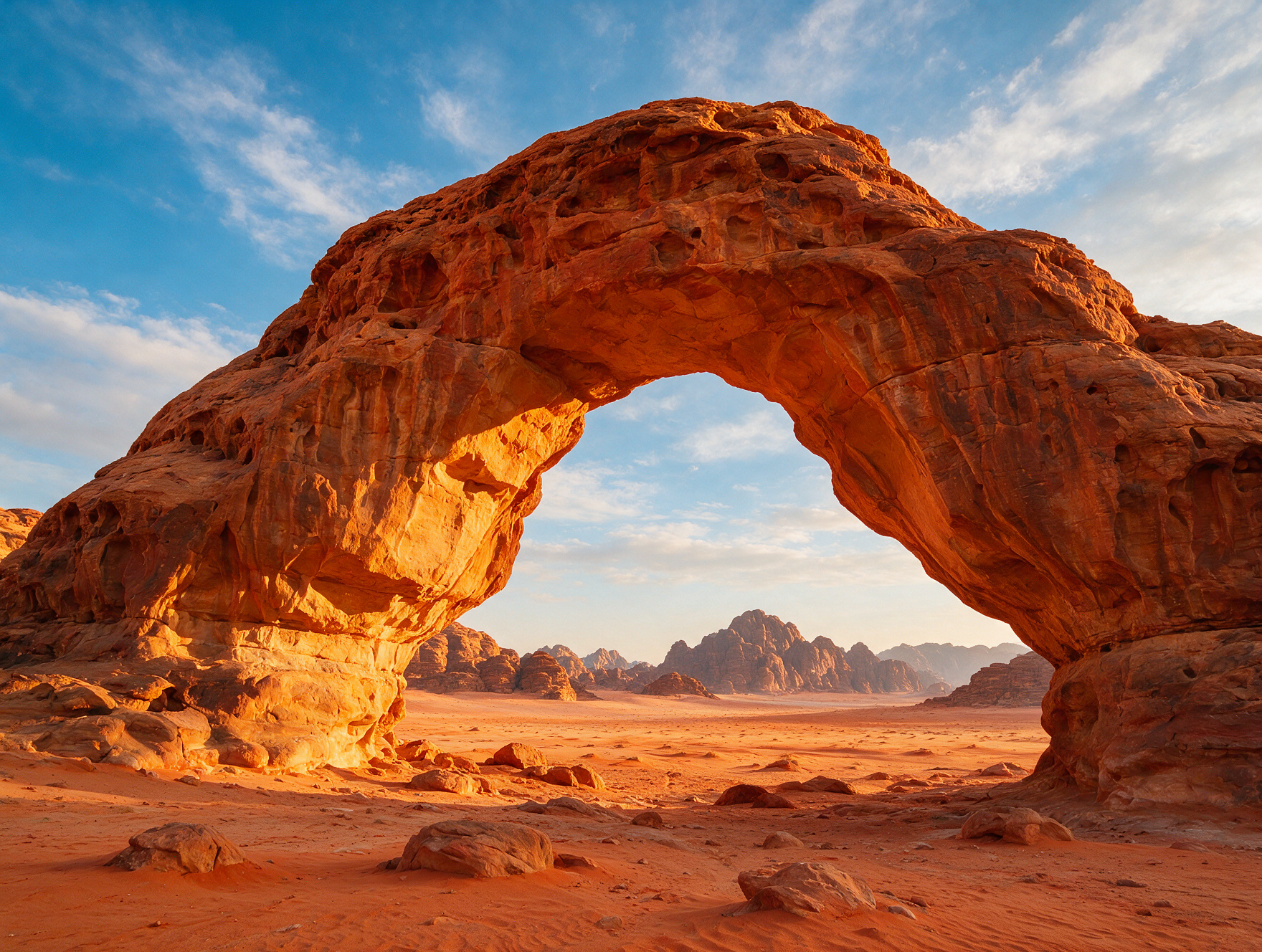
Back at camp, breakfast is usually simple and good — flatbread, labneh, olives, boiled eggs, sweet tea or Bedouin coffee spiced with cardamom. After that, most full-day itineraries build in a scramble up one of the smaller rock formations near camp, not a technical climb, more a hands-and-feet clamber up sandstone that’s grippy enough not to need ropes. Burdah Rock Bridge and the smaller Um Fruth arch are the two most commonly climbed; both reward you with a flat lookout over a huge stretch of the protected area.
Mistake to avoid: flip-flops or open sandals. The sandstone holds grip well, but the approach is loose sand and sharp gravel, and by mid-morning in warmer months the rock itself gets hot enough to make bare-sole footwear genuinely uncomfortable. Closed-toe shoes with some ankle support make the difference between enjoying the scramble and cutting it short.
10:30 AM — Khazali Canyon and the Quieter Alternative
Khazali Canyon is the classic late-morning stop: a narrow slot canyon on foot, with genuine Nabataean and Thamudic rock inscriptions on the walls, some over 2,000 years old. It’s a highlight, but it’s also on every standard itinerary, so by mid-morning it can have two or three other groups in it at once.
Hidden gem: ask your guide to add the Anfishieh inscriptions on the way back instead of lingering at Khazali. It’s a smaller, far less visited rock-art and inscription site with carvings of camels and human figures that most day-tour groups never stop for — we’ve had entire visits there with nobody else around, which is rare anywhere in Wadi Rum between 9 AM and 4 PM. If you’d rather dig into more off-the-main-track spots across the country, our piece on Jordan’s hidden gems beyond Petra and the Dead Sea has a few more in this vein.
12:30 PM — Bedouin Lunch Under Canvas
Lunch is typically served back at camp or at a shaded Bedouin tent stop along the route — usually a spread of grilled chicken or lamb, rice, hummus, fattoush, and fresh flatbread, eaten sitting on cushions rather than at a table. It’s unhurried by design; this is also the point in the day when the heat peaks, so most camps build in a long lunch specifically so nobody’s out climbing rock in the worst of the midday sun.
2:00 PM — Quiet Camp Time or Lawrence’s Spring
This is the one stretch of the day we’d actively protect rather than fill. Early afternoon heat in Wadi Rum, especially from late spring through early autumn, is no joke, and the better camps know it — this is nap time, reading-in-the-shade time, or a slow swing back out for travellers who want more. The classic add-on here is Lawrence’s Spring, a natural water source in the cliffs named for T.E. Lawrence, who wrote about this valley in Seven Pillars of Wisdom (the rock formation near Wadi Rum Village that shares the book’s name is visible from the Rest House and worth a photo stop even if you don’t have time to climb it). If you came for the quieter version of the day, this is where you take it; if you’re chasing every stop, this is where the itinerary gets long.
4:30 PM — Golden Hour at the Red Dune
Around 4:30 to 5 PM depending on the season, jeeps head for one of the big red dunes for the pre-sunset window. This is the single best hour for photos in the entire day — the sand genuinely shifts from a dusty orange to a deep, almost blood-red as the sun drops, and the long shadows off the dune ridges give every shot real depth instead of the flat midday look. Expect to share the dune with other groups at this hour; it’s popular for a reason.
Photography tip, part two: climb to the top of the dune rather than shooting from the base. The extra five minutes of effort gets you a clean horizon line and separates your shot from the dozen other people photographing the same ridge from ground level.
6:30 PM — Sunset and the Seven Pillars
Sunset proper is usually watched from camp or from a final viewpoint on the way back in, and this is where the “vast desert landscapes, towering rock formations… and unforgettable sunsets” line from Jordan’s own tourism board stops being marketing copy and starts being accurate. The rock turns through orange, then a deep rust-red, then a kind of charcoal-purple in the last few minutes before dark — and because there’s essentially no urban light anywhere nearby, the transition to full night happens faster and more completely than it does almost anywhere else you’ll have travelled.
7:30 PM — Dinner Under a Bedouin Spread
Dinner is the day’s set-piece meal, and at most camps it’s cooked zarb-style — meat and vegetables slow-cooked in a pit oven buried in the sand, then dug up and served on a huge communal platter with rice, grilled vegetables, and bread. It’s genuinely one of the best meals most of our travellers have in Jordan, not because it’s elaborate, but because the setting — floor cushions under an open tent, fire going, dark already full overhead — does a lot of the work.
9:00 PM — Why Wadi Rum’s Night Sky Is Genuinely Different
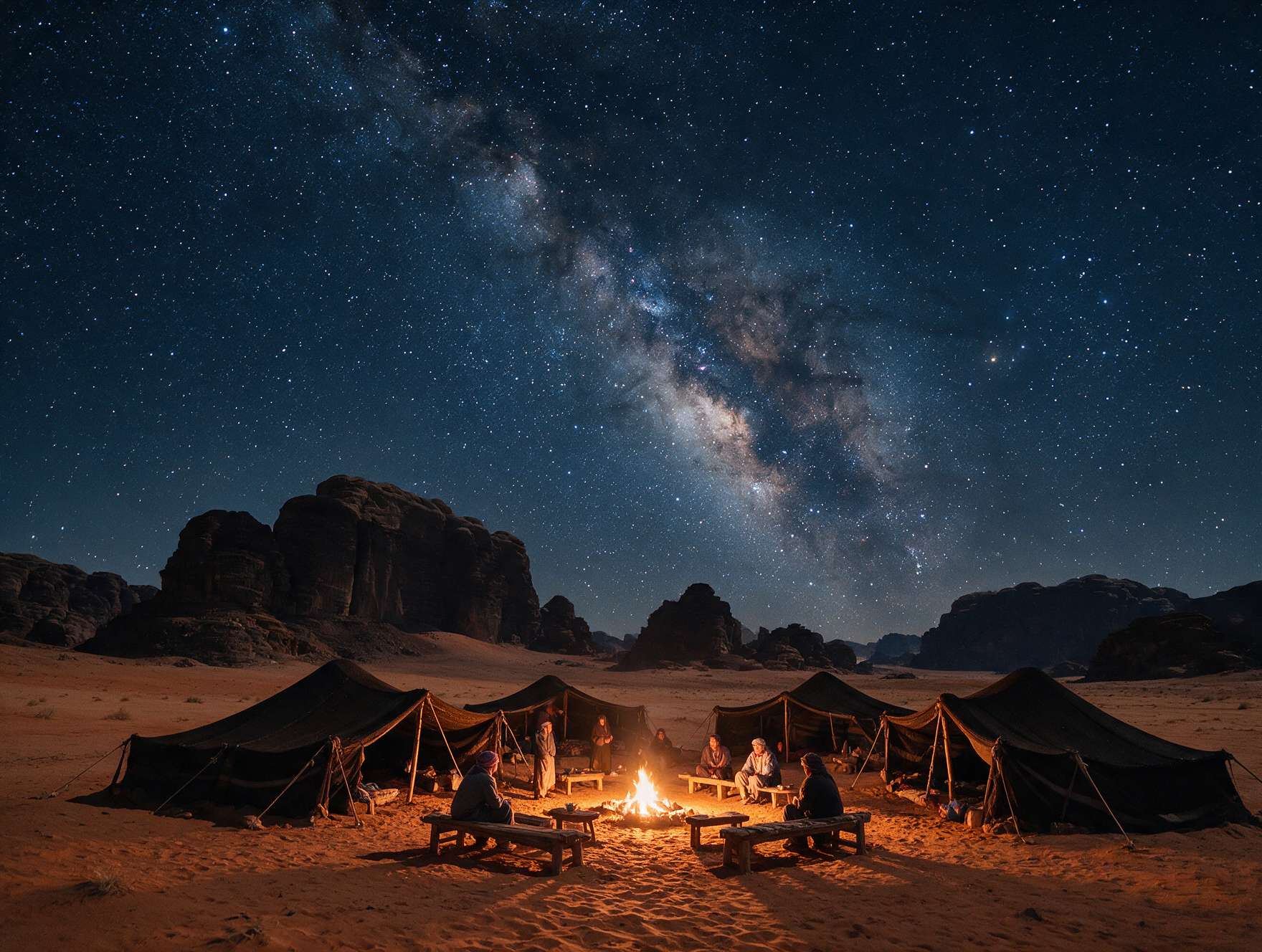
This is the part of the day we’d argue is Wadi Rum’s real differentiator, more than the jeep tours or the rock formations. The Wadi Rum Protected Area has close to zero light pollution — no nearby city, no highway glow, nothing competing with the sky. On a clear, moonless night you can see the Milky Way as a distinct band rather than a smudge, pick out planets with the naked eye, and on a good night, catch a meteor without needing to wait for a shower. It’s not an exaggeration to say most travellers who’ve seen “dark sky” destinations elsewhere still find Wadi Rum a step beyond what they expected.
Fun fact: this same emptiness and otherworldly geology is exactly why Wadi Rum has stood in for Mars and other alien worlds on screen — The Martian, parts of Dune, and scenes in Rogue One and Lawrence of Arabia were all filmed here. Several camps lean into this directly with Mars-dome-style tents.
Bring a red-light torch if you have one (it preserves night vision for everyone around you) and ask your camp if they have a telescope — a growing number do, and even a basic one turns Saturn’s rings or Jupiter’s moons from an idea into something you’ve actually seen.
Where to Stay: Choosing the Right Camp Tier
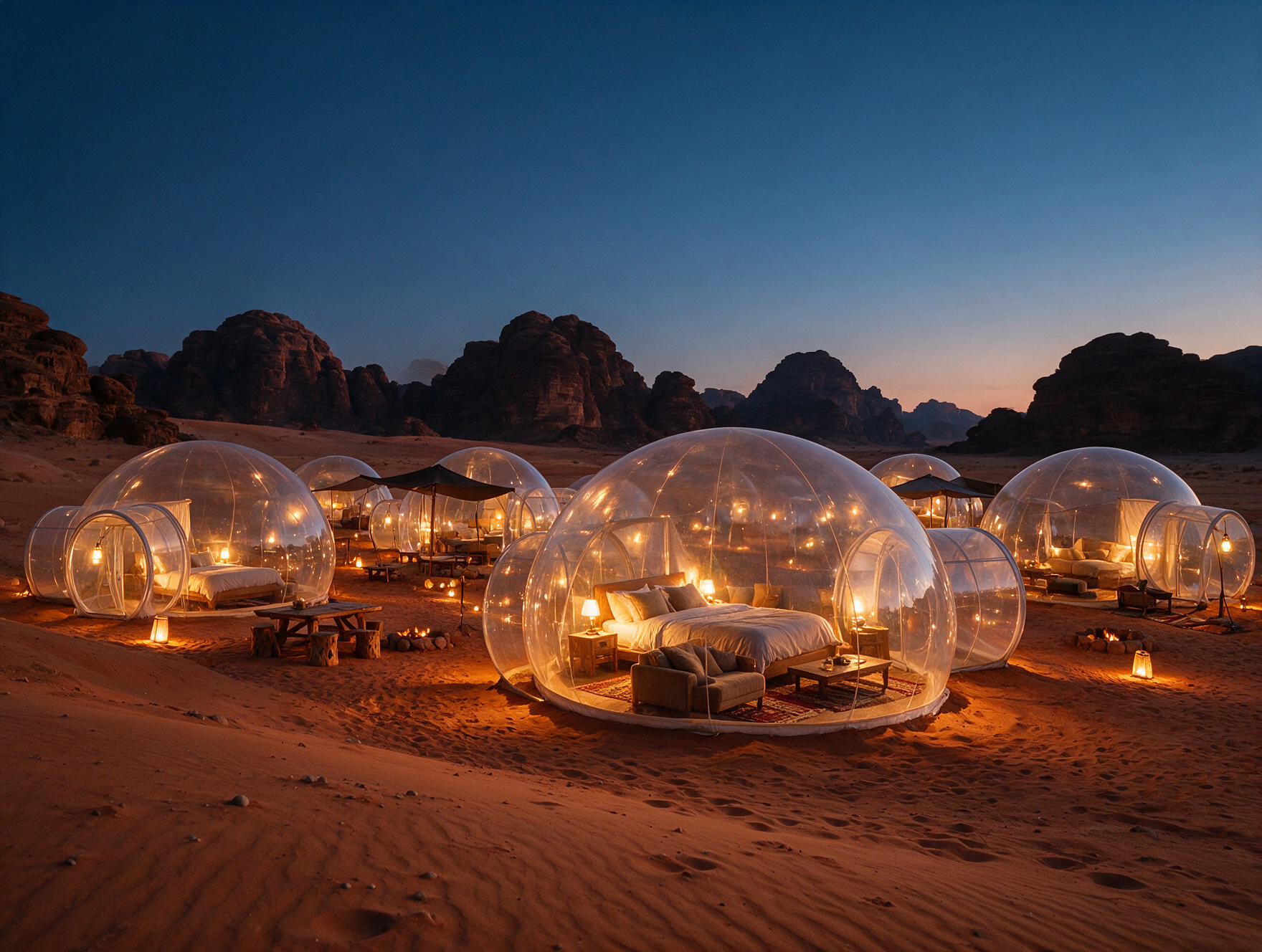
“Bedouin camp” covers an enormous range in Wadi Rum, and this is where we see the most mismatched expectations. At the simple end, you’re in a standard goat-hair or canvas tent with a shared bathroom block, sleeping on a mattress on the floor — clean and atmospheric, but closer to a hostel than a hotel. At the end we book for most Get Tripped travellers, you’re in a private en-suite tent or a transparent “bubble” dome with your own bed, climate control, and a clear or retractable roof so you can watch the stars from bed without leaving your tent. The newer luxury lodges around Wadi Rum Village have built entire concepts around exactly that, some now adding private plunge pools or dedicated suites on top.
Mistake to avoid: booking based on photos alone. “Luxury camp” and “basic camp” can look nearly identical in a wide sunset shot with everyone’s tent silhouetted against the sky — the difference only shows up in whether you have a private bathroom, how firm the mattress is, and whether the generator runs all night or shuts off at 10 PM. If any of that matters to you, ask directly rather than assuming from the gallery.
Second mistake to avoid: underestimating the cold. Desert nights drop fast once the sun is gone, and outside the hottest months it can get genuinely cold by 9 or 10 PM — close to freezing on winter nights in January and February. Pack a proper layer even if you’re visiting in what Jordan calls the warm season; our Jordan packing guide by season breaks down exactly what to bring for a desert night versus a Dead Sea afternoon, since they’re not the same kit at all.
Best Time to Visit Wadi Rum
Spring (March to May) and autumn (September to November) are the sweet spot, with daytime temperatures roughly 20–28°C and nights cool but manageable. This is also, broadly, the best time to visit Jordan overall, since it lines up with comfortable weather at Petra and the Dead Sea too.
Summer (June through August, roughly the window people mean when they ask about Jordan trips June to October) is a different proposition — daytime highs regularly clear 35–40°C, and the jeep tours and climbs get rescheduled around early morning and evening to avoid the worst of it. It’s not impossible, and summer holidays in Jordan do work if you’re disciplined about timing activities around the heat, but it’s not what we’d default to recommending for a first visit. Winter brings pleasant, mild days but genuinely cold nights, so it suits travellers who want the stargazing and the solitude more than they mind an extra blanket.
What a Day in Wadi Rum Actually Costs
As of 2026, the Wadi Rum Protected Area entrance fee is 5 JOD per person for foreign visitors, with children under 12 free; a private 4×4 brings an additional vehicle fee (around 25 JOD for a privately owned jeep, more for a rental). If you’ve bought the Jordan Pass, the Wadi Rum entrance fee is already included, on top of covering Petra and dozens of other sites — for most itineraries that include Petra, the pass pays for itself before you’ve even reached Wadi Rum.
Jeep tours are usually quoted per vehicle, scaling with duration: short sunrise or sunset runs at the lower end, half-day tours in the middle, full-day tours at the top. Camp pricing varies far more by tier than by season — a shared-bath standard tent costs a fraction of a private bubble suite, which is exactly where the camp-tier decision above plays out in your budget. If you’re working out overall Jordan trip cost from India, Wadi Rum’s overnight is rarely the single most expensive night of the trip — Amman and Dead Sea stays usually run higher — but it’s worth upgrading the jeep and camp here specifically, since it’s the one night most travellers say was worth paying up for.
Visa and Getting to Jordan From India
Indian passport holders need a visa for Jordan — either a visa on arrival at the airport or an e-visa arranged in advance — and the single-entry fee is waived entirely if you’re staying three nights or more and using the Jordan Pass, which bundles site entries with the visa waiver in one purchase. It’s one of the more traveller-friendly visa setups in the region, and a big part of why a custom Jordan itinerary built around Petra, Wadi Rum, and the Dead Sea has become such a popular combination for Indian travellers lately.
On safety: Jordan consistently ranks among the more stable, tourist-friendly countries in the region, and Wadi Rum specifically is a managed protected area where every visitor registers at the Visitor Centre and travels with a licensed Bedouin guide — not a place you wander into unsupervised, which is part of what keeps it safe and well looked after.
Who This Day Is Actually For
Couples and honeymooners: this is one of the most genuinely romantic nights you can build into a Jordan trip — a private bubble tent, dinner under the stars, zero outside noise. It’s consistently the night couples mention first when they tell us about the trip afterward.
Families: the jeep tours are genuinely fun for kids — open-top 4x4s bouncing over dunes rarely disappoints — and camps with family-sized tents or adjoining rooms are easy enough to request. Build in more downtime and skip the longer rock scrambles for younger children, and the day works well.
Luxury seekers: look for camps built around private en-suite domes rather than the standard shared-facility layout — Wadi Rum has a genuine high end now, with a handful of properties offering private pools, dedicated dining, and serious attention to the stargazing experience (clear or retractable roofs, telescopes on request). This is where Wadi Rum stops being a “rough it for one night” stop and becomes a legitimate luxury leg of the trip.
FAQs
How many days do you need in Wadi Rum?
One overnight is enough to get the full experience — a jeep tour, a Bedouin meal, and a night under the stars. Two nights make sense if you want a slower pace, a longer multi-site jeep route, or extra buffer for a camel trek.
Is Wadi Rum safe for Indian tourists?
Yes. It’s a protected area where every visitor registers at the Visitor Centre and travels with a licensed guide, and Jordan overall is considered one of the more stable, tourist-friendly countries to visit in the region.
Do I need a guide, or can I drive myself into Wadi Rum?
You can’t self-drive into the protected desert itself — access beyond the Visitor Centre is by licensed Bedouin guides in 4×4 jeeps or on camels. You can drive your own car to the Visitor Centre and village, but the desert interior is guided-access only.
What should I pack for a night in Wadi Rum?
Layers, even outside summer — desert nights get cold fast, close to freezing in winter. Bring closed-toe shoes for the rock scrambles, a headtorch with a red-light mode for stargazing, sunscreen, and a scarf or hat for sun and dust.
Can I visit Wadi Rum as a day trip, or should I stay overnight?
You can do it as a day trip from Petra or Aqaba, but an overnight is genuinely the better version — the sunset, dinner, and stargazing are a big part of what makes Wadi Rum worth the detour, and none of that happens on a daytime-only visit.
What’s the real difference between a budget camp and a luxury camp here?
Mainly privacy and comfort: shared versus private bathrooms, a mattress on the floor versus a proper bed, and a standard canvas tent versus a climate-controlled bubble dome with a clear roof. Both put you in the same desert under the same sky — the luxury tier just makes the night itself more comfortable.
Does the Jordan Pass cover Wadi Rum?
Yes — the Jordan Pass includes Wadi Rum’s entrance fee along with Petra and dozens of other sites, and for stays of three nights or more it also waives the single-entry visa fee for most nationalities, including Indian passport holders.
Is Wadi Rum usually included in a 7-day Jordan itinerary?
Almost always, yes. Most well-built 7-day Jordan itineraries route Amman to Petra to Wadi Rum to the Dead Sea (or a variation on that order), since Wadi Rum sits conveniently between Petra and Aqaba.
Final Thoughts
Wadi Rum is one of the only places on a Jordan trip where the “hero” experience — the sunset, the stars, the sheer scale of the landscape — doesn’t cost extra to access. What you’re really choosing is how comfortably you want to experience it: a shared tent and fire, or a private dome with a bed under a clear roof. Either way, build in the full day and night rather than a quick jeep loop — it’s the one stop on a Jordan 7 days travel itinerary that consistently outperforms what people expected going in.
Get Tripped builds custom Jordan itineraries that get this balance right — the right camp tier for how you actually want to sleep, a private jeep instead of a shared one, and the timing worked out so you’re not rushing Wadi Rum between two other stops. If you’re planning a Jordan trip and want Wadi Rum done properly, get in touch about a custom Jordan itinerary and we’ll build the day around you.