Free Things to Do in Malaysia: A Premium Traveler’s Bonus Guide
Malaysia is one of Southeast Asia’s better-value destinations, and one of the reasons is how many genuinely worthwhile things cost nothing. Not “free if you ignore the four-hour queue” free or “technically free if you don’t buy anything in the attached gift shop” free — actually free, walk-in, as-long-as-you-like free. Batu Caves. The best street art in George Town. The Islamic Arts Museum courtyard. The KLCC park and the fountain show at night. The Malacca River walk. The beach at Cenang.
This isn’t a roundup of activities to feel smug about not spending money on. It’s a list of things worth doing on their own merits that happen to cost nothing — alongside honest notes on what’s worth the entry fee when there is one.
Contents
Kuala Lumpur: Where Free Has a Surprising Premium Feel
Batu Caves (Main Cave)
The golden Lord Murugan statue — at 42.7 metres, one of the tallest Murugan statues in the world — and the 272 rainbow-painted steps up to the limestone cave temple are free to visit. No entry fee for the main Cathedral Cave. Arrive before 9 AM to avoid the crowds and the worst of the heat; the steps face east and the morning light on the statue is significantly better than the midday glare.
The cave complex also has a small art gallery cave (RM 5) and a cave villa with exhibits (RM 25) — these are optional and, frankly, skippable. The main cave is the reason to come.
One mistake to avoid: wearing white or light-coloured clothes. The pigeons and monkeys near the base of the steps are both plentiful and unhygienic. Keep bags zipped — the macaques are opportunists and know how to open backpack pockets.
KLCC Park and the Petronas Towers Exterior
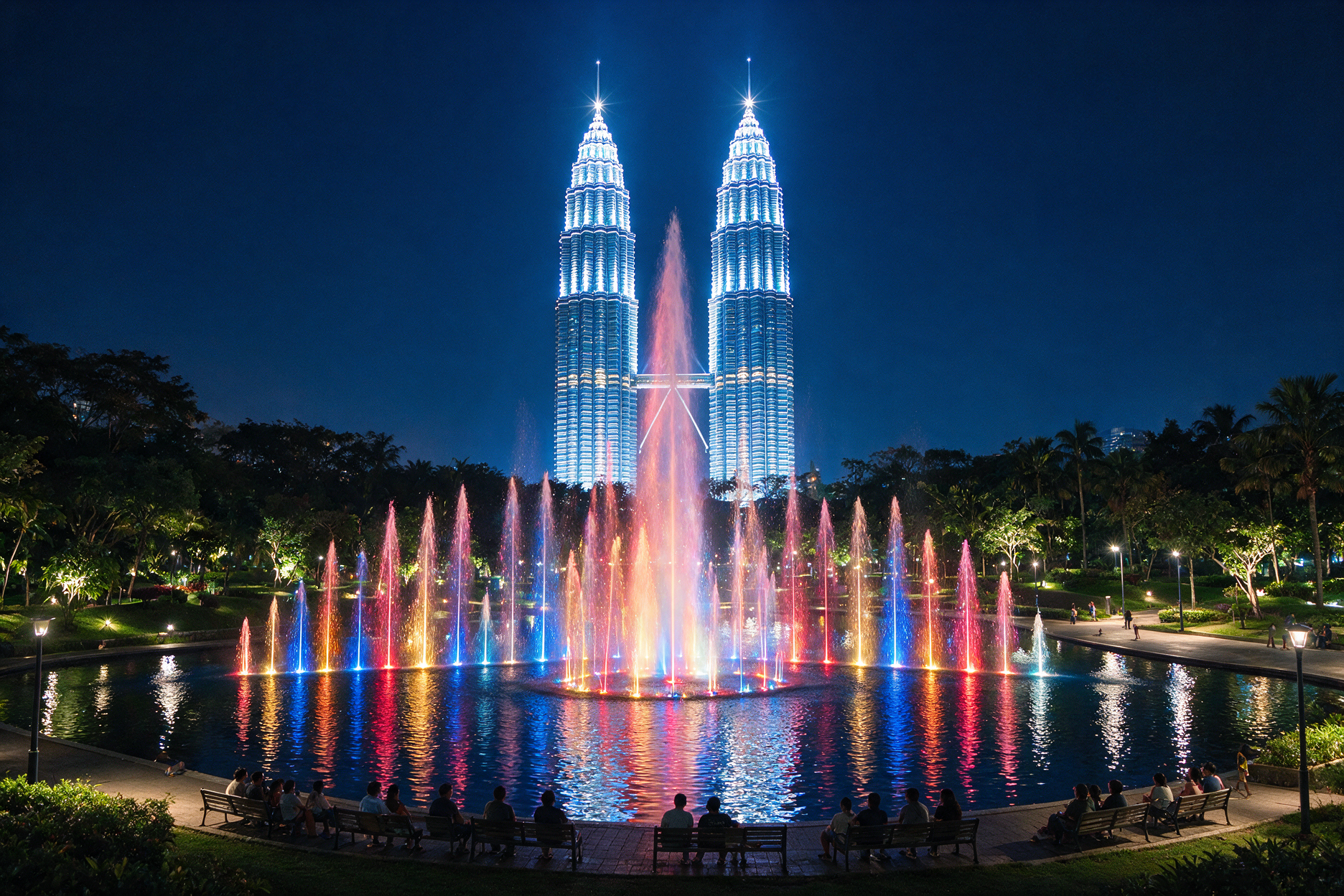
The park below the Petronas Twin Towers is one of the better urban parks in Southeast Asia — well maintained, with a wading pool area for families, jogging paths, and benches that face directly at the towers. Entry is free. The musical fountain show runs at 8 PM, 9 PM, and 10 PM on weekdays, and also at 3:30 PM on weekends — free from the park, and a genuine spectacle rather than a tourist-trap light show. The towers themselves are visible from the park in their full height; the paid observation deck at Level 86 adds the city view from above, but the towers from below have their own quality.
Thean Hou Temple
The six-tier Chinese Buddhist temple on Robson Hill in Seputeh is free to enter and one of KL’s more genuinely beautiful religious sites — it’s covered in intricate carvings, lit with hanging lanterns, and built on a hillside that offers an unexpected view over the city at its rear terrace. No entry fee, no time limit. The temple is most atmospheric at dusk when the lanterns come on, and during the run-up to Chinese New Year when decorations extend across the whole complex.
Islamic Arts Museum Malaysia (Exterior and Gardens)
The museum itself charges entry (RM 20), but the grounds and exterior architecture are accessible without a ticket. The Mughal-inspired domes are worth a photograph; the manicured gardens out front offer a quiet 20 minutes that requires nothing except walking in. If you decide to go in, the permanent collection is one of the better Islamic arts collections in Asia — Quranic manuscripts, architecture models of the world’s great mosques, textiles and ceramics from the full range of Islamic civilization. For RM 20, it’s genuinely good value.
Merdeka Square and the Colonial Quarter
Malaysia’s independence was declared here on August 31, 1957. The square has the tallest flagpole in KL and a cricket ground-turned-walking-space surrounded by the most intact cluster of British colonial buildings in the city: the Sultan Abdul Samad Building (a Moorish Revival confection in copper and brick), the Royal Selangor Club, and the former General Post Office. Free, best in early morning for photos before the traffic builds.
Jalan Petaling (Chinatown)
The covered market on Petaling Street charges nothing — the experience of walking through (knockoffs, keychains, dried goods, and a shouted sales pitch from every direction) is free. The real point is the food lanes running perpendicular to the main strip, where hawker stalls have been doing the same dishes for decades at prices unchanged by any tourism premium. Browse without buying; eat without restraint.
Central Market (Pasar Seni)
The 1930s art deco building houses a permanent handicraft market — Batik, pewter, shadow puppets, Malay textiles, traditional instruments. Entry is free; you’ll likely buy something but you don’t have to. The building itself is a heritage structure and worth seeing for the architecture even if you don’t shop.
Masjid Negara (National Mosque)
Malaysia’s national mosque is open to non-Muslim visitors outside prayer times, and entry is free. Visitors need to be appropriately dressed — robes and headscarves are available at the entrance for those who need them, also at no charge. The building’s blue-tiled star-shaped roof and its 73-metre minaret are the recognisable exterior, but the interior has a scale and calm that merits 30 minutes even if you’re not architecturally inclined.
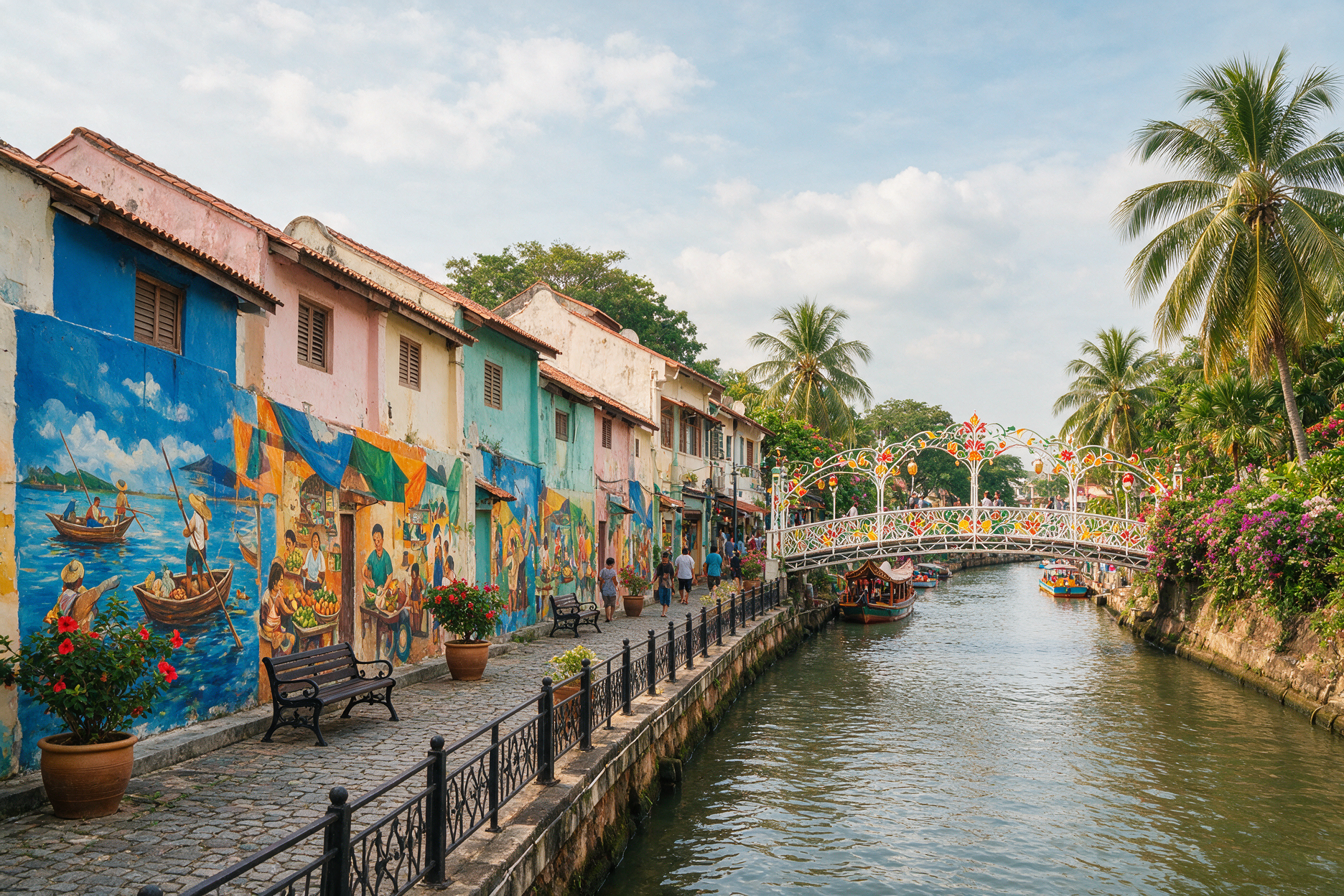
Penang: The City That Turned Its Walls into Art
George Town Street Art and Iron Sculptures
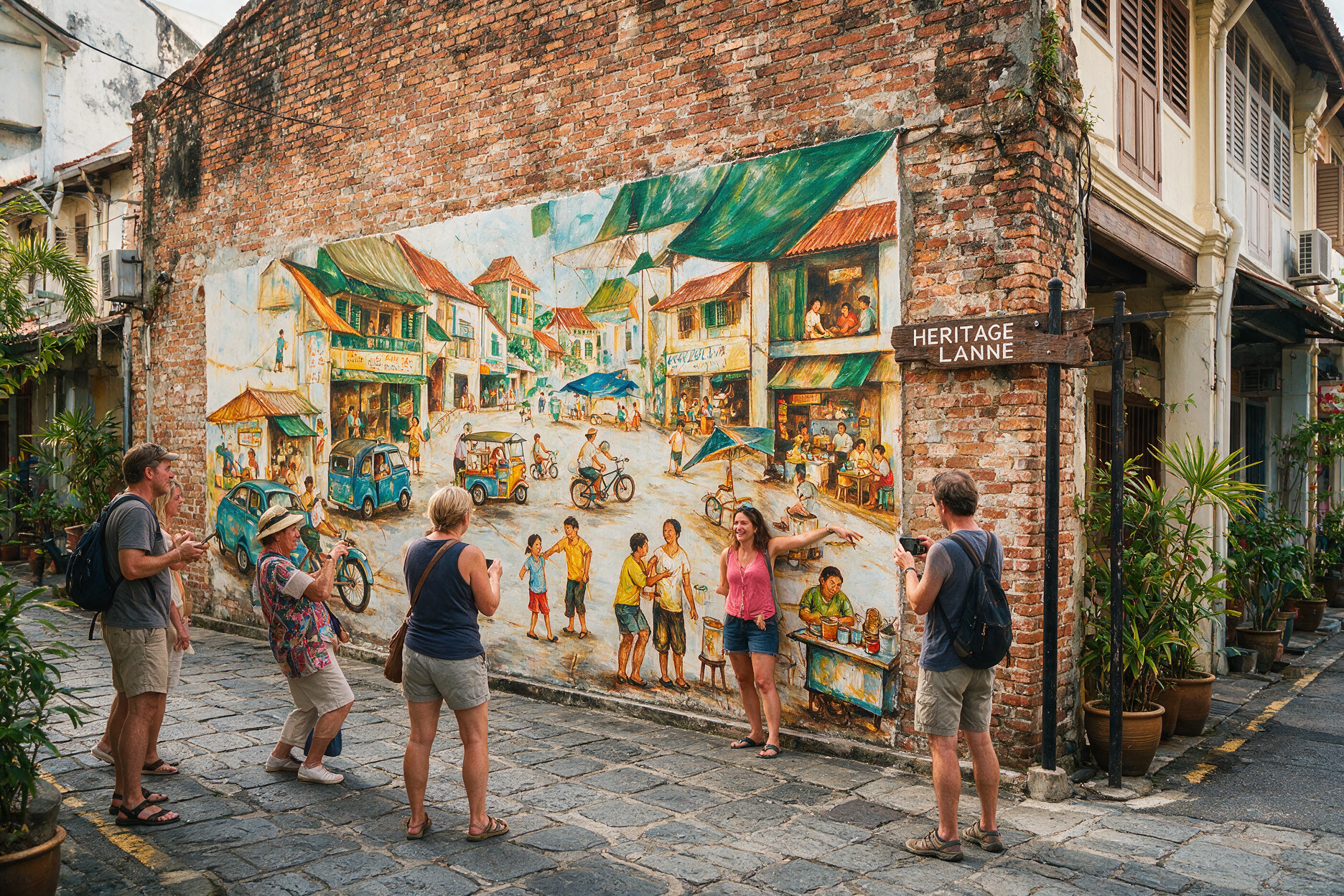
Penang’s street art program began in 2012 with a commission from the George Town Festival. Lithuanian artist Ernest Zacharevic created a series of interactive murals — actual children on a swing mounted to a building, a boy and girl on a bicycle, a boy on a motorbike leaning against a real bike chained to the wall — that are photographed by thousands of visitors daily and still feel genuinely clever rather than gimmicky. Free printed maps of their locations are available at most guesthouses; Google Maps also has them pinned.
The Sculpture at Work iron-rod caricatures — small metal cartoons fixed to walls at street level — are the subtler, less-photographed counterpart and, honestly, more interesting to find. They illustrate historical scenes and cultural moments specific to Penang’s different communities.
Cheong Fatt Tze “Blue Mansion” (Exterior)
The famous indigo-blue heritage mansion on Leith Street charges for guided interior tours (RM 25 per person, worth it if heritage architecture interests you). The exterior is free to admire from the street and still impressive — the building is a genuine Chinese merchant mansion from the 1890s, and the colour is that specific blue that’s been endlessly imitated but never quite matched.
George Town Heritage Lanes Walking Tour (Self-Guided)
A systematic walk through Lebuh Armenian, Lebuh Cannon, Chulia Street, and the surrounding lanes is a free activity that takes 2–3 hours and covers more of Penang’s history than most guided tours. Look for: the five-foot way covered walkways outside each shophouse (the colonial building regulation that required ground-floor shelter for pedestrians), the clan association buildings with their distinctive signboards, the temples, mosques, and churches within a few hundred metres of each other.
Clan Jetties
The seven clan jetties on Penang’s south waterfront are extended communities built over the water — wooden houses on stilts, connected by walkways, inhabited by descendants of the Hokkien clans who settled here over a century ago. Chew Jetty, the largest, has been somewhat touristified but is still a living community, not a museum. Walk it slowly; the resident cats vastly outnumber the tourists at most hours.
Malacca: Walking the Heritage Core for Nothing
Dutch Stadthuys and the Heritage Quarter Walk
The red-painted Dutch administrative buildings, the Christ Church, the Jonker Street area, and the Portuguese settlement are all free to walk through and photograph. The Stadthuys houses a museum inside (RM 10) — the exterior and the square in front of it are free. This is the densest collection of colonial-era buildings in Malaysia and UNESCO-listed along with George Town; it’s not being oversold when travel writers call it remarkable.
Malacca River Walk
The 3-kilometre riverside walkway from the heritage zone south through the Kampung Morten area and the Portuguese settlement is entirely free and one of the nicest walking experiences in Malaysia. The river banks have been cleared and landscaped; murals appear on the backs of shophouses; the footbridges crossing the river at several points give different angles on the heritage buildings. Best in the early morning or after 5 PM when the heat has dropped.
Cheng Hoon Teng Temple
Malaysia’s oldest functioning Chinese temple (established 1646) is free to visit. The building combines Buddhist, Taoist, and Confucian elements; the craftsmanship — particularly the ceramic mosaic dragons on the roof ridges — is worth a close look. Dress modestly; the temple is in active use.
Langkawi: Beaches, Eagles, and a Geopark
Pantai Cenang and Pantai Tengah Beaches
Langkawi’s main beach strip is free. The water is warm and clean enough for swimming (though not on the level of the Maldives or Andamans — be calibrated about this). Sunrise and sunset from the west-facing Cenang beach are excellent; the evenings have food and drinks from beachfront restaurants at reasonable prices. Nothing to pay for the beach itself.
Kilim Karst Geopark (by Walking)
The Kilim Geopark can be reached by paid kayak tour or boat — but the entrance to certain sections of the mangrove area by walking or cycling is possible without a tour for those who’d rather go at their own pace. The bat caves and eagle-spotting requires a boat; the mangrove viewing paths near the Kilim Jetty area offer a fraction of the experience for free. Set your expectations accordingly.
Eagle Square (Dataran Lang)
The 12-metre eagle sculpture at Kuah’s harbor front is Langkawi’s official symbol — a massive brown-and-white steel Brahminy kite in flight. The surrounding square is a nice enough evening walk with views across the strait; free, and the eagle itself photographs well.
Genting Highlands: Sky Deck and Outdoor Areas
Chin Swee Caves Temple
The Taoist temple complex carved into and around the rock faces at the edge of the Genting resort is free to visit. The temple covers multiple tiers of the hillside, with outdoor figures and a cable car down to the lower complex (RM 3–5). The views from the temple’s outdoor terraces look across the rainforest canopy to the valley below. In clear weather, the perspective on the forested Titiwangsa Range is worth the trip up.
SkyAvenue Outdoor Areas
The outdoor walkways and viewpoints of the SkyAvenue mall at Resorts World Genting are free to access. At 1,800 metres elevation, the air temperature is around 18–22°C even in Malaysia’s summer — genuinely cool in a way that justifies the cable car ride up even if you’re not staying at the resort. Budget RM 10 each way for the SkyCable from Gohtong Jaya.
Taman Negara: What’s Free Inside the Park
Once you’re in Taman Negara (after paying the park entry fee of RM 1 for foreigners — one of the cheapest national park fees in the world), much of the park experience is included. The Bukit Teresek hiking trail and the hang bridge are part of the general park access. Swimming in the river is free. Night wildlife walks with a guide aren’t — but wandering the edge of the settlement after dark with a torch of your own is, and the amphibian and insect noise from the jungle at 9 PM is an experience that costs nothing and stays with you.
Smart Spending Notes for Indian Travelers
Malaysia’s top paid attractions are: Petronas Towers Level 86 observation deck (RM 80–90, worth it for the view), Langkawi SkyCab (RM 25–30 return, the cable car at the northwest corner of the island with panoramic views), the Penang Hill funicular (RM 15–30), and the Langkawi Mangrove Kayak tour (RM 80–130, genuinely excellent). If you’re making a list of what to pay for in Malaysia, those four stand up to scrutiny. Everything else on this page is free.
The easy mistake is spending RM 50–80 on a hop-on-hop-off tourist bus that goes to all the places on this list slower than a Grab ride would. The HOHO bus in KL has its uses for orientation on Day 1, but walking, the MRT, and Grab handle everything better after that.
FAQs
Do I need to book Batu Caves in advance?
No — the main cave is walk-in. The smaller caves (Dark Cave, etc.) within the complex require separate tickets and some advance booking during festivals. Thaipusam (usually January/February) brings massive crowds; if your visit coincides with Thaipusam, arrive very early or accept that it will be an event rather than a casual visit.
Are the free beaches in Langkawi really good?
For calm swimming, sunset views, and general beach relaxation, yes. For snorkeling, the water around Cenang isn’t particularly clear — for that, join a paid island-hopping tour that reaches the coral areas around Pulau Payar or the outer islands.
What’s the dress code for free temples and mosques?
Cover shoulders and knees for all religious sites. For mosques, women also cover their hair; sarongs/robes are available at entrances if needed, usually at no charge. Remove shoes before entering most temple buildings. These rules are applied consistently and politely; dress modestly from the morning if you’re planning a temple-heavy day rather than changing in and out.
Can I do the George Town street art walk on my own?
Yes — and it’s actually more enjoyable self-guided. The locations are well-documented on Google Maps, the area is walkable, and hunting for the iron-rod sculptures yourself (rather than being led to them) is more satisfying. Allow 2–3 hours and start early; by 10 AM the most popular murals have long queues of visitors waiting for photos.
Experience Malaysia’s Best at Every Price Point
Some of the most memorable moments in Malaysia — the scale of Batu Caves at sunrise, the jungle sounds from a river platform at night, the light falling on George Town’s blue mansion facade — don’t cost a thing. That’s not an argument against the paid experiences (the Petronas deck and the Langkawi cable car are worth the RM). It’s a reminder that travel quality isn’t a function of spend.
Get Tripped designs Malaysia trips that balance both. Explore our Malaysia itineraries — curated for travelers who want the full experience without paying twice for what’s already free.