Beyond the Common Spots in Penang: What to Do After George Town
George Town is one of Asia’s most compelling cities to walk around in. The combination of colonial shophouses, Tamil temples, Chinese clan houses, mosques, and street art — all compressed into a UNESCO World Heritage zone you can cross on foot in 20 minutes — is genuinely remarkable. The food is, by any reasonable measure, some of the best in Southeast Asia. These things are said constantly about Penang and they’re true.
The common spots: the Clan Jetties (Chew Jetty in particular), the giant mural of children on bicycles by Ernest Zacharevic, Kek Lok Si temple, Fort Cornwallis, and Penang Hill via the funicular. All worth doing. All also done by every visitor to Penang in the same order, on the same route, with the same photographs.
After you’ve done those, and if you have another day or even half a day to spare, Penang has another set of experiences that aren’t necessarily secret — they’re just further off the standard loop. This guide is for those. As part of your Malaysia trip, adding one or two of these to your Penang time gives the island a depth the usual itinerary doesn’t reach.
Table of Contents
- Balik Pulau — The Interior You Don’t See on Day Tours
- Ghee Hiang — Where the Best Tau Sar Piah Is Made
- Batu Ferringhi Beyond the Beach
- The Armenian Street Precinct: Behind the Famous Murals
- The Food That Doesn’t Get Instagram’d
- Getting Around Penang Without the Tourist Bus
- Practical Information
- FAQs
Balik Pulau — The Interior You Don’t See on Day Tours
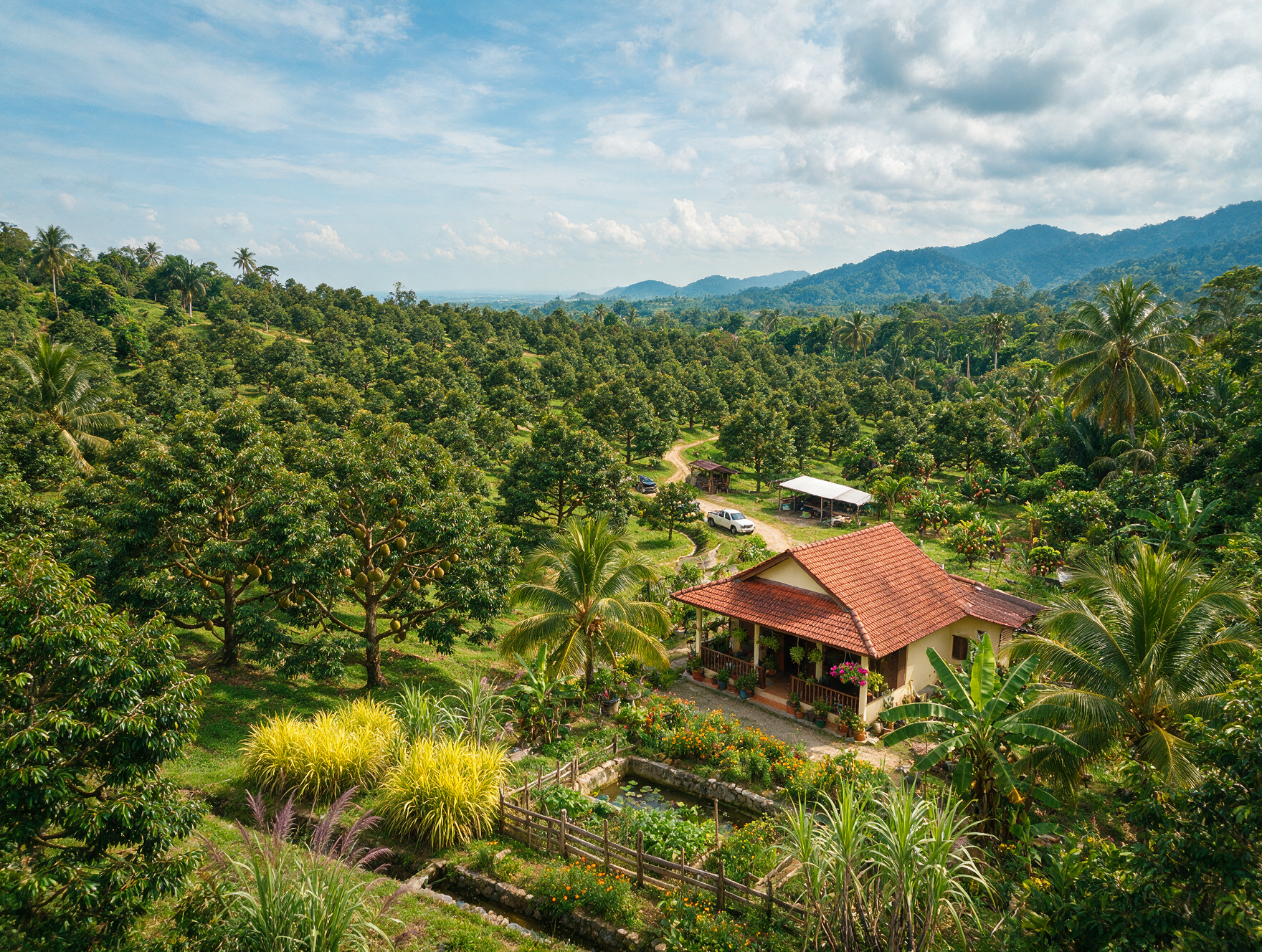
The name means “back of the island” in Malay, which describes it perfectly. Balik Pulau is the agricultural interior of Penang Island — away from George Town’s dense urban grid and away from the beach strip at Batu Ferringhi — and it’s where durian orchards, nutmeg farms, rice paddies, and small Malay fishing villages create a landscape that feels nothing like the Penang on the postcards.
The drive from George Town to Balik Pulau takes about 40 minutes along the southern route (via Paya Terubong). It’s all on good roads, and most of the journey passes through farmland and village strips rather than tourist infrastructure. Rent a scooter or car for this — there’s no convenient public transit.
What to do in Balik Pulau: the durian season runs roughly June to August, and the orchards in this area sell directly to visitors. Malaysian durians — especially the Musang King variety that originated on Penang Island — are in a different category from the Thai durians that reach Indian supermarkets. The flesh is orange-yellow, intensely flavoured (sweet, bitter, and custard-rich simultaneously), and eating it in a roadside orchard for RM 20–40 per fruit is the correct context.
Outside durian season, the area still has the Penang Tropical Fruit Farm (an orchard that grows over 250 varieties of tropical fruit), the weekend markets in Balik Pulau town (locals, no English signage, very good curry puffs), and the Pantai Aceh Forestry Reserve — a secondary forest with a short hiking trail that reaches a viewpoint over the Malacca Strait.
A genuine caveat: Balik Pulau has almost no English menus, very few tourist-facing businesses, and a pace of life that’s genuinely slower than George Town. This is the appeal, not the inconvenience. Go with patience and curiosity rather than an agenda.
Ghee Hiang — Where the Best Tau Sar Piah Is Made
Tau sar piah is a shortcrust pastry filled with sweet or salted mung bean paste, baked until golden. It’s the definitive Penang souvenir, and roughly every other shophouse in George Town sells some version of it. The question of which bakery makes the best one is, in Penang, a subject of strong local opinion.
Ghee Hiang (吉祥) has been making tau sar piah since 1856. The main shophouse on Muntri Street is the original location. It looks like a colonial-era provisions shop because it is one — glass jars of preserved fruits on wooden shelves, ceiling fans, the smell of sesame oil and baking pastry. The tau sar piah are made on site, still warm when they sell them from trays in the morning. The salted version is better than the sweet version — a minority opinion that locals will argue about but that I maintain.
Beyond tau sar piah, Ghee Hiang sells their proprietary sesame oil (excellent quality, significantly better than supermarket equivalents and an ideal gift) and a range of other Peranakan preserved sweets. The shop is genuinely worth visiting as a cultural artefact rather than just a purchase — the interior has barely changed in 50 years.
The practical note: stock sells out. If you want warm tau sar piah from the morning batch, arrive before 10am.
Batu Ferringhi Beyond the Beach
Batu Ferringhi is Penang’s main beach strip — a long, palm-lined beach with resort hotels, parasailing, jet ski rentals, and a night market that operates from roughly 7pm. The beach itself is mediocre by Southeast Asian standards (the water is murky and the sand is average), and most visitors there on package holidays fill their days with water sports and their evenings at the night market.
The things most people miss: the beach road north of the main hotel strip, where the restaurants are locally-oriented and the prices drop substantially. The Batu Ferringhi night market is worth one evening — it’s mostly copy goods and tourist fare, but there’s a solid section of local food stalls at the far end (away from the souvenir stalls) where Penang families buy their dinner. The grilled corn cobs and keropok lekor (fish crackers) are excellent and cost RM 3–5.
Further north, the road eventually reaches Teluk Bahang, a small fishing village that hasn’t yet been completely absorbed into the tourist economy. The seafood restaurants here are significantly better than the resort-adjacent versions in Batu Ferringhi proper — ask for the catch of the day, eat it steamed with ginger and soy sauce, and pay Penang market prices rather than tourist prices.
The Armenian Street Precinct: Behind the Famous Murals
The Ernest Zacharevic murals on Armenian Street are iconic — the children on bicycles, the girl on a swing — and they’re genuinely well done. They’ve also been replicated, referred to, and photographed so extensively that the street art angle can obscure what makes this part of George Town actually interesting.
Armenian Street (Lebuh Armenian) and the surrounding streets form the core of the old Peranakan — or Straits Chinese — heritage district. The buildings are pre-20th century shophouses with internal courtyards, ornate tilework, and the particular architectural logic of a Straits-born culture that blended Chinese, Malay, and European influences over generations.
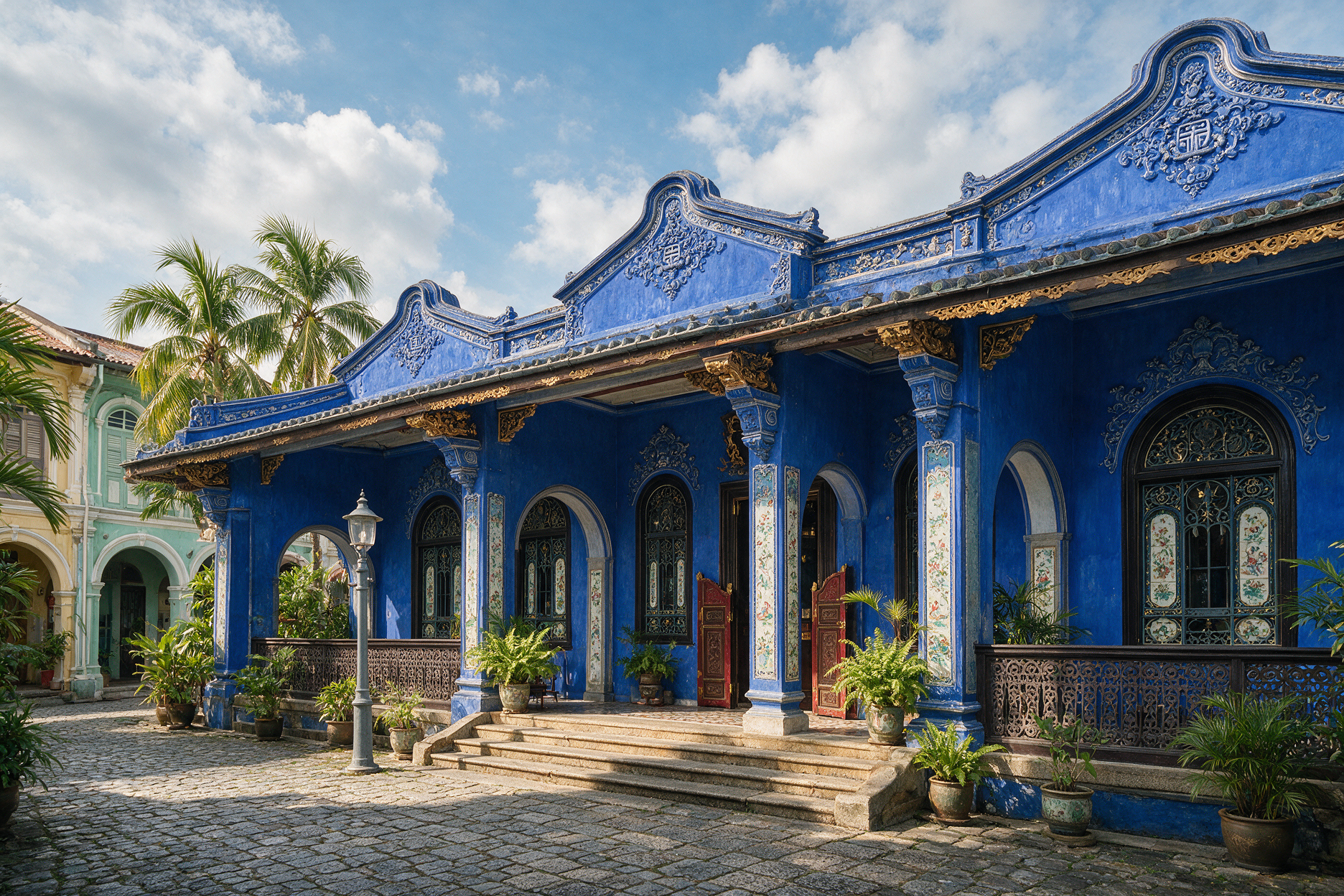
What most visitors walk past without going into: Cheong Fatt Tze Mansion (the Blue Mansion), on Leith Street — a late 19th-century indigo-blue townhouse with 38 rooms and an interior that’s both preserved and genuinely inhabited (it’s also a boutique hotel). Guided tours run at specific times and cost RM 20. The light in the inner courtyard, falling through the glass roof designed to catch monsoon rains, is the most beautiful interior I’ve encountered in George Town.
The Pinang Peranakan Mansion on Church Street is a competing version — more maximalist (the family that built it had money and wanted you to know it), with an extraordinary collection of Nyonya porcelain and antique furniture. It takes about 45 minutes to walk through properly and costs RM 20.
Skip the “street art tour” packages that organise a van around Zacharevic’s various murals. Walk instead. The murals are all within a small area, there are helpful maps in every café, and the serendipitous discoveries in between — a temple you hadn’t planned to stop at, a calligraphy shop with an elderly master working in the back, a pocket-sized Malay café that serves the best nasi kandar you’ve ever had — are better than anything a scheduled tour produces.
The Food That Doesn’t Get Instagram’d
Penang’s hawker food is famous and the famous version is legitimately good: Assam laksa at Air Itam market, char kway teow at the Kimberley Street stalls, cendol from the stall outside Penang Road Famous Teochew Chendul (the queue is real and worth joining). These have made Penang’s food reputation globally and they deserve it.
But there are food experiences in Penang that haven’t made the Instagram cycle yet:
Nasi Kandar at Line Clear: Near Penang Road, this 24-hour restaurant has been serving nasi kandar — rice with an array of curries poured over it, the curries combined by the cook in a specific order — since 1930s. The mixture of curries on the rice is called “banjir” (flooding) and is non-negotiable if you’re eating here properly. Cost: RM 8–15 depending on what you pick. Bring patience — the queue at lunch moves slowly.
Prawn Mee Soup at the Jalan Kulim market: The prawn noodle soup (hokkien mee) in Penang is the local’s reference for the dish. The version at Jalan Kulim wet market — early morning, long queue, very basic seating — is the kind of bowl that ends discussions. Get there by 7:30am. The broth runs out before the noodles do.
Penang breakfast, properly: Roti canai exists all over Malaysia, but in Penang it’s eaten with a specific curry that has more coconut milk and less chile heat than the KL or Singapore versions. The correct breakfast companion is a teh tarik made with Penang’s “white coffee” tradition (condensed milk, very hot). This combination at a Mamak restaurant in the morning costs RM 5–7 and is the local formula for a productive morning.
Indian travelers will find Penang particularly comfortable food-wise — the Tamil influence is substantial in both the Indian Muslim (mamak) and Tamil Hindu food traditions, and vegetarian eating is straightforward across many categories of Penang cuisine.
Getting Around Penang Without the Tourist Bus
The Penang tourist hop-on hop-off bus circuit exists and is convenient but slow. George Town itself is extremely walkable — the UNESCO heritage zone is compact enough that you can cross it on foot in 20 minutes. For everything else, options:
Rapid Penang buses: Decent coverage of the main corridors (George Town to Batu Ferringhi, George Town to Balik Pulau). RM 1.50–3 per journey. Slower than a car or bike but genuinely functional.
Scooter or bicycle rental: George Town is flat — cycling is genuinely viable in the heritage zone. Rentals are RM 8–12/day for bicycles, RM 40–60/day for scooters. For Balik Pulau or Batu Ferringhi, the scooter is more practical (the distances and hills are more demanding).
Grab: Works well in Penang, prices are reasonable, and the driver network is dense enough that wait times are short. Good for the early morning market runs when bikes aren’t practical.
Practical Information
Getting to Penang: Direct flights from Chennai, Bangalore, Hyderabad, and other South Indian cities on AirAsia and Malindo Air. Flight time around 3.5–4 hours. Penang International Airport is well-organised — you’re in George Town in 30 minutes by taxi (around RM 40–60) or by bus (RM 2, 45 minutes).
From KL to Penang: Budget 4 hours by train (comfortable, scenic, RM 40–80 on the KTM Intercity), 4 hours by bus (cheaper, RM 25–40), or 50 minutes by flight (from RM 60–120). The train from KL Sentral to Butterworth, then the ferry to Penang Pier, is the classic way — the ferry across the channel is a 15-minute experience with views of the Penang Bridge and the old harbour.
Best time to visit: The northeast monsoon runs November to March, bringing heavier rain to Penang’s east coast (where George Town sits). The weather is rarely severe enough to ruin a trip, but umbrella-in-bag is necessary. April to October is drier and generally more reliably clear. The Penang International Food Festival in October is worth timing your visit around — the city goes into genuine food-celebration mode.
Where to stay in George Town: The heritage zone has a good range of boutique hotels in restored shophouses — Ren i Tang, China Tiger House, Seven Terraces. Prices run RM 250–600 per night for these. Budget options are plentiful outside the heritage zone. For beaches, the hotels at Batu Ferringhi are mostly large international resort chains.
FAQs About Penang Beyond the Usual
How many days do you need to see Penang properly?
Two days for the main circuit (George Town heritage, one or two key food streets, Penang Hill). Three days if you want to add Balik Pulau and Batu Ferringhi. Four days if you’re going to do all of the above with time to wander without a schedule. Most Indian travellers fit Penang into a 2-night stop on a larger Malaysia itinerary — which works, but rushing the food is a shame.
Is Penang good for vegetarian Indian travelers?
One of the best destinations in Southeast Asia for vegetarian eating. The Peranakan cuisine has many vegetable-heavy dishes, the Indian Muslim restaurants have excellent vegetarian curries and roti, and there’s a large Buddhist vegetarian restaurant scene in the Chinese community areas. Finding vegetarian food in Penang requires very little effort.
What is Peranakan culture?
Peranakan (also called Straits Chinese or Baba-Nyonya) culture emerged when Chinese immigrants who came to the Straits Settlements in the 15th–19th centuries married locally and developed a hybrid culture that blended Chinese traditions with Malay, and later British colonial, influences. The result shows in the food (Nyonya cuisine), the architecture (the shophouses of George Town), the language (Baba Malay), and crafts (beaded shoes, embroidered garments). Penang is the most accessible place in the world to understand this culture.
Is the Penang Hill funicular worth it?
Yes, once. The view from the summit over George Town and the strait between Penang Island and the mainland is good. The summit itself has a colonial-era hotel, a few restaurants, and a small Hindu temple. The funicular queue can be long in peak season (30–60 minutes). Buy tickets in advance online to skip this. Don’t base your Penang schedule around it — it’s a half-day addition, not a centrepiece.
Can I combine Penang and Langkawi on the same Malaysia trip?
Easily. Ferry services run between Penang Swettenham Pier and Langkawi Kuah Jetty — the crossing takes about 2.5 hours and costs RM 70–90 one way. A logical circuit for Indian travelers is Penang by air from India (Chennai, Bangalore), 2–3 nights, then ferry to Langkawi for 2–3 nights, then fly back from Langkawi International Airport. Singapore and Malaysia tour packages often include this combination.
Penang Has More Than a Day
George Town’s heritage zone, at two hours walking pace, can feel like you’ve seen the highlights. You have — the highlights. But the city rewards staying long enough to find the morning market that doesn’t appear on any map, the mamak restaurant that every local goes to for lunch, the side street with the calligraphy master who might sell you a piece of work if you ask properly.
Beyond George Town, the island itself has an interior that most visitors never see, a beach strip with a local fishing village at one end, and an agricultural back-country with the best durian in Malaysia. These things don’t require extraordinary effort. They just require time and a scooter.
Building Penang into your Malaysia trip? Get Tripped designs custom itineraries for Indian travelers that make the most of the time you have, including the food experiences and heritage detours that standard package tours don’t reach. Plan your Malaysia trip with us.