Best Evening Spots in Malacca: Where to Be After the Tour Buses Leave
The tour buses leave Malacca at 5pm. By 5:30, the main Instagram positions in front of the red Christ Church have cleared out, the souvenir shops begin to roll down their shutters, and the city shifts into the version of itself that belongs to the people who stayed.
Malacca — or Melaka — is a UNESCO World Heritage city on Malaysia’s southwest coast, about 1.5 hours from Kuala Lumpur by express bus. It was the centre of one of Southeast Asia’s most significant 15th-century sultanates, then sequentially Portuguese, Dutch, and British colonial territory, and the layering of those histories is visible in the architecture, the food, and the culture in ways that are unusually legible for a city of its size. The UNESCO listing covers a compact heritage zone that you can walk across in 20 minutes.
In the afternoon, Malacca is a day-trip destination doing its job — well-managed historical sites, efficient tourist infrastructure, reasonable food options near the sights. After 6pm, when the hawker stalls on Jonker Street open and the river walk lights up, the city does something different. The pace slows, the local crowd comes out, and the heritage buildings that were backdrop for photographs all day become the setting for an evening that’s genuinely its own thing.
Here are the best spots, as part of a Malaysia trip that treats Malacca as an overnight rather than a rushed afternoon stop.
Table of Contents
- Jonker Street at Night — The Hawker Circuit
- The Malacca River Walk — After Dark
- Dutch Square Illuminated — The Heritage Architecture at Its Best
- The Shore Hotel Rooftop — Above the Heritage Zone
- Nancy’s Kitchen and the Peranakan Food Hour
- Getting to Malacca
- Practical Information
- FAQs
Jonker Street at Night — The Hawker Circuit
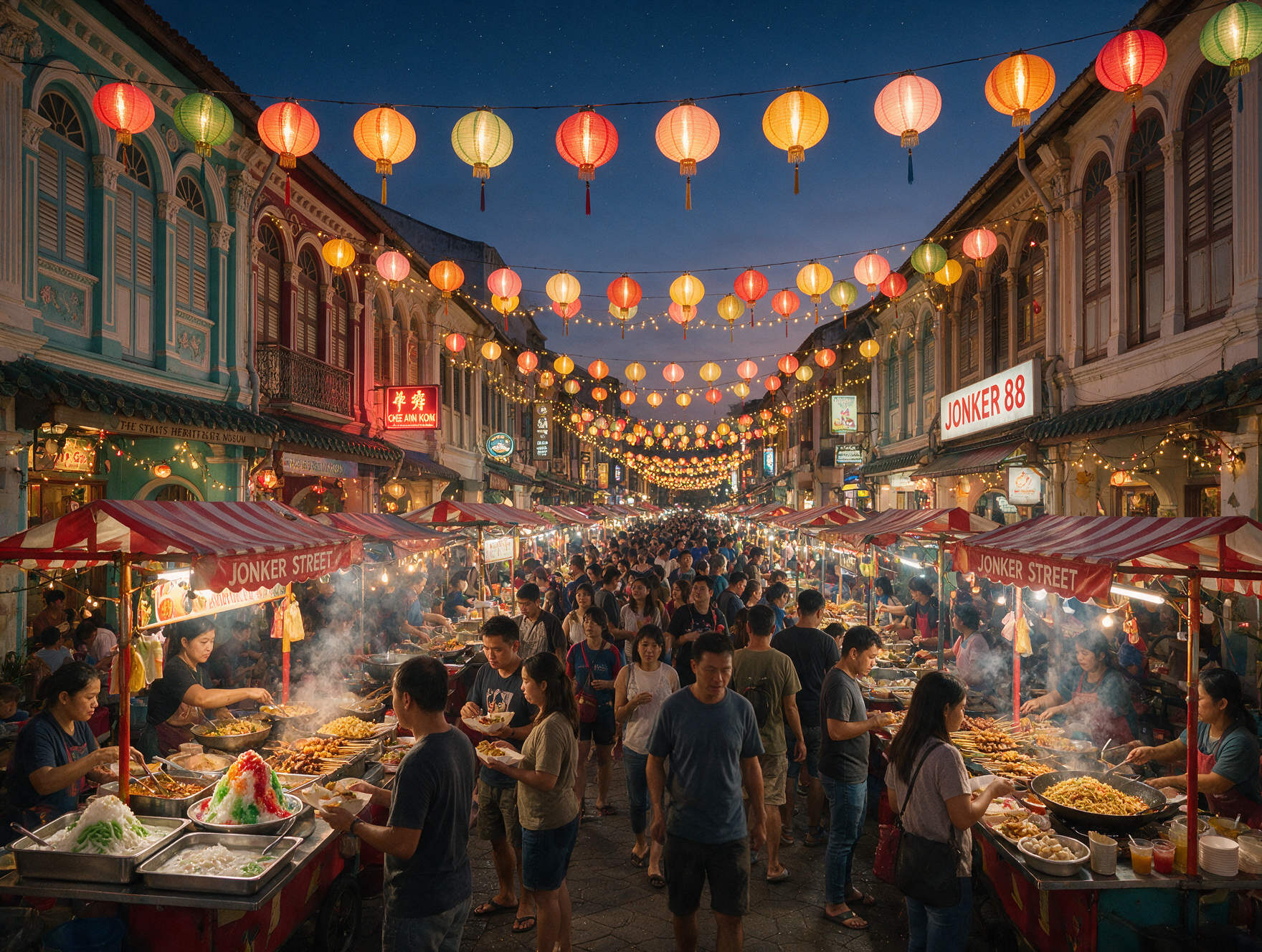
Jonker Street (Jalan Hang Jebat) is the main artery of Malacca’s Chinatown district. During the day it’s antique shops, heritage building fronts, and a steady flow of visitors. On Friday and Saturday nights from about 6pm, it becomes a hawker and market street — stalls down the centre of the road, the antique shop owners sometimes operating secondary food stalls from their own frontage, and the crowd shifting from tourist to mixed local-and-visitor.
What to eat here, specifically: the Nyonya laksa (Malacca’s version uses coconut milk broth rather than the tamarind-sour version from Penang), available at the stall that sets up around the midpoint of the street and typically has the longest queue of the food vendors. Also the cendol — shaved ice with palm sugar, coconut milk, and green rice flour jelly — which has competing shops along the street but where the best version is at the stall that uses fresh-grated coconut rather than the packaged versions. Ask any local which stall that is and you’ll get pointed to different ones: this is a genuine local debate.
The chicken rice ball is the Malacca dish that gets the most external attention — rice formed into small balls, eaten with poached chicken and a dark soy dipping sauce. It’s more interesting as an eating experience than it sounds, and the hawker versions on Jonker Street are the accessible introduction (the full sit-down version at Chung Wah restaurant on the same street is considered the reference, but the queue for a table can be long on weekends).
The Jonker Walk night market also runs on Friday and Saturday nights only — if you’re visiting on a weekday, the street is quieter and the food options are reduced to the permanent restaurants rather than the hawker circuit. Worth noting before you plan around it.
The Malacca River Walk — After Dark
The Malacca River runs through the heritage zone and along both banks there’s a maintained promenade — about 3km of walking path, lit at night, with the river’s colonial-era bridges and heritage shophouses reflected in the water. This is genuinely one of the better after-dark walking experiences in Malaysia, and it’s essentially free.
The river walk is quieter than Jonker Street and less explicitly touristic — you’ll share it with local families taking evening walks, couples on the benches that face the water, and the occasional pedicab driver looking for late fares. The stretch between the Kampung Morten traditional village (on the west bank) and the main heritage district has the best building density and the most interesting reflections.
Two things to know: the night cruise boats operate on the river from a dock near the Maritime Museum, running 45-minute circuits for about RM 15–20 per person. The boat view of the river architecture is different from the pedestrian view and worth doing once. Book at the dock rather than through a hotel (they add a premium). Second: some sections of the riverbank promenade are better maintained than others — the stretch around the Portuguese Settlement area is more worn and less lit. Stick to the central section for the evening walk.
The fun detail: Malacca’s river walk includes a series of murals painted directly on the concrete retaining walls along the banks — local artists commissioned to paint scenes from Malacca’s history. These aren’t as famous as Penang’s street art but they’re better suited to the evening format, lit from above and readable as you walk rather than requiring you to stop in a crowd for a photograph.
Dutch Square Illuminated — The Heritage Architecture at Its Best
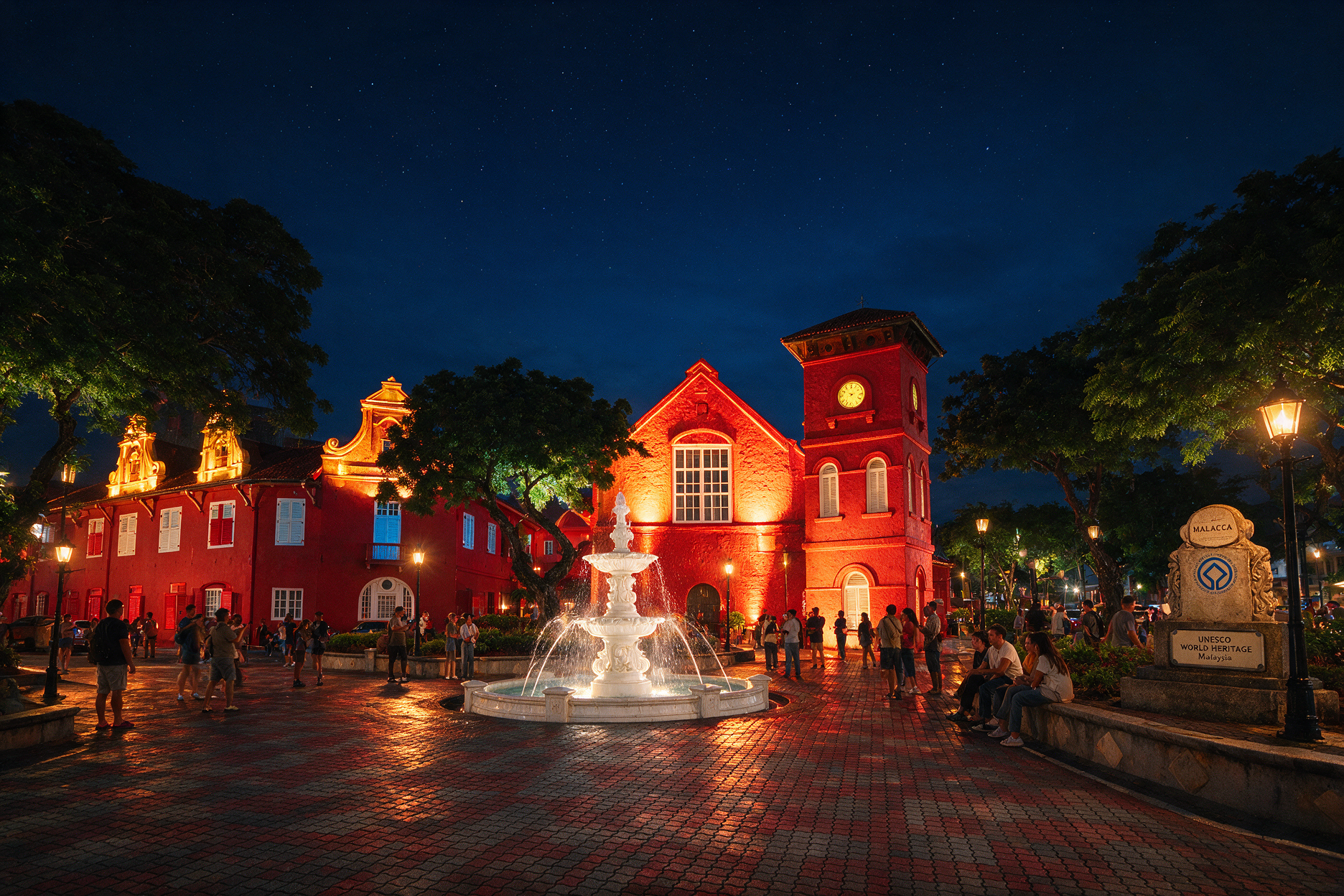
Dutch Square (Dataran Dutch or the Red Square area) is the civic heart of Malacca’s colonial heritage — the bright red Christ Church, the Stadthuys (the oldest remaining Dutch building in the East), the old town hall, all arranged around a central fountain and a roundabout. By day it’s the most photographed spot in Malacca. By evening, with the buildings illuminated in red and yellow and the tourist pressure off, it’s a different proposition.
The light is better after sunset for a practical reason — the red Dutch brick, which reads as slightly muddy in flat afternoon light, becomes vivid under the warm artificial lighting. The best time to be in the square is around 7:30pm, when it’s dark enough for the illuminated effect but still early enough that the remaining visitors are spread across the space rather than concentrated.
The surrounding streets — Jalan Quayside, Jalan Laksamana — also repay an evening wander. The narrow lanes behind the main square have restaurants and small bars in converted shophouses that operate in the heritage zone’s permitted commercial areas. These are lighter in tourist-facing energy than the Jonker Street strip and tend toward the date-night, sit-down-dinner format rather than hawker browsing.
Practical note: St. Paul’s Hill, above the Dutch Square, has the ruins of St. Paul’s Church at the top — a 16th-century Portuguese church that was later used as a Dutch fortification and is now an open-air ruin with walls but no roof. It’s accessible at night via the steps from Dutch Square and the hilltop views over the lit city are good. There’s no fee and no closing time — the steps are lit and the walk takes about 10 minutes.
The Shore Hotel Rooftop — Above the Heritage Zone
The Shore Hotel and Residences is a modern tower at the edge of the Malacca heritage zone, tall enough to offer rooftop views across the city. The rooftop bar (Sky28) operates as the main evening venue for guests and non-guests who know to ask — it’s not heavily advertised outside the hotel but it’s open to walk-in visitors.
The view from Sky28 covers the UNESCO heritage zone below, the Malacca Strait, and on clear evenings, the Sumatra coastline across the water (Malacca is that close to Indonesia — the Strait narrows to about 65km here). The bar runs from 5pm and the sunset, facing west toward the strait, is worth timing your arrival around. Drink prices are hotel-tier — RM 25–40 for cocktails, RM 18–25 for beer — but the entry is free if you’re ordering.
There’s also a pool on the rooftop level that hotel guests can use and that non-guests can access with a day-pass purchase (around RM 60–80 including a drink credit). On weekday evenings it’s quiet enough that the pool is practically private. On weekends it fills with local KL residents who’ve driven up for the night.
Alternative rooftop option: The Wyndham Hotel also has a rooftop pool and bar at the other end of the heritage zone, with a slightly different angle on the city. If The Shore feels full or expensive, Wyndham is the practical backup with similar views and similar pricing.
Nancy’s Kitchen and the Peranakan Food Hour
Nancy’s Kitchen is a Nyonya restaurant on Jalan KL 3/8, run by a Peranakan family, that serves the Malacca version of Nyonya cuisine — the local term for the cooking of the Peranakan community (Chinese-Malay fusion culture that developed in the Straits Settlements). The restaurant is small, operates on a first-come seating basis, and stops taking orders when they run out of the day’s prep — which happens earlier than you’d expect.
What to order: the ayam buah keluak (chicken braised with black nuts brought from Indonesia — the nut is crushed, the interior extracted and cooked back with the chicken, producing a dark, complex, slightly bitter sauce that’s unlike anything else in the Nyonya repertoire). Also the otak-otak (fish paste in banana leaf, grilled) and the ikan assam pedas (fish in a tart, spicy tamarind gravy). Prices are mid-range for the quality — RM 60–80 for two people with rice and a couple of dishes.
The Peranakan food hour works like this in practice: arrive at Nancy’s or one of the similar family restaurants (Peranakan Heritage Restaurant, Baba Charlie Nyonya Cake) around 6:30–7pm, before the Jonker Street crowds migrate to sit-down dinner. The walk-in wait is manageable at this time. By 8pm, the tables are fully committed.
Indian vegetarian travellers should know that Nyonya cuisine uses pork in many dishes — ask specifically about vegetarian options rather than assuming. Nancy’s has a small vegetarian selection (the vegetable curries and tofu preparations are genuinely good), but it’s a minority of the menu rather than the focus.
Getting to Malacca
Malacca is 148km from Kuala Lumpur — approximately 1.5 hours by express bus under normal traffic conditions, or 2–2.5 hours if you’re travelling on a Friday afternoon when the weekend exodus from KL begins. Buses depart from Pudu Sentral in KL every 15–20 minutes (RM 11–15 each way) and drop at Malacca Sentral, the main terminal about 5km from the heritage zone. From there, grab a taxi or Grab to the Jonker Street area (RM 12–18).
There’s no train service directly to Malacca. Some visitors take the KTM Komuter to Pulau Sebang/Tampin station and connect onward by taxi — this doesn’t save time over the direct bus and isn’t generally recommended unless you have a specific reason to prefer rail.
Malacca makes sense as a day trip from KL but benefits substantially from a one-night stay. The evening sequence described here — dinner at 7pm, Jonker Walk from 8pm, river walk, Dutch Square — runs to midnight comfortably and requires accommodation. Budget stays start around RM 80–120/night in guesthouses near Jonker Street; boutique heritage hotels in converted shophouses (The Majestic Malacca, Casa del Rio) run RM 350–600/night.
Practical Information
Best time to visit: Malacca has a relatively stable climate year-round — less affected by monsoon seasons than Penang or the east coast. The wet season runs roughly October to January, bringing afternoon and evening rain that can interrupt the outdoor components of the evening. March to September is generally drier. The weekend night market on Jonker Street (Friday–Saturday) is the specific thing worth timing around.
Getting around within Malacca: The heritage zone is walkable — you shouldn’t need transport between Jonker Street, Dutch Square, and the river walk. For the rooftop bars, Grab is available and reliable within Malacca town. Trishaws (decorated three-wheeled bicycle taxis, now fitted with speakers playing music at considerable volume) operate around the heritage zone — they’re a local attraction in themselves but not efficient transport. RM 20–30 for a circuit if you want the experience.
For Indian travellers: Malacca has a historically significant Indian Tamil community, and the Little India district around Jalan Temenggong has Tamil Nadu-style restaurants, temples, and shops. For vegetarian Indian food, this area is more reliable than the Nyonya restaurants around Jonker Street. The Sri Poyyatha Vinayagar Moorthi Temple on Jalan Tukang Emas is one of the oldest Hindu temples in Malaysia, dating to 1781.
Currency: Malacca is cash-friendly — most hawker stalls and small restaurants don’t take cards. The ATMs around Dutch Square and inside the Dataran Pahlawan mall are well-maintained. 1 MYR ≈ ₹18. Budget RM 100–200 per person for an evening that includes dinner, a few drinks, and transport.
FAQs About Malacca Evenings
Is Malacca worth an overnight stay from KL?
Yes, specifically for the evening. Malacca as a day trip covers the historical sites competently but misses the best of what the city does — the Jonker Street night market runs Friday and Saturday only, the river walk and Dutch Square are significantly better after dark, and the Nyonya restaurants that are worth going to require arriving at a non-rushed dinnertime. One night (Friday to Saturday for the full Jonker experience) is the right commitment.
What is Nyonya cuisine and is it suitable for vegetarians?
Nyonya (or Peranakan) cuisine is the cooking tradition that developed when Chinese traders who settled in the Straits Settlements married locally and created a fusion of Chinese ingredients and Malay spicing. Malacca’s version of Nyonya cuisine is the most authentic and distinct — dishes like ayam buah keluak and ikan assam pedas are specific to this region. It’s largely not vegetarian by default — pork and seafood feature prominently. However, the vegetable curries and tofu preparations are genuinely good, and restaurants with advance notice can accommodate vegetarians. The Little India district nearby has better options for strict vegetarians.
Is Malacca the same as Melaka?
Yes. Malacca is the English spelling derived from Portuguese colonial records; Melaka is the Malay spelling and the official name of both the city and the state it sits in. Road signs and official documents use Melaka; older maps, tourist material aimed at international visitors, and history books often use Malacca. They’re the same place.
How long does it take to see Malacca properly?
For the historical sites (Dutch Square, Christ Church, St. Paul’s Hill, the Stadthuys museum, Baba Nyonya Heritage Museum): a focused half-day is sufficient. For the full experience — a morning for the sites, an afternoon for the quieter streets and the Portuguese Settlement, an evening on Jonker Street and the river walk — one full day and one night is the right allocation. Two nights gives you time for the slower version: sitting longer at dinner, taking the night cruise, exploring the Little India area without rushing.
Can I combine Malacca with Penang on the same Malaysia trip?
Easily as sequential stops, though the routing means one or two nights in KL between them (Malacca is south of KL, Penang is north). A logical Malaysia circuit for Indian travellers: fly into KL, 2 nights KL, day trip or overnight to Malacca (south), back to KL, train or flight to Penang (north), then fly or ferry to Langkawi. The two heritage cities complement each other well and don’t duplicate — Malacca is more overtly Portuguese-Dutch colonial, Penang more British-Chinese-Tamil in character.
The City After the Coaches Leave
Malacca’s tourist economy is substantial — the city gets over 15 million visitors a year, which is remarkable for a city of under 500,000 people. Most of those visitors come and go before dinner. The question of what’s left after they leave isn’t rhetorical: the answer is a working city with a genuine hospitality culture, excellent food that hasn’t been repositioned for tourists, and heritage buildings that look better in artificial light than afternoon sun.
An evening in Malacca doesn’t require a specific programme. The elements are: arrive when the dinner restaurants open (7pm), eat the Nyonya food properly rather than at a hawker stall, walk Jonker Street while it has energy (8–10pm), follow the river walk south to Dutch Square, and end somewhere with a drink and a view. The city provides the rest.
Building Malacca into your Malaysia trip? Get Tripped designs custom Malaysia itineraries for Indian travellers that combine the right length of stay in each place — including one-night Malacca stops that don’t rush the best of what it does. Plan your Malaysia trip with us.