Search “Maldives” on Instagram and you’ll get the same twelve resorts on loop — the same overwater villa in North Male Atoll, the same infinity pool shot taken forty minutes after check-in, the same glass-bottomed walkway. It’s not that those resorts are bad. It’s that they’re a 25-minute speedboat ride from Velana International Airport, which is exactly why every influencer ends up there and why the Maldives has quietly become, for a lot of Indian travelers, a country they think they’ve “seen” after visiting one atoll out of twenty. There are 1,192 islands spread across roughly 90,000 square kilometres of ocean. Most travelers experience about 2% of that.
This guide is about the rest of it — specifically Baa Atoll, a UNESCO Biosphere Reserve where manta rays gather by the hundreds; Thulusdhoo, the local island that quietly built a surf culture around a break called Coke’s; and the string of outer atolls (Laamu, Shaviyani, Noonu, Raa) where a handful of serious boutique and luxury properties operate without a single influencer queue in sight. Everything here is verified for 2026 — visa rules, transfer costs, flight routes from India, manta season timing — because half the value of a “hidden gems” piece is useless if the practical details are two years stale.
Table of Contents
- The Maldives Is Bigger Than Your Feed
- Baa Atoll: Where the Mantas Outnumber the Influencers
- Thulusdhoo: The Local Island That Surfers Found First
- Laamu, Noonu, Raa and Shaviyani: The Quiet Luxury Atolls
- A Local Island Worth Visiting for More Than a Selfie
- Best Time to Visit: Dry Season, Wet Season and Manta Season
- Maldives Visa for Indian Passport Holders in 2026
- Getting There: Flights From India
- Seaplane, Speedboat or Domestic Flight: Getting to the Outer Atolls
- Currency, Cards and What Things Actually Cost
- A Mistake Worth Avoiding
- Who This Trip Is Actually For
- FAQs
The Maldives Is Bigger Than Your Feed
Here’s the thing nobody tells first-time Maldives travelers: the country is organized into 20 atolls, and the resort industry is heavily concentrated in just two of them — North and South Male Atoll — because they’re closest to the airport. Speedboat transfer, no seaplane, resort by lunchtime. That convenience is exactly why those islands are the ones everyone photographs, and exactly why they can feel, by day three, a little like a very beautiful holding pattern. Same reef fish, same sandbank photo, same sunset angle as the resort two islands over.
The outer atolls exist precisely because the Maldives isn’t actually short on reef, sandbank or overwater villa — it’s short on travelers willing to take a 30-minute seaplane instead of a 20-minute speedboat. That’s the entire trade you’re making by going further out: slightly more transfer logistics, in exchange for house reefs that see a fraction of the snorkelers, resorts that were built by people obsessed with a specific thing (diving, sustainability, manta rays, quiet), and a version of the Maldives that doesn’t look like the one already saturating your feed.
Baa Atoll: Where the Mantas Outnumber the Influencers
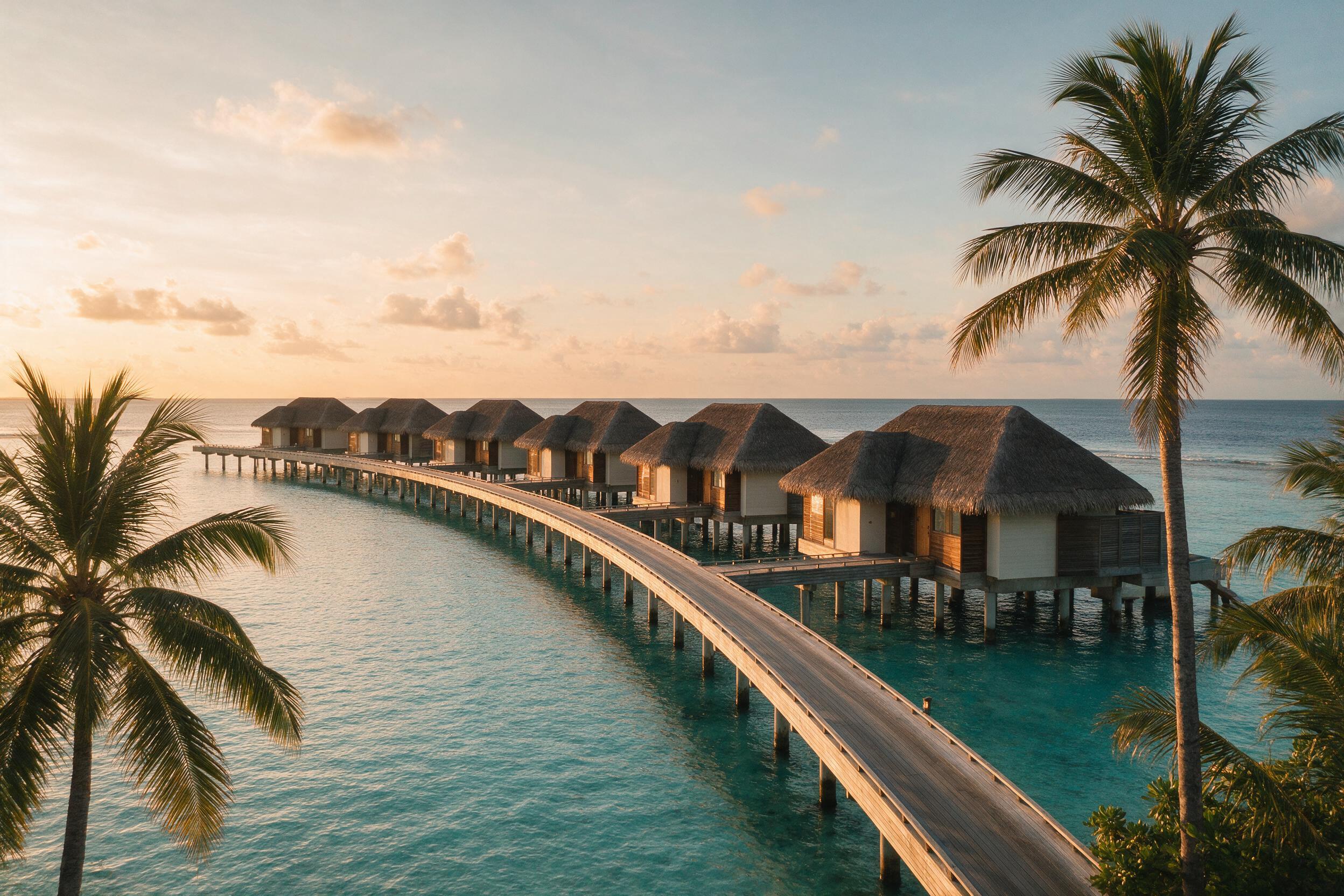
Baa Atoll, about 30 minutes by seaplane from Male, is a UNESCO Biosphere Reserve — one of the only atolls in the Maldives with that designation, granted in 2011 for its reef diversity and, specifically, for Hanifaru Bay. Hanifaru is a shallow, cul-de-sac-shaped bay that, under the right lunar and current conditions, turns into what researchers call a manta “cyclone feeding” event: dozens to hundreds of reef manta rays circling in a tight column, mouths open, filtering plankton that’s been pushed into the bay by the tide. It’s one of the largest documented manta ray feeding aggregations anywhere in the world, and it happens in water shallow enough to snorkel.
Two honest caveats before you build a trip around it. First, Hanifaru Bay is a strictly managed marine protected area — no scuba diving is allowed inside the bay itself, only snorkeling, and boat numbers and swimmer groups are capped, so you’re not getting the water to yourself even in season. Second, it’s a wildlife event, not a schedule. The bay only “turns on” a handful of days a month, timed loosely to full moon and new moon current patterns, and your resort’s marine biologist team will radio you when it’s happening rather than promising a fixed daily excursion. Go in with the expectation of “very likely, not guaranteed,” and you won’t be disappointed.
Where to Stay in Baa Atoll
This is not guesthouse territory — Baa Atoll’s reputation is built on boutique and full luxury properties that market themselves on conservation and quiet rather than nightlife or size:
- Soneva Fushi — the original Soneva property and one of the most design-led resorts in the country, barefoot-luxury villas set into a genuinely large, dense island, with an observatory and a working glass studio.
- Four Seasons Resort Maldives at Landaa Giraavaru — sits inside the Biosphere Reserve itself and runs a manta ray research programme in partnership with the Manta Trust, useful if you want the marine-biology briefing to be more than a gift-shop poster.
- Milaidhoo Maldives — a smaller, all-villa boutique property that leans hard into its manta and dive access rather than trying to be all things to all guests.
- Anantara Kihavah Maldives Villas and Vakkaru Maldives — both overwater-villa properties with strong house reefs and dive centres built around Baa Atoll’s specific sites rather than generic Maldives programming.
- The Nautilus Maldives — ultra-luxury, all-villa, no set meal times or fixed itinerary; the closest thing the atoll has to a “just tell us what you want” resort.
All of the above are roughly 30 minutes from Male by seaplane, which matters for your itinerary planning — see the transfers section below.
Thulusdhoo: The Local Island That Surfers Found First
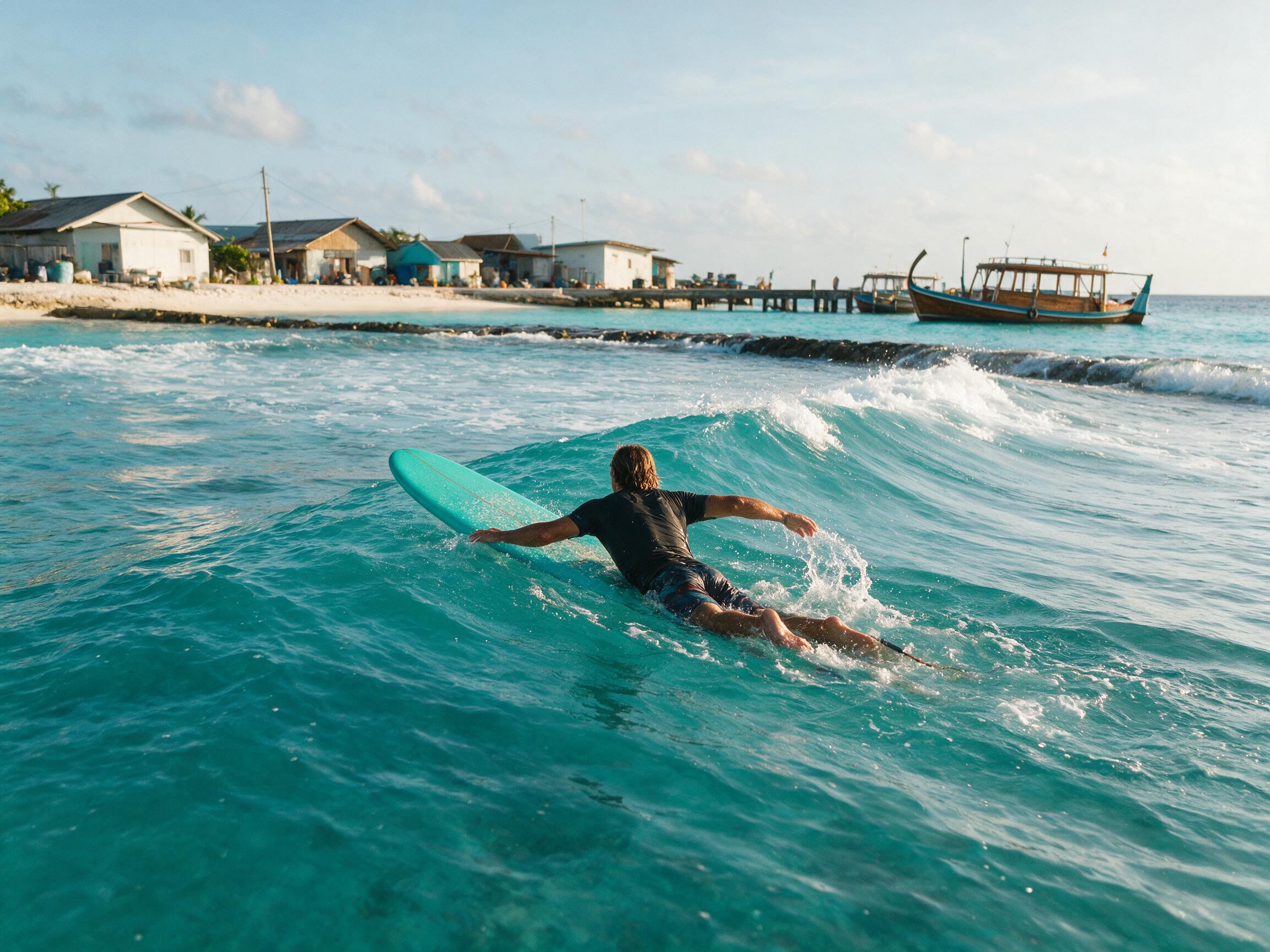
Thulusdhoo is a small local island in North Male Atoll — technically close to the “Instagram” resorts geographically, but a different world in practice. It’s known among a small, loyal community of surfers for a reef break called Coke’s, named, appropriately, because the Maldives’ first Coca-Cola bottling plant outside Male was built on this exact island — the fun fact that gives the break its name and gives you a genuinely good pub-quiz line. Coke’s is a fast, hollow left-hander that works best from April through October, which happens to be the exact window most Instagram-driven itineraries write off as “the bad season.”
Get Tripped doesn’t route clients into Thulusdhoo’s guesthouse scene — that’s a different, backpacker-adjacent segment — but it’s a genuinely worthwhile half-day or full-day charter from a nearby Male Atoll or Baa Atoll resort if you surf, want to watch people who do, or just want to see what a working local island looks like: a jetty, a few small shops selling short eats, kids playing football on sand at 5pm, a mosque call that actually organizes the rhythm of the day rather than being background noise for tourists. Ask your resort’s guest experience team to arrange a private speedboat charter with a surf guide rather than booking through the island’s tourist-facing operators directly — it’s a smoother, better-briefed version of the same trip.
Laamu, Noonu, Raa and Shaviyani: The Quiet Luxury Atolls
If Baa Atoll is the “known unknown” — famous among people who’ve done real Maldives research, invisible to everyone else — the next tier out is genuinely obscure even by that standard.
- Laamu Atoll, roughly 40 minutes by domestic flight south of Male plus a short speedboat transfer, is home to Six Senses Laamu — a resort built entirely around one of the longest house reefs in the country and a serious sustainability programme (they run their own marine biology and turtle rehabilitation centre). It’s far enough south that its guest mix skews toward people who’ve already done the Male Atoll circuit and specifically want something quieter.
- Noonu Atoll, about 30-35 minutes by seaplane, is where Cheval Blanc Randheli and a handful of newer ultra-luxury properties sit — dramatic house reef drop-offs close to the beach, useful if you want serious snorkeling without a boat ride to reach it.
- Raa Atoll, similar seaplane distance, includes properties with strong dive schools and notably fewer day-trippers than the Male atolls, since there’s no local-island tourist circuit nearby to bring in extra boat traffic.
- Shaviyani Atoll, one of the furthest north, is genuinely remote — Fairmont Maldives Sirru Fen Fushi is essentially the atoll’s sole international resort, which means the reefs around it see close to nobody outside the resort’s own guests.
None of these are quick weekend-trip atolls from India in the way South or North Male is — you’re trading transfer time for isolation, and for a house reef that hasn’t been snorkeled by three resort’s worth of guests before you get there.
A Local Island Worth Visiting for More Than a Selfie
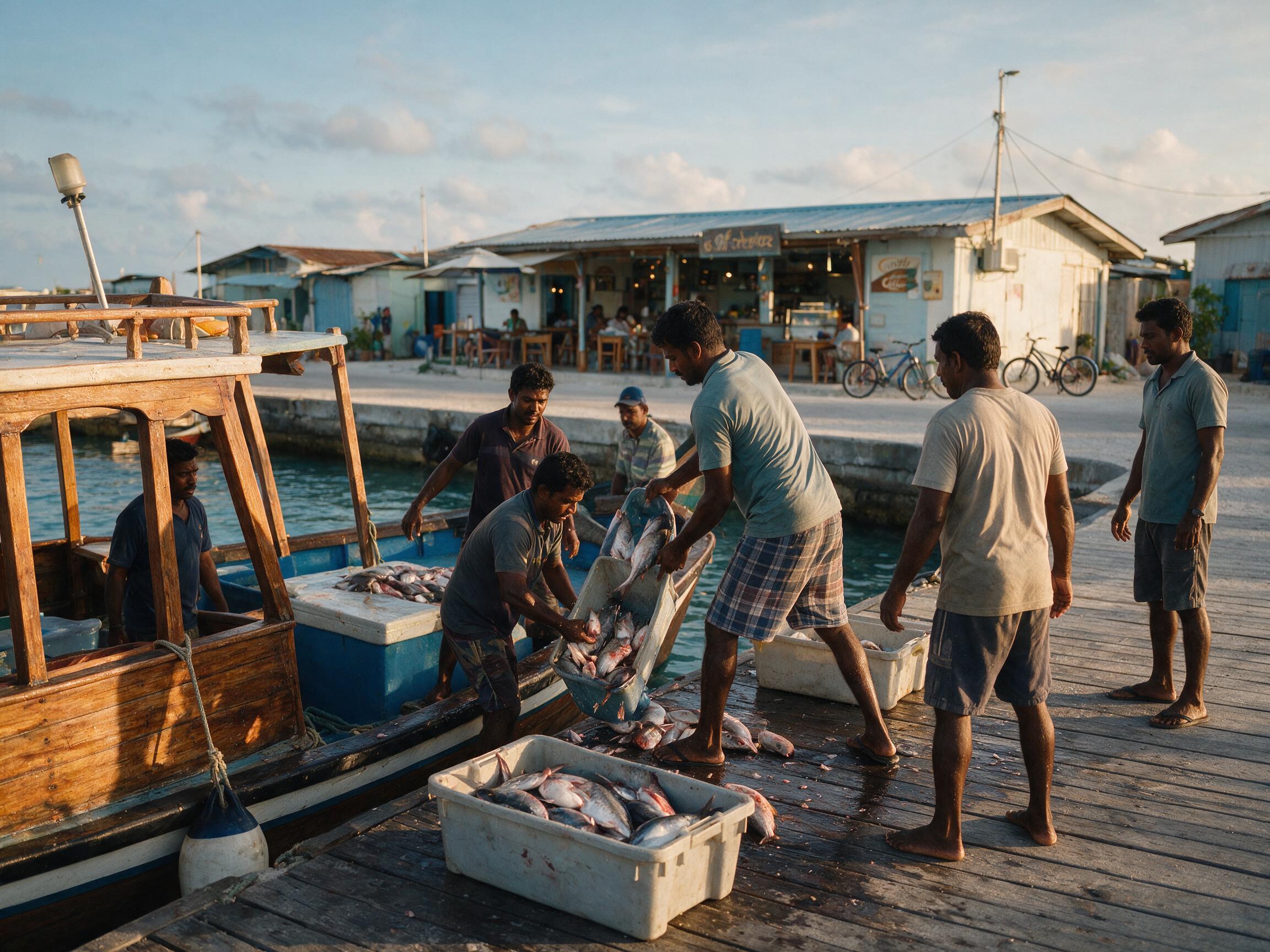
Dharavandhoo, the gateway local island for Hanifaru Bay excursions in Baa Atoll, is worth an hour of your itinerary even if you’re staying at a private resort a few minutes away by boat. It’s small — you can walk the inhabited stretch of it in about 20 minutes — but it’s a real fishing and guesthouse community, not a staged “cultural excursion.” The fish market by the harbour is busiest around late afternoon when the day boats come in; a few small cafés along the main road serve short eats (mas huni, a coconut-and-tuna breakfast dish, and hedhika, the Maldivian tea-time snack spread) that no resort buffet quite replicates. Dress modestly here — it’s a conservative Muslim community, and swimwear that’s fine on a resort beach is not appropriate on the local island’s main street.
Best Time to Visit: Dry Season, Wet Season and Manta Season
The Maldives runs on two monsoons, and the standard advice — “go in dry season, November to April” — is true but incomplete for anyone chasing the outer-atoll experience described above.
Dry season (roughly November-April): Calm seas, minimal rain, daytime temperatures around 29-31°C. This is peak season, and resort rates typically run 30-50% higher than the rest of the year, with Christmas and New Year weeks pushing 50-100% above standard rates. It’s also the best window for flat-water activities and for guaranteed seaplane operations, since seaplanes don’t fly after dark or in poor weather.
Wet season (roughly May-October): Short, intense afternoon showers rather than all-day rain — typically 1-2 hours of rain with 6-7 hours of sunshine still on most days. Rates commonly drop 40-60% from peak season. This is also, not coincidentally, both surf season (consistent swell from April through October, which is why Coke’s works best here) and manta season at Hanifaru Bay, where sightings peak from July through October. If your actual goal is mantas or surf rather than a postcard-flat lagoon, wet season isn’t a compromise — it’s the correct season.
Worth flagging honestly: September and October are the wettest months of the year, and that’s also close to peak manta activity, so you’re weighing marginally rougher weather against the best wildlife odds. Most travelers we’ve worked with find that trade worth it.
Maldives Visa for Indian Passport Holders in 2026
As of 2026, Indian passport holders receive a free 30-day visa on arrival at Velana International Airport — no advance application, no visa fee. What you do need to arrange before you fly:
- A passport valid for at least one month beyond your arrival date, with a blank visa page — manually extended pages are not accepted.
- The IMUGA Traveller Declaration, a mandatory online form (at imuga.immigration.gov.mv) that every traveler completes within 96 hours before departure — do this before you leave home, not at the airport.
- Proof of a confirmed resort or hotel booking.
- A return or onward flight ticket.
- Evidence of sufficient funds for your stay, though there’s no fixed minimum amount specified by immigration.
If you want to stay longer, extensions are available for up to 60 additional days (90 days total) through the Department of Immigration in Male, for an approximate fee of MVR 750. There’s no vaccination requirement for Indian travelers as of 2026. Always check the official Maldives Immigration site (immigration.gov.mv) close to your travel date — visa policy is one of those things worth re-verifying even when nothing has recently changed, because “nothing has changed” is exactly the assumption that gets people caught out.
Getting There: Flights From India
One underrated advantage of the Maldives for Indian travelers: it’s one of the few international beach destinations reachable by direct flight from multiple Indian cities, not just the usual Delhi/Mumbai gateways.
- Trivandrum (TRV): the shortest hop — around 1 hour 15 minutes to 1 hour 30 minutes direct, operated by Air India and other carriers. If you’re based in Kerala or Tamil Nadu, this is genuinely the fastest international beach holiday available to you.
- Kochi (COK): direct flights run roughly 1.5-2 hours.
- Chennai (MAA): direct flights, roughly 2-2.5 hours, operated by carriers including IndiGo and SriLankan Airlines’ partner services.
- Bengaluru (BLR): direct flights, roughly 2.5-3 hours.
- Mumbai (BOM): direct flights, roughly 3.5-4 hours, with the widest range of daily departure times given Mumbai’s flight volume.
IndiGo, Air India and SpiceJet all operate India-Male routes at various points in the schedule, so compare rather than assume one carrier has it locked down — capacity shifts season to season.
Seaplane, Speedboat or Domestic Flight: Getting to the Outer Atolls
This is the part first-time Maldives travelers most often get wrong, so it’s worth a dedicated section rather than a footnote.
| Transfer type | Typical cost (return, per adult) | Duration | Used for |
|---|---|---|---|
| Speedboat | US$150-400 | 15-90 minutes | North & South Male Atoll resorts; operates 24/7 |
| Seaplane | US$450-800 | 25-50 minutes | Ari, Baa, Noonu, Raa, Lhaviyani atolls; daylight hours only |
| Domestic flight + speedboat | US$450-700 | ~50 min flight + 15-45 min boat | Far atolls — Laamu, Addu, Gaafu, Haa, Shaviyani; can accommodate night arrivals |
The detail that catches people out: seaplanes don’t fly after dark. Land in Male after roughly 2pm and you likely won’t make a same-day seaplane connection to a Baa or Noonu Atoll resort — you’ll need an overnight in Male instead. Check your inbound arrival time against the transfer type before you lock in an outer-atoll resort.
Currency, Cards and What Things Actually Cost
The US Dollar effectively runs Maldives tourism — it’s accepted at every resort and on local islands too, alongside the Maldivian Rufiyaa (MVR). Visa and Mastercard are widely accepted at resorts; American Express less consistently. On local islands, small shops and guesthouses sometimes add a 3-5% card surcharge, so carrying a mix of USD cash for local-island stops is sensible. ATMs exist mainly in Male and larger inhabited islands — you generally won’t find one on a private resort island, so don’t plan on withdrawing cash once you’ve transferred out. Most resorts run on a room-charge system, so day-to-day cash needs are minimal if you’re not leaving the property; tipping is discretionary but appreciated, commonly USD 2-5/day for housekeeping and USD 5-10/day for villa hosts or butlers.
On cost: this isn’t a budget destination and Get Tripped isn’t positioning it as one, but for context — boutique properties in the outer atolls typically start in the US$400-700/night range for an entry villa category, while the flagship ultra-luxury properties (Soneva Fushi, Four Seasons Landaa Giraavaru, Six Senses Laamu at their top villa categories) run well into four figures a night, usually on a half-board or full-board plan. Add transfers (see the table above) and expect them to be a meaningful line item, not an afterthought, on outer-atoll trips.
A Mistake Worth Avoiding
The single most common planning mistake we see: booking an outer-atoll resort for a specific wildlife event — Hanifaru Bay mantas especially — without building in flexibility. The bay’s feeding events depend on current and plankton density, not a booking calendar, and even in peak season (July-October) there can be quiet stretches of several days. Book a resort with its own dedicated marine biology team and multiple weekly Hanifaru excursions rather than a single scheduled trip, and treat any sighting as a bonus on top of an already good house reef, not the entire reason for the holiday.
Who This Trip Is Actually For
Honeymooners and luxury seekers: the outer atolls solve the exact problem Male Atoll resorts sometimes create — a lagoon and reef you’re not sharing with a boatload of day-trippers from a neighboring island. Soneva Fushi and Milaidhoo in Baa Atoll, or Six Senses Laamu further south, both do genuinely private, low-density luxury well, with better honeymoon-specific extras (private sandbank dinners, in-villa spa, dive-in-dive-out access) than most Male Atoll equivalents at a comparable price point.
Families: Four Seasons Landaa Giraavaru in Baa Atoll runs one of the more substantial kids’ and teen programmes in the outer atolls, alongside the resort’s manta ray research centre, which turns into a genuinely good family activity rather than a side excursion — kids can sit in on marine biologist briefings, not just look at fish through glass. Factor the extra transfer cost and time into a family itinerary, though; a seaplane with small children is a different logistics conversation than a 20-minute speedboat.
FAQs
Is the Maldives visa-free for Indians in 2026?
Not visa-free, technically, but free and automatic: Indian passport holders get a 30-day visa on arrival at no cost, provided you’ve completed the online IMUGA Traveller Declaration and can show a confirmed resort booking and onward ticket.
Which is the best atoll in the Maldives for manta rays?
Baa Atoll, specifically Hanifaru Bay, holds the record for the largest documented reef manta ray feeding aggregation anywhere. Peak season is July through October, with sightings possible from May through November depending on lunar cycles and current.
Do I need to fly a seaplane to reach the outer atolls?
Not always. Baa, Noonu and Raa atolls typically use seaplane transfers (25-50 minutes, daylight hours only). Further-out atolls like Laamu and Shaviyani generally use a short domestic flight plus a speedboat, which — usefully — can operate after dark, unlike seaplanes.
Is Thulusdhoo worth visiting if I’m not a surfer?
Yes, as a half-day charter from a nearby resort rather than a place to stay. It’s a genuine working local island with a jetty, small eateries and an actual community rhythm, and Coke’s is worth watching even if you’re not paddling out yourself.
What’s the best time to visit the Maldives for good weather and good value together?
Late April through early June, or November, tend to offer a useful middle ground — shoulder-season rates below full dry-season peak pricing, without the heaviest wet-season rain of September and October.
Can I use Indian Rupees in the Maldives?
No — bring or plan to use US Dollars and cards. INR is not commonly accepted. USD cash is useful for local-island stops and small purchases; resorts run mostly on room-charge and card systems.
Are the outer atolls more expensive than North or South Male Atoll?
Not necessarily more expensive at the resort rate itself, but transfers add real cost — seaplane or domestic-flight-plus-speedboat transfers run US$450-800 return per person, compared to US$150-400 for a Male Atoll speedboat transfer. Factor that into your overall budget comparison, not just the nightly villa rate.
Do outer-atoll resorts still have overwater villas and typical Maldives luxury features?
Yes — the outer atolls aren’t a stripped-down version of the Maldives experience. Soneva Fushi, Four Seasons Landaa Giraavaru, Six Senses Laamu and similar properties all offer overwater villas, spas, multiple dining venues and dive centres; the difference is density and distance from Male, not the level of luxury.
The Maldives Doesn’t End at the First Resort You See
The version of the Maldives on your Instagram feed is real, and it’s genuinely beautiful — that’s not the argument here. The argument is that it’s one atoll’s worth of a twenty-atoll country, and the rest of it is where you find a UNESCO biosphere reserve full of manta rays, a local island that built its own surf identity, and boutique resorts designed by people who cared more about the reef outside their door than the view from a drone. A 30-minute seaplane ride is a small price for a house reef nobody’s snorkeled through twice this week.
Plan Your Maldives Trip With Get Tripped
Get Tripped Travels builds Maldives itineraries around the atoll and season that actually suit you — manta ray timing in Baa Atoll, a surf-adjacent stay near Thulusdhoo, or a genuinely private honeymoon further south in Laamu — not just the nearest resort to the airport. We handle the visa documentation, the seaplane-versus-speedboat math against your actual flight times, and the resort selection, so the only decision left is which villa category to book. Get in touch with our travel consultants to start planning your outer-atoll Maldives trip.