Netherlands 7 Nights 8 Days Itinerary: Amsterdam, Rotterdam, Utrecht, Giethoorn & Beyond
Eight days is the right amount of time to feel like you understand the Netherlands rather than just having seen it. You could spend all eight in Amsterdam and still leave with a list of things you didn’t get to — but you’d miss the point. The country is small enough that Rotterdam is an hour from Amsterdam by train, Giethoorn is two hours, and Keukenhof (when tulips are blooming) is barely 45 minutes. The richness is in the contrast: the urban reboot of Rotterdam’s architecture after the Second World War, the silence of Giethoorn’s waterways, the sheer mad spectacle of Keukenhof in April.
This 7 nights / 8 days Netherlands itinerary covers all six key destinations on Get Tripped’s Netherlands page: Amsterdam, Rotterdam, Giethoorn, Zaanse Schans, Utrecht, and Keukenhof — structured as a logical loop that moves easily by public transport, with room for your own pace on each day.
Table of Contents
- Trip Overview
- Days 1–2: Amsterdam (arrival and the classics)
- Day 3: Amsterdam to Zaanse Schans
- Day 4: Amsterdam to Keukenhof (seasonal) or Haarlem
- Day 5: Rotterdam
- Day 6: Utrecht
- Day 7: Giethoorn
- Day 8: Back to Amsterdam / Departure
- Practical Information
- FAQs
Trip Overview
| Day | Location | Highlights |
|---|---|---|
| 1 | Amsterdam | Arrival, canal walk, Jordaan neighborhood |
| 2 | Amsterdam | Rijksmuseum, Anne Frank House, Albert Cuyp Market |
| 3 | Zaanse Schans | Working windmills, clog factory, Dutch countryside by train |
| 4 | Keukenhof (Mar–May) / Haarlem (rest of year) | Tulip fields / medieval market city |
| 5 | Rotterdam | Erasmus Bridge, Cube Houses, Markthal |
| 6 | Utrecht | Domtoren, canal wharves, Dom Square |
| 7 | Giethoorn | Whisper boats, thatched farmhouses, waterway walks |
| 8 | Amsterdam | Last-minute picks, Schiphol departure |
Best time to visit: April–May for tulip season (Keukenhof open mid-March to mid-May). June–August for warm weather and outdoor festivals. September–October for fewer crowds and autumn light. December for Christmas markets.
Getting around: Dutch trains connect all major cities efficiently. Giethoorn requires a bus (from Zwolle station) or a day tour — no direct train. Use the NS app for train times and buy OV-chipkaart or single-trip tickets at station machines.
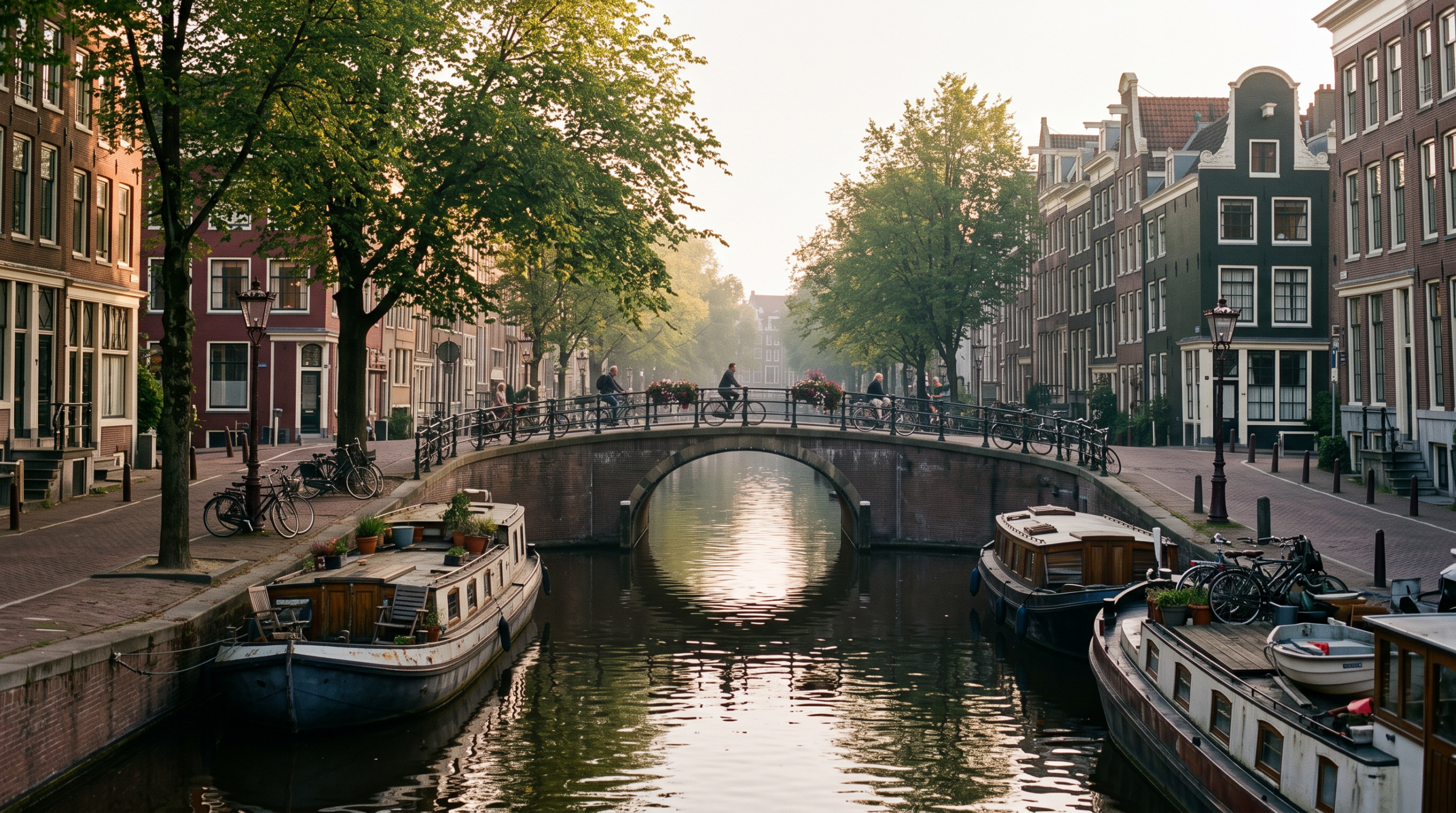
Days 1–2: Amsterdam — Canals, Museums, and the Jordaan
Day 1: Arrival and First Impressions
Schiphol Airport is one of Europe’s most efficient transit hubs. The Intercity Direct train to Amsterdam Centraal runs every 15 minutes and takes about 17 minutes. Buy your ticket at the airport machine — Schiphol is technically a separate fare zone, so an OV-chipkaart alone won’t cover the airport surcharge unless you specifically top up for it.
Check into your hotel in the canal belt (the 9 Streets / Jordaan area is a good base — walkable to most of central Amsterdam, quieter than the Red Light District zone, and genuinely pretty). Then walk. Specifically: walk the Herengracht, cross to the Keizersgracht, find a canal-side bench at dusk and just sit with it for a while. That view is what people picture when they think “Netherlands” and it holds up in person.
Evening: dinner in the Jordaan. Try the area around Elandsgracht or Noordermarkt — there are good Dutch and Indonesian restaurants tucked between the boutiques, and you won’t need a reservation if you’re eating by 7pm.
Day 2: The Museums and the Market
Start early at the Rijksmuseum (open 9am — the ticket queue gets long after 11am, so booking online in advance is worth the small fee). The Night Watch and Vermeer’s The Milkmaid are the anchors, but the applied arts collection on the ground floor is underrated and less crowded.
From the Rijksmuseum, it’s a 15-minute walk north to the Anne Frank House. Book tickets online weeks in advance — they sell out at the popular entry times. The experience is quieter and more affecting than the crowds outside suggest. Plan 75–90 minutes inside.
Afternoon: wander to the Albert Cuyp Market in De Pijp — the largest outdoor market in the Netherlands. Buy a stroopwafel from a stall that makes them fresh (the pre-packaged version you get at Schiphol is a pale imitation). If you have the appetite, raw herring with onions and gherkins from a haringhandel cart is the local thing to try.
Evening: if you’re up for a canal cruise, the evening departures (roughly 8–9pm in summer) offer a quieter experience with the lit bridges — more atmosphere than the busy daytime tours.
Day 3: Zaanse Schans
Take the Sprinter from Amsterdam Centraal to Zaandijk-Zaanse Schans (about 18 minutes). The station is literally a 10-minute walk from the windmills — no shuttle needed.
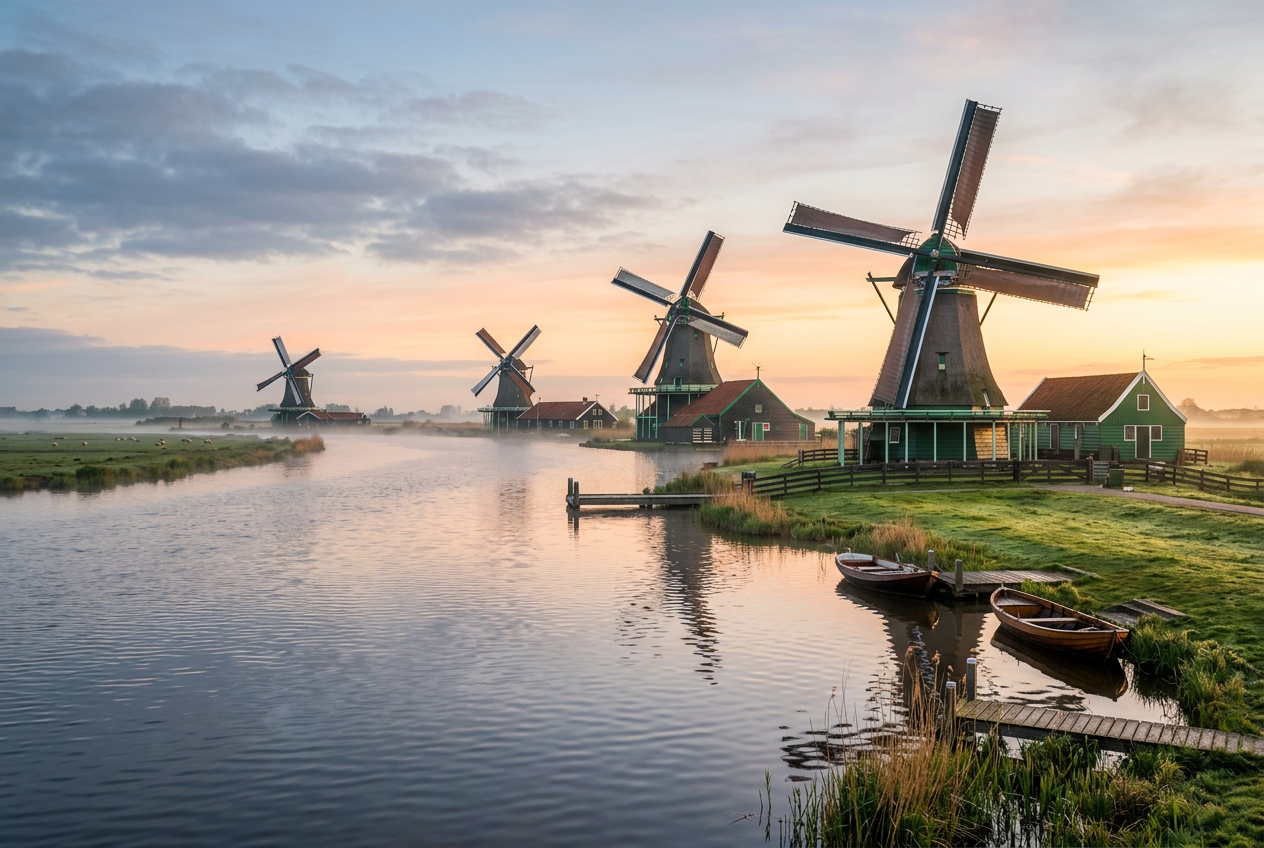
Zaanse Schans is the Netherlands’ best-preserved example of what a 17th/18th-century industrial village actually looked like: wooden houses painted in the traditional Dutch green-grey, working windmills grinding mustard and sawing timber, a clog workshop, a cheese farm, and a pewter workshop. It’s touristy, yes — there are coach buses — but go early (arrive by 9am) and most of the hordes haven’t materialized yet. The windmills are operational on windy days and you can go inside the De Kat windmill (paid entry) to see the machinery working.
The mistake most people make: staying only 2 hours. Give it half a day. Walk to the far end of the river path beyond the main cluster — the view back toward the windmills with the Zaan River in the foreground is the classic photograph, and it’s 100 meters from where all the tour groups stop.
Return to Amsterdam by 3pm and use the afternoon for anything from Day 1/2 you didn’t get to: the Van Gogh Museum (book ahead), a bike rental for the Vondelpark, or just more canal-side time in the Jordaan.
Day 4: Keukenhof (mid-March to mid-May) or Haarlem
If visiting during tulip season (mid-March to mid-May)
Keukenhof Garden, near the town of Lisse, is the largest flower garden in the world — 32 hectares, 7 million bulbs, roughly 800 varieties of tulips. It’s open only about 8 weeks a year and it genuinely warrants the hype. From Amsterdam, take the train to Haarlem or Leiden and then the Keukenhof Express bus (clearly signed at both stations).
Buy tickets online before you travel — the garden operates at a set capacity and the on-the-day ticket lines are long. Arrive at opening time (8am) if you want the early light and quieter paths. By noon the main paths are packed; the back sections of the garden remain more peaceful.
The fields outside Keukenhof — visible from the bus as you approach — are often more photogenic than the garden itself, with long rows of single-color tulips stretching to the horizon. If you rent a bike in Lisse, you can cycle through the Bollenstreek (bulb region) on dedicated paths and see the working fields up close.
If visiting outside tulip season
Take a 20-minute train to Haarlem instead — a compact medieval city with a beautiful main square (Grote Markt), the Frans Hals Museum (excellent Dutch Golden Age collection), and a walkable canal center that feels like Amsterdam without the crowds. It’s a good half-day and combines well with the return trip.
Day 5: Rotterdam
Rotterdam is the city that didn’t let its wartime destruction define it — it redesigned itself instead. After Allied bombing flattened almost the entire center in 1940, the city rebuilt with radical architecture: the Cube Houses (Kubuswoningen), the Erasmus Bridge, the Markthal food market, and the Depot Boijmans Van Beuningen (the world’s only publicly accessible art depot, with a mirrored dome that reflects the sky). It looks nothing like Amsterdam, and that’s entirely the point.
Take the Intercity train from Amsterdam Centraal to Rotterdam Centraal (around 40 minutes). The train station itself is worth pausing at — it’s a significant piece of contemporary architecture with a vast canopy roof.
Walk to the Cube Houses (Piet Blom, 1984) — distinctive yellow cube homes tilted at 45 degrees. One is open as a museum; the €3.50 entry fee is worth it to see how people actually live in a space designed by a provocateur. From there, walk to the Markthal for lunch — a horseshoe-shaped market hall with about 100 food stalls under a massive painted ceiling. The Dutch cheese, stroopwafel, and Indonesian food sections are all good.
Afternoon: Erasmus Bridge and the Wilhelminapier waterfront, then the Depot Boijmans Van Beuningen if you’re interested in how art collections actually work (you can see the storage, the conservation labs, and the art together — it’s unlike any museum experience in Amsterdam).
Stay overnight in Rotterdam or return to Amsterdam for the night.
Day 6: Utrecht
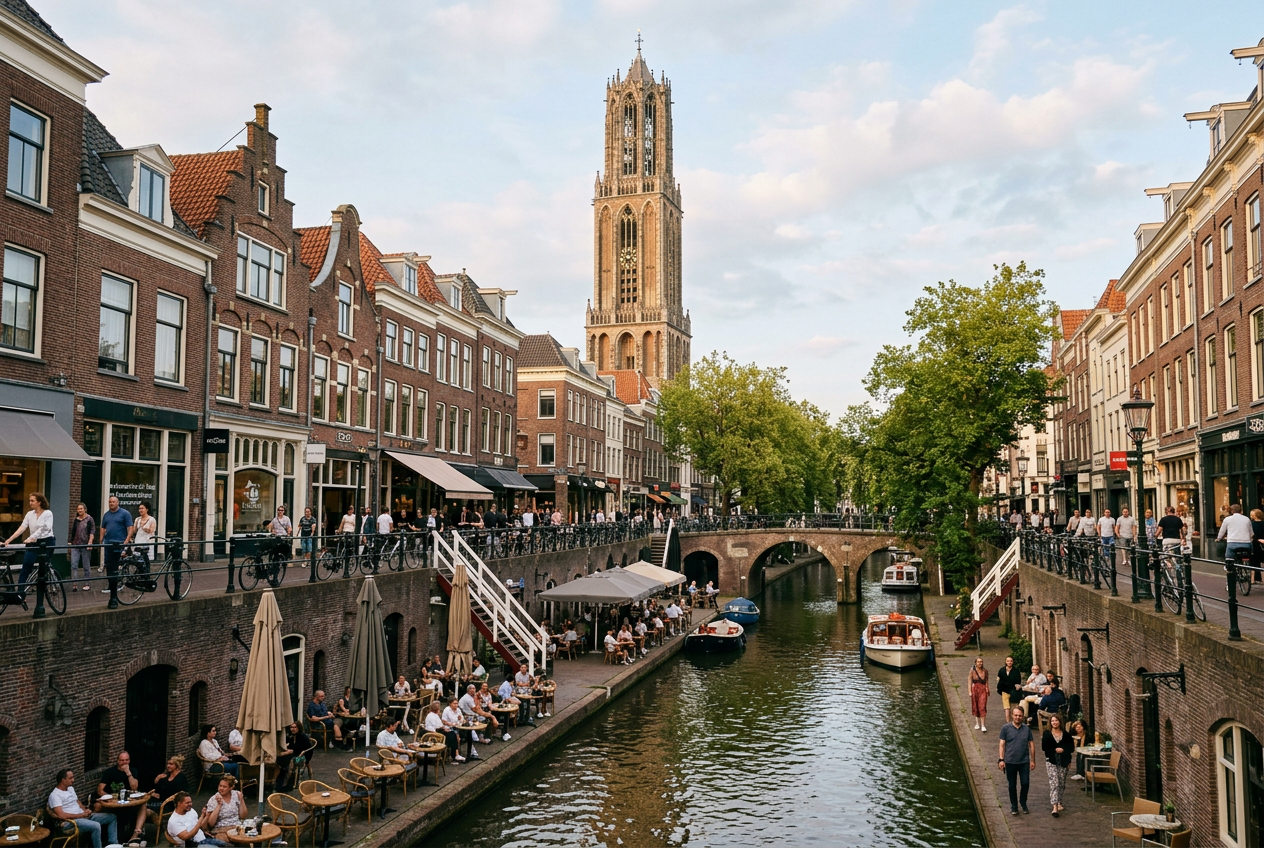
Utrecht is the Netherlands’ fourth-largest city but feels smaller — it’s a university town with a genuinely medieval center. The Dom Tower (Domtoren) is the country’s tallest church tower at 112 meters; you can climb it with a guided tour for views that on a clear day extend to Amsterdam. The Dom Square below was originally the nave of the cathedral — the main structure collapsed in a storm in 1674 and was never rebuilt, leaving the tower standing alone and the square open.
The most distinctive thing about Utrecht’s canal system: the wharves. While most canal cities have streets at water level, Utrecht’s canals have a lower terrace — sunken stone wharves built into the banks — that served as warehouses for centuries and now house cafes and restaurants at the waterside. Sit at a wharf-level café in the afternoon and you’re looking up at houseboats and cyclists from below. It’s an unusual urban geography and the best thing to understand about the city.
From Rotterdam or Amsterdam, Utrecht is about 40–45 minutes by Intercity train. Day trip or overnight — if you’re interested in museums, the Centraal Museum Utrecht has a strong collection including designs by Gerrit Rietveld (the Utrecht-based designer behind the famous Rietveld Schröder House, worth booking a visit to in advance).
Day 7: Giethoorn
Giethoorn is sometimes called the “Venice of the North” — but what it actually is, is a village of roughly 2,700 people where the streets are waterways and you get around by boat, bicycle, or on foot along narrow paths. There are no roads through the historic center. The houses are connected by 176 bridges and the only sounds in the early morning are birds and the electric whisper of rental boats.
Getting there from Utrecht or Amsterdam takes about 2 hours by public transport (train to Zwolle, then bus 70 toward Giethoorn — get off at the Dominee Hylkemaweg stop). Alternatively, several day-tour operators run direct coaches from Amsterdam that include a boat rental — convenient if you don’t want to navigate connections.
Rent a whisper boat (electric, no noise) for 2–3 hours in the morning. The boat operator will give you a basic route map; the main waterway runs the length of the village but the smaller side canals are worth getting lost in. By mid-morning the main canal fills with tourist boats; the side channels stay quiet. Spend the afternoon walking the perimeter path on foot to see the farmhouses and the thatched rooftops from land.
Practical note: Giethoorn gets very crowded in summer (July–August) on weekends. Visiting on a weekday, or arriving early and leaving by early afternoon, makes a real difference.
Day 8: Back to Amsterdam and Departure
Return to Amsterdam or travel directly to Schiphol from your Day 7 location (Zwolle to Schiphol is about 80 minutes by train). If your flight is in the afternoon, a morning in Amsterdam’s Bloemenmarkt (floating flower market on the Singel canal, open from 9am) or a final breakfast in the Jordaan is a good way to close the trip.
The walk from Amsterdam Centraal along the Singel canal to the Bloemenmarkt takes about 25 minutes and passes several of the city’s best coffee spots — the kind that appear once the morning rush clears. If you haven’t tried Dutch-Indonesian food (rijsttafel — a shared meal of small dishes), this last night in Amsterdam is the time.
Practical Information
Currency: Euro (€). Cards are widely accepted, including contactless and mobile pay. Some smaller cafes and markets prefer cash — carry €50–100 for incidentals.
Transport: NS (Dutch Railways) is reliable. The NS app shows real-time delays and platform changes. OV-chipkaart or OV-pas (the newer contactless card) works on all buses, trams, and metro too.
Weather: The Netherlands has changeable weather year-round. Pack a light rain jacket regardless of season — not because it rains constantly, but because it rains suddenly.
Cycling: Renting a bike in Amsterdam is easy; dozens of shops near Centraal Station offer day rentals for €12–18. Rule one: use the cycle lane, not the pavement. Rule two: lock your bike to a fixed object, not to itself — Amsterdam has a serious bike theft problem.
Tipping: Not obligatory but appreciated. Rounding up or leaving 5–10% in restaurants is standard.
Language: Dutch, but English is spoken almost universally, including in smaller towns and in train station interactions.
Frequently Asked Questions
How many days is enough for Amsterdam alone?
Two to three full days covers the major museums, canal neighborhoods, and markets without feeling rushed. Four days allows for day trips to Zaanse Schans or Keukenhof as well. This 8-day itinerary treats Amsterdam as your base for the first few days before moving on.
Is it worth visiting Keukenhof if tulip season is over?
Keukenhof is only open for about 8 weeks (mid-March to mid-May), so if your trip is outside that window, it’s simply not accessible. The Bollenstreek (bulb fields) around Lisse remain somewhat visible outside this window if you’re cycling, but the big show is over. Haarlem is the better substitute day trip.
Can I do this itinerary without renting a car?
Yes, entirely. The Netherlands has excellent train connectivity between cities, and Giethoorn (the one exception) is reachable by bus from Zwolle. A car can be useful for the bulb fields, but it’s not necessary.
How far in advance should I book Rijksmuseum and Anne Frank House tickets?
Anne Frank House: 6–8 weeks in advance during peak season (April–September). Tickets are released daily at midnight for a window 2 months ahead — popular slots sell out within minutes. Rijksmuseum: 1–2 weeks ahead is usually sufficient outside peak summer. Van Gogh Museum: similar to Rijksmuseum.
What’s the best way to get from Giethoorn back to Amsterdam/Schiphol?
Take bus 70 from Giethoorn to Zwolle station, then direct Intercity to Amsterdam Centraal (about 80 minutes). From Centraal, the Intercity Direct to Schiphol runs frequently and takes about 17 minutes.
Ready to take this itinerary from a plan to a reality? Get Tripped’s Netherlands packages handle the logistics — transport, accommodation, and expert curation — so you arrive knowing the best stopping points at Keukenhof and the right time to be on Giethoorn’s back channels. Start planning your Netherlands trip on WhatsApp today.