Giethoorn has a strange relationship with its own fame. It got discovered by Instagram and Chinese and South Korean tour groups over the last decade, got nicknamed “the Venice of the North,” and now runs the real risk of becoming a place people visit to take the photo everyone else has already taken, rather than to actually experience a working Dutch canal village. It’s still worth going. You just need to go at the right hour, and know what you’re actually looking at once you’re there.
This is a narrative walk through one full day in Giethoorn, timed around the two windows — early morning and late afternoon — when the village looks like the photos and feels like somewhere people genuinely live, rather than a tour-bus stop.
Table of Contents
- Getting There From Amsterdam
- 7:00-9:30am: The Village Before the Crowds
- 10:00am-1:00pm: On the Water
- 1:00-2:30pm: Lunch and a Slow Walk
- 2:30-5:00pm: The Museum and the Quiet Corners
- 5:00-7:00pm: Golden Hour on the Canal
- A Mistake to Avoid
- FAQs
Getting There From Amsterdam
Giethoorn sits roughly 120km northeast of Amsterdam, in Overijssel province, and there’s no single fast way to get there. Direct shuttle services (from around €65, including a short canal cruise) run from Overhoeksplein near Amsterdam Centraal and are the simplest option if you don’t want to deal with transfers. The public transport route — train to Steenwijk, then local bus 70 — technically works but runs on a limited schedule (one to two buses an hour) and takes 2-2.5 hours each way, which eats most of your day before you’ve seen a single canal. If you’re driving, it’s about 1.5 hours and gives you by far the most flexibility over timing, which matters more here than almost anywhere else in the Netherlands.
My honest recommendation: this is a trip where paying for a direct shuttle or arranging a private transfer through your travel operator is worth it. The time you save goes straight back into the hours that actually make Giethoorn worth the trip.
7:00-9:30am: The Village Before the Crowds
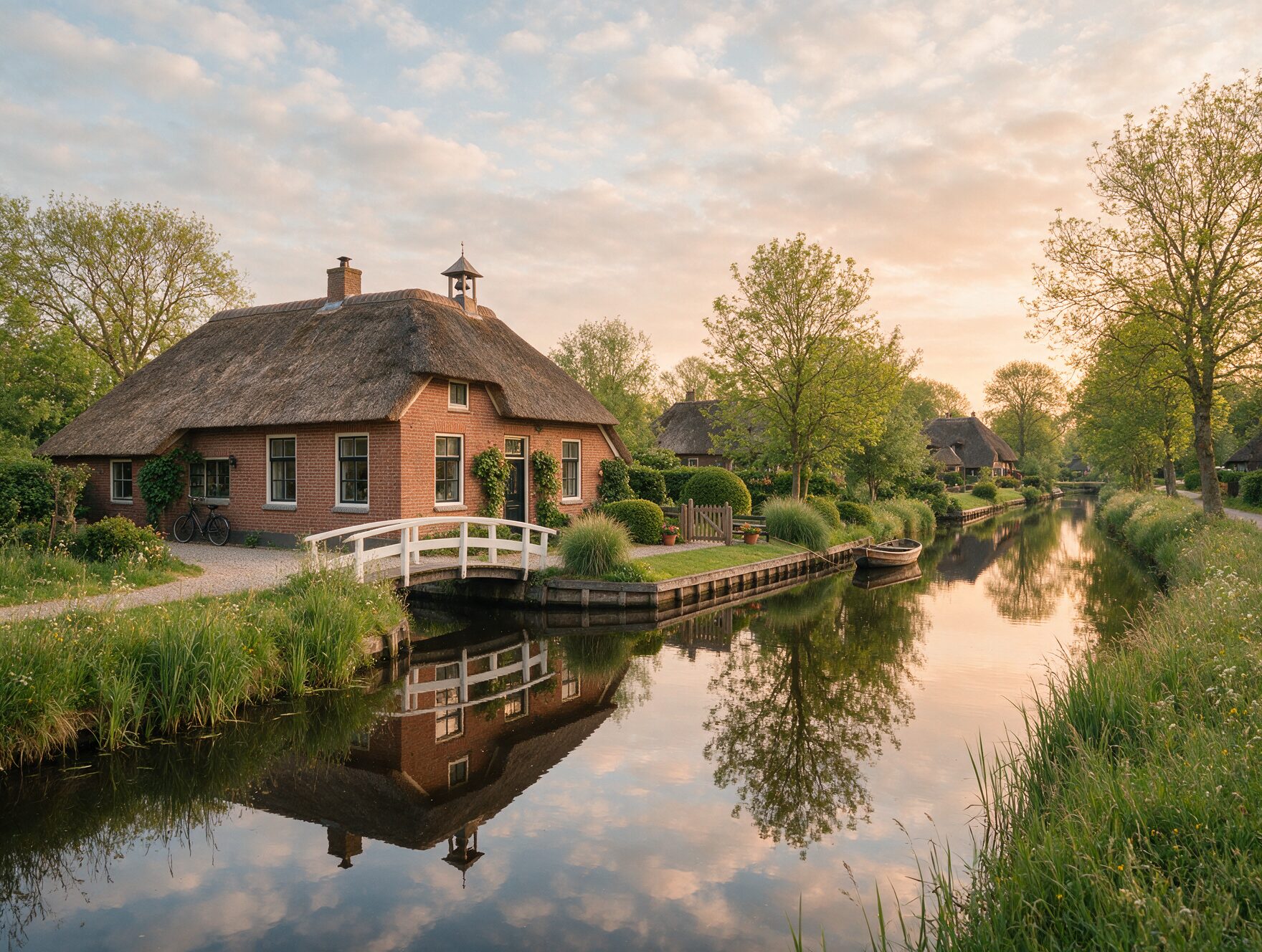
If you can manage it, arrive by 7:30am. Giethoorn’s resident population is small — a few hundred people — and the tour buses from Amsterdam typically don’t arrive until mid-morning, so the first ninety minutes of daylight give you the village close to how it actually looks day to day: thatched farmhouses, wooden footbridges, the water still enough to hold a near-perfect reflection of the cottages along it. Walk the main path along the Binnenpad rather than renting a boat yet — this is the best stretch for photos precisely because nobody else is out on the water to break up the reflection.
10:00am-1:00pm: On the Water
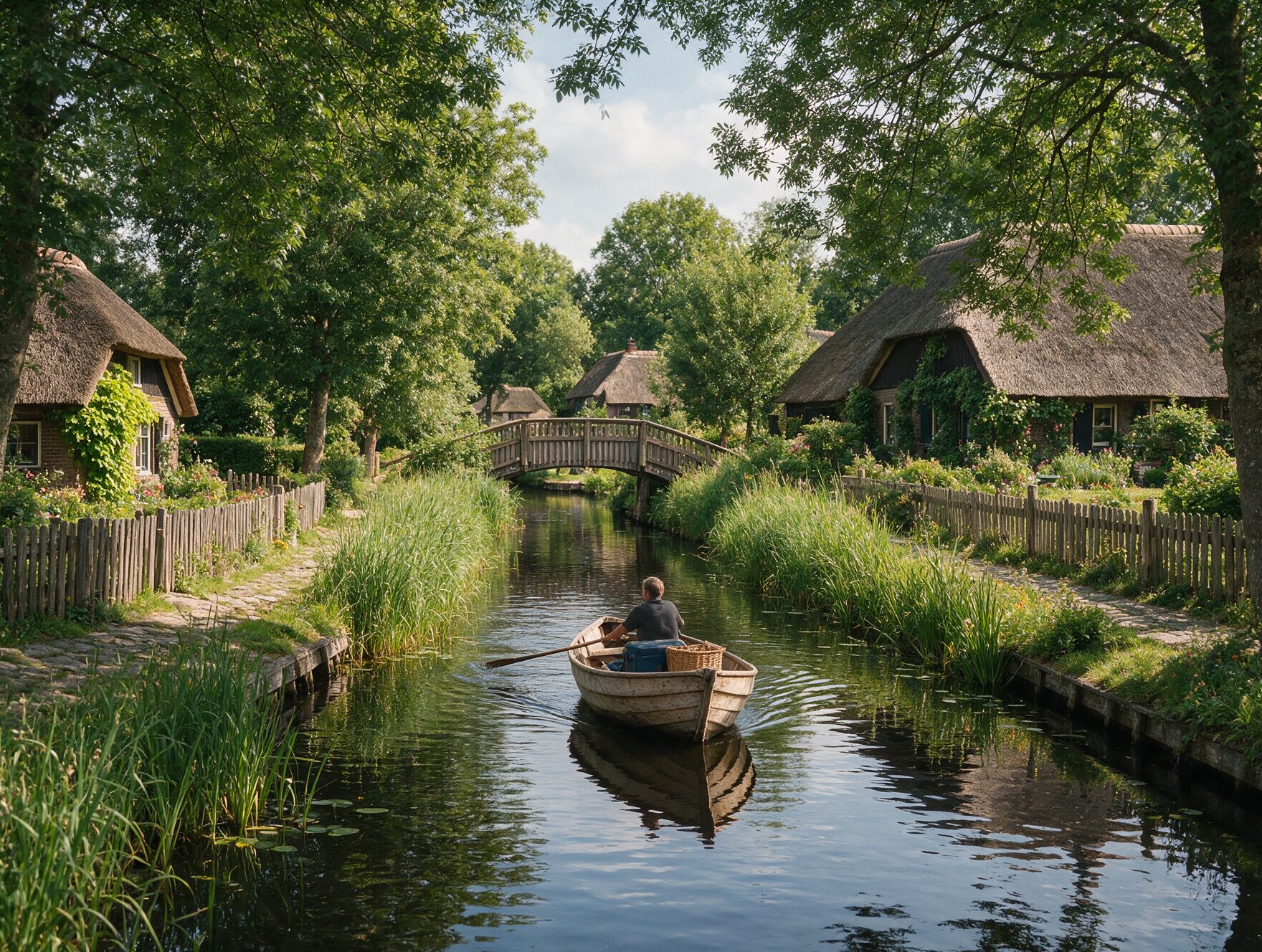
By mid-morning, it’s time to actually get on the canal, which is the only way to see a meaningful chunk of the village — many of Giethoorn’s houses have no road access at all and are reachable only by water or footpath. A self-drive boat (from roughly €69 for a group of up to eight) gives you control over pace and is the better option if your group is a mix of ages; a boat with a captain (from around €153 for up to four) is worth it if nobody in your group has handled a boat before and you’d rather not spend your morning figuring out steering in a narrow canal.
Book this in advance. Boats are genuinely limited, and showing up without a reservation on a weekend between June and August — the busiest stretch — means you may not get one at all.
1:00-2:30pm: Lunch and a Slow Walk
Giethoorn’s dining options are modest and mostly clustered near the Dorpshuis — pancake houses and simple Dutch cafés rather than destination restaurants, which is honestly appropriate for a village this size. Eat lightly here and plan a better dinner back in Amsterdam or wherever you’re staying that night. Use the slower post-lunch hour for a walk rather than another boat trip — the footpaths that wind away from the main canal toward the edges of the village are where you’ll actually see residents going about an ordinary afternoon: gardening, ferrying groceries by small boat, kids cycling the narrow bridges.
2:30-5:00pm: The Museum and the Quiet Corners
If you want context rather than just scenery, the small local museum (Museum Giethoorn ‘t Olde Maat Uus) walks through what life here actually looked like before tourism — turf-cutting, the original reasons the village has no roads (it was built on peat marshland, and canals were simply more practical than paths), and how the whole area was shaped by centuries of peat extraction rather than designed as a pretty village from the start. It’s a small, unglamorous museum, and that’s exactly why it’s useful: it explains the “why” behind everything you’ve been photographing all day.
5:00-7:00pm: Golden Hour on the Canal
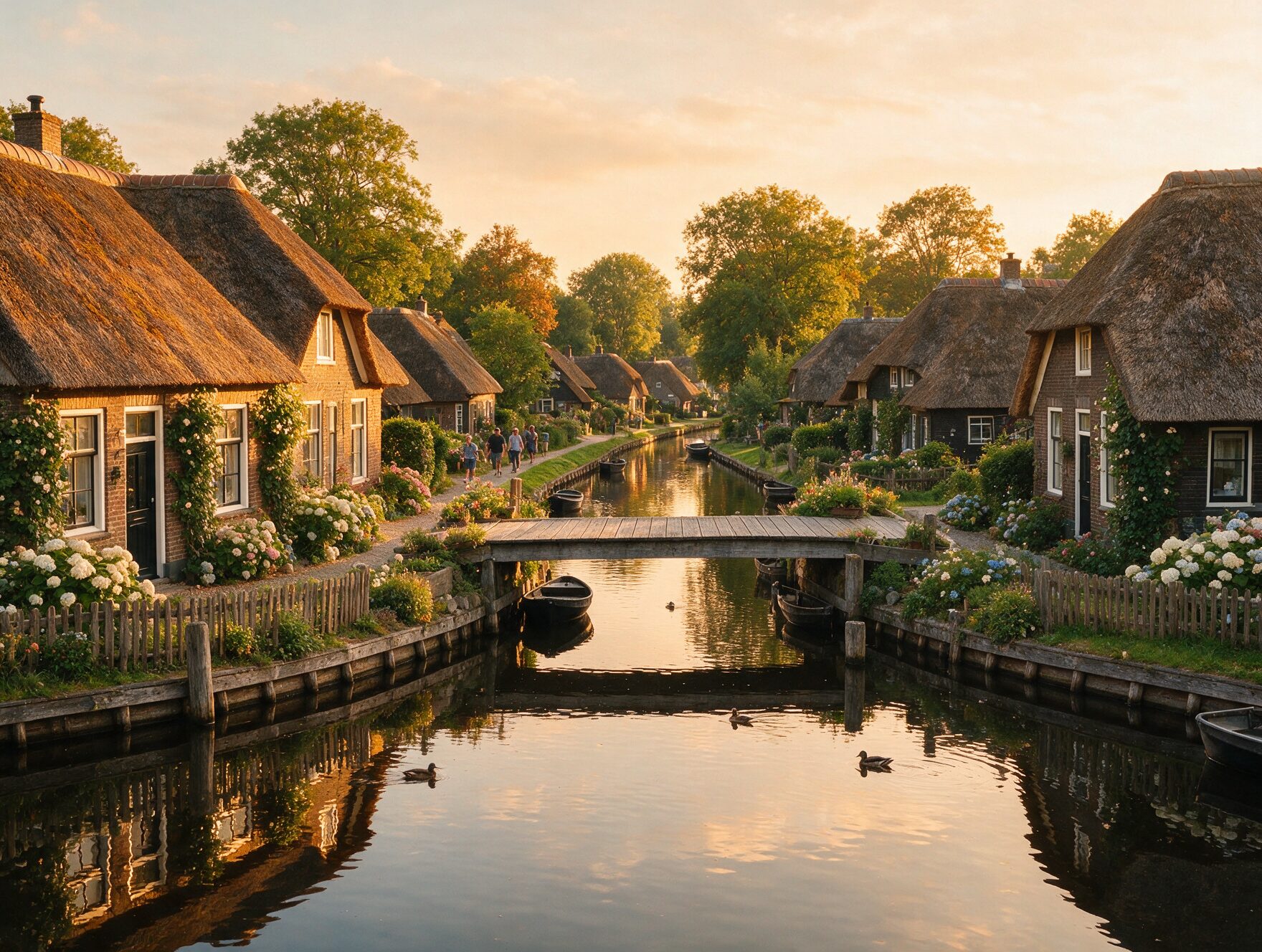
This is the second window worth protecting in your schedule. By 5pm, day-trip tour groups are heading back toward their buses, and the light turns the kind of warm gold that makes the thatched roofs and water genuinely glow rather than just look pretty in an ordinary way. If you timed your boat rental for a late return rather than an early one, this is when to be out on the water, not the museum or lunch stop. If you’ve already returned your boat, a slow walk back along the Binnenpad gives nearly the same effect.
A Fun Fact Worth Knowing
Giethoorn’s name has a slightly odd origin story: locals say it comes from the large number of goat horns (“geit” meaning goat, “hoorn” meaning horn) found in the area after a 1170 flood washed up the remains of goats that had drowned in the disaster. Whether that’s literal history or village folklore passed down long enough to harden into fact, it’s the kind of detail that makes the place feel less like a theme-park version of “quaint Dutch village” and more like somewhere with an actual, sometimes grim, history underneath the postcard surface.
A Quieter Corner Most Visitors Miss
Almost every visitor sticks to the main Binnenpad stretch, where the famous thatched-cottage view is. Fewer walk or boat out toward the Bovenwijde and Beulakerwijde lakes just north of the village — a short paddle or boat ride that opens into genuine open water with reed beds and birdlife, a sharp contrast to the tight, picture-postcard canals everyone photographs. If you’ve rented a boat for the morning anyway, extending ten minutes further out here gives you a sense of the wider wetland landscape Giethoorn actually sits inside, rather than just the curated village core.
Payments, Connectivity, and Practical Notes
Card payments, including contactless, are accepted at nearly every boat rental counter, café, and the museum — cash isn’t necessary, though it’s worth keeping a small amount for anywhere that has an older card machine. Mobile data coverage is solid throughout the village despite its rural feel, so navigation apps and boat-return coordination over WhatsApp both work fine. There’s no real “nightlife” here in any form — this is a day-trip and early-evening destination, not somewhere to plan an overnight social scene, even if you do stay over.
A Mistake to Avoid
Don’t try to fit Giethoorn into the same day as Zaanse Schans or a Volendam stop, which is a combination I see pushed on a lot of generic day-tour itineraries. Giethoorn is far enough from Amsterdam, and different enough in character, that stacking it with another day-trip destination turns both into a rushed, 45-minute photo stop rather than a real visit. Give Giethoorn its own day.
What a Day in Giethoorn Actually Costs
Budgeting for a mid-range day trip from Amsterdam: a direct shuttle runs roughly €65 per person including a short cruise, a self-drive boat rental for a group of four to six adds another €15-20 per person for a half-day, and lunch at one of the village cafés is €12-18 per person for something simple like Dutch pancakes or a sandwich. All in, expect somewhere around €100-120 per person for a comfortable day trip with a private boat, less if you’re splitting a larger group boat across more people. The museum entry is a modest €6-8 and genuinely worth adding if you have the afternoon slot free.
A Few Honest Notes by Traveller Type
Families with young kids: the self-drive boats are genuinely manageable even with children aboard, since the canals are calm and shallow, but keep life jackets on regardless of how still the water looks.
Couples: the golden-hour window described above, in a self-drive boat with no guide or group around you, is one of the quietest, most romantic hours you’ll spend anywhere in the Netherlands — genuinely worth the planning it takes to protect that slot.
Photography-focused travellers: skip the busy June-August window entirely if you can. Spring and autumn give you a real chance at the village without a boat traffic jam in frame.
Frequently Asked Questions
Is Giethoorn worth the long travel time from Amsterdam?
If you go during the crowded windows (midday, peak summer weekends) without any plan, it’s a fair question. Timed around the early morning or golden-hour windows described here, it’s one of the most distinctive day trips in the entire country — nowhere else in the Netherlands looks quite like this.
Do I need to know how to drive a boat?
No prior experience is needed for the self-drive electric or petrol boats — they’re low-speed and the canals are forgiving. A quick briefing at the rental point covers everything you need.
What’s the best time of year to visit?
Late spring through early autumn for warm weather and full greenery, but the village is at its quietest and arguably most atmospheric in shoulder months (April-May, September-October), away from the June-August crowds.
Is Giethoorn expensive compared to other Netherlands day trips?
Transport is the main cost — a direct shuttle or private transfer runs more than the equivalent trip to Zaanse Schans, which sits much closer to Amsterdam. Once there, food and the boat rental itself are reasonably priced.
Can I stay overnight in Giethoorn instead of a day trip?
Yes, and if your schedule allows it, this solves the golden-hour and early-morning timing problem entirely — a handful of small guesthouses and B&Bs let you have both quiet windows without the shuttle schedule dictating your day.
Is Giethoorn accessible for elderly travellers or those with limited mobility?
Partially. The main Binnenpad path is flat and walkable, and self-drive boats require minimal physical effort once seated, but many of the footbridges have a step or a slight arch, and boarding a boat does require a reasonable degree of balance. A boat with a captain removes the steering concern but not the boarding itself — it’s worth discussing specific mobility needs with your operator before booking.
Plan the Rest of Your Trip
Giethoorn works best as a deliberate, standalone day within a broader Netherlands itinerary rather than a box to tick alongside other day trips. See our 7 nights / 8 days itinerary for how to slot it in, and our packing guide by season if you’re timing this around a specific month.