Keukenhof is one of the few places in this entire guide where the photo you’ve seen genuinely matches what’s in front of you — 32 hectares, more than 7 million bulbs planted fresh every single year, and a eight-week window (19 March to 10 May in 2026) in which the whole garden is deliberately timed to peak. The catch is that everyone who’s seen the same photos knows this too, and by midday in April the main pathways can feel more like a queue than a garden. The light is also genuinely part of the experience here in a way most gardens don’t bother with — low morning sun through rows of tulips does something no midday shot manages.
Here’s how to time a Keukenhof visit around its best light and its quietest hours, rather than just showing up and hoping.
Table of Contents
- 2026 Dates, Hours, and Tickets
- The Opening-Hour Window
- The Historic Windmill Viewpoint
- Rainy-Day Backup: The Indoor Pavilions
- The Late-Afternoon Window
- The Whisper Boat Through the Fields
- A Mistake to Avoid
- FAQs
2026 Dates, Hours, and Tickets
Keukenhof opens for exactly eight weeks a year: 19 March through 10 May 2026, daily from 08:00 to 19:30, with last entry at 18:00. Adult tickets run roughly €21.50 booked online (book ahead — walk-up pricing and availability are both worse), children aged 4-17 around €9-10, and under-4s free. Parking is a separate purchase if you’re driving rather than taking the bus from Amsterdam or Schiphol.
The Opening-Hour Window
Arrive at or just before 08:00. This is the single most important piece of advice in this guide: the gardens stay genuinely walkable for roughly the first ninety minutes after opening, and the low-angle morning light through the tulip rows — especially in the more open field sections rather than the shaded wooded paths — is a different experience from the flatter, harsher light of midday. By 10:30-11:00, tour buses from Amsterdam have arrived in force and the main pathways through the most photogenic sections slow to a shuffle.
The Historic Windmill Viewpoint
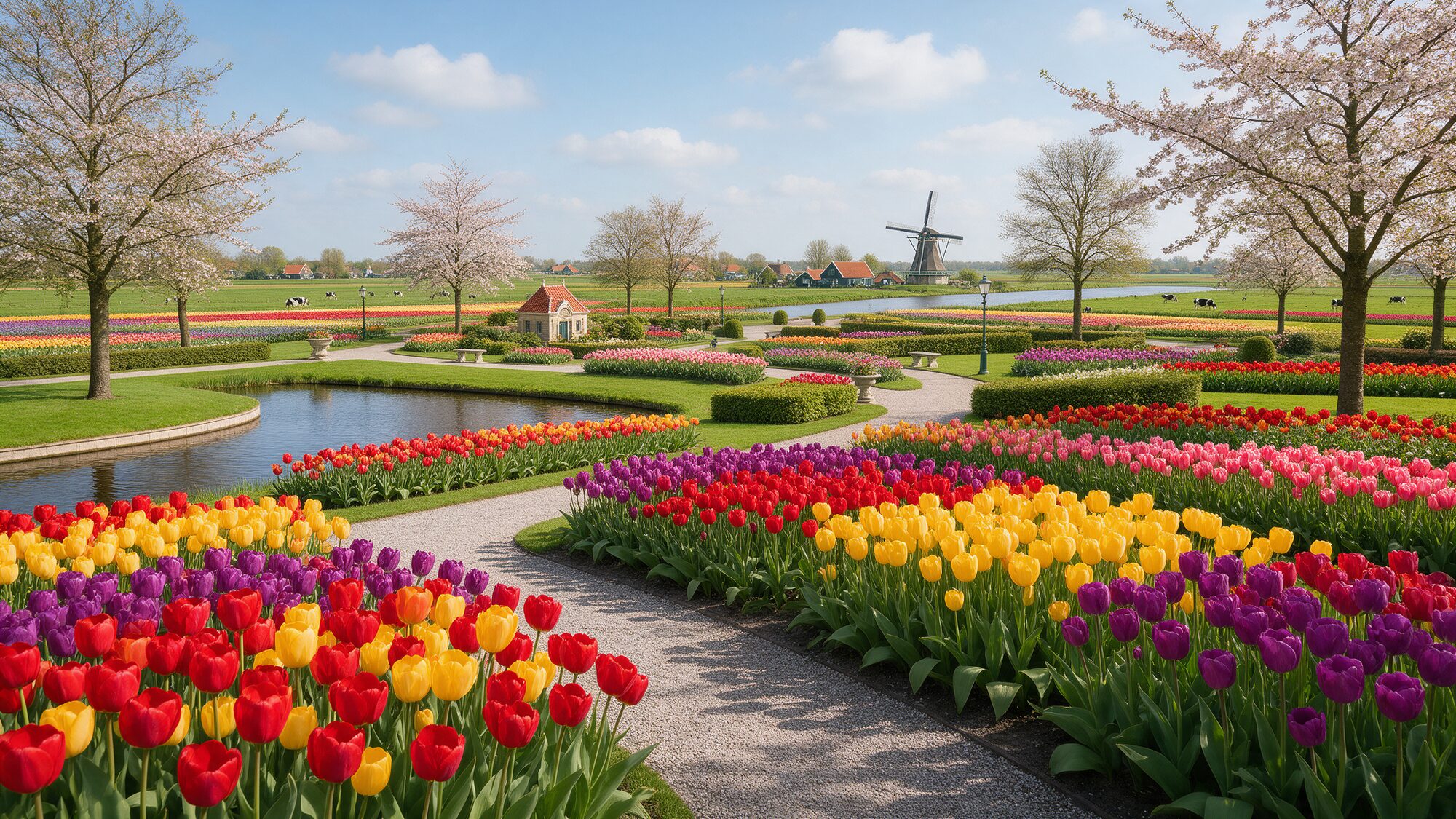
Keukenhof has its own historic windmill within the grounds, and climbing it gives you an elevated view over the garden and the commercial flower fields stretching beyond the park boundary — genuinely one of the better vantage points in the whole complex, and one a meaningful share of visitors skip because it’s a short climb rather than a flat path. Morning light from this height, looking out over both the manicured garden and the working flower fields beyond, is worth prioritising in that first 90-minute window.
Rainy-Day Backup: The Indoor Pavilions
Dutch spring weather is unpredictable, and Keukenhof’s indoor pavilions — rotating flower exhibitions, mostly orchids and other greenhouse flowers rather than tulips specifically — are a legitimate backup if you hit a wash-out morning. They don’t replace the outdoor gardens, but they’re not an afterthought either, and they’re markedly less crowded than the main paths regardless of weather, since most visitors come specifically for the tulip fields and treat the pavilions as optional.
The Late-Afternoon Window
The second viable light window is roughly 17:00 to the 18:00 last-entry cutoff. Tour groups have largely departed by mid-afternoon, and while the light isn’t quite as dramatic as the early morning — Keukenhof’s own guidance doesn’t specifically tout golden-hour photography the way you’d expect of a garden this photogenic, which suggests the late window is more about crowd levels than a dramatic lighting payoff — it’s meaningfully quieter than midday and still well within the operating hours. If an 8am start genuinely isn’t realistic for your group, this is the fallback that still beats the middle of the day.
The Whisper Boat Through the Fields
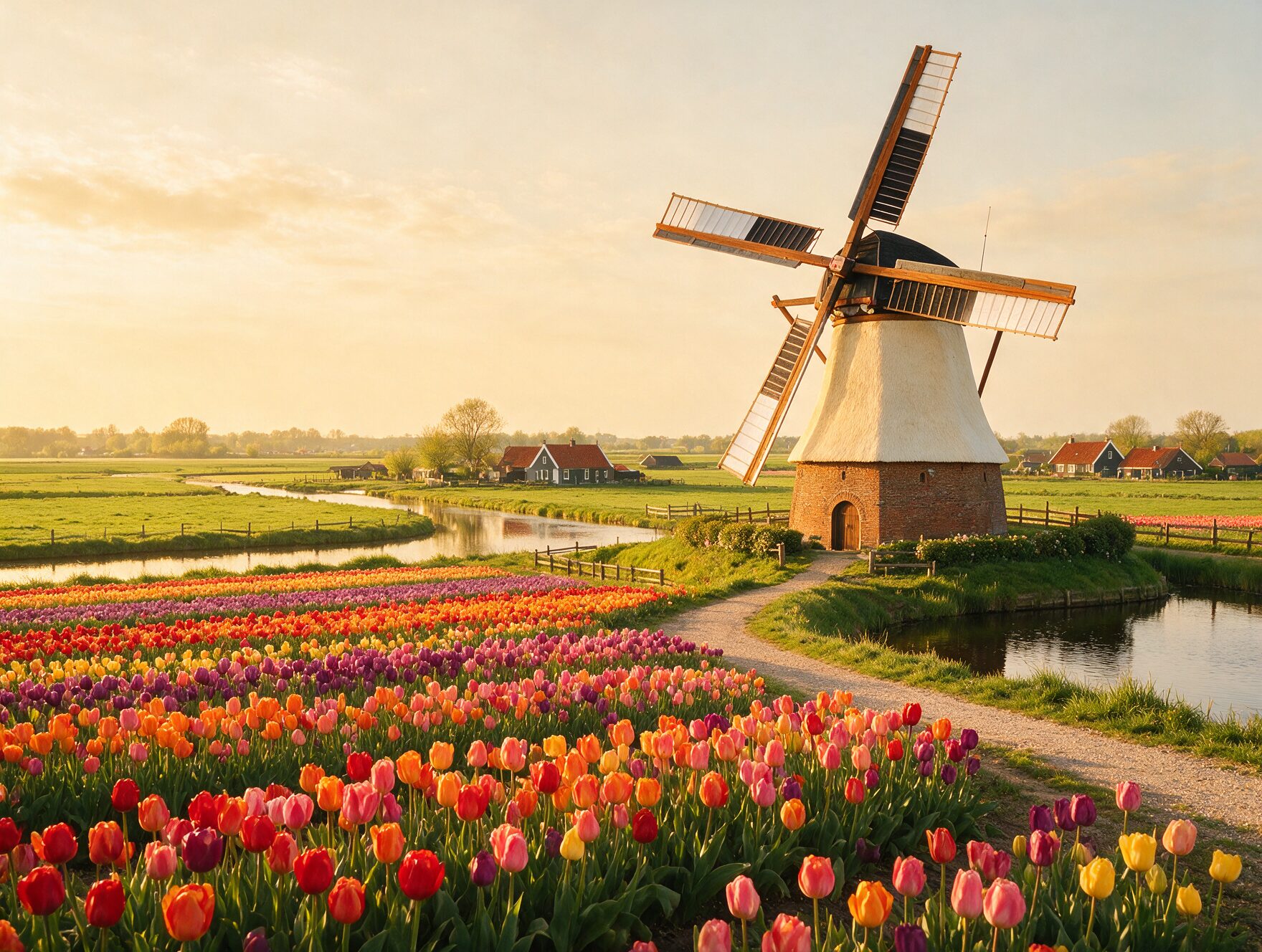
Beyond the garden’s own paths, whisper boat tours run through the nearby waterways and give you a view of the surrounding commercial bulb fields — the vast, single-colour blocks of tulips that extend for acres beyond Keukenhof’s own boundary — from the water. If the garden itself feels crowded on the day you visit, this is a genuinely good release valve: fewer people, a different vantage point, and arguably a more striking sense of scale than anything inside the garden walls, since the commercial fields run in solid colour blocks the garden’s curated beds don’t replicate.
The Wider Bollenstreek Region
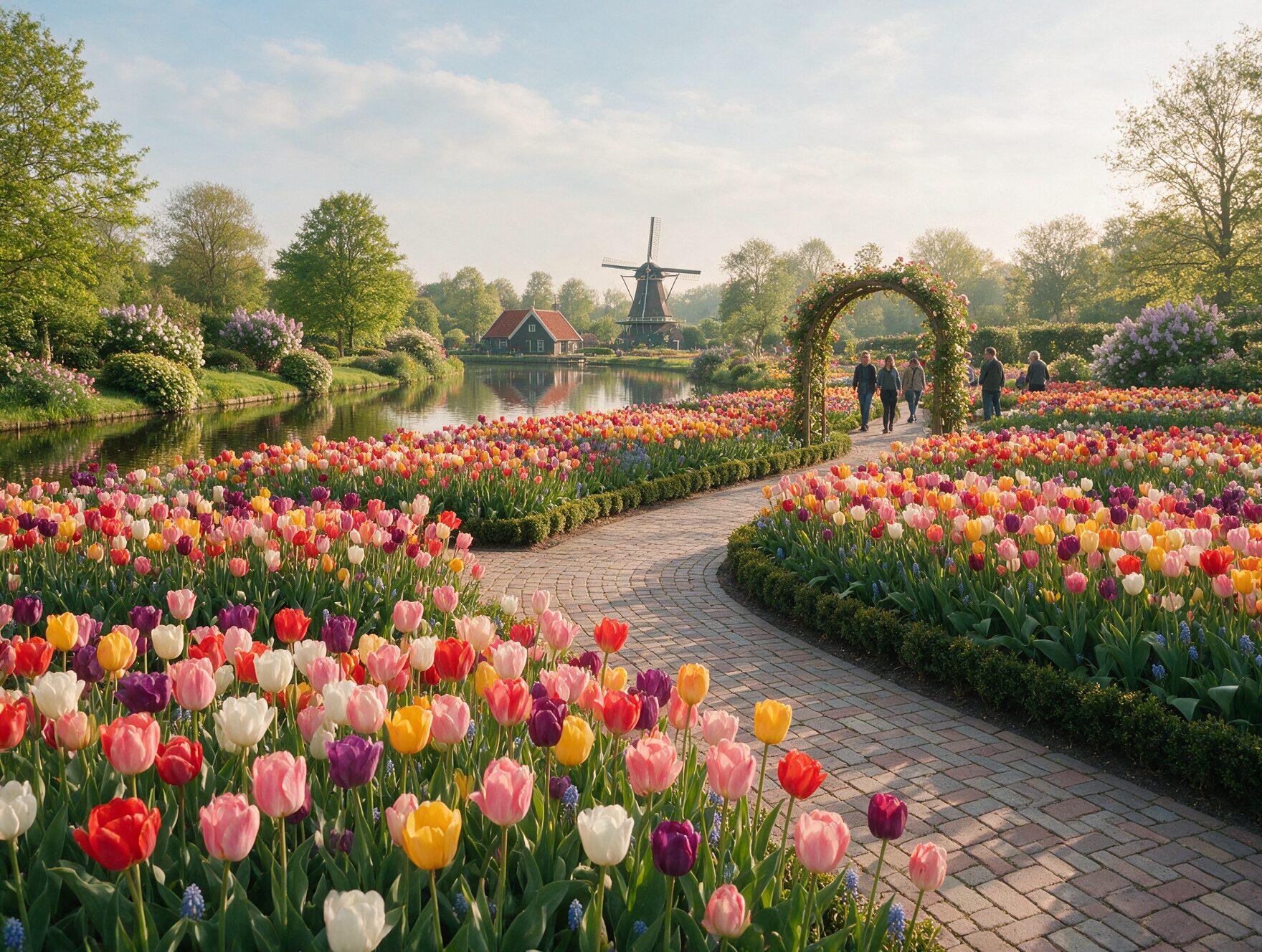
Keukenhof sits inside the Bollenstreek, the bulb-growing region stretching between Haarlem and Leiden, and the garden itself is really just the curated showcase for an agricultural industry that extends for miles around it in commercial fields. If you have a car or are on a cycling tour, driving or riding the back roads around Lisse in bloom season — past working fields in single, solid colour blocks — gives you a sense of scale that the garden, however large, can’t quite match on its own.
Getting There From Amsterdam and Schiphol
Direct Keukenhof Express buses run from Amsterdam Centraal and Schiphol Airport during the season, taking roughly 30-45 minutes depending on traffic and your starting point, with combined bus-and-entry tickets typically working out cheaper than buying separately. If you’re aiming for that 08:00 opening, check the first bus departure time carefully — the earliest buses don’t always align with opening time, and a private transfer or early rental car may be the only way to guarantee you’re actually at the gate when it opens.
Payments and Practical Notes
Card payments work throughout the park, including at food kiosks and the gift shop, and pre-booking tickets online (strongly recommended regardless of which window you choose) is done by card as well. Bring a light jacket even on a sunny-looking March or April morning — Dutch spring mornings are cold enough that the “golden hour” light comes with a genuine chill, especially in the more open, less sheltered sections of the garden.
A Mistake to Avoid
Don’t assume any day within the eight-week window looks the same. Keukenhof’s bloom is a living, moving thing — different bulb varieties peak at different points across March, April, and early May, so a visit in the first week looks different from one in the last. If a specific flower or colour palette matters to you, check Keukenhof’s own current bloom status before you lock in dates, rather than assuming “any day in the window” guarantees the photo you have in mind.
A Fun Fact Worth Knowing
Keukenhof’s grounds were originally the kitchen garden (the name literally means “kitchen courtyard”) of a 15th-century countess’s castle estate, used to grow herbs, fruit, and vegetables for the household — not flowers. It only became a dedicated flower show garden in 1949, when a group of bulb growers and exporters used the existing historic grounds to showcase Dutch spring bulbs to the world, a marketing project that’s now one of the most visited gardens on earth.
A Smart-Spending Tip
Combined bus-and-entry tickets from Amsterdam or Schiphol are reliably cheaper than booking the bus and the garden entry as two separate purchases, and they also guarantee you a return seat on a specific service rather than queuing for whichever bus has space. Book both legs together even if it means committing to a return time slightly earlier than you’d ideally like — the saving and the certainty are usually worth the small loss of flexibility.
A Few Honest Notes by Traveller Type
Photography-focused travellers: the 8am window is non-negotiable if this is your priority — nothing else on this list substitutes for it.
Families with young kids: the later, slightly less rushed late-afternoon window can be easier logistically than an 8am start with children, even if the light is a notch less dramatic.
Couples: the whisper boat tour through the surrounding fields is a genuinely good, quieter alternative to fighting crowds on the main garden paths, and makes for a nice slower-paced half of the visit.
Luxury-minded travellers: consider a private transfer timed to have you at the gate right at 08:00 rather than relying on a shared shuttle’s schedule, which may not get you there until well after the crowds have built.
Frequently Asked Questions
How long should I spend at Keukenhof?
Three to four hours covers the main garden thoroughly, including the windmill and a pavilion stop if the weather calls for it. Add another hour if you’re doing the whisper boat tour through the surrounding fields.
Is Keukenhof worth it if I can’t get an early morning slot?
Yes, just adjust expectations — midday will be crowded, but the garden itself, the bulb displays, and the windmill view are still worth seeing. Aim for the 17:00-18:00 window if mornings genuinely don’t work for your schedule.
Can I combine Keukenhof with another day trip?
It pairs reasonably with a stop in Lisse or the surrounding Bollenstreek bulb-growing region on the same day, but avoid stacking it with a more distant destination like Giethoorn or Rotterdam — the early start this guide recommends doesn’t leave room for a second major stop.
What happens if I visit outside the March-May window?
Keukenhof is closed to the public outside its eight-week season — the grounds aren’t open as a general park the rest of the year. Plan your Netherlands trip dates around this window specifically if Keukenhof is a priority.
Is Keukenhof suitable for elderly travellers or wheelchair users?
The main paths are flat, paved, and wheelchair-accessible, though the windmill climb itself involves stairs and isn’t accessible. Benches are placed throughout the garden for anyone who needs to rest partway through a visit.
Can I buy flower bulbs to take home to India?
Keukenhof’s shop sells bulbs specifically packaged with phytosanitary certificates for international travel, which is the documentation you’ll need to get them through customs on arrival in India. Loose bulbs bought elsewhere, without that certification, are a genuine risk at the border — stick to the official packaged options if bringing bulbs home matters to you.
How crowded is Keukenhof really, compared to what photos suggest?
Photos taken in that early morning window genuinely look close to empty. Photos from a midday weekend in peak bloom look nothing like that — dense, shuffling crowds along the narrower paths. Both are real; which one you experience is almost entirely a function of what time you arrive, which is the whole point of this guide.
Plan the Rest of Your Trip
Keukenhof’s narrow seasonal window means it should anchor your Netherlands trip dates rather than being squeezed in as an afterthought. See our packing guide by season for what spring weather in the Netherlands actually calls for, and our 7 nights / 8 days itinerary for how to build a full trip around the bloom window.