Netherlands Visa Guide for Indian Travelers: Schengen Made Simple
The Netherlands requires a Schengen visa from Indian passport holders — no visa on arrival, no e-visa option, no last-minute shortcuts. What it does have is a reasonably predictable process if you give yourself enough lead time and get the paperwork right the first time. This guide walks you through every step: which category to apply under, what the Dutch consulate actually wants to see in your bank statements, what not to forget (travel insurance is a bigger deal than most people realise), and how to handle the VFS Global appointment without losing an entire morning.
Planning a Netherlands trip from India? Read this before you book anything non-refundable.
Table of Contents
- What Kind of Visa Do You Need?
- Validity and Stay Rules
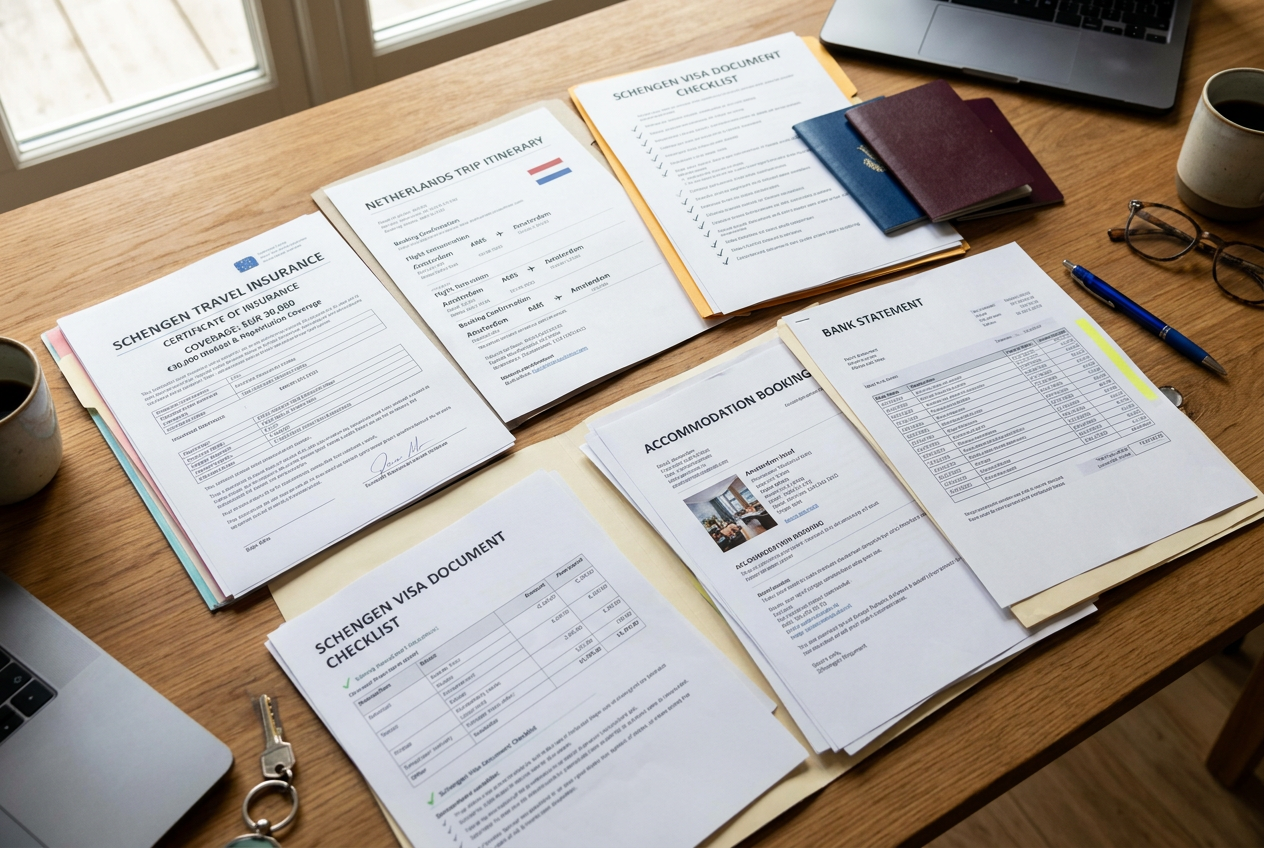
- Complete Document Checklist
- Fees and Costs
- How to Apply: Step by Step
- When to Apply
- Travel Insurance: Don’t Get This Wrong
- Proving Financial Sufficiency
- Common Reasons for Refusal
- Tips for a Smooth Application
- FAQs
What Kind of Visa Do You Need?
Indian citizens need a Schengen Type C short-stay visa to visit the Netherlands for tourism. The Dutch government authorises the Royal Netherlands Embassy in New Delhi and the Netherlands Consulate-General in Mumbai to process these applications, but most Indians go through VFS Global, which handles the logistics across six cities.
The tourist visa covers leisure travel, visiting friends or family, attending events, and short sightseeing trips. If you’re going for business or attending a conference, you’ll apply under the business visitor category with slightly different supporting documents.
One thing that trips people up: a Netherlands Schengen visa is valid across all 27 Schengen countries, not just the Netherlands. So if your itinerary swings through Belgium or Germany on the same trip, the same visa covers you — as long as the Netherlands is your primary destination (or the first Schengen country you’re entering).
Validity and Stay Rules
A short-stay Schengen visa allows a maximum of 90 days within any rolling 180-day period. The 180-day window rolls continuously — it’s not a calendar year calculation — so if you visited Europe earlier in the year, those days count.
First-time applicants usually receive a visa valid for the exact trip duration plus a few buffer days. If you’ve travelled to Europe before on a Schengen visa, you’re more likely to get a longer validity (3–12 months with multiple entries). The embassy has discretion here, so don’t count on it, but repeat travellers do tend to get more flexibility.
Complete Document Checklist
The Netherlands consulate is specific. Missing or inconsistent documents are the single biggest reason applications get delayed or refused. Here’s the full list:
Identity and Travel Documents
- Original passport valid for at least 3 months beyond your return date, with a minimum of 2 blank visa pages
- All previous passports (even expired ones) — the consulate wants to see your travel history
- Two recent passport-size photographs in Schengen biometric format (35mm × 45mm, white background, taken within 6 months)
- Signed Schengen visa application form
Trip Documentation
- Confirmed return flight booking (the booking reference is enough — no need to actually purchase the ticket yet, though a cancellable booking is safer)
- Hotel bookings or proof of accommodation for the entire stay (AirBnB confirmations work; hosting an invite letter from a Dutch resident also works)
- Day-by-day itinerary — not a vague “5 days in Amsterdam” but actual plans: Amsterdam Day 1 — Rijksmuseum, canal walk, etc.
- Cover letter explaining your trip, financial situation, and ties to India
Financial Documents
- Bank statements for the last 3–6 months (more on what these need to show, below)
- Income Tax Returns for the last 2 assessment years
- Employment letter on company letterhead confirming your designation, salary, and that leave has been approved. If self-employed: GST registration, business bank statements, and a CA-certified income declaration
- If a family member or company is sponsoring the trip: a sponsorship letter plus the sponsor’s financial documents
Insurance
- Travel insurance covering the entire Schengen zone, with a minimum of EUR 30,000 medical and repatriation coverage (more details in the insurance section below)
Fees and Costs
The consular fee is EUR 90 (approximately INR 8,200–8,500 at current exchange rates). This is set by the EU and is non-refundable regardless of outcome. Children aged 6–11 pay EUR 45; children under 6 pay nothing.
VFS Global charges a service fee of approximately INR 1,855 (including GST). This also doesn’t come back if the visa is refused.
Add to this the cost of a Schengen-compliant travel insurance policy — typically INR 1,500–4,000 for a 10–14 day trip depending on the coverage and insurer. And if you’re using a visa agent to handle the paperwork, factor in their fee.
Total out-of-pocket before the actual trip starts: roughly INR 12,000–15,000 in visa and processing charges alone.
How to Apply: Step by Step
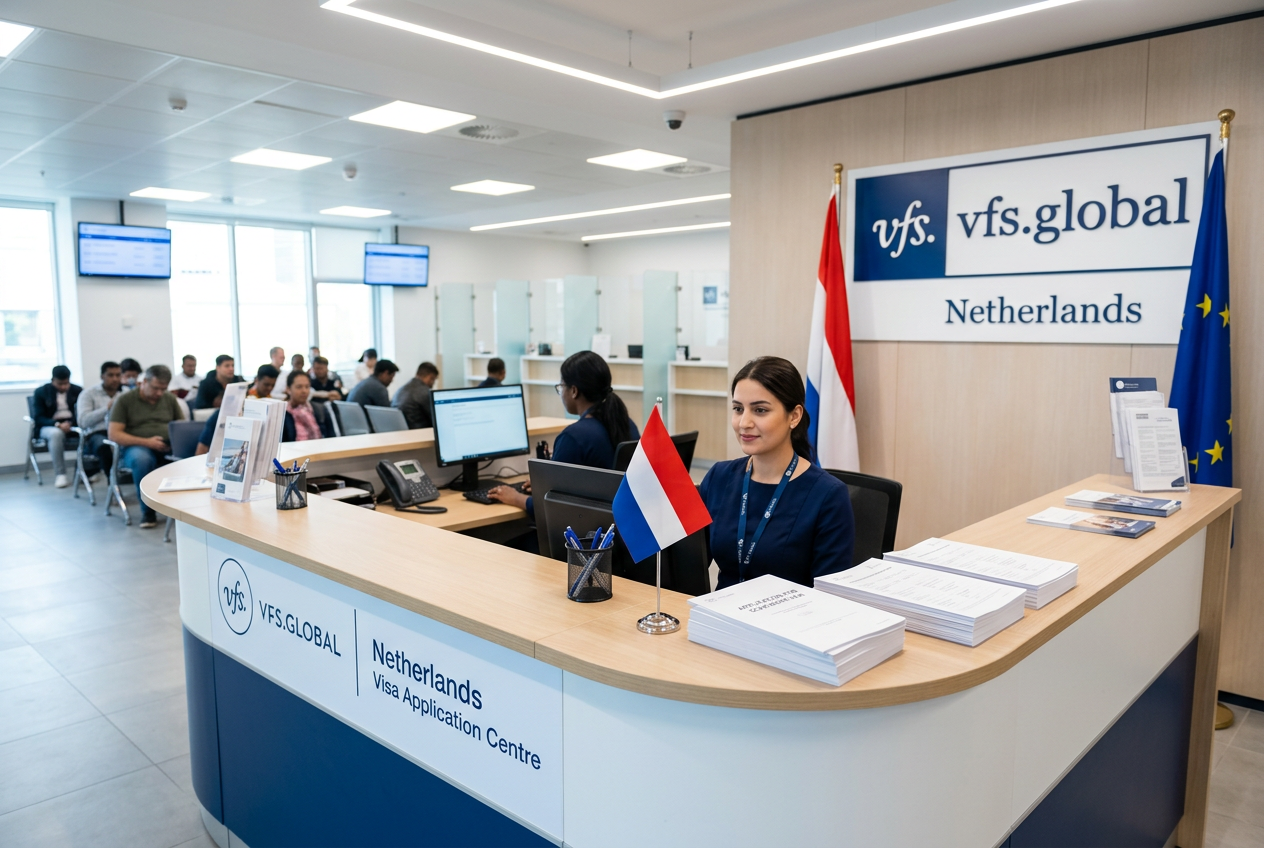
Step 1: Determine your nearest VFS Global centre. VFS handles Netherlands Schengen applications in Mumbai, New Delhi, Bangalore, Chennai, Kolkata, and Hyderabad. Book your appointment on the VFS Global website for Netherlands.
Step 2: Gather your documents. Bank statements must be freshly printed — most VFS offices want them within 7 days of the appointment date. Don’t print them two weeks ahead and wonder why they’re being questioned at the counter.
Step 3: Fill out the application form. The Schengen application form is available on the VFS Global Netherlands page. Fill it in carefully — inconsistencies between the form and your documents (different travel dates, wrong employer name) are red flags.
Step 4: Attend your appointment. Every applicant needs a separate appointment, including children. The process takes about 15–20 minutes. For applicants 12 and older, biometrics (fingerprints and photo) will be collected. Arrive on time — VFS is fairly strict about appointment slots.
Step 5: Track and collect. You’ll receive a reference number for status tracking. Collection is either at the VFS centre or by courier, depending on what you selected at booking.
When to Apply
Apply 4–6 weeks before your travel date. The standard processing time after the consulate receives your application is 15 working days, but during peak periods — typically March through May (spring/tulip season) and June through August — this can stretch to 45 calendar days.
You can submit an application up to 6 months before travel. Don’t apply more than 6 months ahead; the consulate won’t process it.
If you’re planning a Netherlands trip in April for the Keukenhof tulip gardens, apply by mid-February at the latest. That’s not an exaggeration — spring is the Netherlands’ busiest tourist season and visa volumes spike accordingly.
Travel Insurance: Don’t Get This Wrong
This is the section most applicants skim and then regret. The Schengen insurance requirement is specific:
- Minimum coverage: EUR 30,000
- Must cover all Schengen countries (not just Netherlands)
- Must include emergency medical treatment and repatriation
- Coverage dates must match (or exceed) your visa period
Indian insurers — Bajaj Allianz, HDFC ERGO, ICICI Lombard, Tata AIG — all offer Schengen-compliant travel insurance. Buy it before the application, not after. The insurance certificate needs to be in your documentation at the time of submission.
One thing to check: some corporate group policies and credit card travel insurance don’t meet the EUR 30,000 Schengen requirement. Read the fine print before assuming your existing cover qualifies.
Proving Financial Sufficiency
The consulate wants to see that you can fund your trip without working illegally in the Netherlands. The informal benchmark that visa agents often cite is around EUR 50–100 per day of travel, plus the return ticket. So for a 10-day trip, that’s EUR 500–1,000 available beyond your regular monthly expenses.
What they’re really looking at in bank statements:
- Consistent salary credits over 3–6 months (not a sudden large deposit just before the application)
- An average balance that makes the trip plausible without draining you
- No red flags like large unexplained transfers in or out
If you have a savings account, fixed deposits, or mutual fund holdings, include those statements too. They strengthen the picture without being mandatory.
Common Reasons for Refusal
Netherlands visa refusals come with a written reason. The most frequent causes Indian applicants encounter:
- Insufficient financial proof — balance too low, or statements showing irregular income
- Inadequate travel insurance — below EUR 30,000, or not covering all Schengen
- Weak ties to India — no job letter, no property, no dependents — anything that suggests you might overstay
- Vague itinerary — “Amsterdam and surrounding areas” without specifics raises questions
- Mismatched documents — travel dates on the form don’t match flight bookings
If refused, the letter will specify the grounds, and you have the right to appeal or reapply. Many reapplications succeed when the specific gap identified in the refusal is addressed.
Tips for a Smooth Application
A few things that make a real difference:
- Print bank statements fresh — not from PDF, but from the branch or internet banking portal with the bank’s stamp/letterhead
- Write a thorough cover letter that connects the dots: who you are, where you’re going, what you’ll do, how you’re funding it, and why you’ll definitely come back
- Book refundable or flexible flights and hotels until the visa comes through
- If you’ve visited Schengen before, highlight that — it shows you’ve respected visa rules previously
- Apply as early in the 6-month window as your dates allow, especially for April–June travel

Frequently Asked Questions
Can I apply for a Netherlands Schengen visa online?
No. You must appear in person at a VFS Global centre for biometric collection. You can fill in and prepare documents online, but the appointment itself requires physical presence.
How long does the Netherlands Schengen visa take for Indians?
Standard processing is 15 working days after the consulate receives your file from VFS. During peak months (March–August), allow up to 45 calendar days.
Can I travel to Belgium or Germany with a Netherlands Schengen visa?
Yes. A Schengen visa issued by the Netherlands covers all 27 Schengen member states. The Netherlands should be your primary destination or the first Schengen country you enter.
Do I need a confirmed flight ticket or just a booking?
A confirmed booking (reservation, not necessarily a purchased ticket) is usually accepted. A paid, refundable ticket is safer since it shows real intent and can be changed later.
What is the Netherlands visa fee in Indian rupees?
The consular fee is EUR 90 (approximately INR 8,200–8,500) plus VFS service charges of around INR 1,855. Total is roughly INR 10,000–10,500 before insurance.
What if my Netherlands visa is refused?
You’ll receive a written refusal with the reason. You can appeal within the Netherlands or reapply addressing the specific gap. Many refusals are overturned on reapplication when the right documents are provided.
Can children apply for the same Netherlands Schengen visa?
Yes, but each child needs a separate appointment and their own application. Children 6–11 pay EUR 45; under-6s pay no consular fee. If the child isn’t travelling with both parents, a notarised consent letter from the absent parent is required.
Start Planning Your Netherlands Trip
The visa process feels bureaucratic, but it’s manageable once you know exactly what’s needed. Get the documents right, apply early enough to leave buffer room, and the Netherlands becomes very reachable from India. The country handles a significant volume of Indian tourist visa applications, and most go through without incident when the financial and documentary picture is clear.
Once your visa is sorted, the real planning begins. Amsterdam’s canal ring, Rotterdam’s design districts, the windmills of Zaanse Schans, the quiet waterways of Giethoorn, Utrecht’s historic city centre, and the tulip fields of Keukenhof — the Netherlands packs a lot into a small geography. Let Get Tripped plan your Netherlands holiday and handle the experience end of the trip while you handle the paperwork.