Somewhere over the Andaman Sea, about six hours into the flight, the woman next to me on AI2362 asked the cabin crew if this route was new. It is — Air India started flying non-stop between Delhi and Manila a little under a year ago, and it’s still the only airline doing it without a layover in Bangkok, Singapore, or Hong Kong. She’d been going to the Philippines for work for a decade and had never once made the trip in under fourteen hours. This time it took nine.
That flight, paired with a visa-free entry rule that most Indian travelers still don’t know exists, is why the Philippines has quietly become one of the easiest long-haul, tropical, genuinely different trips you can book from India right now. Not “easy” in the generic travel-blog sense — easy in the specific sense of paperwork you don’t have to do and connections you don’t have to make.
Table of Contents
- Why the Philippines, Why Now
- Visa-Free Entry for Indians: The Actual Rules
- Getting There: The Direct Flight and What It Costs
- Best Time to Visit
- Where to Go: Manila, Palawan, Boracay, Cebu
- Where to Stay
- What It Actually Costs
- Food and Where to Eat
- Money, SIM Cards and Getting Around
- A Mistake to Avoid
- FAQs
Why the Philippines, Why Now
Two things changed almost at the same time. First, the Philippines extended visa-free entry to Indian passport holders for short tourist stays — a policy shift tied to a broader push by Manila to grow arrivals from India, alongside easier flight access. Second, Air India launched the first-ever non-stop service between the two countries, flying five days a week on an Airbus A321neo with a proper three-cabin setup (Economy, Premium Economy and Business), instead of the old routing through a third country that ate half a travel day in transit alone.
Neither of those facts alone would be a big deal. Together, they take a destination that used to require real planning — visa paperwork, a layover, sometimes an overnight in Singapore just to make the connection work — and turn it into something you can book the way you’d book Bali or Sri Lanka. That’s the actual story here, and it’s the reason more Indian travel searches are turning up Palawan and Boracay lately: the friction is gone.
Visa-Free Entry for Indians: The Actual Rules
Here’s what the rule actually says, because “visa-free” gets thrown around loosely online and the fine print matters. Indian passport holders can enter the Philippines without a visa for tourism purposes for up to 14 days. If you happen to already hold a valid visa or permanent residency from the US, UK, Canada, Australia, Japan, Singapore, or a Schengen country, that window extends to 30 days — a detail a lot of coverage skips, and one worth checking before you assume you’re capped at two weeks.
The visa-free entry is strictly for tourism. If you’re going for work, study, business meetings beyond casual client visits, or planning to stay longer than the permitted window, you still need to apply for the appropriate visa in advance — don’t try to stretch the tourist exemption to cover something it isn’t meant for.
What you do need at immigration, regardless of the exemption:
- A passport valid for at least six months beyond your arrival date
- A return or onward ticket showing you’ll leave within the permitted stay
- Proof of accommodation — a hotel booking confirmation is enough
- Evidence you can support yourself financially for the trip, which immigration officers can ask for but don’t always check
One honest caveat: immigration officers in Manila have some discretion, and Indian travelers with a thin-looking itinerary or one-way intentions have occasionally faced extra questioning. Carry a printed hotel booking and a rough day-by-day plan on your phone. It’s not required paperwork, but it ends the conversation faster.
Getting There: The Direct Flight and What It Costs
Air India’s AI2362 leaves Delhi at 1:20 PM and lands in Manila at 10:40 PM local time; the return, AI2361, leaves Manila at 11:40 PM and lands in Delhi at 3:50 AM. It runs Mondays, Wednesdays, Thursdays, Saturdays and Sundays — five flights a week, not daily, so build your dates around the schedule rather than assuming you can fly out any day. Round-trip fares in economy typically start somewhere in the ₹35,000–₹45,000 range depending on how far out you book and the season, with business class running considerably higher on the A321neo’s lie-flat-adjacent seats.
If you’re flying from Mumbai, Bengaluru, or elsewhere, you’ll still connect through Delhi for the non-stop leg, or route via Singapore, Bangkok, Hong Kong, or Doha on carriers like Singapore Airlines, Cathay Pacific, or Qatar Airways — all of which fly the Philippines regularly and are worth comparing if the connection timing works better for you than the Delhi departure slot. For most North and West India travelers though, the Air India direct is now the fastest way in, and it’s the reason a long weekend to Manila is suddenly a realistic idea rather than a “someday” trip.
Best Time to Visit
The Philippines runs on two seasons, not four, and they matter more than most first-time visitors expect. November through April is the dry season, driven by the northeast monsoon — clear skies, calm seas, and the kind of light that makes El Nido’s lagoons look the way they do in photos. December through February is the driest, coolest stretch, with daytime temperatures in the 29–33°C range and minimal rain.
June through October is the wet season, and this isn’t a light-drizzle situation — it’s the southwest monsoon and typhoon season, with July alone averaging around 300mm of rainfall. Boat tours to the islands around El Nido and Coron get cancelled regularly during peak wet months, and travel insurance with weather-related cancellation cover stops being optional and starts being sensible. If your dates are flexible, March is worth knowing about specifically — the shoulder window between the dry season’s high season and the onset of rain, when prices ease and the crowds thin out but the weather hasn’t turned yet.
Where to Go: Manila, Palawan, Boracay, Cebu
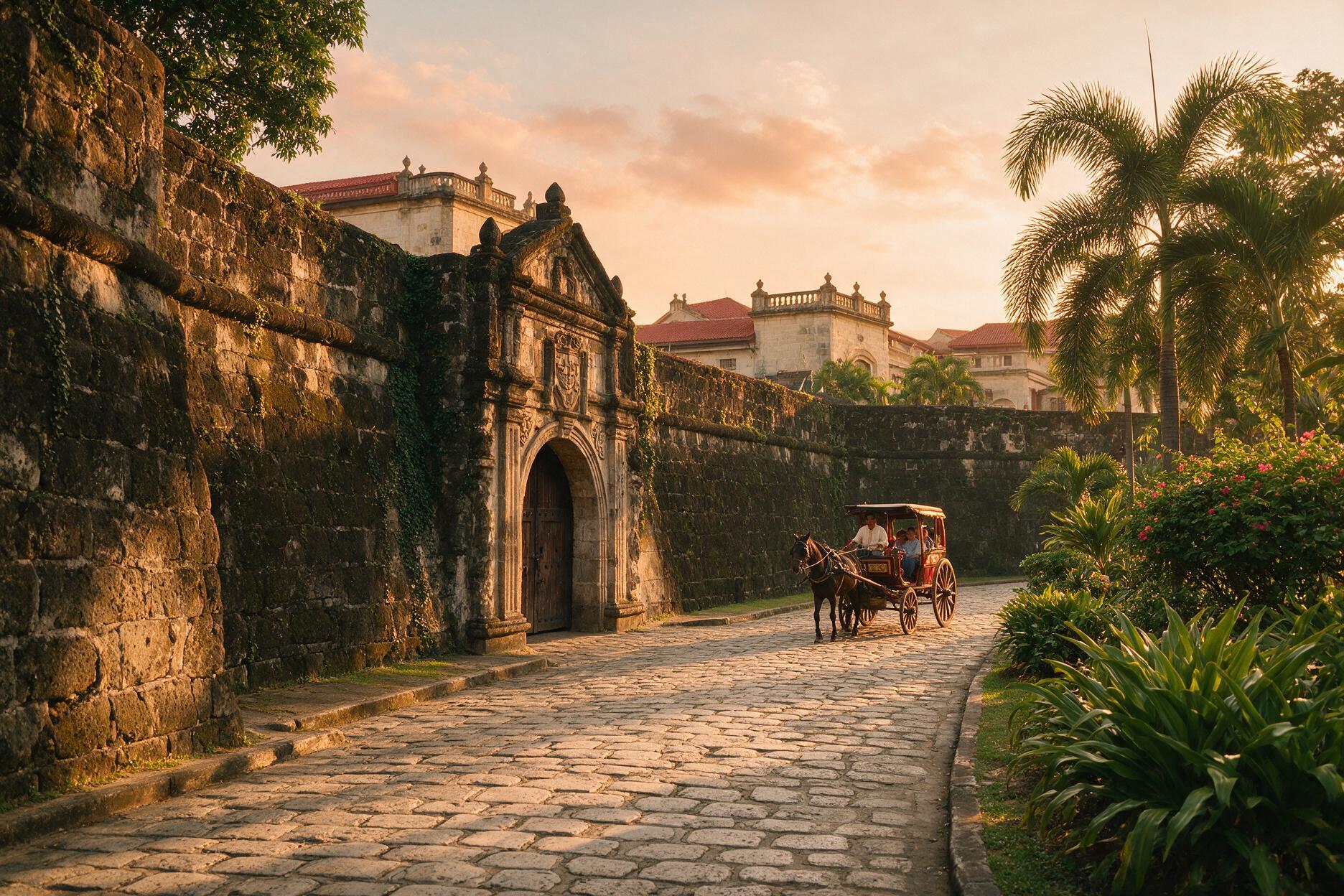
Manila is where you land, and it deserves more than the one transit night most itineraries give it. Intramuros, the old walled Spanish quarter, is worth a half-day on foot — Fort Santiago, San Agustin Church, and the horse-drawn kalesa rides that feel touristy until you’re actually in one, weaving through streets too narrow for cars. Beyond that, Manila is genuinely a city, not just a gateway: a serious food scene, rooftop bars in Bonifacio Global City, and enough traffic that you should never book a flight connection with less than three hours’ buffer.
Palawan is the reason most people are searching for this trip in the first place. El Nido and Coron sit at opposite ends of the same island province, and they’re different enough that picking one over the other changes your trip: El Nido is lagoons, limestone cliffs, and island-hopping tours (Tour A, B, C and D, each covering a different cluster of islands); Coron is wreck diving — a genuine draw for anyone certified, with Japanese shipwrecks from WWII sitting in startlingly clear water — plus Kayangan Lake, which regularly gets called one of the cleanest lakes in Asia and mostly lives up to it before 9 AM, before the tour boats arrive.
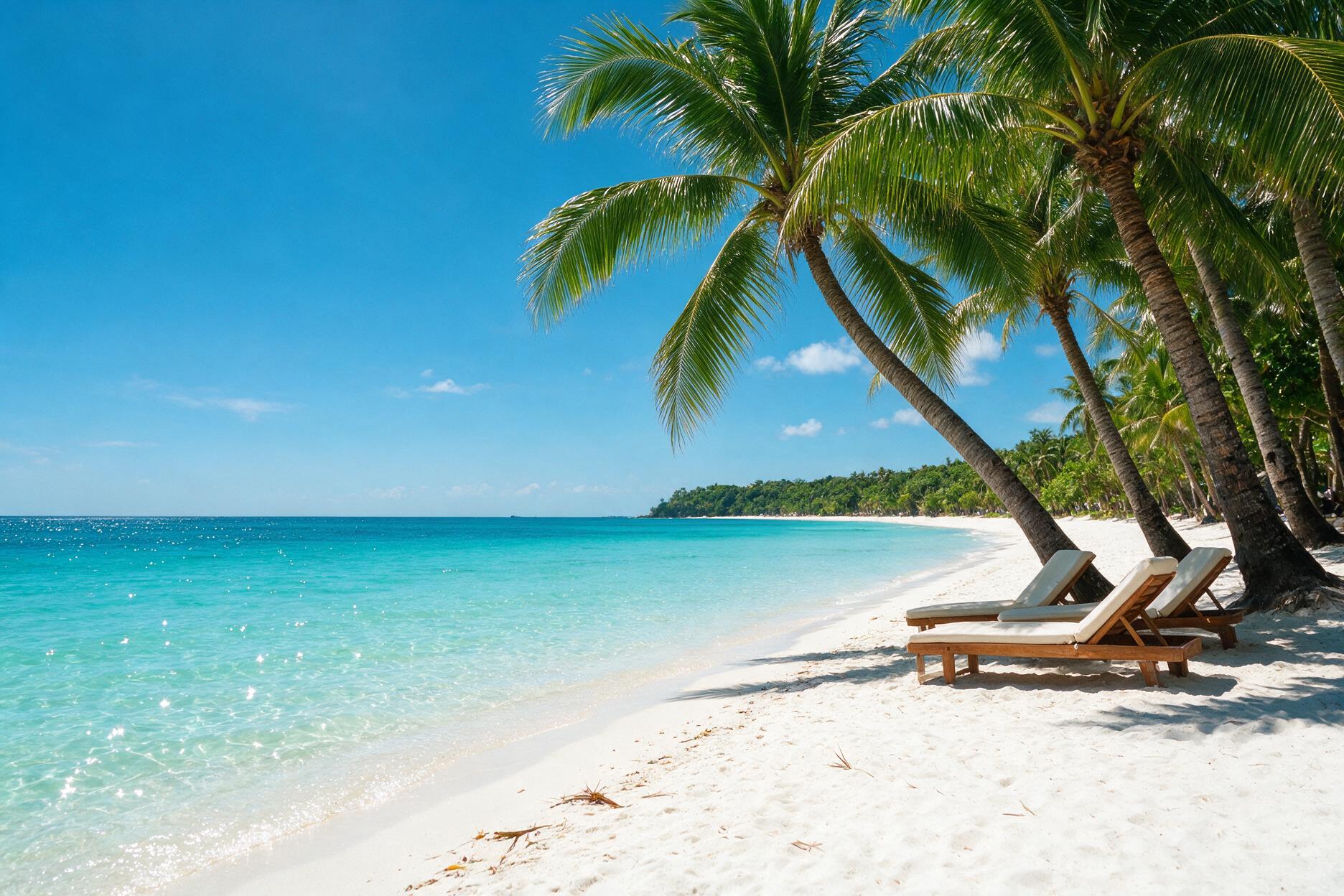
Boracay gets the Instagram traffic, and White Beach’s four-kilometre stretch of genuinely fine, powder-white sand earns some of it. It’s more built-up and easier logistically than Palawan — a short flight to Caticlan or Kalibo followed by a boat transfer — which makes it a better fit if you want beach time without multi-leg island-hopping logistics. Cebu, further south, is worth considering if whale sharks (Oslob, with real ethical caveats worth reading up on beforehand), canyoneering at Kawasan Falls, or a quieter, less-touristed island base appeal to you more than Boracay’s density.
Where to Stay
This isn’t a hostel-dorm destination, and the Philippines has enough mid-range and upscale inventory that you shouldn’t need to settle for one. In El Nido, look at properties along or near Corong-Corong beach for a quieter base than the noisy main town strip — several boutique resorts there run private-beach setups with better value than the marquee names right in town. Coron’s better stays cluster around the harbor with easy access to the wreck-diving boats. In Boracay, Station 1 has the best sand and the calmest water; Station 2 is the commercial center with restaurants and nightlife; if you want distance from both, look toward Diniwid or Punta Bunga up the coast. Manila’s better hotel clusters sit in Makati and BGC — both considerably calmer and safer after dark than the areas immediately around the airport.
What It Actually Costs
Beyond the flight, figure on ₹6,000–₹12,000 a night for a genuinely good mid-range resort room, climbing well past that for beachfront villas or the better Palawan properties with private plunge pools. Island-hopping tours in El Nido run roughly ₹2,500–₹4,500 per person for a full day including lunch and gear, and a private boat charter — worth it if you want to skip the group-tour crowds and pick your own stops — starts higher but splits reasonably across a small group. A good sit-down dinner for two runs ₹1,500–₹3,000 depending on where you eat; street food and local carinderias (small eateries) cost a fraction of that and are some of the best food you’ll have on the trip. Domestic flights between Manila, Palawan, Cebu, and Boracay’s gateway airports typically run ₹4,000–₹8,000 one-way if booked a few weeks out.
Food and Where to Eat
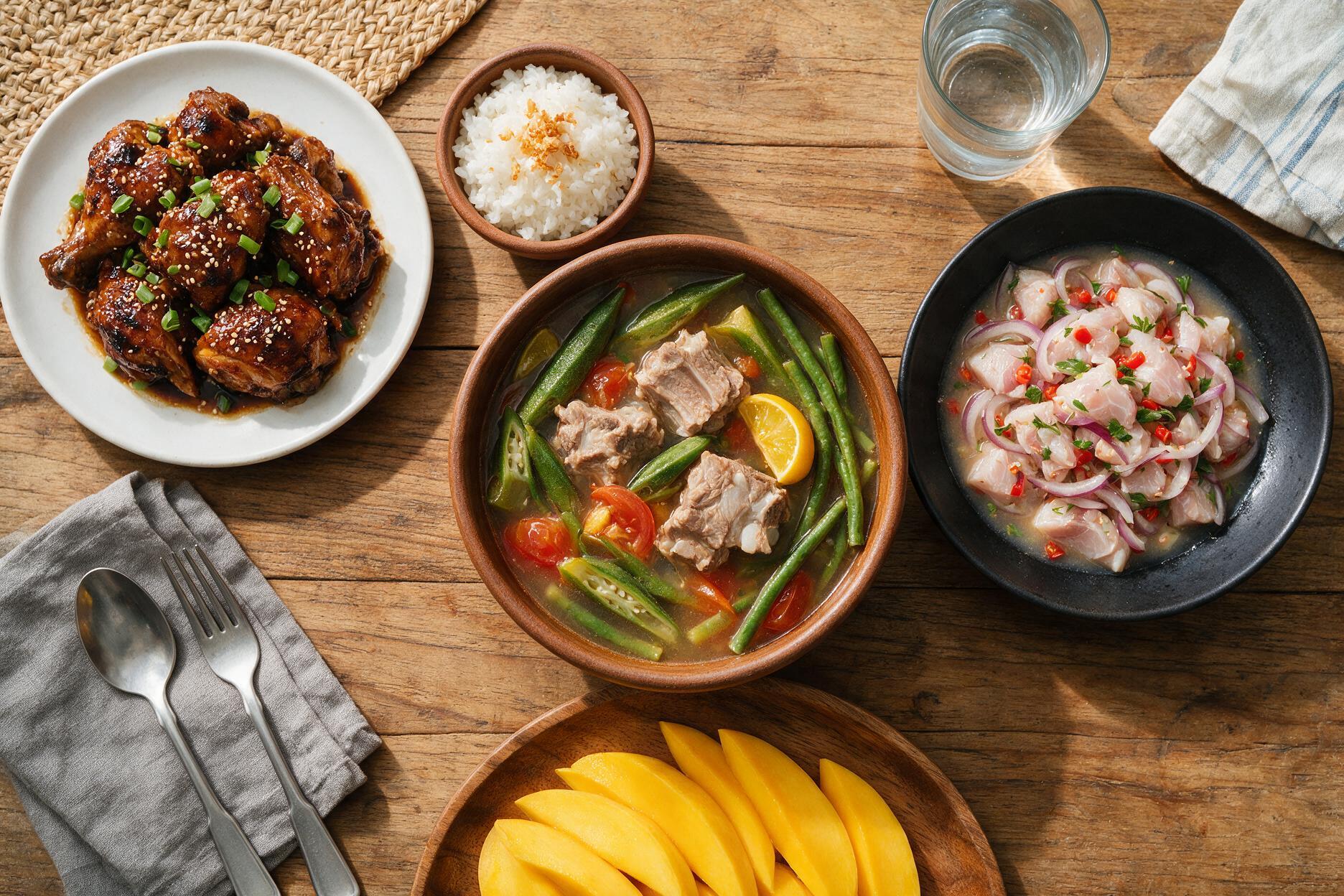
Filipino food doesn’t get the international attention Thai or Vietnamese cooking does, and that’s honestly part of the appeal — you’re not eating a version of something you’ve already had at home. Adobo (chicken or pork braised in vinegar, soy, and garlic) is the dish everyone mentions, but sinigang — a sour tamarind-based soup, usually with pork or prawns — is the one I’d actually steer a first-timer toward first; it’s more distinctive and less like anything on an Indian menu. Kinilaw, a Filipino take on ceviche using local vinegar instead of citrus, is worth seeking out on the coast. In Manila, the food stalls around Quiapo and the newer, cleaner food-hall concepts in BGC both work depending on how adventurous you’re feeling on day one versus day three.
A small, honest note for vegetarian travelers: the Philippines is not an easy vegetarian destination the way, say, parts of Southeast Asia with a strong Buddhist food culture are. Fish sauce and pork stock show up in dishes that don’t obviously look meat-based, so it’s worth learning the phrase “walang karne” (no meat) and using it liberally, especially outside the bigger cities.
Money, SIM Cards and Getting Around
The Philippine peso is the local currency, and cash still rules outside Manila’s malls and the bigger resort chains — carry more of it than you think you’ll need once you’re in Palawan or the smaller Boracay guesthouses, since card machines go down often enough to be a real planning consideration, not a hypothetical. ATMs are common in Manila and the tourist towns but thinner on the ground in Coron and El Nido’s outer areas.
For connectivity, an eSIM from Globe or Smart (both bookable online before you land) is the easiest option and avoids hunting for a physical SIM counter at Manila airport. Coverage is solid in Manila, Cebu, and Boracay; it thins out noticeably in parts of rural Palawan, which is worth knowing before you count on Google Maps working everywhere. Grab (the regional Uber-equivalent) covers Manila and Cebu well; in Palawan and Boracay you’ll mostly be dealing with tricycles, habal-habal motorbike taxis, and hotel-arranged transfers instead.
A Mistake to Avoid
Don’t build a Philippines itinerary that treats Manila as a pure layover and tries to cram Palawan, Boracay, and Cebu into one trip. Domestic connections aren’t as fast or frequent as the map suggests, Manila traffic eats buffer time you didn’t budget for, and island-hopping days genuinely need to be full days, not half-days squeezed between flights. Pick two destinations for a first trip — Manila plus one island province — and actually spend time there instead of spending half your holiday in airport lounges.
Frequently Asked Questions
Do Indians really not need a visa for the Philippines?
Correct, for tourism stays of up to 14 days (30 days if you hold a valid visa or PR from the US, UK, Canada, Australia, Japan, Singapore, or a Schengen country). You still need a valid passport with six months’ validity, a return ticket, and proof of accommodation at immigration.
Is the Delhi-Manila flight really non-stop?
Yes — Air India operates it as the only carrier flying non-stop between India and the Philippines, five days a week on an Airbus A321neo.
Should I choose El Nido or Boracay for a first trip?
El Nido if you want dramatic lagoon scenery and are willing to do island-hopping tours; Boracay if you want easier logistics and a long, powder-sand beach without as much boat time.
Is the Philippines safe for Indian travelers, including solo travelers?
The main tourist areas — Manila’s BGC and Makati, Boracay, El Nido, and Cebu’s resort areas — are generally safe and well used to international visitors. Standard precautions apply: avoid flashing valuables, use registered transport after dark, and keep an eye on solo late-night moves in unfamiliar neighborhoods, as you would anywhere.
What’s the best time to book island-hopping tours?
Book the morning slot if you can — El Nido’s lagoons get genuinely crowded with tour boats by midday, and the light is better early anyway.
Can I use Indian debit or credit cards in the Philippines?
Yes in Manila and Cebu’s bigger establishments, but carry cash as backup — card machines are unreliable in smaller towns and most of Palawan.
Do I need travel insurance for a Philippines trip?
Strongly recommended, especially if you’re traveling in or near typhoon season (June–October), when boat tours and even domestic flights can get cancelled with short notice.
The Bottom Line
The Philippines was never actually hard to fall in love with — the limestone islands, the diving, the food that doesn’t taste like anywhere else in Southeast Asia. What kept it off more Indian itineraries was the getting-there part: visa admin and a routing that added half a day to an already long trip. That part is solved now. The direct flight and the visa-free entry don’t change what the destination is, but they change who can reasonably say yes to it on a ten-day window instead of a three-week one.
If Palawan or Boracay has been sitting on a “someday” list, this is the year the logistics stopped being the reason to wait. Get Tripped’s Philippines itineraries are built around exactly this direct route — get in touch with our travel experts to put together a Manila-and-Palawan trip that actually fits the days you have.