Thailand Packing Guide by Season: What to Pack for Cool, Hot & Rainy Season Trips
Thailand’s three seasons don’t just change the weather — they change what you’ll actually need in your bag. November through February, you’ll be in 24-28°C weather with low humidity and the air feels light. March through May, you’re in 36-38°C heat with humidity that makes Mumbai’s worst days feel mild. June through October, you’re gambling with the monsoon, which can mean a single dramatic afternoon downpour or three consecutive days of actual rain. Same country, very different packs.
This guide covers what to bring for each season, with specific notes for the Bangkok-islands itinerary (the most common Indian traveler route), and a base list that works regardless of when you go.
Table of Contents
- Cool Season (November–February)
- Hot Season (March–May)
- Rainy Season (June–October)
- The Base List (All Seasons)
- Clothing by Destination Type
- Tech and Connectivity
- Documents and Travel Essentials
- Notes for Jain and Vegetarian Travelers
- FAQs
Cool Season (November–February)
November to February is Thailand’s most popular travel window and also its most forgiving weather-wise. Temperatures run 22-30°C in Bangkok, slightly warmer at the coast. Humidity is manageable. This is peak season — book accommodation and domestic flights earlier than you think you need to.
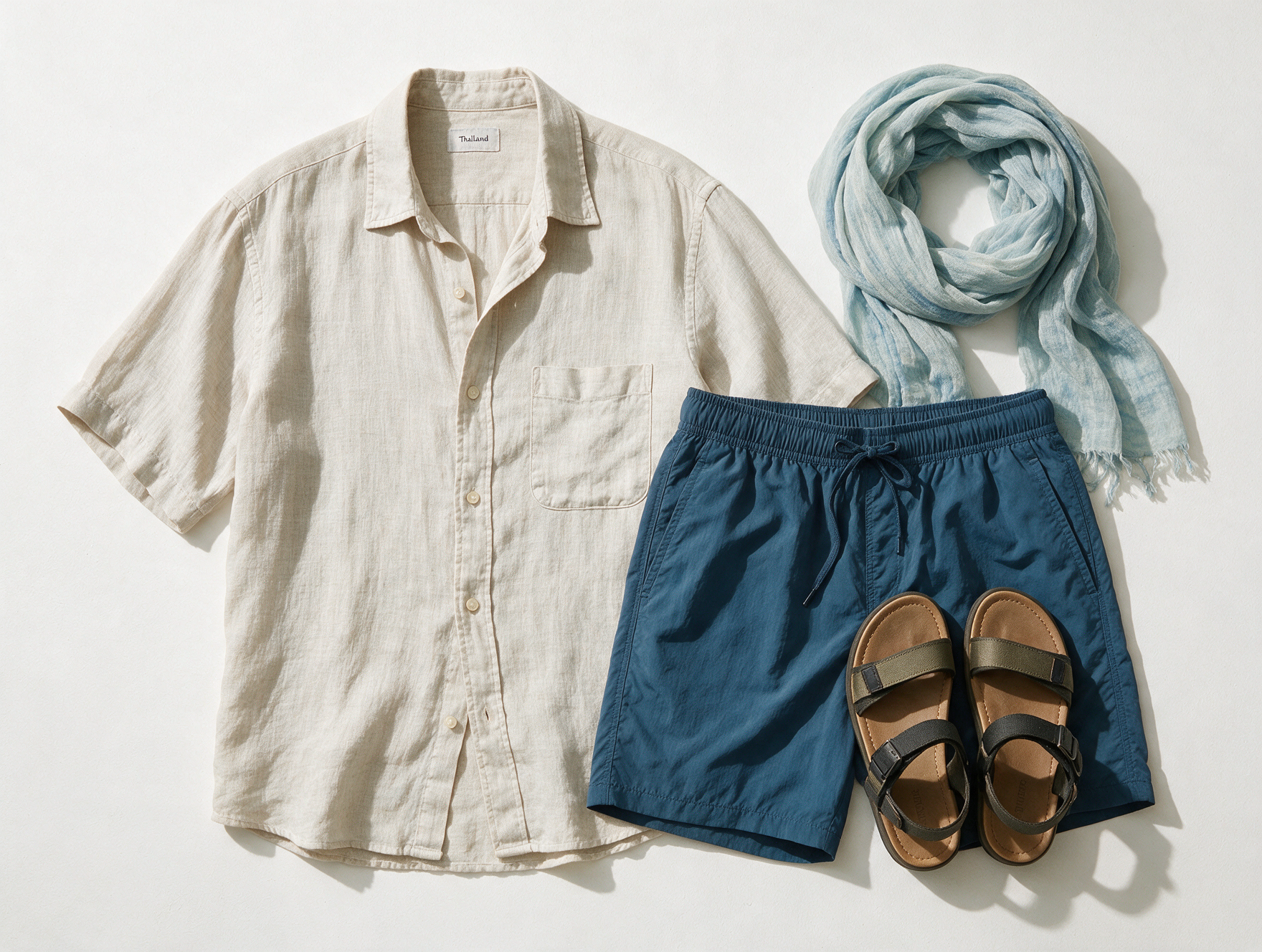
What this season adds to your base pack: essentially nothing mandatory. A light long-sleeved layer is useful for one or two situations — an early morning boat trip (the Chao Phraya at 6 AM is cooler than you expect), heavily air-conditioned restaurants or shopping malls (Thai AC can be aggressive), and the overnight domestic flight cabins on some regional carriers. A thin cotton or linen shirt or a light scarf does the job.
What you don’t need: A rain jacket. The cool season is genuinely dry in most of Thailand — pack no bulky waterproof gear. Exception: if you’re going to Koh Samui or the east coast of the peninsula in November or early December, those areas have their own monsoon timing and November can be wet there. Check weather specifically for your east coast destinations if they’re in the itinerary.
Footwear for cool season: This is the best season for walking. Comfortable walking shoes for Bangkok’s temples and markets. Flip-flops or sandals for the beach and temple entrances (you remove footwear before entering any temple — slip-ons are faster). Avoid bringing heavy closed shoes unless you have specific plans that require them.
Photography note: Cool season light is the best in Thailand. Golden hour exists here in the way travel photographers dream about. Bring whatever camera system you use; the light won’t let you down.
Hot Season (March–May)
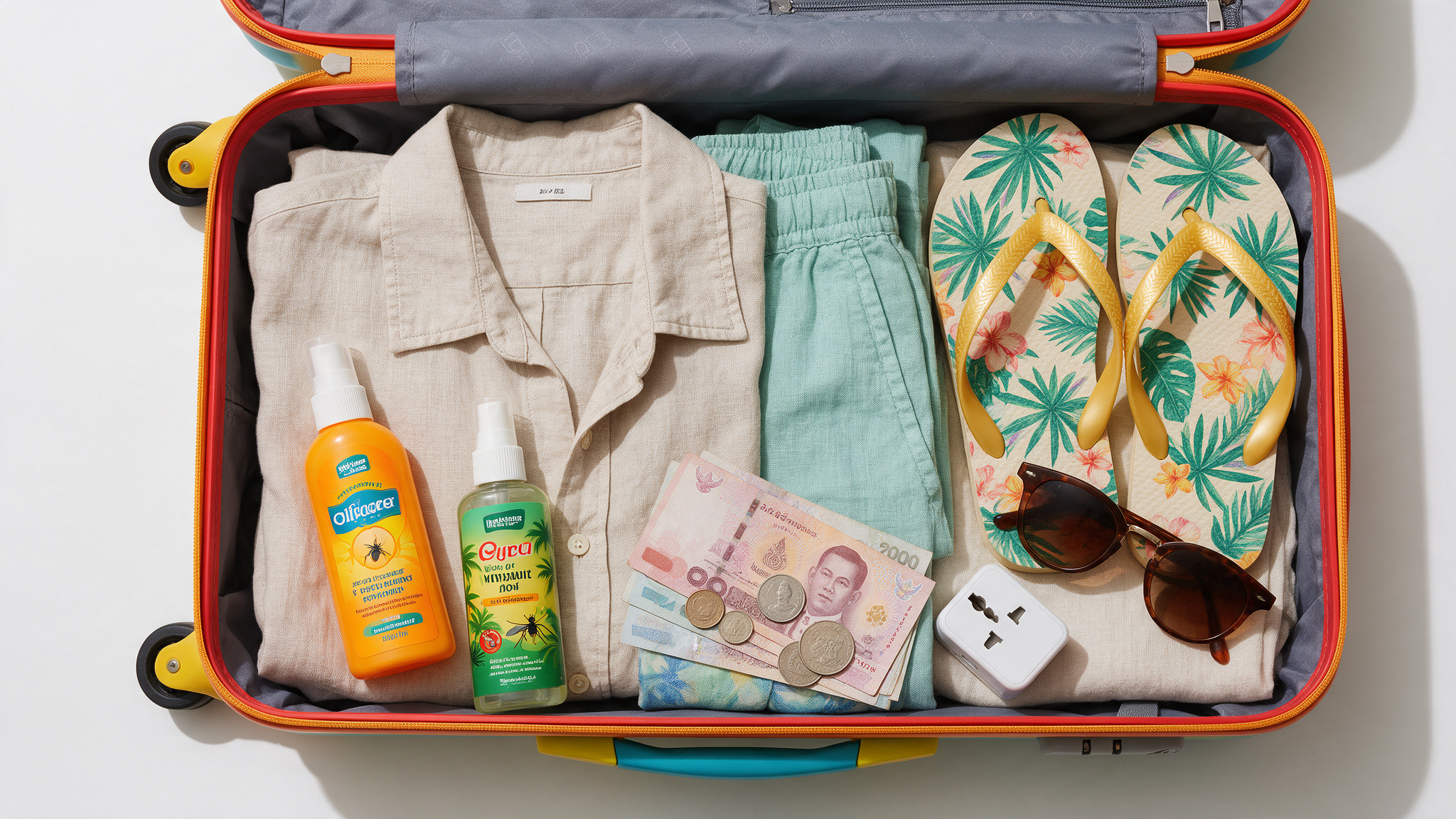
March through May is genuinely hot. Bangkok in April is 38-40°C with high humidity. April is Songkran (the Thai New Year water festival), which is one of the most chaotic and joyful things you can witness in Southeast Asia — and also means you will be soaked in water repeatedly whether you like it or not.
What this season adds to your base pack:
Sweat management is the priority. Technical fabrics (moisture-wicking polyester or nylon blends) outperform cotton here. Cotton that gets saturated with sweat stays heavy and takes hours to dry in humid heat; a lightweight synthetic shirt dries in 30 minutes and you can pack two and rotate. This isn’t a comfort preference, it’s a practical difference.
Sunscreen, more of it than you think. Thailand’s sun at this latitude is intense — UV index regularly hits 11-12 in the hot season. Indian travelers often underestimate this because our skin tones handle sun differently, but the UV here burns fair and dark skin alike. SPF 50+ on all exposed skin, reapplied every two hours if you’re outdoors or in water. Buy extra once you arrive — Boots and Watson’s pharmacies in Bangkok carry good local and Japanese sunscreen brands at lower prices than bringing from India.
Electrolyte sachets or tablets. Heat exhaustion is a real risk if you’re spending long days outdoors. A 45-minute temple visit in April heat depletes you noticeably. Pharmacy rehydration sachets (ORS sachets, widely available in Thai pharmacies as “Oral Rehydration Salts”) mixed in water are more effective than plain water in the heat. Bring 10-15 from India or buy locally.
A small folding fan. Sounds old-fashioned. It works. Useful in outdoor queues, at markets, on longtail boats. Several Indian pharmacies stock them, as do all Bangkok shopping malls.
Songkran note (April 13-15 and surrounding days): If your trip overlaps with Songkran, pack clothes you don’t mind being drenched in. Waterproof your electronics — a dry bag or a ziplock bag for your phone is enough. Your passport and documents should be in a waterproof case or a hotel safe during festival days. Songkran is worth experiencing; plan for it rather than being surprised by it.
Rainy Season (June–October)
Thailand’s rainy season is regional, not uniform, and understanding the difference matters for what you pack.
The west coast (Phuket, Krabi, Koh Phi Phi, Koh Lanta) faces the Andaman Sea and gets its monsoon from May through October — heavy rain, rough seas, some ferry services suspended. The east coast (Koh Samui, Koh Tao, Koh Phangan) faces the Gulf of Thailand and gets its heavy rain October through January. Bangkok gets scattered rain from July through September, but rarely all-day downpours — typically an afternoon thunderstorm that clears in 2 hours.
The practical implication: if you’re going in rainy season, choose your coast based on the calendar, and pack accordingly.
What this season adds to your base pack:
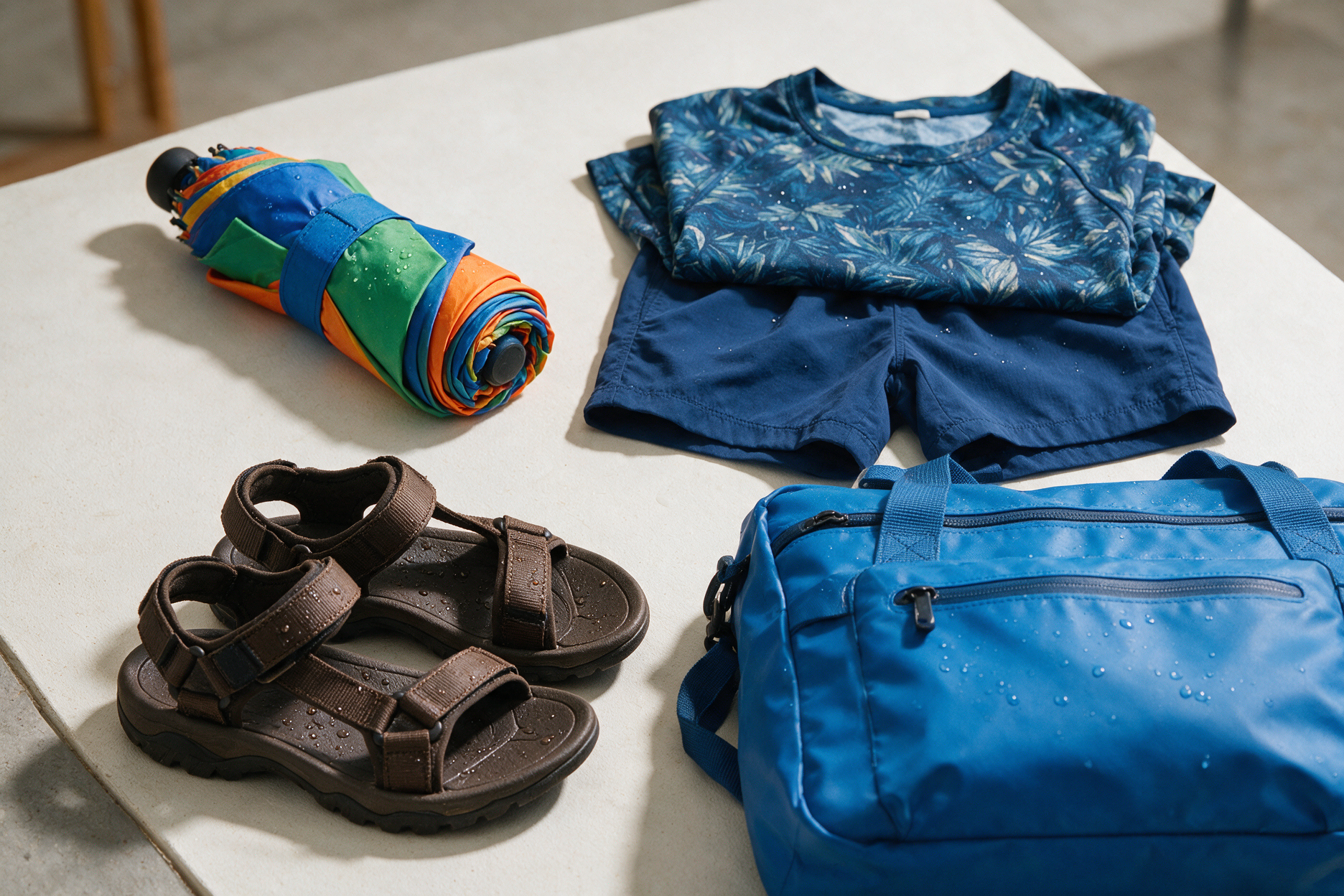
A packable rain jacket. Not optional for rainy season — get one that compresses to the size of a cricket ball and can live in your day bag. The important thing is it’s always with you, not in your hotel room when the 4 PM storm hits while you’re at a market. Lightweight alternatives: a reusable rain poncho (25-40 baht from every Thai 7-Eleven in rainy season, fine for a single downpour) is good as a backup but not as a primary — they’re single-use quality.
Waterproof sandals or quick-dry shoes. Leather sandals and suede trainers are a mistake in rainy season. Waterproof sandals (Teva, Reef, or similar) or rubber-soled quick-dry water shoes handle the wet environments well. You’re going to be walking through puddles and getting on/off longtail boats in rain — footwear that handles this is a real improvement.
Extra ziplock bags or dry bags. Salt spray on boat rides and rain during outdoor activities make waterproofing your electronics an ongoing practice rather than a one-time precaution. A 10L dry bag or a set of heavy-gauge ziplock bags for your phone, camera, and anything critical is worth the minimal weight.
Rainy season travel has genuine advantages: lower hotel prices (20-40% below peak in affected areas), fewer tourists, prices drop at tourist-facing restaurants. For travelers with flexible dates, rainy season on the east coast (Koh Samui in November, which is relatively drier than the west coast in the same month) can be the sweet spot.
The Base List (All Seasons)
This is what you should pack regardless of when you go. Everything above is seasonal addition; everything below is standard.
Clothing (7 days, adjusting for trip length):
- 5-6 lightweight tops — cotton or technical fabric, mix of casual and one or two that are presentable for a nicer dinner
- 3 bottoms: 1 pair of light trousers that pass temple dress code (covers knees), 1-2 shorts for beach/casual
- 1 light long-sleeved shirt or thin zip-up for AC environments and temple shoulders-covered requirement
- Swimwear (1-2 pieces)
- Comfortable walking shoes or trainers (1 pair)
- Flip-flops or sandals (1 pair)
- Underwear + socks for 7 days (Thai laundry services are cheap — 40-80 baht per kg — but you won’t always be near one)
Toiletries and health:
- SPF 50+ sunscreen — bring enough for the trip or plan to buy locally
- Insect repellent with DEET: mosquitoes in Thailand carry dengue (less so malaria in tourist areas, but dengue is present). Apply every evening, particularly near water and in forested areas.
- Your prescription medications plus a 3-5 day buffer in case of delays. Thai pharmacies are excellent and well-stocked but getting an exact equivalent of a specific Indian brand isn’t guaranteed.
- Antidiarrheal (Imodium or equivalent) and ORS packets. Street food is safe in Thailand — Thai hygiene standards are generally good — but stomach adjustment in the first 2-3 days is common.
- Small first aid: bandages, antiseptic cream, paracetamol. Available everywhere in Thailand but useful to have immediately.
- Hand sanitizer: compact and practical between street food stalls.
Documents and money: Covered in the documents section below.
Clothing by Destination Type
Thailand’s destinations have different dress cultures and practical requirements:
Bangkok temples: Shoulders and knees must be covered. Men need long trousers (or can wear sarong-style wraps often available at temple entrances for 20 baht). Women need a top with sleeves and skirt/trousers below the knee. A light cotton scarf doubles as a temple shoulder cover and a neck cover on windy boat rides. Bring one rather than renting — they’re practical for multiple uses.
Beaches and islands: Standard beach wear — swimsuit, shorts, casual tops. Most beachside restaurants are shirt-and-shorts casual. The Phuket resort scene has some restaurants with “smart casual” dress codes (no swimwear, covered shoulders) but these are the exception rather than the rule at mid-range establishments.
Phuket Old Town and heritage sites: No formal dress code but modest clothing (not swimwear) is respectful and practical for a long walk in the sun.
Bangkok’s higher-end restaurants: Bangkok has excellent fine dining. If you’re planning a special dinner (say, one of the rooftop restaurants in Silom or the Thai-tasting menu places), men typically need closed shoes and a collared shirt. Check the specific restaurant’s policy — most have it on their website or will confirm by WhatsApp if you message them.
Tech and Connectivity
Power adapters: Thailand uses Type A (two flat pins) and Type B (two flat pins + round ground) sockets at 220V. Indian plugs (Type D, three round pins) generally don’t fit Thai sockets directly. Bring a universal adapter — or check whether your laptop/charger is dual-voltage (input 100-240V, which most modern electronics are) and buy a cheap adapter at Bangkok airport arrivals for 150-250 baht.
SIM card: Buy a tourist SIM at Suvarnabhumi or Don Mueang airport arrivals hall. AIS and True Move both sell 7-15 day unlimited data packages starting at 299 baht. This is more convenient than local purchase and the airport price difference from city prices is minimal. It gives you Grab access, Google Maps, and WhatsApp from the moment you clear customs — which you need.
Download offline: Before you land, download Google Maps Thailand for offline use. Also: Grab app, currency converter. Offline maps are particularly useful on islands where data can be patchy.
Power bank: A 10,000-20,000 mAh power bank is useful for long island days where you’re away from charging points. Most Thai hotels have adequate USB ports, but a day on a boat or at a beach without charging access runs down an active phone quickly.
Camera gear: If you’re bringing a camera, a rain cover or waterproof bag for it matters in rainy season and on longtail boat crossings. The spray on fast-moving longtail boats can be significant. A ziplock bag handles basic protection; proper rain covers are better for sustained rain.
Documents and Travel Essentials
Mandatory for Thailand entry:
- Indian passport valid for at least 6 months beyond your departure date from Thailand
- Thailand Digital Arrival Card (TDAC) QR code — fill out at tdac.immigration.go.th within 72 hours of your flight. Save the QR code offline.
- Return/onward flight ticket (booking confirmation on phone is fine)
Strongly recommended to have on phone or printed:
- All hotel booking confirmations, particularly the first night’s address (required for TDAC)
- Travel insurance policy with emergency contact number — Thai private hospitals are excellent, the bills without insurance are large
- Copy of passport photo page and visa page (separate from the actual passport) — email yourself a scan
- Emergency contact card with your hotel addresses in Thai script (your hotel can email you this, or use Google Translate to Thai)
Money: Thai baht is the currency. ATMs in Thailand charge a foreign transaction fee of 220 baht per withdrawal — take out larger amounts (3,000-5,000 baht) at once rather than multiple small withdrawals. Forex exchange counters at airports and Superrich exchange (widely located in Bangkok) give better rates than ATMs for cash exchange. Credit cards work at hotels and most restaurants but not at street food stalls or local markets.
Notes for Jain and Vegetarian Travelers
Packing for dietary restrictions in Thailand requires some extra food items that aren’t easily available locally:
- Ready-to-eat snacks: Roasted chana, murmura mixes, energy bars, rice crackers. Thai supermarkets (Big C, Lotus’s) have some equivalent options but the variety and familiar flavors are limited. Packing 5-7 days of backup snacks for situations where restaurant options are inadequate is practical, particularly if you’re on the Jain diet.
- Protein snacks: Nuts are available everywhere in Thailand but specific roasted/salted varieties popular in India (masala groundnuts, mixed dry fruit) are harder to find. Pack a supply.
- Spice sachets: Not strictly necessary — Thai food has plenty of flavor — but if you’re eating at places that accommodate dietary restrictions by essentially making plain stir-fried vegetables, having a sachet of chaat masala or achaar in your bag upgrades simple food considerably.
FAQs
What is the best season to visit Thailand from India?
November to February. The weather is reliably dry and comfortable across most of Thailand, it’s the peak season for a reason. Prices are higher than off-season, and domestic flights and hotels book up early — but the experience is easier and more predictable than other times of year.
Do I need a rain jacket for Thailand?
In cool season (November-February): no. In hot season (March-May): no — rain is minimal. In rainy season (June-October): yes, a packable one is worth packing. But rainy season Thailand rarely has all-day rain — afternoon downpours that clear in 1-2 hours are more typical in Bangkok and most islands.
Can I buy sunscreen in Thailand?
Yes. Boots, Watson’s, and Family Mart/7-Eleven all stock sunscreen. Japanese brands (Biore, Skin Aqua, Anessa) are excellent quality and reasonably priced — around 300-600 baht for a full bottle of SPF 50+. Indian travelers often find it easier and cheaper to supplement locally rather than bringing large quantities from home.
Do I need insect repellent in Thailand?
Yes. Dengue mosquitoes are present in Thailand, particularly near water (beaches, canals, rivers). Apply DEET-based repellent in the evenings when mosquitoes are most active. Most Thai pharmacies carry local repellent brands. Bring a travel-size tube from India and replenish locally if needed.
What type of power adapter do I need in Thailand?
Type A/B (flat two-pin or flat two-pin + round ground). Indian Type D plugs don’t fit Thai sockets directly. A universal adapter covers this and future trips. Alternatively, buy one at Bangkok airport arrivals for 150-250 baht.
How many outfits should I pack for a 7-night Thailand trip?
5-6 tops, 3 bottoms, 1 longer trouser for temples, swimwear, walking shoes, flip-flops. Thai laundry services (found at every guesthouse and many hotels) are cheap — 40-80 baht per kg — so you can re-wear and wash rather than packing for every day independently. A 7-day trip doesn’t require 7 complete outfit changes; 5 is plenty.
Pack Smart, Travel Well
Thailand is not a destination that demands elaborate preparation. The country is well-supplied, well-connected, and remarkably tolerant of travelers who arrive under-equipped — you can solve almost any packing gap at a Bangkok mall, a 7-Eleven, or a Boots pharmacy within hours of landing. The things worth bringing are the ones that improve your first day (sunscreen, Grab app, TDAC QR code downloaded offline) and the things you can’t buy locally (your specific prescriptions, dietary restriction snacks, the exact electronic adapter for your devices).
Browse Get Tripped’s Thailand packages to see how our curated itineraries handle the practical logistics — which transfers are pre-arranged, which hotels work for families or couples, and how we build the right mix of Bangkok, beach, and island into a trip that doesn’t require a spreadsheet to execute.