Thailand Public Transit Guide: BTS, MRT, Ferries, Grab & Getting Around Between Cities
Getting around Thailand is one of the least stressful parts of planning a trip there — not because it’s frictionless, but because there are so many overlapping options that you’re rarely stuck. Bangkok has a metro system that’s clean, fast, and genuinely useful. Between cities, domestic flights are cheap. And everywhere, Grab makes the last mile easy in a way that a decade of taxi negotiation couldn’t.
This guide covers transport within Bangkok, between the major destinations (Bangkok to Phuket/Krabi/Koh Samui/Pattaya), and the island logistics for Koh Phi Phi and the smaller islands.
Table of Contents
- Bangkok’s BTS and MRT
- Bangkok Boats and Ferries
- Grab: The Essential App
- Tuk-Tuks and Metered Taxis
- Domestic Flights: Bangkok to Islands and Back
- Trains and Overnight Buses
- Island Ferries and Longtail Boats
- Songthaews and Local Buses
- SIM Cards and Offline Maps
- FAQs
Bangkok’s BTS and MRT
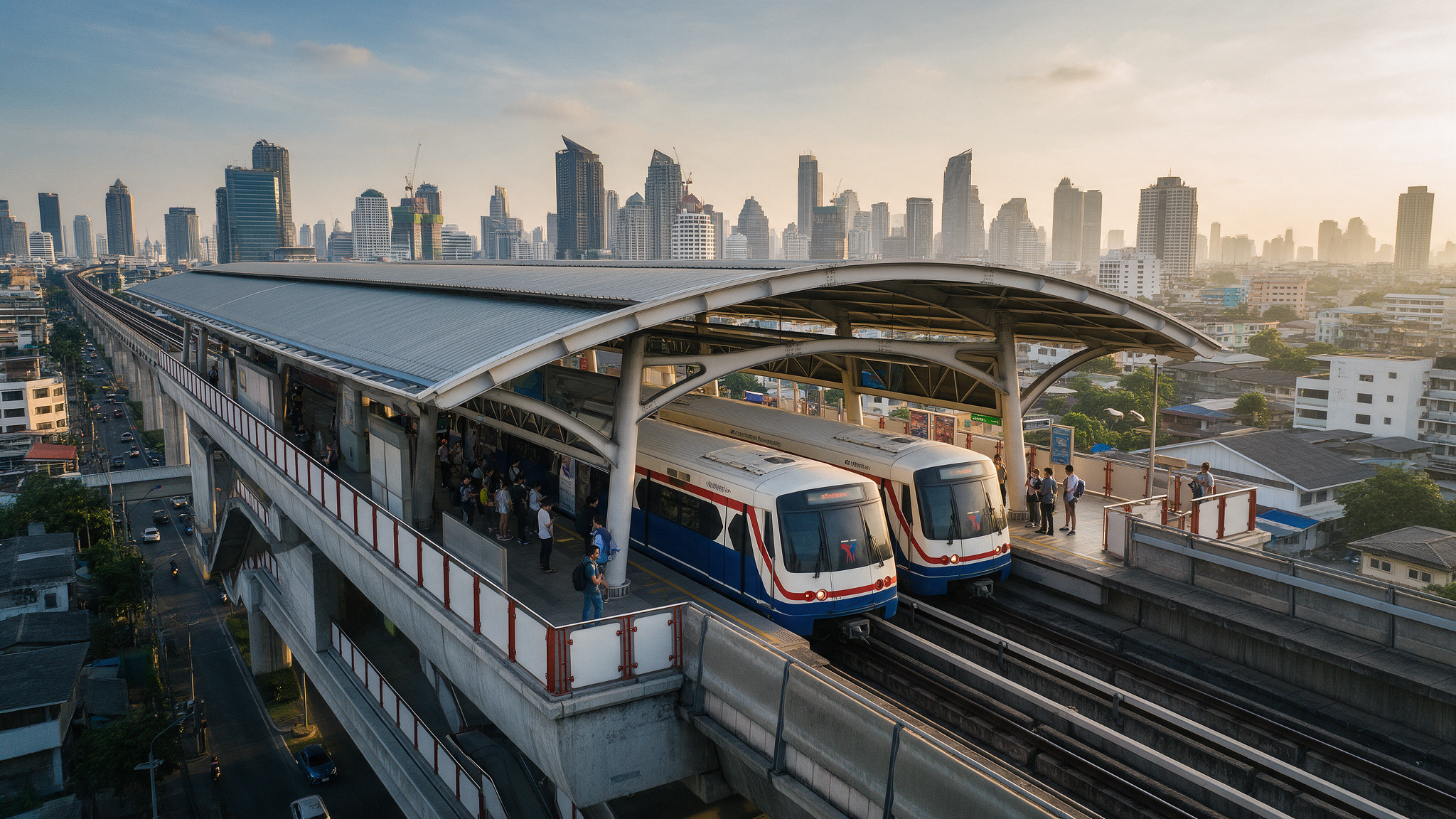
Bangkok has two primary rail systems that most travelers use: the BTS Skytrain (elevated rail) and the MRT (underground metro). They connect at several interchange stations and together cover most of the city’s tourist areas and hotel clusters.
BTS Skytrain: Two lines — the Sukhumvit Line (runs northeast-southwest) and the Silom Line (central and south). Covers Siam (the main shopping district), Sukhumvit (hotels and nightlife), Silom (financial district and Lumphini Park), and Mo Chit (Chatuchak Market). Trains run every 3-8 minutes, 6 AM to midnight. Fares: 17-62 baht depending on distance. The Rabbit Card (a reloadable smart card, similar to Delhi Metro’s metro card) saves time over buying tickets each trip — available at any BTS customer service counter for 200 baht (100 baht deposit + 100 baht credit).
MRT: The underground complements the BTS and extends to areas the Skytrain doesn’t reach, including Hua Lamphong (main train station), Chatuchak Park, and Chinatown (Wat Mangkon station, opened 2019). Same operating hours as BTS, similar pricing. MRT Stored Value Card works like the Rabbit Card — worth getting if you’re spending more than two days in Bangkok.
The BTS and MRT stations are connected at interchange points — Asok/Sukhumvit (BTS/MRT), Sala Daeng/Silom, Chatuchak Park/Mo Chit, and others. The connections are a short walk inside the stations, not a re-fare.
Bangkok Boats and Ferries
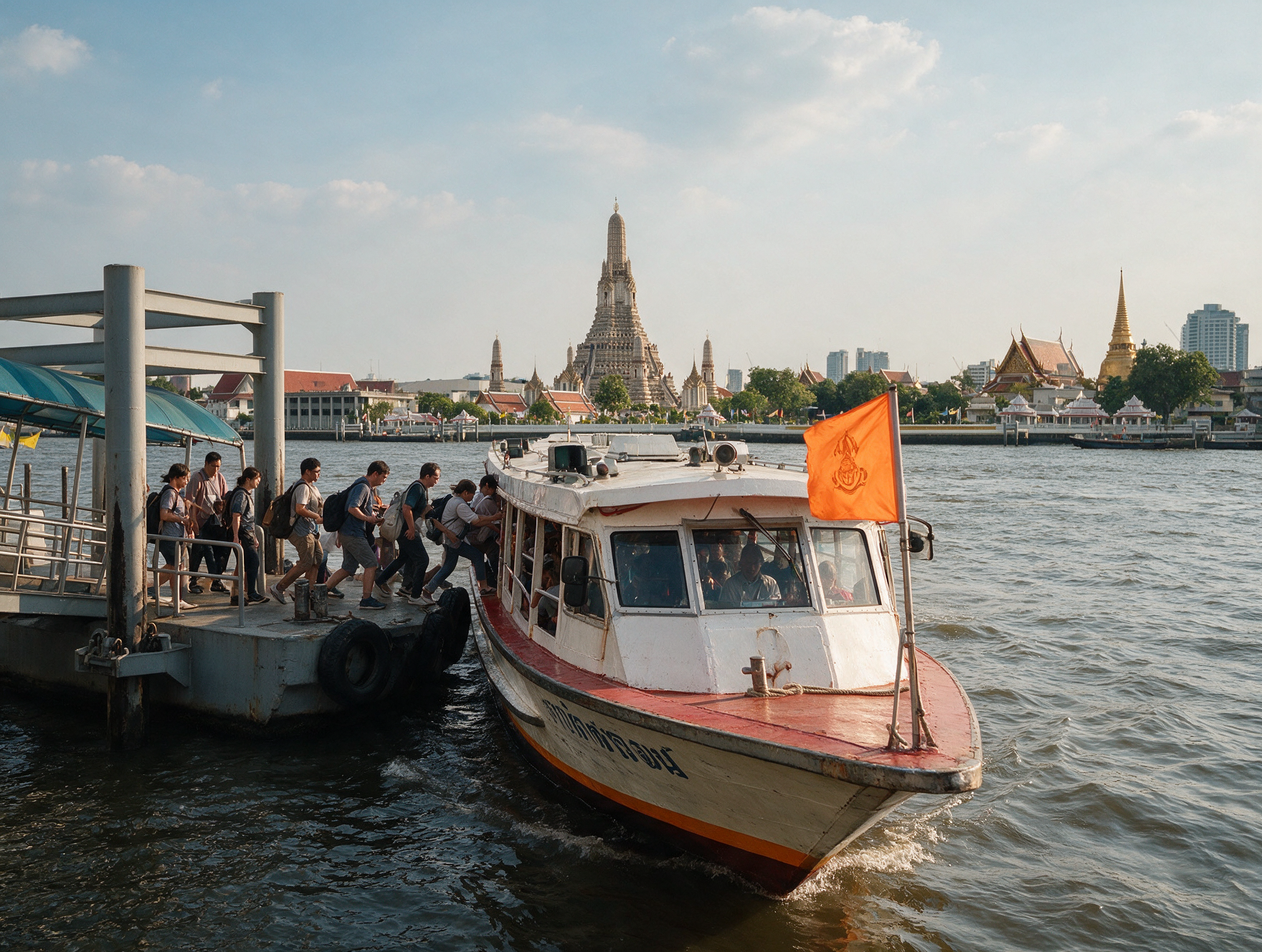
The Chao Phraya Express Boat is one of the most useful and most underused transport options in Bangkok. It runs along the Chao Phraya River between Nonthaburi in the north and Sathorn (Central Pier) in the south, with stops at all major riverside attractions: the Grand Palace, Wat Pho, the flower market, and the major bridge crossings.
The orange flag boat is the fastest and most reliable for tourists — it runs all day and stops at fewer piers. The express yellow flag boats run during rush hours only. Fares start at 15 baht. The Sathorn/Central Pier connects to BTS Saphan Taksin station, making the boat-Skytrain combination one of the fastest ways to cross the city.
Longtail boat taxis also crisscross Bangkok’s khlongs (canals). The Khlong Saen Saep express boat service runs east-west across the city, parallel to Sukhumvit, and is used by Bangkok locals for a fraction of what a taxi costs in traffic.
Grab: The Essential App
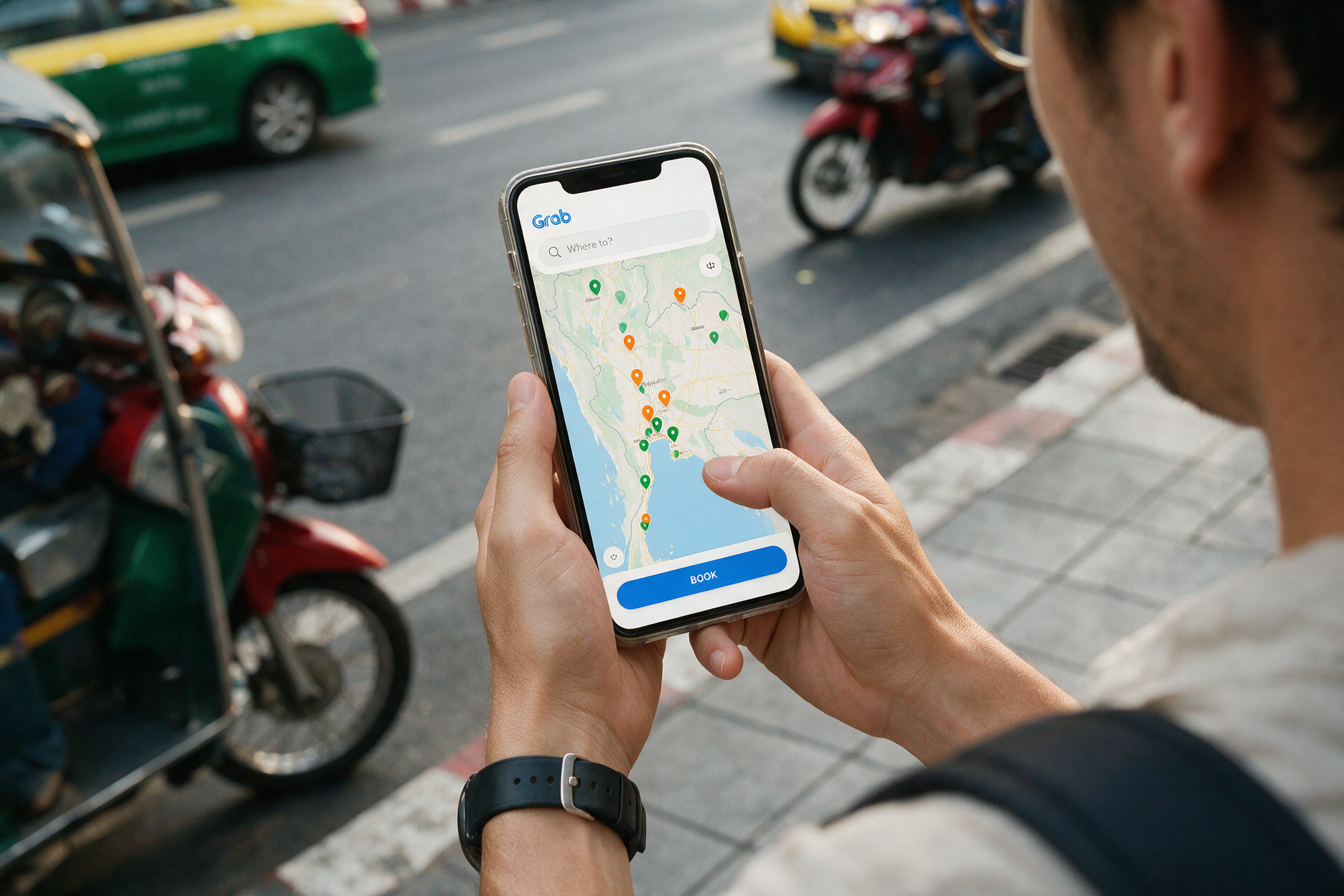
Download Grab before you leave India. It’s the dominant ride-hailing app across Southeast Asia and works in every major Thai city. You can book with your Indian phone number, pay by card or cash, and the fare is shown upfront in Thai baht with an option to see the approximate Indian rupee equivalent.
Grab works for standard cars (GrabCar), bikes (GrabBike — fast for solo travelers in traffic), and in some areas, GrabTaxi (which books you a regular metered taxi through the app). The prices in Bangkok are significantly lower than in India’s metro cities — a 20-minute ride in Bangkok typically costs 60-120 baht, roughly ₹140-280.
In Phuket, Grab is particularly valuable because Phuket has no metered taxi system — regular taxis quote fixed prices and negotiate, while Grab shows you the upfront fare. The difference can be significant (a Patong-to-airport trip may be 400 baht fixed taxi vs. 250-300 baht on Grab).
Grab also operates GrabFood, GrabMart, and GrabExpress if you need food delivery or pharmacy runs at your hotel.
Tuk-Tuks and Metered Taxis
Tuk-tuks are three-wheeled open-air vehicles and one of Bangkok’s most photographed icons. For practical transport purposes, they’re usually more expensive than Grab and significantly more exposed to traffic fumes. Their main advantage is navigating narrow sois (side streets) where cars can’t easily turn. Negotiate the fare before you get in — there’s no meter. For tourist-zone short hops, 80-150 baht is reasonable.
Beware the tuk-tuk gem shop scam: a driver offers to take you to a major attraction for 20-30 baht and then detours to a gem shop or suit tailor where he earns a commission. If a tuk-tuk fare seems too cheap to be genuine, it is. Just use Grab.
Metered taxis in Bangkok are reliable and use meters by law. If a taxi driver refuses to turn on the meter, get out and take the next one. Standard flag fall is 35 baht, then 6.5 baht per km. Most airport rides to central Bangkok run 200-350 baht plus expressway tolls (which the passenger pays separately, usually 45-75 baht).
Domestic Flights: Bangkok to Islands and Back
For a Thailand itinerary that covers Bangkok and the south, domestic flights are the clear winner for time efficiency. The Bangkok-Phuket corridor is one of Thailand’s busiest domestic routes, with departures every 30-60 minutes throughout the day from both Suvarnabhumi and Don Mueang.
Key airlines: Thai AirAsia, Nok Air, Thai Lion Air, Bangkok Airways, Thai Vietjet. Bangkok Airways is the premium option and flies into Koh Samui’s private airport (the only airline that does) — if you’re going to Koh Samui, Bangkok Airways is usually your only commercial flight option unless you go via Surat Thani and ferry.
Book domestic flights at least 2-3 weeks in advance to get reasonable prices. Last-minute bookings on busy routes (especially Bangkok-Phuket and Bangkok-Koh Samui) can cost 3-4× the advance fare. Typical advance-purchase prices: Bangkok-Phuket 900-2,500 baht; Bangkok-Krabi 1,100-2,800 baht; Bangkok-Koh Samui 1,800-4,500 baht.
Note which Bangkok airport your flight uses: Suvarnabhumi (BKK) or Don Mueang (DMK). They’re 30 km apart, and getting the wrong one wrong costs you an hour and a taxi fare.
Trains and Overnight Buses
The State Railways of Thailand (SRT) connects Bangkok to destinations across the country. The train to Surat Thani (for Koh Samui/Koh Tao ferry connections) takes about 8 hours on the express service. The overnight sleeper to Chiang Mai is 12 hours and a genuine travel experience — the first-class sleeper cabins are comfortable and the train passes through the Thai countryside at dawn.
For most Indian travelers on a 7-10 day trip, trains make sense for specific routes (the overnight Chiang Mai run) but not for the Bangkok-south corridor where flights save 8-10 hours. If time isn’t a factor or you want the countryside experience, trains are excellent value — a first-class sleeper Bangkok to Chiang Mai costs 1,600-2,000 baht versus a 1,200-3,000 baht flight.
Overnight buses (Nakhon Chai Air, Transport Co.) connect Bangkok to most major destinations and are cheaper than trains, but less comfortable. The bus terminal at Mo Chit (BTS Mo Chit station) is the main departure point.
Island Ferries and Longtail Boats
Getting to Thailand’s islands requires ferries. The main routes from the south’s mainland:
- Krabi to Koh Phi Phi: High-speed catamaran, 90 minutes, 400-650 baht. Runs multiple times daily. Book in advance during December-January high season as boats fill up.
- Surat Thani to Koh Samui: Car and passenger ferry, 2.5 hours, or high-speed catamaran, 1 hour 30 minutes. The Lomprayah and Seatran ferries are the most reliable operators.
- Phuket to Koh Phi Phi: High-speed catamaran, about 90 minutes. Operated by Tha Rua and Phi Phi Cruiser.
- Krabi to Railay Beach: Longtail boat from Ao Nang, 15 minutes, 100-150 baht each way. Runs whenever there are passengers during daylight hours.
Ferries don’t run in rough weather, particularly June-September when the Andaman Sea has significant swells. If you’re planning a ferry hop during monsoon season, build flexibility into your schedule or check weather forecasts before booking non-refundable accommodation on islands.
Songthaews and Local Buses
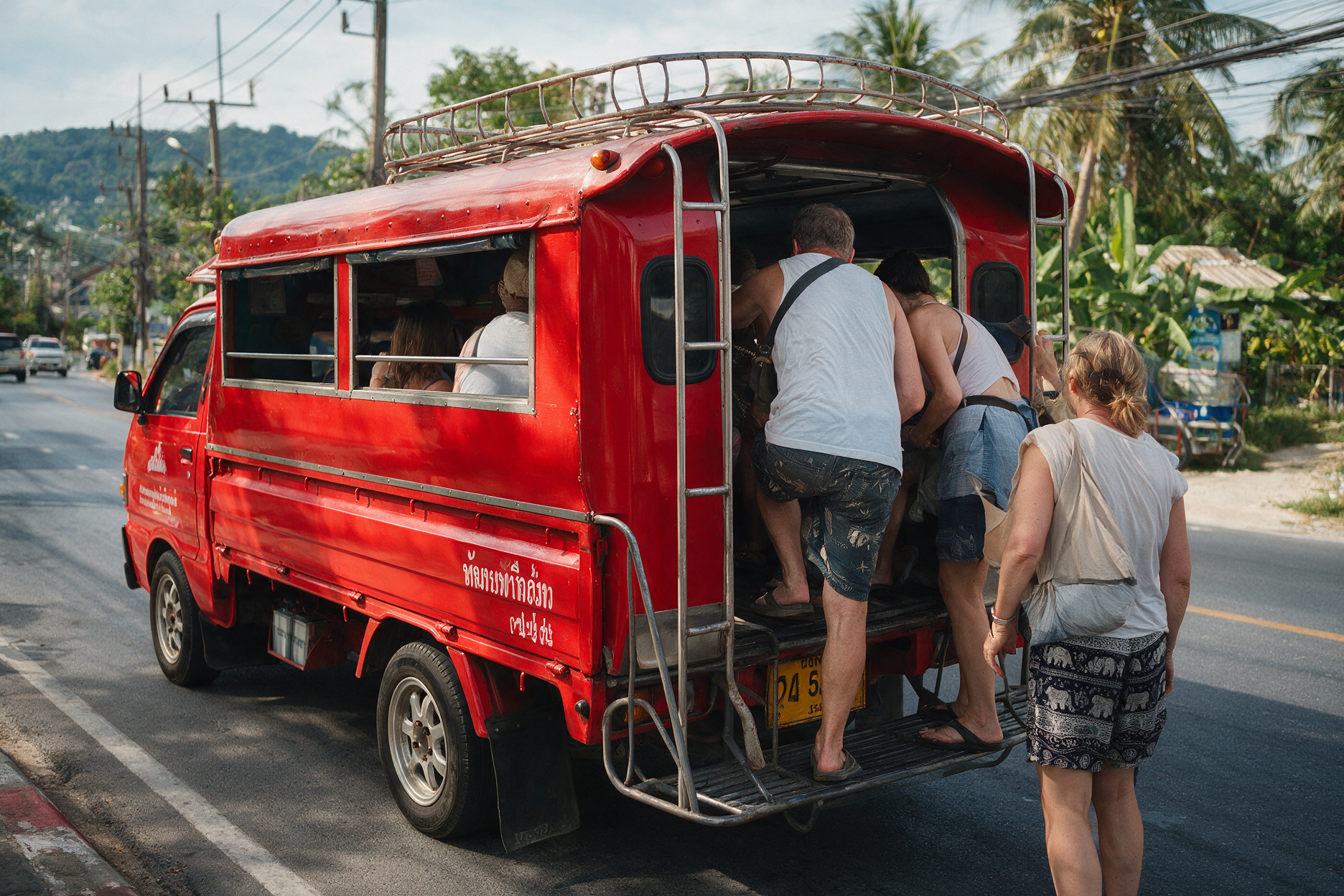
Songthaews (literally “two rows”) are pickup trucks with two bench seats in the back, operating as shared taxis on fixed routes. They’re the primary local transport in Phuket, Krabi, Chiang Mai, and most provincial towns outside Bangkok. Flag one down, hop in, and tell the driver your destination — if it’s on their route, you pay 20-50 baht. If they’re going a different direction, they’ll wave you off.
In Phuket, songthaews run between Patong, Kata, Karon, and Phuket Town on fixed routes. The fare from Patong to Phuket Town is typically 30 baht — compared to 300+ baht for a private taxi. The trade-off is that you follow the route rather than going door to door.
SIM Cards and Offline Maps
Buy a Thai tourist SIM at Suvarnabhumi or Don Mueang airports on arrival. AIS, DTAC (now part of True Move H), and True Move all sell 7-15 day unlimited data packages at the arrival halls, starting at 299 baht. The convenience of immediate connectivity is worth the slightly higher price versus buying in the city.
Download Google Maps Thailand for offline use before you arrive. Also download the Grab app, the airport’s transit maps (Suvarnabhumi has a complex setup), and a Thai language app with pronunciation guides. The offline maps let you navigate songthaews and boats without having to show your phone to every driver.
FAQs
Can I use metro cards from one Thai city in another?
No. The Rabbit Card works for Bangkok BTS only. The MRT has its own stored value card. Provincial cities don’t have card systems — you pay cash on songthaews and local transport.
Is Grab available everywhere in Thailand?
In all major cities and tourist areas, yes. Grab works in Bangkok, Phuket, Chiang Mai, Pattaya, Krabi, Hua Hin, and Koh Samui. On smaller islands like Koh Phi Phi, Grab is not available.
How do I get from Bangkok airport to the city?
Suvarnabhumi: Airport Rail Link (ARL) — 45 minutes to Phaya Thai station, 45 baht. Or Grab/taxi from the designated taxi stands (not touts) — 300-450 baht including expressway tolls. Don Mueang: A4 bus to Mo Chit (BTS), 30 baht, or taxi 250-350 baht.
Do I need an international driving license for Thailand?
Yes, to drive a car legally. Motorbike rentals in tourist areas happen without license checks, but riding without a license means you’re uninsured and liable if anything goes wrong. For island mobility, a scooter with a valid license is practical; without one, use songthaews and Grab.
What’s the best way to get around Phuket?
Grab for point-to-point travel. Songthaew for the main corridor routes (Patong-Phuket Town is well served). Private motorbike rental (with license) for maximum flexibility. Taxis exist but the prices are negotiated — always higher than Grab for the same route.
Move Like You Know the City
Thailand’s transport network is more straightforward than it looks on paper. Once you have Grab on your phone, a Rabbit Card for Bangkok’s BTS, and a basic sense of which airport serves which route, the logistics largely take care of themselves.
Explore Get Tripped’s Thailand packages where transport between cities and islands is pre-arranged — so the only decisions you’re making on the ground are where to eat and how long to stay at the beach.