Thailand Visa Guide for Indian Travelers 2026: Documents, TDAC & What to Expect
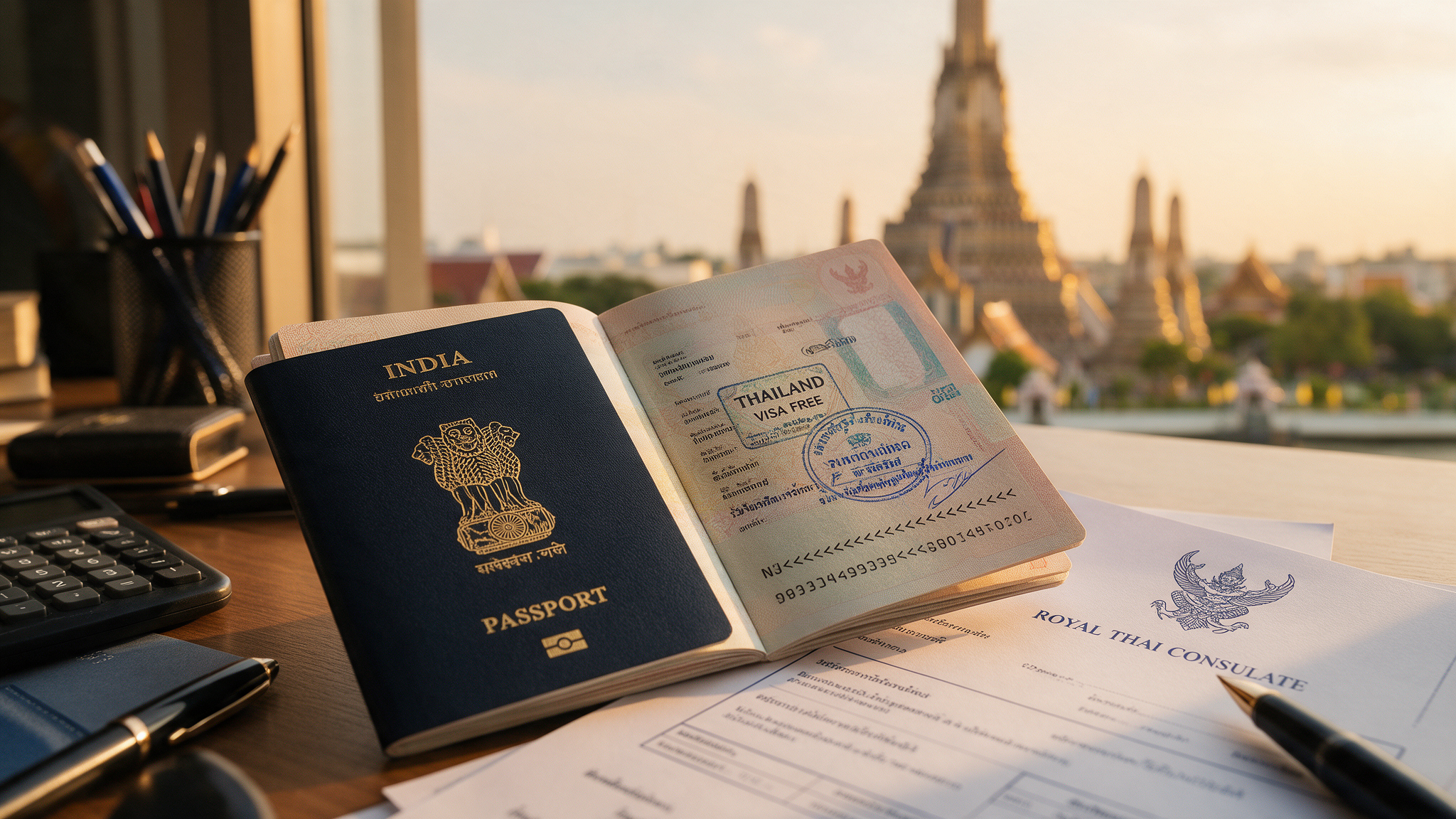
Here’s the short version: Indian passport holders do not need a visa to visit Thailand. You can land, clear immigration, and be eating pad thai within an hour of touching down — no sticker visa, no embassy appointment, no application fee.
The longer version has a few moving parts worth understanding before you fly, specifically the Thailand Digital Arrival Card (TDAC), the 30-day stay limit, and what immigration officers sometimes ask to see. This guide covers all of it, updated for 2026, with details specific to travelers flying from India.
Table of Contents
- Thailand Visa-Free Status for Indians (2026 Update)
- The Thailand Digital Arrival Card (TDAC): How to Fill It
- Documents to Carry at Immigration
- What Happens at the Airport
- Can You Extend Your Stay?
- Options for Stays Longer Than 30 Days
- Practical Tips and Mistakes to Avoid
- FAQs
Thailand Visa-Free Status for Indians (2026 Update)
Thailand has offered Indian passport holders visa-free entry for 30 days since September 2022, and as of 2026, that policy remains in place and permanent — not a temporary arrangement or trial. The exemption applies on arrival at all major international airports: Suvarnabhumi (Bangkok), Don Mueang (Bangkok), Phuket International, Chiang Mai International, and Hat Yai International.
The 30-day window starts the day you arrive. If you land on 1 November, you must leave by 30 November. Overstaying carries a fine of 500 Thai baht per day (capped at 20,000 baht), plus potential detention and a re-entry ban — so mark your calendar and don’t cut it close.
One important detail: the visa-free exemption is for tourism only. It does not cover working remotely on a professional basis for Thai clients, conducting business negotiations, or any employment. For those purposes, you’d need a Non-Immigrant B visa obtained from the Thai Embassy in advance.
The Thailand Digital Arrival Card (TDAC): How to Fill It
This is the part that catches people off guard. Thailand replaced the paper TM6 arrival/departure card with the Thailand Digital Arrival Card (TDAC) in 2024. You fill it out online before you fly — not at the airport, not on the plane. There’s no paper backup option anymore at most entry points.
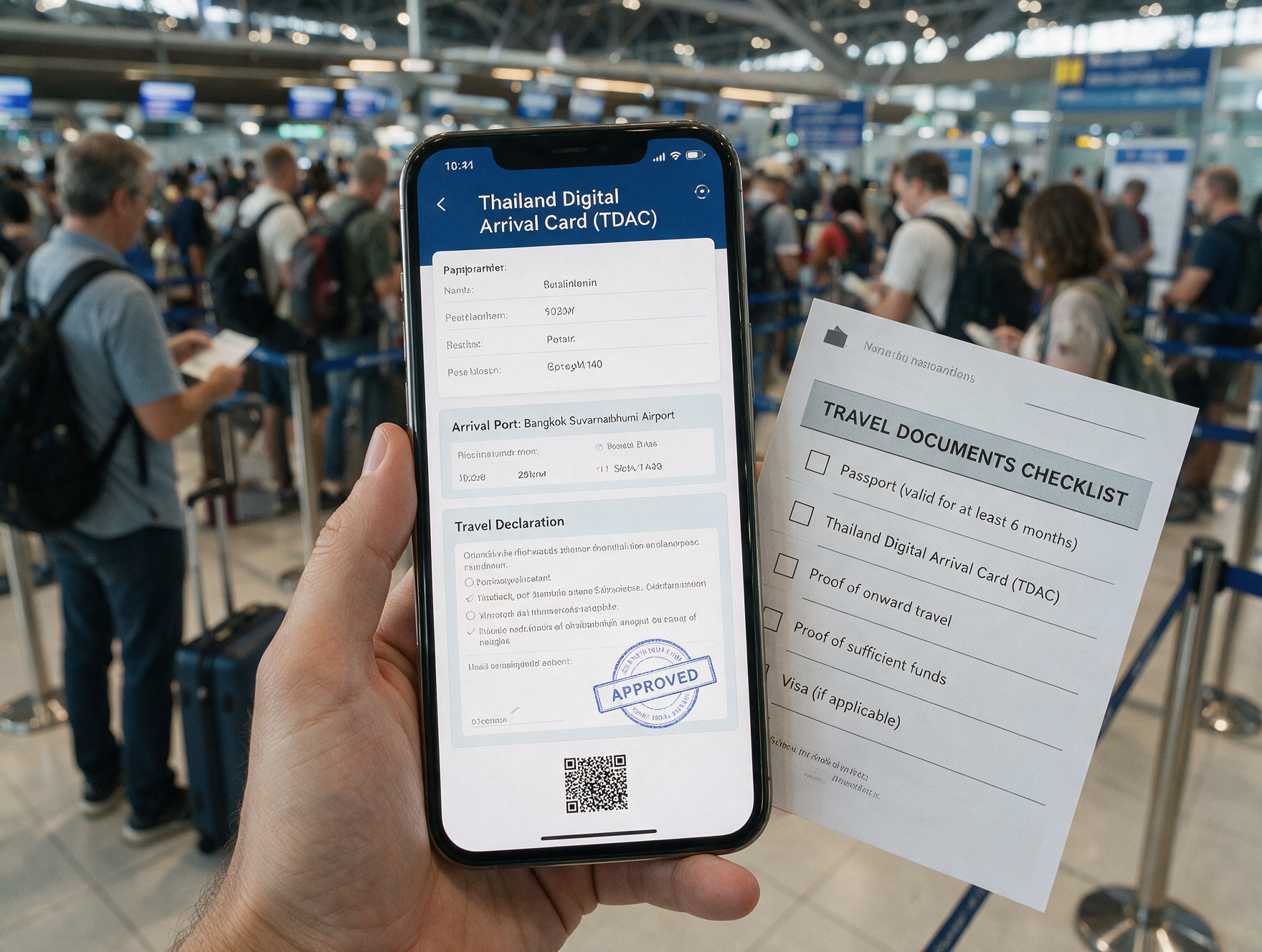
The TDAC is available at tdac.immigration.go.th. Fill it out within 72 hours before your flight departs. It asks for: passport number and expiry, flight details (flight number, arrival airport), accommodation address in Thailand (hotel name and address for at least the first night), and purpose of visit.
Once submitted, you get a QR code. Screenshot it, save it offline, print it if you’re worried about connectivity. You’ll show this QR code to the immigration officer on arrival.
Practical note: the TDAC system sometimes runs slowly during peak travel periods. Fill it out the evening before your flight rather than at the airport. The site works fine on mobile Chrome; Safari sometimes has issues on iOS, so switch browsers if you run into problems.
Documents to Carry at Immigration
Thai immigration doesn’t always ask for supporting documents, but when they do, you want them ready. Here’s what to have in your bag:
Mandatory:
- Indian passport valid for at least 6 months beyond your planned departure date from Thailand
- TDAC QR code (on your phone or printed)
- Return or onward flight ticket (booking confirmation on your phone is fine)
Strongly recommended:
- Proof of accommodation for the full stay: hotel booking printouts or screenshots for each night, particularly the first night
- Proof of sufficient funds: bank statement or credit/debit card. A general rule of thumb is 10,000 baht (roughly ₹23,000) per person — this isn’t a fixed rule but immigration sometimes asks, especially at Suvarnabhumi during busy periods
- Travel insurance: not mandatory but worth having for any trip from India
A word on accommodation: “I’m staying with a friend” is technically fine but harder to verify at the counter. If you’re doing this, have your friend’s name, address, and phone number written down.
What Happens at the Airport
Suvarnabhumi’s immigration hall is large and the queues can be long, particularly on Sunday evenings when flights from India, the Middle East, and Europe converge. Budget 45 minutes to 90 minutes for immigration during peak periods. Don Mueang, which handles many budget carriers including IndiGo and Air India Express flights from India, is usually faster.
When you reach the immigration counter:
- Hand over your passport and have your TDAC QR code ready on your phone
- The officer scans both and takes biometrics (photo and fingerprints)
- They may ask the purpose of visit, how many days you’re staying, and where you’re staying
- Your passport gets a stamp with your permitted stay date
The permitted stay date stamped in your passport is what controls when you must leave — not the date on your return ticket. Double-check this stamp before leaving the immigration hall.
Can You Extend Your Stay?
Yes, once. You can apply for a 30-day extension at any Thailand Immigration Office (there are offices in Bangkok, Chiang Mai, Phuket, Pattaya, and other cities). The fee is 1,900 baht. You’ll need your passport, a recent passport-sized photo, the TM.7 extension form (available at the immigration office), and proof of your accommodation. Processing is usually same-day if you arrive early.
The Bangkok Immigration Office at the Government Complex in Chaeng Wattana is the main one, and the wait can be long — get there before 8 AM if you want to avoid spending half your day in line. The Phuket Immigration Office at Phuket Town is more manageable.
This extension gives you 30 extra days, bringing your total stay to 60 days. A second extension at the same office is not typically granted — you’d need to exit the country and re-enter.
Options for Stays Longer Than 30 Days
If you’re planning to spend more than 60 days in Thailand (common for digital nomads, people doing language courses, or extended travel), your options are:
Tourist Visa (TR): Applied for at the Thai Embassy or Consulate in India before you travel. A single-entry Tourist Visa gives you 60 days on arrival plus the option to extend for 30 more days (total 90 days). A multiple-entry version is also available. Fee from the Indian side: approximately ₹4,500-6,000 for a single-entry visa, processed in 3-5 business days in person or by mail.
Thailand Privilege Card (formerly Thailand Elite): A long-stay visa program for travelers planning 5-20 years of access. Not relevant for most tourists, but worth knowing exists.
For most Indian travelers doing a Thailand trip as a holiday, the 30-day visa-free entry (or 60 days with extension) is more than enough. The average Thailand tour package from India runs 5-10 days.
Practical Tips and Mistakes to Avoid
Mistake 1: Forgetting the TDAC until you’re at the airport. The immigration lines at Suvarnabhumi during peak hours are long and stressful. The last thing you want is to be fumbling with a form on spotty airport Wi-Fi after a 4-hour flight. Fill it out the night before.
Mistake 2: Letting your passport expiry creep up. If your passport expires within 6 months of your travel dates, renew it before booking your Thailand trip. Indian travelers occasionally get stopped at check-in for this, since airlines are responsible if they carry a passenger who’s denied entry.
Mistake 3: Crossing the land border from Thailand to Myanmar and back thinking it resets your visa. This “border run” to reset the 30-day timer worked in the past but Thai immigration has become significantly stricter about repeated entries. Don’t plan your trip around this.
Mistake 4: Not having your accommodation address for the TDAC. The system requires an actual street address for your first night. “I’m deciding at the airport” won’t work. Book at least one night in advance so you have an address to enter.
Fun fact: Thailand has never been colonized by a European power — it’s the only Southeast Asian country to maintain independence throughout the colonial era. The name “Thailand” means “Land of the Free” in Thai (from “Thai” meaning free and “land”). This independence shaped a confidence and pride you can sense even in small interactions.
FAQs
Do Indian passport holders need a visa for Thailand in 2026?
No. Indian citizens can enter Thailand visa-free for up to 30 days. You need a valid passport, a completed TDAC (Thailand Digital Arrival Card), and a return/onward ticket.
What is the TDAC and how do I fill it out?
The TDAC (Thailand Digital Arrival Card) replaced the old paper TM6 card. You fill it out online at tdac.immigration.go.th within 72 hours before your flight. It takes about 5 minutes and generates a QR code you show at immigration on arrival.
How much money should I have to show at Thailand immigration?
There’s no fixed requirement, but immigration can ask to see proof of funds. The unofficial guideline is around 10,000 baht per person (roughly ₹23,000). A credit card or bank statement typically suffices.
Can I extend my 30-day visa-free stay in Thailand?
Yes, once, for an additional 30 days. Apply at a Thai Immigration Office. The fee is 1,900 baht, and the extension is usually processed the same day.
Can I work remotely from Thailand on a visa-free stay?
Working for Thai clients or employers requires a proper work permit. However, working remotely for a non-Thai employer while on a tourist exemption exists in a legal grey area — Thailand has not yet established a formal digital nomad visa, though this has been discussed. For longer remote work stays, a tourist visa is the most common approach.
What documents do I need to board my flight to Thailand from India?
Passport (6 months validity), TDAC QR code, return or onward flight ticket, and accommodation booking for the first night. Airlines will verify the TDAC at check-in.
Is the Thailand visa-free policy permanent or temporary?
As of 2026, the policy is permanent, not a temporary exemption. Thailand made it permanent in 2023 after initially trialing it in 2022.
Ready to Plan Your Thailand Trip?
The paperwork is genuinely simple — a 5-minute online form and a valid passport is all it takes. The bigger decisions are where to go, when to go, and how to make the most of your days once you’re there.
Thailand tour packages from India cover everything from beach-focused trips to Phuket and Krabi to cultural itineraries through Bangkok, day trips to Koh Phi Phi, and everything in between. Explore Get Tripped’s Thailand packages to see curated options with flights, hotels, and local experiences handled — so you focus on the trip, not the logistics.