By 8:40am, the woman running the bindaetteok stall three rows into Gwangjang Market has already flipped what looks like her fortieth mung bean pancake, and she hasn’t said a single word to any of us in line — just points at an empty stool with the back of her tongs. That’s the whole interaction. You sit, a pancake the size of a dinner plate lands in front of you a minute later, crackling at the edges, and you understand instantly why people fly to Seoul just to eat.
This is the version of Seoul that doesn’t show up on a “top 10 things to do” list, because it isn’t a list of things — it’s one day, walked in a specific order, that takes you from a hundred-year-old wet market to a UNESCO-adjacent royal palace to a coffee shop inside a converted 1970s shoe factory, all without needing more than a T-money card and comfortable shoes. If you’re building a longer Seoul trip, this is the day you build the rest of the itinerary around.
Table of Contents
- Why This Particular Day, and Not a Checklist
- Before You Land: Visa, Flights and the Best Time to Do This
- 8:30 AM — Gwangjang Market: Bindaetteok, Mayak Gimbap and a Rooftop Starbucks
- 10:30 AM — Renting a Hanbok and Walking Bukchon Hanok Village
- 12:00 PM — Gyeongbokgung Palace (Free If You’re Still in Hanbok)
- 2:30 PM — Crossing the City to Seongsu-dong
- 3:00 PM — Seoul Forest, Design Shops and the Café Trail
- If It’s Raining: The Ikseon-dong Backup Plan
- The Practical Toolkit: Money, SIM, Safety
- One Mistake Worth Avoiding
- Who This Day Suits
- FAQs
- Final Word
Why This Particular Day, and Not a Checklist
Most Seoul itineraries you’ll find online string together the palace, the market, and a “trendy neighbourhood” as three separate bullet points, usually on three separate days, with a museum wedged in between for good measure. That’s a reasonable way to see Seoul. It is not a good way to feel Seoul.
The four neighbourhoods in this walk — Jongno’s Gwangjang Market, Bukchon, the Gyeongbokgung palace grounds, and Seongsu-dong — sit on a rough east-to-east line across the city, connected by one subway change, and they tell a coherent story if you do them in order: old food culture at 8:30am, five-centuries-old royal architecture by late morning, and a neighbourhood that was literally a shoe-manufacturing district ten years ago and is now Seoul’s answer to Brooklyn by evening. You get the market-stall Seoul, the palace-guard Seoul, and the concept-store Seoul in one 12-hour stretch, and the contrast is the point.
Before You Land: Visa, Flights and the Best Time to Do This
Visa for Indian passport holders. South Korea has extended its temporary K-ETA exemption for roughly 65-plus countries through December 31, 2026 — but India isn’t on that list. Indian citizens still need a proper tourist visa (category C-3-9), not a K-ETA and not an e-visa waiver. You’ll apply through the Korean Visa Application Centre in India (Delhi, Mumbai, Bengaluru, Chennai and a few other cities), with the usual documentation: passport valid six months, two photos, six months of bank statements, ITRs, an employment letter, and round-trip flight and hotel bookings. Processing runs 5–10 working days, so build in two to three weeks of buffer, and don’t book non-refundable hotels until the visa is stamped.
Getting there from India. Delhi is the direct option: Air India and Korean Air both fly non-stop to Seoul Incheon, about ten flights a week combined, roughly 7 hours 30 minutes in the air. Mumbai and Bengaluru have no non-stop service yet — you’re routing through Delhi, or via a one-stop connection through Hong Kong, Singapore, Bangkok, or Kuala Lumpur. Total travel time from those cities runs 12-17 hours depending on the layover, so it’s worth comparing a Delhi connection against a Southeast Asian one on price rather than assuming one is automatically faster.
Best time to do this specific day. Late October into mid-November is the sweet spot — daytime temperatures sit comfortably around 12–18°C, the maples in Seoul Forest and along Bukchon’s back lanes are turning, and you can walk the whole day in a light jacket without either freezing at the palace gate or sweating through a hanbok. Skip late July through August unless you enjoy 33°C with monsoon humidity that makes a rented hanbok feel like a sauna suit. Spring (early April) is the other strong option, for cherry blossoms instead of maple, with similar temperatures. Whichever season, aim for a Wednesday, Thursday, or Friday — Gyeongbokgung Palace closes entirely on Tuesdays, and several Gwangjang Market stalls take Monday off after the weekend rush, so a midweek day is the one where every stop on this route is actually open.
8:30 AM — Gwangjang Market: Bindaetteok, Mayak Gimbap and a Rooftop Starbucks
Gwangjang Market opens at 8:30am and runs to about 6pm for the day-market stalls (the night-food alley outside keeps going later), and the single best piece of timing advice I can give you is this: get there right at opening, on a weekday, and be done with your main eating before noon. By lunchtime — specifically the 12 to 2pm window — this market pulls something like 65,000 visitors on a busy day, most of them fighting for the same six famous stalls, and the wide-eyed wonder of the place curdles fast into elbow-to-elbow queuing.
Start with bindaetteok, the mung bean pancake this market is arguably most famous for — thick, griddle-fried, crisp at the edge and almost custardy in the center, usually about ₩6,000-8,000 a plate. Then find mayak gimbap, the tiny finger-sized seaweed rice rolls whose name literally translates to “narcotic gimbap” because, as the story goes, they’re so addictive people can’t stop eating them — no filling drama, just rice, carrot, spinach, and pickled radish rolled tight and dipped in a mustard-soy sauce. If you want the stall that’s become genuinely famous rather than just Instagram-famous, look for the noodle vendor known locally as the “Netflix noodle lady” — a documentary crew filmed the line out the door a few years back, and she’s still there hand-cutting kalguksu noodles most mornings. Budget roughly ₩15,000-20,000 (about ₹950-1,250) per person to eat your way through four or five stalls, which, honestly, is more food than most people can finish.
One newer addition worth knowing about: a garlic-cream bun stall that’s picked up a local following fast, tucked among the older textile stalls — ask any vendor for “Garlic Boy” and they’ll point you the right direction. And if the market’s chaos gets to be too much, there’s a Starbucks built directly into the market itself, with a rooftop terrace looking down over the stalls — genuinely useful for a five-minute reset with a Korean-inspired drink, and a portion of what it makes goes back into the market community.
Local tip: the market is at its calmest, oddly, on Mondays — several vendors take the day off after the weekend crush, but the ones that stay open have noticeably shorter lines. If your schedule allows it and you don’t mind a slightly thinner stall selection, a Monday morning here is the quiet version of this experience.
10:30 AM — Renting a Hanbok and Walking Bukchon Hanok Village
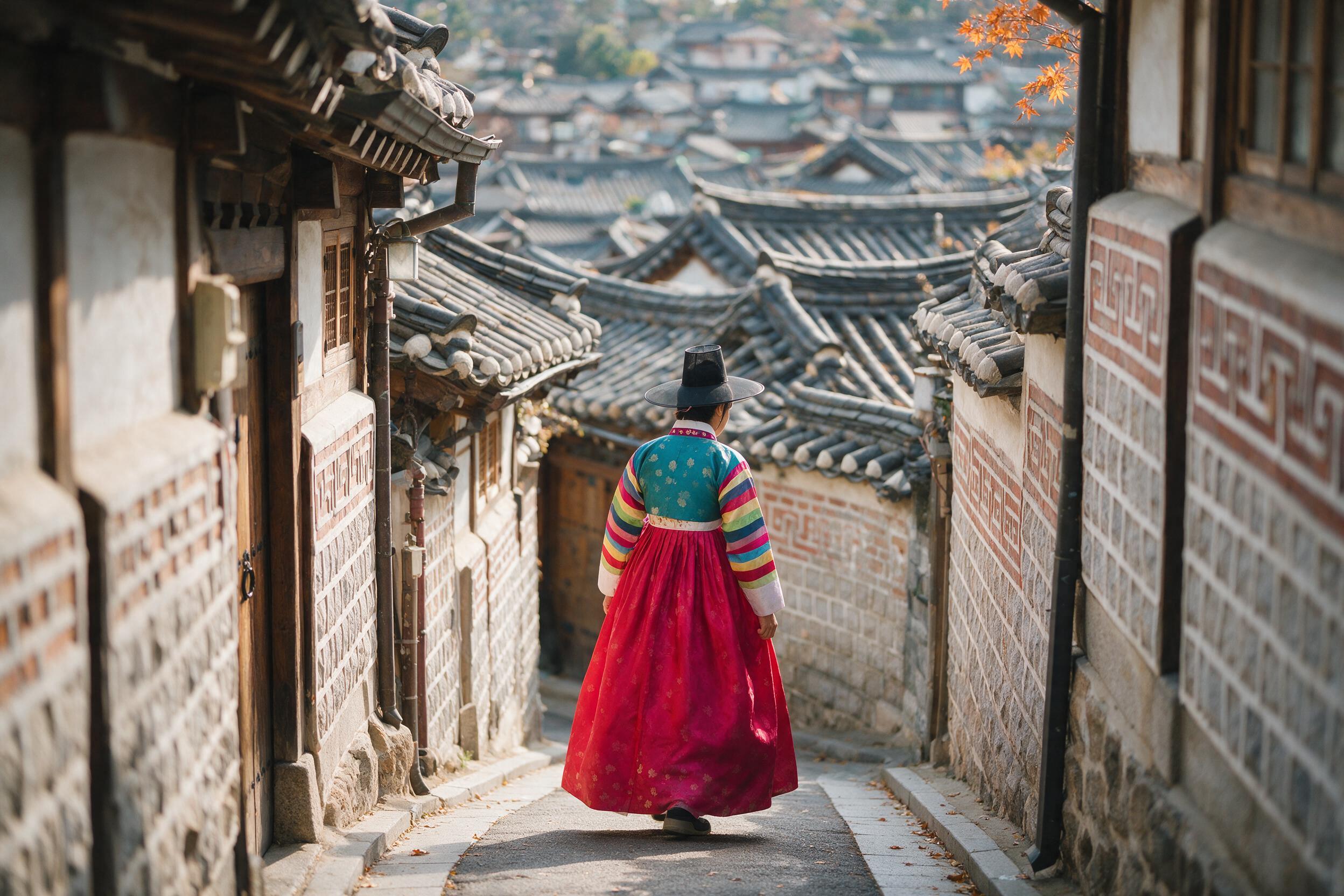
From Gwangjang Market, it’s a short subway hop (Jongno 5-ga to Anguk on Line 3) to Bukchon, Seoul’s best-preserved hanok (traditional house) neighbourhood, stacked up a hillside between Gyeongbokgung and Changdeokgung palaces. This is where you rent a hanbok — and you should, not for the photos alone but because it changes how the next two hours feel; walking these narrow lanes in modern activewear versus in a full hanbok is a genuinely different experience of the same street.
Rental shops cluster around Anguk station and along the edges of Bukchon itself — a well-reviewed option is 3355 Hanbok Rental, one of several shops within a few minutes’ walk of the palace gate. Book online in advance and a basic hanbok set runs under ₩15,000-20,000 (roughly ₹950-1,250) for a few hours; walk-in shops right at the palace entrance charge by the hour and tend to run noticeably higher, so a five-minute advance booking the night before saves real money. Hair accessories, a “premium” fabric tier, and couple-matching sets cost extra.
Once you’re dressed, walk Bukchon-ro slowly — the famous alley (Bukchon-ro 11-gil) with the tiled rooflines cascading down toward the city is the one every hanbok photo you’ve seen online was taken on, and it gets genuinely crowded between about 10:30am and 2pm with everyone else who had the same idea. What the photos don’t show you: people actually live in these houses, and several alleys have signs politely asking visitors to keep their voices down — Bukchon is a residential neighbourhood first, an attraction second, and locals have gotten understandably tired of tour groups treating their front doors as photo backdrops. Keep it to a quiet murmur, don’t peer into open gates, and you’ll notice how much better the neighbourhood receives you.
Couple note: matching hanbok sets are a whole genre here — most rental shops stock coordinated colour pairs specifically for couples, and this stretch of Bukchon is where you’ll see the most engagement-shoot-style photography happening organically, no professional photographer required.
12:00 PM — Gyeongbokgung Palace (Free If You’re Still in Hanbok)
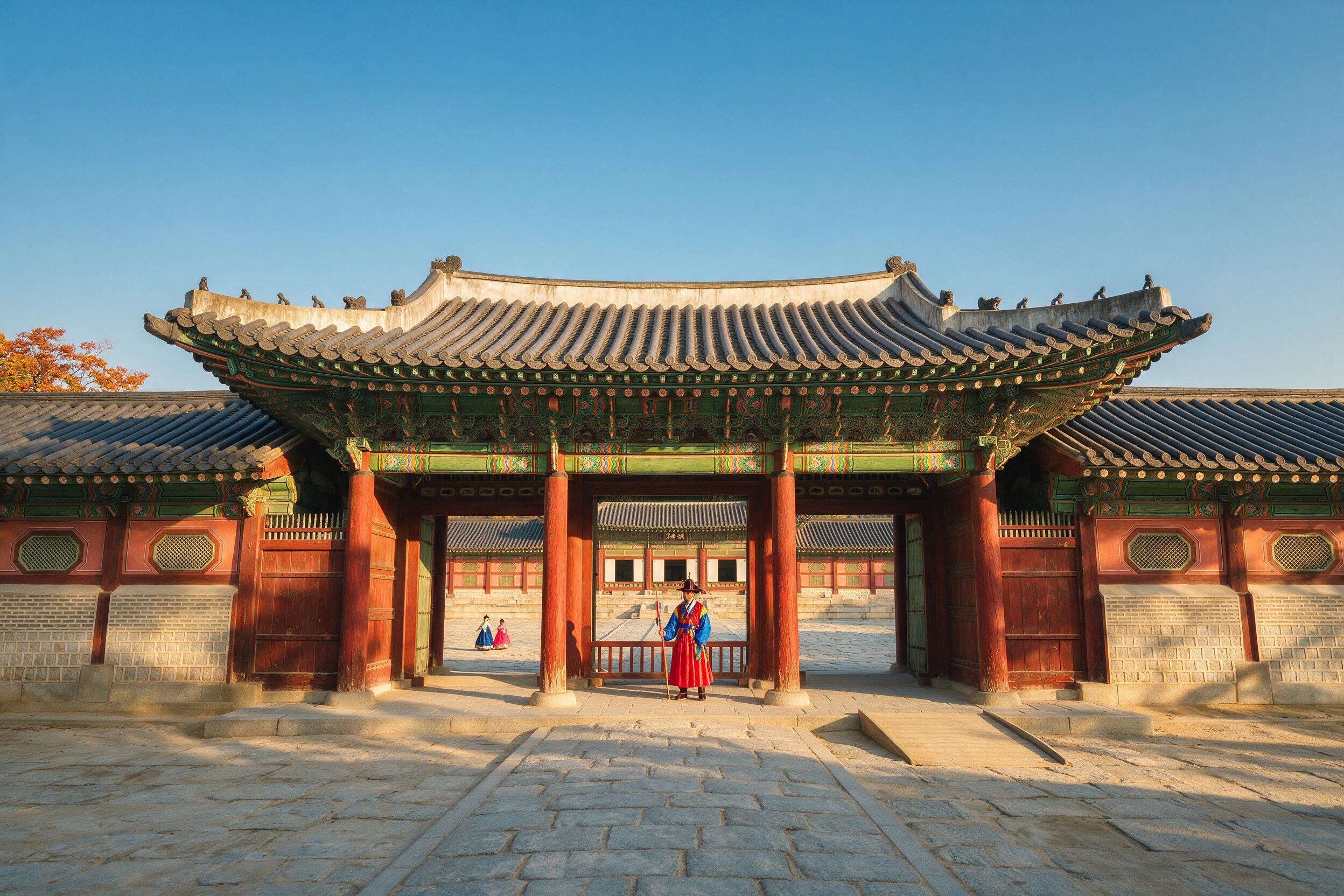
Keep the hanbok on and walk the last ten minutes down to Gyeongbokgung, because here’s the detail that makes the timing of this whole day work: entry is completely free if you’re wearing one. Everyone else pays ₩3,000 (about ₹185) for an adult ticket. The palace is open 9am–5pm in the winter months with shorter last-admission windows, extended later into the evening during spring and summer, and closed entirely on Tuesdays — check the current seasonal hours before you go, since they shift a few times a year.
Gyeongbokgung was first built in 1395 as the main royal palace of the Joseon dynasty, and the version standing today is a partial reconstruction — Japanese forces destroyed most of the complex during the 1592 invasion, and what was rebuilt in the 1860s was then deliberately dismantled down to a fraction of its original footprint during the Japanese colonial occupation in the early 1900s. Less than half of the palace’s original 500-plus buildings survive or have been rebuilt, and restoration work is still ongoing today — the fun fact worth knowing before you walk in is that you’re looking at an actively unfinished project, not a static museum piece.
Time your arrival, if you can, around the Changing of the Guard ceremony at Gwanghwamun, the main gate — it typically runs a couple of times through the late morning and early afternoon, with the exact schedule posted on a board at the gate since it shifts by season. It’s genuinely well done: full period costume, ceremonial drums, none of the shuffling-through-the-motions energy you sometimes get from these things elsewhere.
Honest caveat: the inner courtyards get hot and shadeless by early afternoon in warmer months, and hanbok fabric is not built for standing around in direct sun — if you’re visiting outside the October–April window, do the palace closer to opening and save the slower café wandering for later.
2:30 PM — Crossing the City to Seongsu-dong
Return the hanbok (most rental shops give you a same-day window, typically 4-6 hours from pickup, so plan the return before you head across the city), change back into your own clothes, and take the subway from Anguk to Seongsu — one change, roughly 30-35 minutes door to door, using the T-money card you should have bought at any subway station kiosk on arrival in Seoul (₩2,500-5,000 for the card itself, top-ups in cash or at convenience stores).
This is also a good moment to eat something more substantial than market snacks — grab a quick bowl of something near Anguk or wait until Seongsu, where the food options skew toward brunch-style cafés rather than Korean home cooking.
3:00 PM — Seoul Forest, Design Shops and the Café Trail
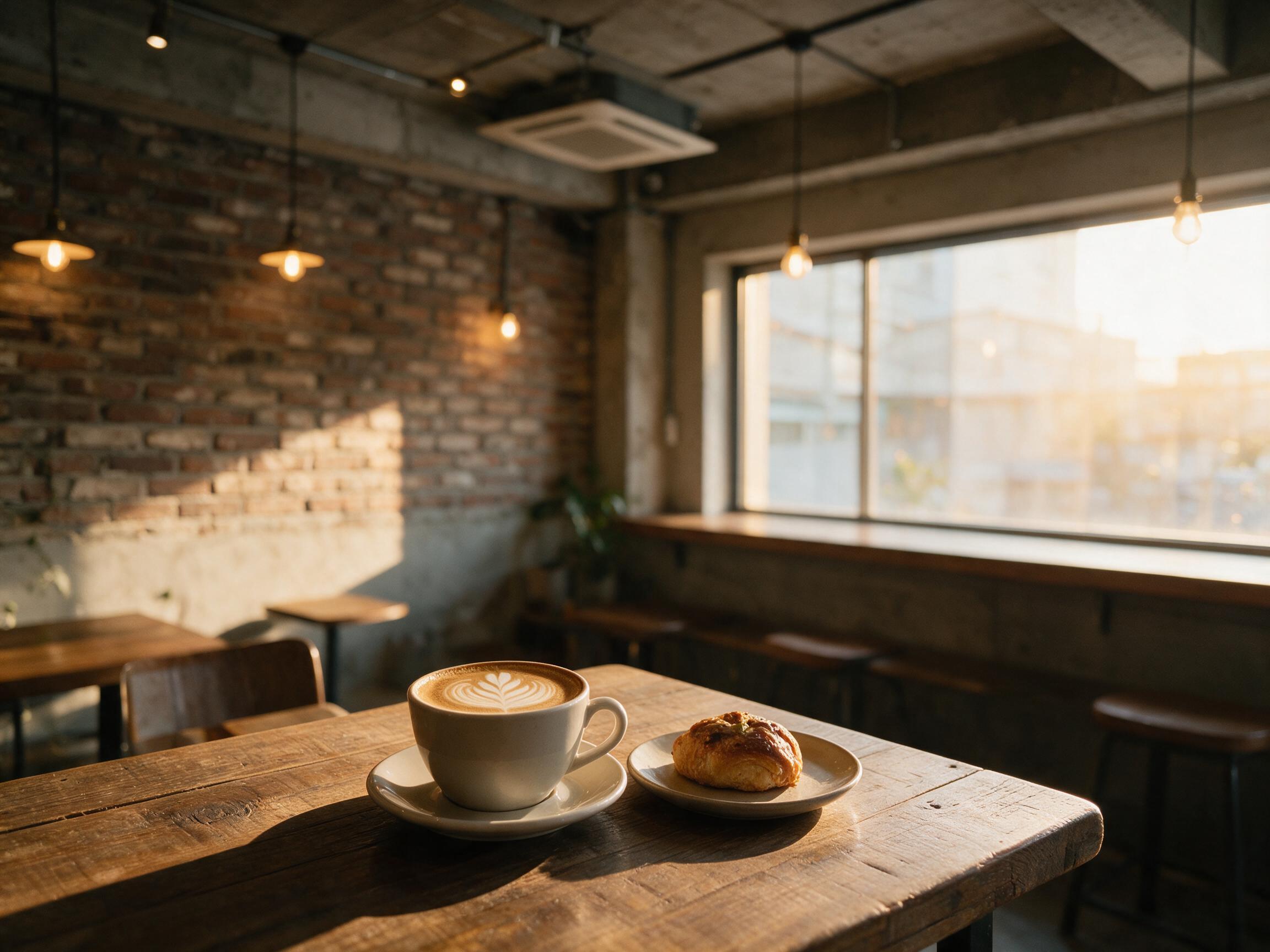
Seongsu-dong earned its “Brooklyn of Seoul” nickname the honest way: it was a working-class shoe and leather manufacturing district into the 2010s, full of small factories and warehouses, and instead of getting torn down for apartment towers, a wave of designers, roasters, and fashion brands moved into the old industrial shells and kept the bones intact. You can still spot the original factory signage on some buildings if you look up.
Start at Seoul Forest itself if you’ve timed this for autumn — a genuinely large park (about 35 hectares) with a deer enclosure, wetland trails, and maple groves that turn a proper orange-red by late October, worth the walk even if you’ve already had your fill of nature earlier in the trip. From there, the café trail radiates out in every direction:
- Mils, a bakery run by a chef who came out of a three-Michelin-star kitchen, known for sourdough and savoury rolls that sell out by mid-afternoon
- Charcoal Live Bakery, tucked down a side alley, for salt bread finished over actual charcoal for a smoky crust
- Blue Bottle Korea’s flagship — the brand’s first Korean location, with a large basement seating floor and a Korea-only menu item or two
- NUDAKE Teahouse, on the fifth floor of the HAUS Nowhere building, for plated desserts paired with specific tea blends — more art installation than café, and worth the trip up for that alone
- Vinyl Seongsu, where you pay a small entry fee and pick a record from the wall to have played while you sit
- Lowkey Coffee, for a perilla-seed rice latte that sounds strange and tastes better than it has any right to
For the version of Seongsu that hasn’t fully hit the algorithm yet, two names locals mention before the famous ones: Cheongsang Gaok, a rooftop café with a genuinely cozy, low-lit interior that’s especially good on a grey or rainy afternoon, and Perment Bake Shop, where a small queue forms before opening for pastries that sell out fast. Neither has the Instagram footprint of Blue Bottle or NUDAKE yet, which is exactly the appeal.
By early evening, several of these spaces do a genuine transformation — Foreplan, an architect-designed café built out of wood, glass, and exposed brick, shifts from filter coffee in the afternoon to a proper bar by night, which makes it a natural place to end the day with a drink instead of one more coffee.
Family note: Seoul Forest’s open lawns and the deer feeding area make this a good de-stress stop if kids have been dragged through a market and a palace already — it’s the one part of the day with actual running-around room. Luxury note: if you want to elevate the evening past café-hopping, several boutique hotels near Seongsu and the nearby Seongsu Restaurant Alley run private hanbok photography add-ons and reservation-only tasting menus that turn this into a proper date-night close rather than a casual one.
If It’s Raining: The Ikseon-dong Backup Plan
If the weather turns, swap the Seongsu leg for Ikseon-dong instead — a smaller, indoor-friendlier hanok-alley district near Jongno 3-ga station, about 15 minutes from Gyeongbokgung, packed with covered hanok cafés, small design boutiques, and a well-known salt bread bakery tucked into one of the alleys. It’s a tighter, cosier version of the same idea — old architecture repurposed for a new generation of small businesses — and it holds up much better under an umbrella than an open park.
The Practical Toolkit: Money, SIM, Safety
Currency and payments. South Korea runs on the Korean won and is heavily card-driven — cards work almost everywhere except traditional markets. Gwangjang’s vendors operate almost entirely on cash, so pull out roughly ₩30,000-40,000 before you start the morning. A WOWPASS kiosk (Incheon Airport and around the city) exchanges currency onto a card that doubles as T-money for transit and works at most merchants — one card instead of juggling cash and a separate transit pass. There’s no tipping culture in Korea; the receipt price is the price.
Connectivity. Grab a Korea-specific eSIM (KT or SK Telecom, via Airalo or Klook) before you land, or rent a pocket WiFi “egg” at Incheon Airport if you’re travelling as a family sharing one connection.
The one navigation quirk to know before you land: Google Maps’ walking and transit directions don’t work properly inside South Korea, thanks to a long-standing data-export restriction tied to national security law. Download Naver Map or KakaoMap before you arrive — both have English modes and are what this entire day’s directions actually depend on.
Safety. Seoul consistently ranks among Asia’s safer cities for visitors, including solo women — well-lit streets, low violent crime, and public transport that runs late without incident. The realistic risks are mundane: sidewalk scooters you won’t see coming, and taxi drivers who may not speak English, one more reason to keep a Korean-script address ready on Naver Map.
One Mistake Worth Avoiding
Don’t try to do this route on a weekend expecting to actually enjoy the photo alleys in Bukchon. By 11am on a Saturday, that famous rooftop-view lane is a queue of a hundred people in rented hanboks waiting for the same three-second gap in the crowd to get the same doorway shot everyone else is getting. Do this walk midweek. You’ll get the market at a human pace, an actual quiet minute in Bukchon’s back lanes, and a palace courtyard that doesn’t feel like a photoshoot set.
Who This Day Suits
Solo travellers will find this one of the easier solo days in Seoul — eating alone at a market counter is completely normal here, and the subway makes the route simple to manage independently with just a T-money card and a mapping app. Couples get a romantic arc built in without trying — matching hanbok in Bukchon, a palace backdrop, a bar-by-night café to close the evening. Families should lean on Seoul Forest as the pressure valve mid-afternoon, and consider starting the market earlier than 8:30am for younger kids on an unpredictable breakfast schedule. Luxury travellers can layer a private guide and photographer onto the hanbok segment and close with a reservation at one of Seongsu’s tasting-menu restaurants instead of café-hopping straight through.
FAQs
Do Indian citizens need a visa to visit South Korea in 2026? Yes. India is not on South Korea’s K-ETA exemption list, so Indian passport holders need a standard C-3-9 tourist visa, applied for in advance through a Korean Visa Application Centre in India. Budget 2-3 weeks for processing and documentation.
Is one day really enough for Gwangjang Market, Bukchon, and Gyeongbokgung, plus Seongsu-dong? It’s a full, fast-moving day, not a leisurely one — expect to be walking or on the subway from roughly 8:30am to early evening. If you’d rather slow it down, split it across two days: market-Bukchon-palace on day one, Seongsu on day two.
How much does hanbok rental cost near Gyeongbokgung Palace? Basic sets booked online in advance run under ₩15,000-20,000 for a few hours; walk-in shops right at the palace gate charge by the hour and cost noticeably more. Premium fabrics, hair accessories, and couple sets add to the base price.
Is Gwangjang Market open every day? The day market runs roughly 8:30am to 6pm, but some individual stalls close on Mondays to recover from the weekend rush. It’s open daily overall — just confirm your favourite stall isn’t one of the ones taking the day off.
What’s the best season to do this specific walk? Late October to mid-November for maple colour in Seoul Forest and Bukchon at comfortable 12-18°C temperatures, or early April for cherry blossoms at similar temperatures. Avoid peak monsoon-humidity August if you can help it, especially for the hanbok segment.
Can I use my Indian credit or debit card everywhere in Seoul? Cards work at most cafés, restaurants, and convenience stores, but Gwangjang Market’s stalls are cash-only. Carry ₩30,000-40,000 in cash for the market morning, and consider a WOWPASS card for a combined currency-exchange-and-transit solution.
Is Seoul safe for solo travellers, including women? Yes — Seoul is consistently rated among the safer major Asian cities for visitors, with low violent crime and well-lit streets even late at night. The more realistic hazards are practical (sidewalk scooters, language gaps with taxi drivers) rather than safety-related.
Which subway line connects Gyeongbokgung/Bukchon to Seongsu-dong? From Anguk Station (near Bukchon and Gyeongbokgung) on Line 3, transfer once to reach Seongsu Station on Line 2 — roughly 30-35 minutes door to door with a T-money card.
Final Word
Most people leave Seoul having seen the palace and eaten at the market as two disconnected checkboxes on two different days, and they miss the thing that actually makes this city interesting — how naturally the five-century-old and the five-year-old sit next to each other, sometimes on the same block. Walk this route in order, on a weekday, and you get that contrast in one continuous, well-fed day instead of a scattered list.
If you’re building a full Korea itinerary around this one day — Busan, the DMZ, a temple stay, or a longer Seoul stretch — Get Tripped’s travel designers put together fully customised, comfort-forward South Korea itineraries for Indian travellers, visa paperwork included. Get in touch and we’ll build the rest of your trip around this day, not the other way around.