The first thing that hits you at Longshan Temple isn’t the gold roofline or the carved stone dragons wrapped around the pillars — it’s the smell. Sandalwood smoke curling up from a hundred bundles of incense, thick enough that it settles in your jacket, mixed with the steam coming off a soy milk cart parked just outside the gate. It’s not even 7:30am and the temple courtyard is already full: grandmothers in cardigans bowing with incense sticks between their palms, office workers stopping for thirty seconds of prayer before their commute, one teenager filming a slow-motion video of the smoke for reasons only he understands. Nobody looks at the handful of tourists standing off to one side. This is just Tuesday morning in Wanhua.
That’s the Taipei most itineraries skip — the one that isn’t a checklist of Instagram landmarks but a city going about its actual day, and inviting you to walk alongside it for a while. This is what one full day here looks like, built the way a local friend would plan it: temple lanes and dried-goods markets in the morning, a gondola ride up into tea-farming hills in the afternoon, and dinner sprawled across a night market that doesn’t wind down until close to midnight. Along the way — everything an Indian traveler actually needs to know about getting here, what it costs, and where to sleep at the end of it.
Table of Contents
- Before You Go: Visa, Flights and the Basics
- Morning: Temple Smoke and Soy Milk in Wanhua
- Midday: Dihua Street’s Dried Goods and a Matchmaker God
- Lunch: Xiaolongbao at the Original Din Tai Fung
- Afternoon: Up the Mountain for Tea at Maokong
- Evening: Dinner at Raohe Street Night Market
- Where to Stay in Taipei
- How Many Days You Actually Need
- FAQs
- Conclusion
Before You Go: Visa, Flights and the Basics
Taiwan has been quietly courting Indian travelers for close to a decade, and the entry process reflects that — but it isn’t the blanket “visa-free” deal that sometimes gets claimed online, so it’s worth getting exactly right before you book anything.
Visa: the free online pass most Indians qualify for
Most Indian passport holders don’t need to visit an embassy at all. Taiwan’s National Immigration Agency runs a free online Travel Authorization Certificate (TAC) that’s typically approved within minutes at niaspeedy.immigration.gov.tw. It covers multiple entries over 90 days, with each individual stay capped at 14 days — plenty for this itinerary and then some.
The catch, and it’s the one people get tripped up on: to qualify for the TAC, you need to hold a valid visa or residence permit from the US, UK, Canada, Australia, Japan, South Korea, New Zealand, or a Schengen country — and it’s fine if that document expired, as long as it was within the last 10 years. If you don’t hold one of those, you’ll need a standard visitor visa applied for in person through the Taipei Economic and Cultural Center (TECC) in Delhi, Mumbai, or Chennai, which runs roughly ₹4,200–12,600 depending on processing speed and takes 2–5 working days. Tour groups of five or more can also apply for a 30-day group eVisa through a registered travel agent.
Mistake to avoid: don’t assume you’re covered because a friend mentioned “Taiwan went visa-free for Indians” — that headline usually refers to the TAC scheme, and it only works if you already hold one of those qualifying visas. Check your own passport before you commit to non-refundable flights, not after.
Getting there: there’s no direct flight, and that’s fine
As of now, there’s no nonstop flight between India and Taipei. You’ll connect through Bangkok, Hong Kong, Singapore, or Kuala Lumpur — Thai Airways, Cathay Pacific, Singapore Airlines, EVA Air, and China Airlines all run workable connections from Delhi, Mumbai, and Bengaluru, with total journey time (layover included) typically landing between 8 and 11 hours. Round-trip economy fares generally sit in the ₹28,000–45,000 range in regular season, occasionally dropping below ₹25,000 on sale fares out of Delhi or Mumbai — worth setting a fare alert a few months out rather than booking the first price you see.
Best time to land this particular day
October, November, March, and April are the sweet spot — mild temperatures, lower rain, and the typhoon risk mostly out of the picture. July through September brings Taiwan’s typhoon season, heaviest in August and September, and a market day like this one genuinely doesn’t work in a downpour. Winter (December–February) is cool and damp rather than cold, and honestly still very walkable if you pack a light jacket — just expect grey skies more often than blue ones.
Money, cards, and the EasyCard you actually need
Cash still rules at night market stalls and small vendors, but Taipei is far more card-friendly than most of Southeast Asia for hotels, malls, and sit-down restaurants. The one thing worth buying on arrival is an EasyCard — a rechargeable contactless card that costs about USD 3 (non-refundable) with no value loaded, sold at every MRT station and convenience store. Top it up with roughly USD 15–20 to start; it covers MRT, buses, the Maokong Gondola, and works as tap-to-pay at 7-Eleven and FamilyMart too, at a small discount over cash fares. Refunds on unused balance are available at MRT counters before you fly home, minus a small processing fee.
SIM, eSIM, and staying connected
Pick up a tourist eSIM before you land — most major providers sell 5–10 day Taiwan plans that activate the moment you touch down, so you’re not fumbling with a physical SIM swap at the airport. Physical SIMs are also sold at counters in Taoyuan Airport arrivals if you’d rather have a backup. Either way, Taipei’s public WiFi coverage is genuinely good, but a working SIM makes navigating the MRT and ordering at markets that don’t have English menus far less stressful.
A quick note on safety
Taipei consistently ranks among the safer major cities in Asia for solo and family travel — low violent crime, well-lit streets even late at night, and a night market culture where lone women eating dinner alone draws zero attention. The honest caveat: pickpocketing does happen in the densest night market crowds, particularly around cash-only stalls where people are digging for small notes. Keep your bag zipped and in front of you, same as you would anywhere crowded.
Morning: Temple Smoke and Soy Milk in Wanhua
Start at Longshan Temple (Longshan Temple MRT, Exit 1) by 7:30am, before the tour groups arrive. The temple dates to 1738, built by early Fujianese settlers and dedicated primarily to Guanyin, the goddess of mercy — though walk the courtyard and you’ll find dozens of other deities tucked into side halls, because Taiwanese folk religion doesn’t do exclusivity. American bombing in 1945 destroyed most of the main hall; the story locals still tell is that the Guanyin statue came through completely undamaged, which is part of why the temple is treated with such reverence today. If you want to try it yourself, there’s a whole ritual for asking Yue Lao — the temple’s matchmaker deity — for luck in love, involving a red thread and a specific way of holding your joss sticks. A staff member near the entrance will usually walk a curious tourist through the steps if you ask politely.
Step back outside and breakfast is everywhere within a two-minute walk — this is Taiwanese breakfast-cart territory, not sit-down cafés. Look for a stall doing dan bing (a thin egg crepe wrapped around scallion pancake, often with cheese or ham) and a cup of hot or cold soy milk (dou jiang), sweet or salty depending on your mood. It costs less than a coffee back home and it’s the kind of breakfast every local you’ll pass on the street is also eating.
From there, walk ten minutes to Bopiliao Historic Block, a stretch of restored Qing-dynasty and Japanese-era shophouses that somehow survived Taipei’s rebuilding boom — brick arcades, old apothecary signage, the odd art installation tucked into a courtyard. It’s quiet, mostly ignored by the average visitor, and a good place to slow down before the day gets busier.
Solo tip: this entire stretch — temple, breakfast, Bopiliao — is comfortably walkable alone and genuinely peaceful before 9am; it’s one of the few times in the day the crowds haven’t caught up yet.
Midday: Dihua Street’s Dried Goods and a Matchmaker God
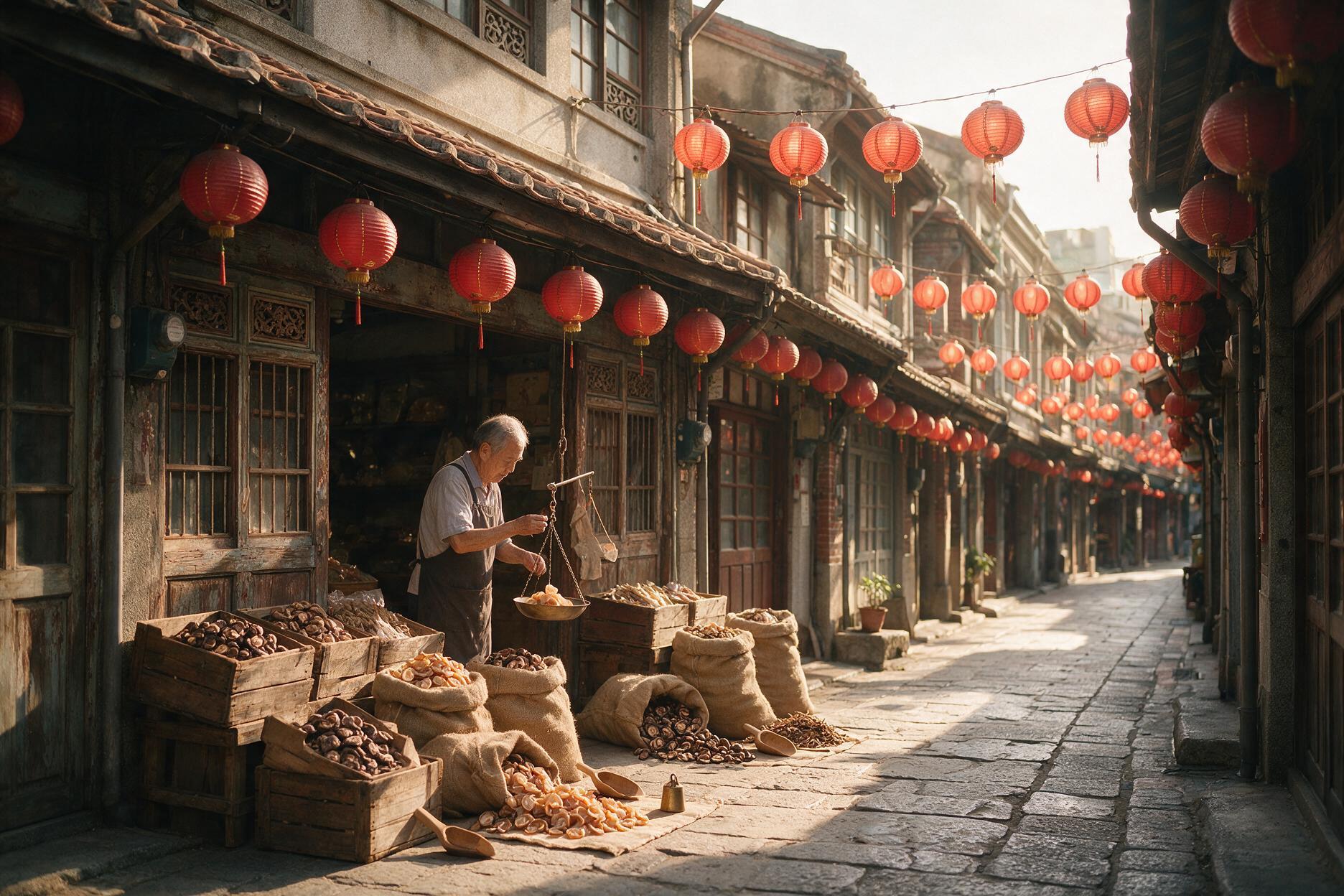
Take the MRT (or a 20-minute walk) north to Dihua Street in the Dadaocheng district — Taipei’s oldest commercial street, and still the city’s centre for dried goods, herbal medicine, and traditional textiles. The street is anchored by the old Yongle Market building, where fabric merchants have operated for generations, and lined with shopfronts selling everything from dried scallops and shiitake to Chinese New Year sweets sold loose by weight, scooped into paper bags the way it’s been done for decades.
Halfway down the street sits the Xiahai City God Temple, a small, almost easy-to-miss shrine that punches well above its size — it’s the most famous matchmaking temple in Taiwan, dedicated to Yue Lao, and locals genuinely credit it with an outsized number of marriages every year (it’s been written up by international outlets for exactly that reason). Even if you’re not there to pray for a partner, it’s one of the more atmospheric small temples in the city, thick with incense and usually busy with single visitors going through the ritual with real sincerity, not for show.
Hidden gem: skip the obvious souvenir shops and duck into one of the smaller tea merchants a block off the main strip — the kind with unmarked tins and an owner who’ll brew you a sample without being asked. Dadaocheng has been a tea-trading district since the 1860s, long before Maokong existed as a tourist draw, and the good stuff is still sold here rather than in the shops with English signage out front.
Lunch: Xiaolongbao at the Original Din Tai Fung
Ride the MRT down to Xinyi and have lunch at the original Din Tai Fung on Xinyi Road, Section 2 — the branch that started this whole global phenomenon. It began, oddly, as a cooking-oil retail shop in 1958; when canned oil started undercutting the business in the early 1970s, the owners pivoted to selling steamed xiaolongbao instead, and the rest is a Michelin-starred, multi-country empire. This original branch still does table-side folding you can watch through a glass kitchen wall, and the soup dumplings — famously a precise 18 folds each — are noticeably better here than the food-court outposts you’ll find elsewhere in the city.
Honest caveat: expect a wait, even on a weekday. It moves fast once you’re seated, but budget 20–40 minutes standing outside, especially around 1pm. Go slightly earlier or later than peak lunch hour if you can.
Afternoon: Up the Mountain for Tea at Maokong
From Taipei Zoo MRT station, board the Maokong Gondola — a cable car strung over forested hillside that climbs to Maokong, a former Fujianese tea-farming village that’s now Taipei’s most relaxed afternoon out. The name reportedly comes from potholes in the exposed bedrock that early settlers thought looked like a cat’s paw prints — “cat hole,” roughly. The ride itself takes about 25–30 minutes and the views back over the Taipei basin are worth the trip on their own, especially with a glass-bottomed gondola car if you can time one.
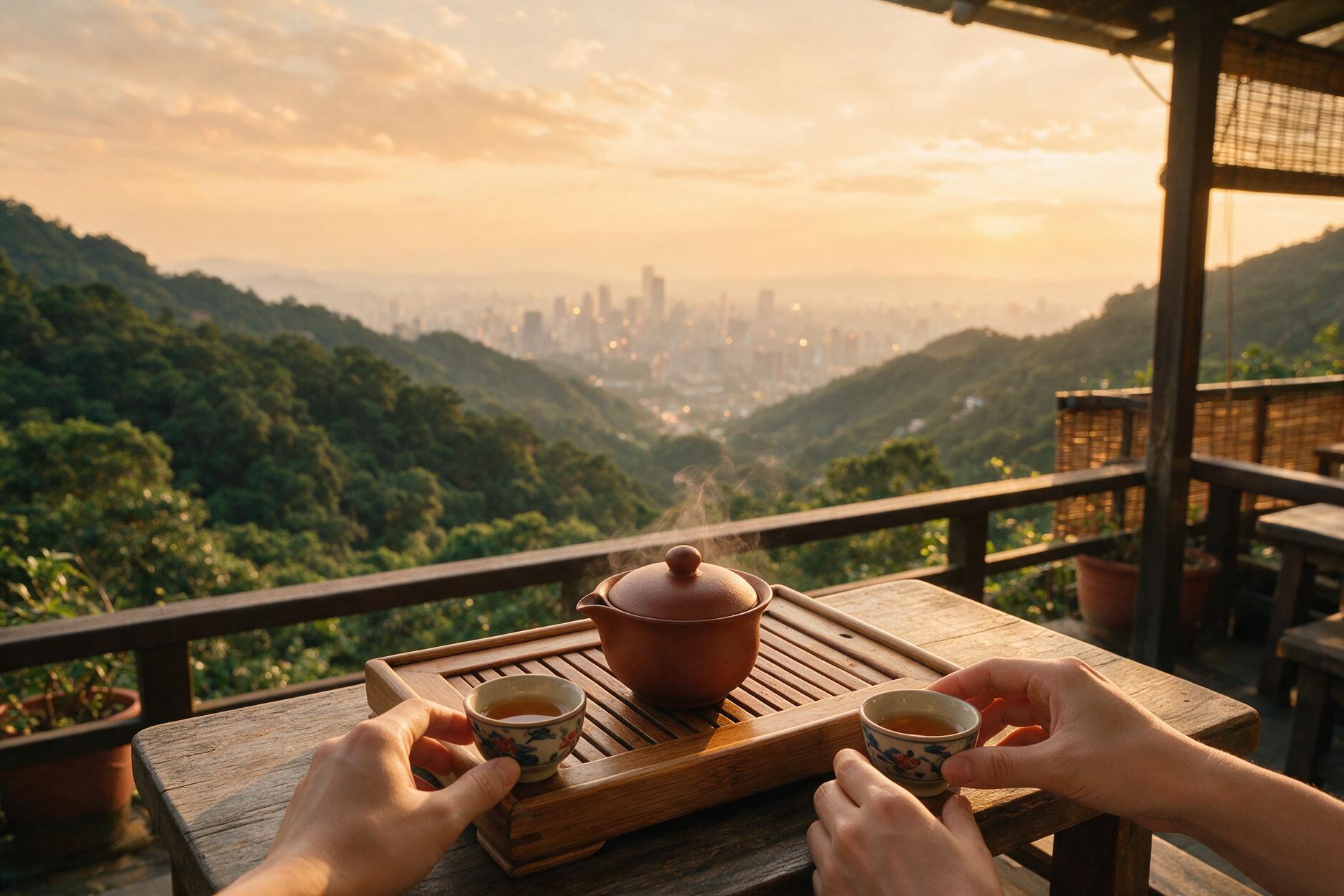
At the top, pick one of the hillside tea houses and settle in for a proper gongfu tea session — a small clay or porcelain gaiwan, several short infusions rather than one long steep, usually of the local Tie Guan Yin oolong grown right on these slopes. Nobody rushes you. Order a plate of tea-infused snacks alongside it and let an hour disappear watching the light change over the city below.
Couple tip: ask for outdoor terrace seating when you book — several of the tea houses have platforms angled specifically toward the sunset view over the valley, and it’s one of the quieter romantic moments you’ll get in an otherwise fast-paced day.
Evening: Dinner at Raohe Street Night Market
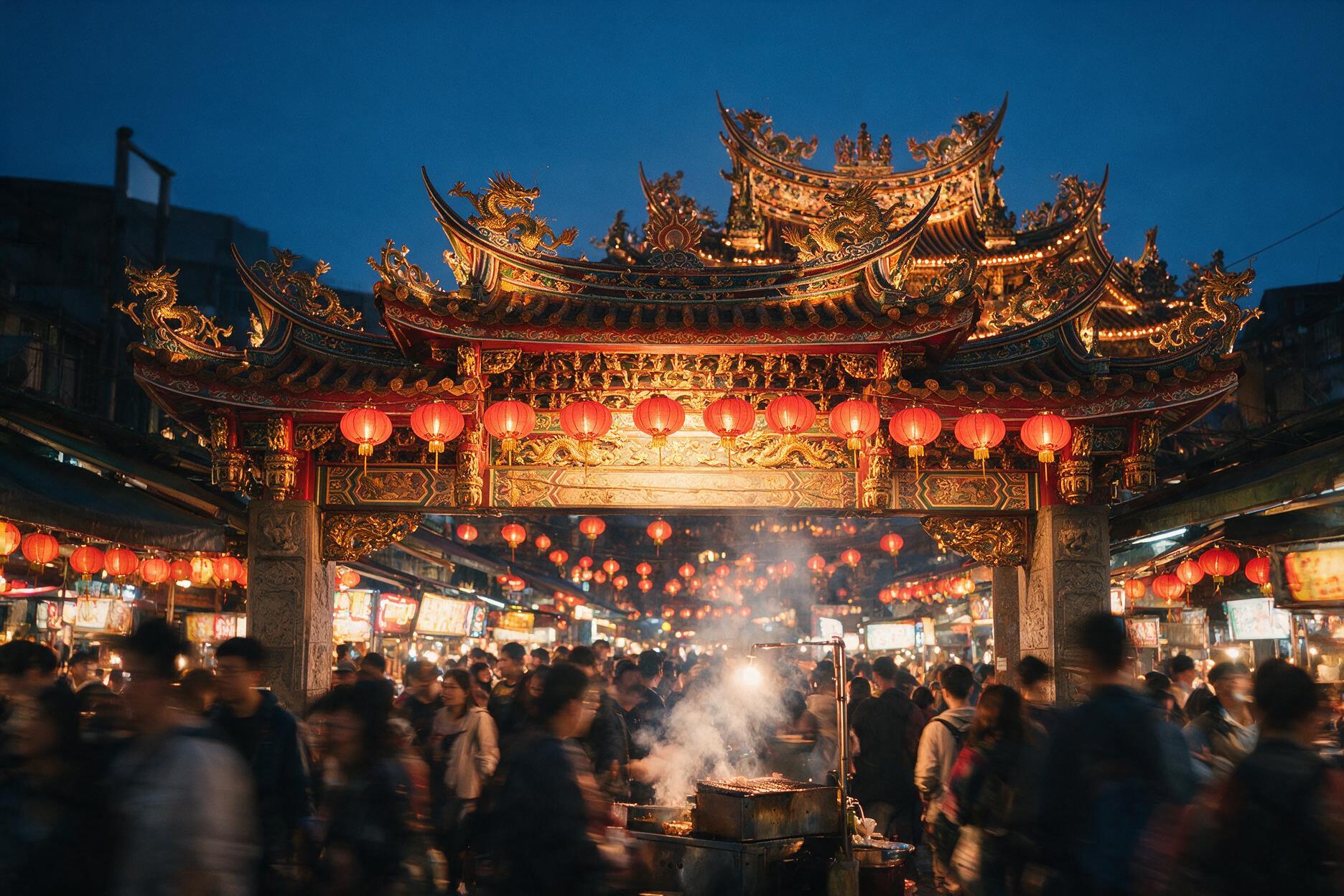
Head back down and across the river to Raohe Street Night Market, entered through the ornate gate beside Ciyou Temple near Songshan MRT — one of Taipei’s oldest night markets and, unlike the sprawl of Shilin, compact enough to walk end to end in under twenty minutes if you weren’t stopping every fifty metres to eat, which you will be.
Get in line early for the market’s most famous stall: the Fuzhou-style black pepper bun (hu jiao bing), a fist-sized bun stuffed with marinated pork and scallion, slapped onto the inside wall of a clay tandoor-style oven and baked until the outside blisters and the inside stays juicy. The queue is part of the ritual — locals wait fifteen to twenty minutes for these without complaint. From there, work your way down the strip: a bowl of oyster vermicelli (a-zong mian xian), thick and glossy with a peppery kick; grilled squid on a stick brushed with a sweet-spicy glaze; and if you’ve got room, a cup of douhua (silky tofu pudding served warm with peanuts and syrup) to close things out. Raohe Street’s namesake gate, its Ciyou Temple backdrop lit up at night, and the sheer density of century-old family-run stalls make it feel less like a tourist stop and more like a neighbourhood that happens to feed thousands of people a night.
Family tip: go earlier in the evening — by 5:30–6pm the market is open and lively but not yet at its 8–9pm peak crowd density, which makes it far easier to manage with kids in tow.
Fun fact worth knowing before you order: that iconic “stinky tofu” smell drifting through every Taipei night market comes from tofu fermented in a brine of vegetables and sometimes shrimp for weeks — Taiwanese people are fairly evenly split on whether it’s delicious or dreadful, so it’s a genuinely fair test to try it yourself rather than trust either camp.
Where to Stay in Taipei
- Xinyi District — Taipei’s glossy, modern face: Taipei 101, upscale malls, and the city’s luxury hotel cluster (think Mandarin Oriental and Grand Hyatt tier). Best base if you want polish and easy MRT access to everything in this itinerary.
- Da’an District — a quieter, leafier mid-range option popular with returning visitors, close to Da’an Park and well connected by MRT, with a strong café and boutique-hotel scene.
- Zhongshan District — good mid-range value, walkable to Dihua Street and Ximending, with a growing crop of design-forward boutique hotels in converted old buildings.
- Ximending — Taipei’s youth-culture, pedestrian shopping district; livelier and more budget-conscious in feel, useful if you want nightlife within walking distance, though it’s the noisiest of these options after dark.
Luxury tip: several higher-end Taipei hotels can arrange a private tea ceremony or a car-and-driver day exactly like this one on request — worth asking your concierge if you’d rather skip the MRT altogether for this particular day.
How Many Days You Actually Need
This one day covers Taipei’s core food-and-culture arc, but it’s genuinely worth building a longer trip around it — 4 to 5 days lets you add a day trip to Jiufen’s hillside teahouses or the Northeast Coast, a proper half-day at the National Palace Museum, and a slower second night market crawl (Shilin, for the sheer scale, or Ningxia, if you want something smaller and almost entirely local). Rough daily budgets: figure ₹8,000–12,000 per day mid-range (hotel, meals, local transport) and upward of ₹20,000+ per day if you’re staying in Xinyi’s luxury tier and adding private guides or tea experiences.
FAQs
Do Indian passport holders need a visa for Taiwan?
Most do not need to apply for a traditional visa. If you hold a valid (or recently expired, within 10 years) visa or residence permit from the US, UK, Canada, Australia, Japan, South Korea, New Zealand, or a Schengen country, you can apply for a free online Travel Authorization Certificate, usually approved within minutes. Without one of those, you’ll need a standard visitor visa through the TECC office in India.
Is there a direct flight from India to Taipei?
Not currently. All routings connect through a hub city — Bangkok, Hong Kong, Singapore, or Kuala Lumpur are the most common — adding roughly 3–5 hours to total journey time depending on the layover.
Is Taipei safe for solo travelers, including women?
Yes, consistently ranked among the safer major Asian cities for solo travel, with low violent crime and well-lit streets even late at night. Standard pickpocket caution in dense night market crowds is the main precaution worth taking.
Is English widely spoken at the markets and temples?
Signage in central Taipei is generally bilingual, and younger vendors often speak workable English, but older stallholders at places like Dihua Street or Raohe may not. Pointing at what you want, or using a translation app, works fine — nobody expects fluent Mandarin from a visitor.
Do I need cash for the night markets, or does card work?
Cash is still king at individual food stalls — bring small notes and coins. Your EasyCard covers MRT, buses, and convenience stores, and larger sit-down restaurants take cards, but budget cash specifically for the night market portion of the day.
What’s the best time of year to do this exact itinerary?
October–November and March–April, for mild weather and low typhoon risk. Avoid July–September if you can, when typhoon season is at its most active and can genuinely wash out an outdoor market day.
Do I need to book the Din Tai Fung or tea house in advance?
Din Tai Fung doesn’t take reservations at the original Xinyi branch — it’s first-come, walk-in queue. Some Maokong tea houses do accept advance bookings for terrace seating, which is worth doing if you’re visiting on a weekend.
How much should I budget per day in Taipei?
Roughly ₹8,000–12,000 per day for a comfortable mid-range trip covering hotel, meals, and local transport, and upward of ₹20,000+ per day if you’re staying in Xinyi’s luxury hotels or adding private experiences like a guided tea ceremony.
Conclusion
Taipei doesn’t announce itself the way some cities do — there’s no single iconic view that sums up the whole trip in one photo. What it has instead is texture: incense smoke at 7am, a matchmaker god tucked into a side street, tea grown on a hillside you rode a cable car to reach, and a night market that’s been feeding the same neighbourhood for generations before you ever showed up. Follow this day loosely rather than by the clock, and it’ll feel less like sightseeing and more like the city let you in for an afternoon.
If a day like this sounds like the kind of trip you want built around your dates, your pace, and your budget — mid-range or fully luxury — Get Tripped’s outbound travel team can put together a complete Taiwan itinerary, visa guidance included, so all you have to do is show up hungry.