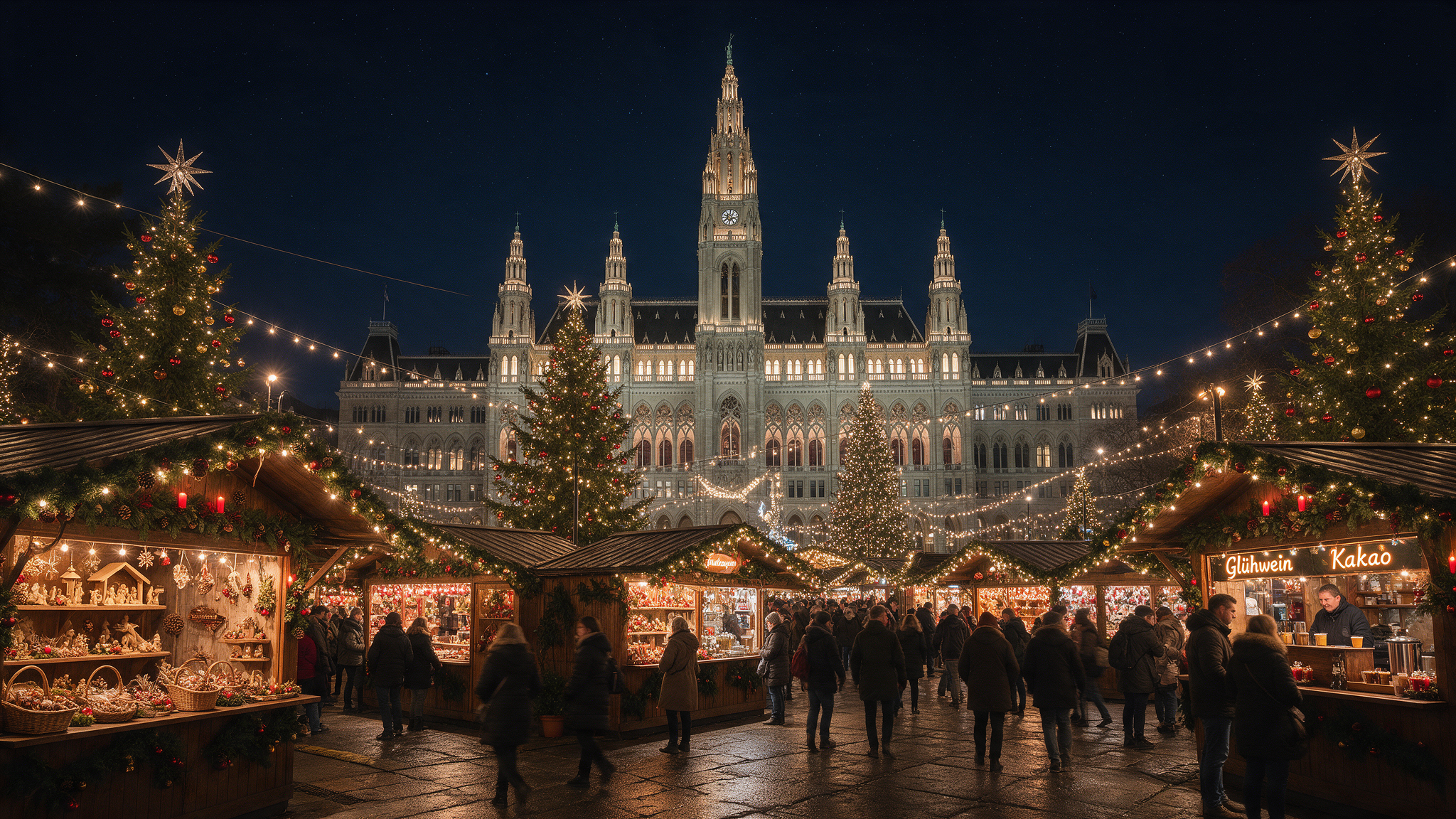
Rathausplatz in front of Vienna’s City Hall is, without question, the market you’ve seen in every photo of Viennese Christmas — the gothic facade lit gold, a towering tree, and a genuinely huge spread of stalls. It’s also the one most Viennese locals visit once, take their photos, and then quietly avoid for the rest of December. A market that draws that many visitors a night stops being a place you linger, and starts being a place you pass through. Vienna actually runs thirteen separate Christmas markets across the city each winter, and knowing which ones locals return to on a random Tuesday evening — versus which one they take out-of-town guests to for the photo — changes the whole trip.
This isn’t a guide telling you to skip Rathausplatz. Go once, see the spectacle, take the photo. But if you’re spending more than a couple of evenings in Vienna over the Christmas season, here’s how to actually spend them the way people who live there do, plus the practical details — dates, what to actually order, and how the markets fit into a wider Austria winter trip.
What’s in this guide
- Rathausplatz, once, and how to do it right
- Spittelberg — where locals actually go
- Karlsplatz Art Advent — for buying something real
- The quieter markets worth a detour
- How to actually order Punsch like you’ve done this before
- 2026 dates and locations at a glance
- Costs, timing and getting to Vienna in winter
- Mistakes to avoid
- FAQs
Rathausplatz, once, and how to do it right
Vienna’s flagship Christkindlmarkt runs from mid-November through December 26th in front of the City Hall, and it earns its reputation for scale and spectacle — the illuminated trees lining the approach, an ice rink, and a genuinely huge tree lit up each evening. The honest local critique is that it’s become “overly commercialised,” and that’s fair: this is the market built for volume, and it feels like it, especially on weekend evenings when it’s shoulder to shoulder.
Do it on a weeknight, ideally right after it opens for the evening around 4 or 5pm, before the after-work and weekend crowds pile in. Get your photo of the illuminated facade, have one cup of Punsch, and then move on to somewhere quieter for the rest of your evening — treating Rathausplatz as the opening act rather than the whole show is the actual local approach to it.
Spittelberg — where locals actually go
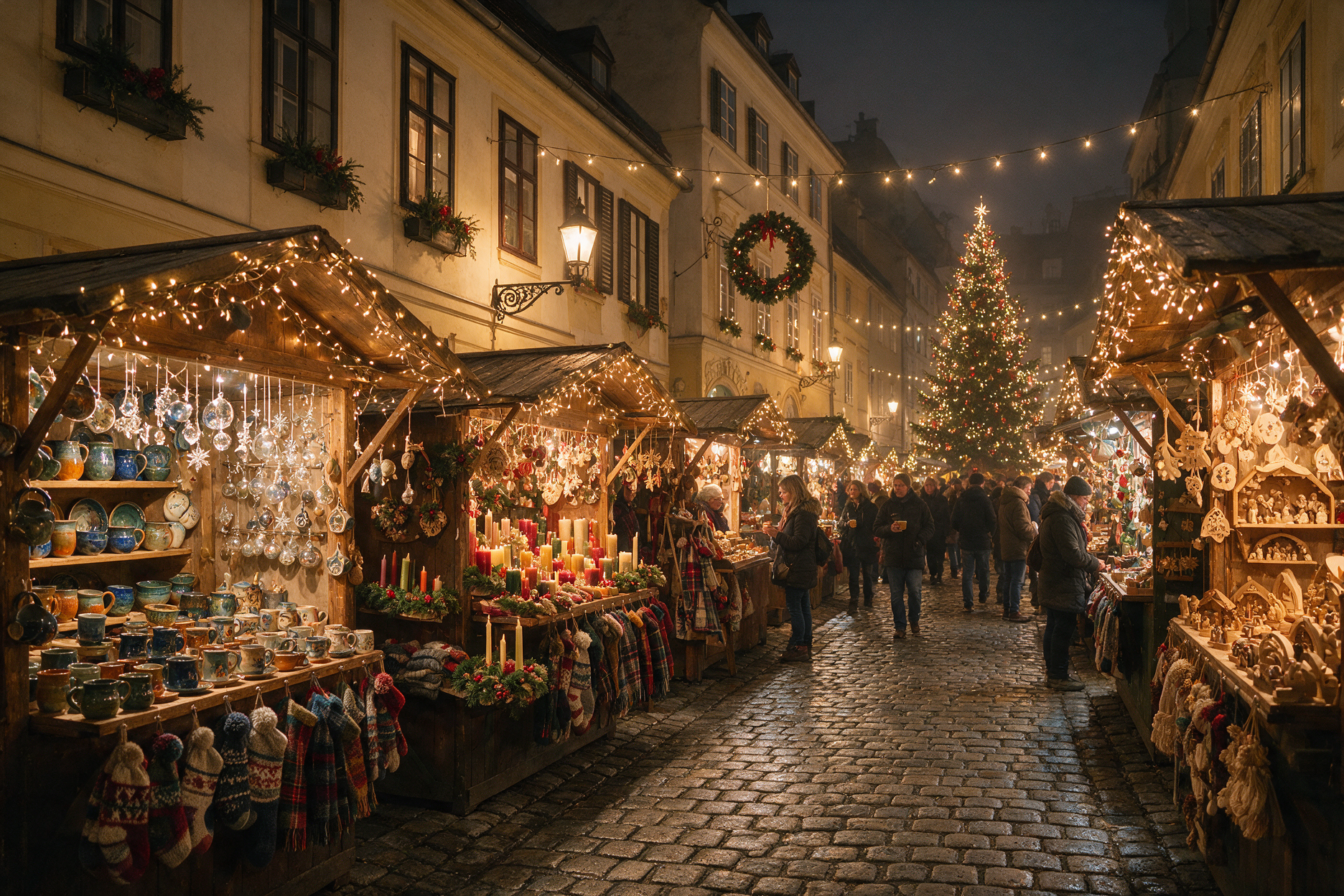
Spittelberg’s Adventmarkt has won Vienna’s own reader poll for its atmosphere for six years running, and it’s not hard to see why once you’re standing in it. It runs through a genuinely pretty cluster of cobblestone lanes lined with Biedermeier-era houses in the 7th district, and the scale is deliberately smaller — handmade crafts, local artisans, and a noticeably calmer pace than Rathausplatz even on a Saturday night. This is the market Viennese friends actually suggest to each other, and it’s the one I’d point you toward if you only have time for two markets on a trip.
Go slowly here. Spittelberg rewards wandering rather than a checklist approach — duck into the smaller side lanes off the main strip, where the stalls thin out and the crowd does too, and you’ll find the quieter, more genuinely local version of the market experience that Rathausplatz, at its size, just can’t offer anymore.
Karlsplatz Art Advent — for buying something real
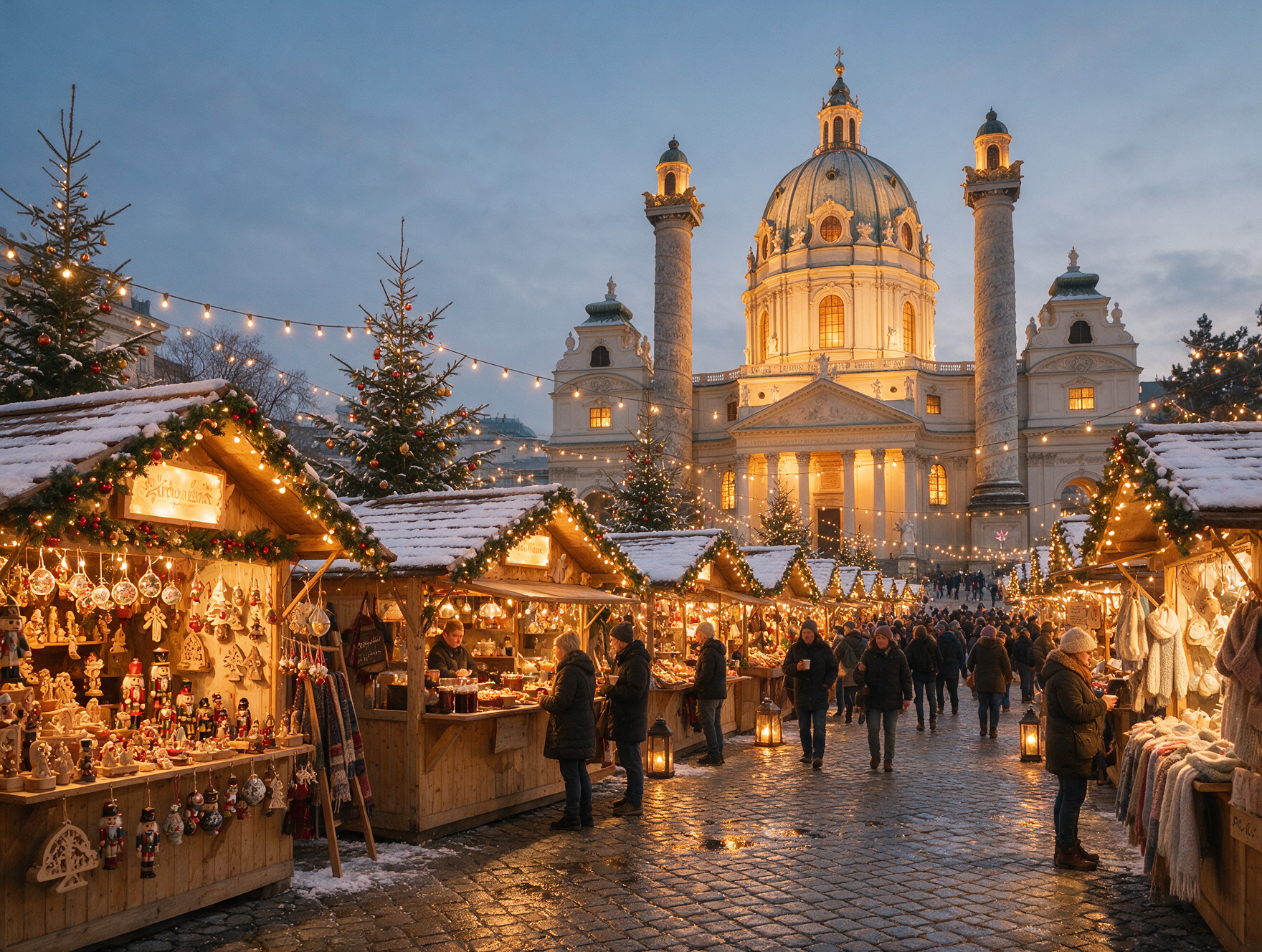
If Rathausplatz is for spectacle and Spittelberg is for atmosphere, Karlsplatz’s Art Advent market — set beneath Karlskirche’s baroque dome — is where locals actually go to buy things they intend to keep. The stalls here skew toward curated artisan work rather than mass-produced souvenirs: ceramics, textiles, small original artwork, the kind of gifts you buy because you genuinely like the piece rather than because it says “Vienna” on it. It’s smaller and quieter than the two markets above, and the setting — Karlskirche lit up behind the stalls — is arguably the most architecturally striking of any market in the city.
The quieter markets worth a detour
- Freyung (Altwiener Christkindlmarkt): documented back to 1772, making it the city’s oldest, with a deliberately old-fashioned, traditional-crafts character rather than the modern light-show approach of the bigger markets.
- Am Hof: a smaller square near Freyung with a genuinely traditional, old-Vienna feel and noticeably less foot traffic than the headline markets.
- Türkenschanzpark: a neighbourhood park market in the 18th district that draws almost entirely locals rather than visitors — worth it if you want a Christmas market experience with essentially no tourists around you at all.
- Schönbrunn Palace market: runs the longest of any Vienna market (into early January some years) and sets a genuinely grand palace backdrop against a smaller, calmer market than the palace’s daytime crowds might suggest.
How to actually order Punsch like you’ve done this before
Punsch, not “mulled wine,” is the term you’ll want at the counter — it’s the broader Viennese category covering mulled wine but also rum-, brandy- and fruit-based hot punches, many stronger and sweeter than a simple Glühwein. Every market sells its own mug design for a small deposit (Pfand), refundable if you return the mug, or keepable as a genuine souvenir if you’d rather pay the deposit and walk off with it — most locals keep at least one mug a season without really thinking about it, which is part of why so many Viennese kitchen cupboards have a random collection of Christmas market mugs from years past.
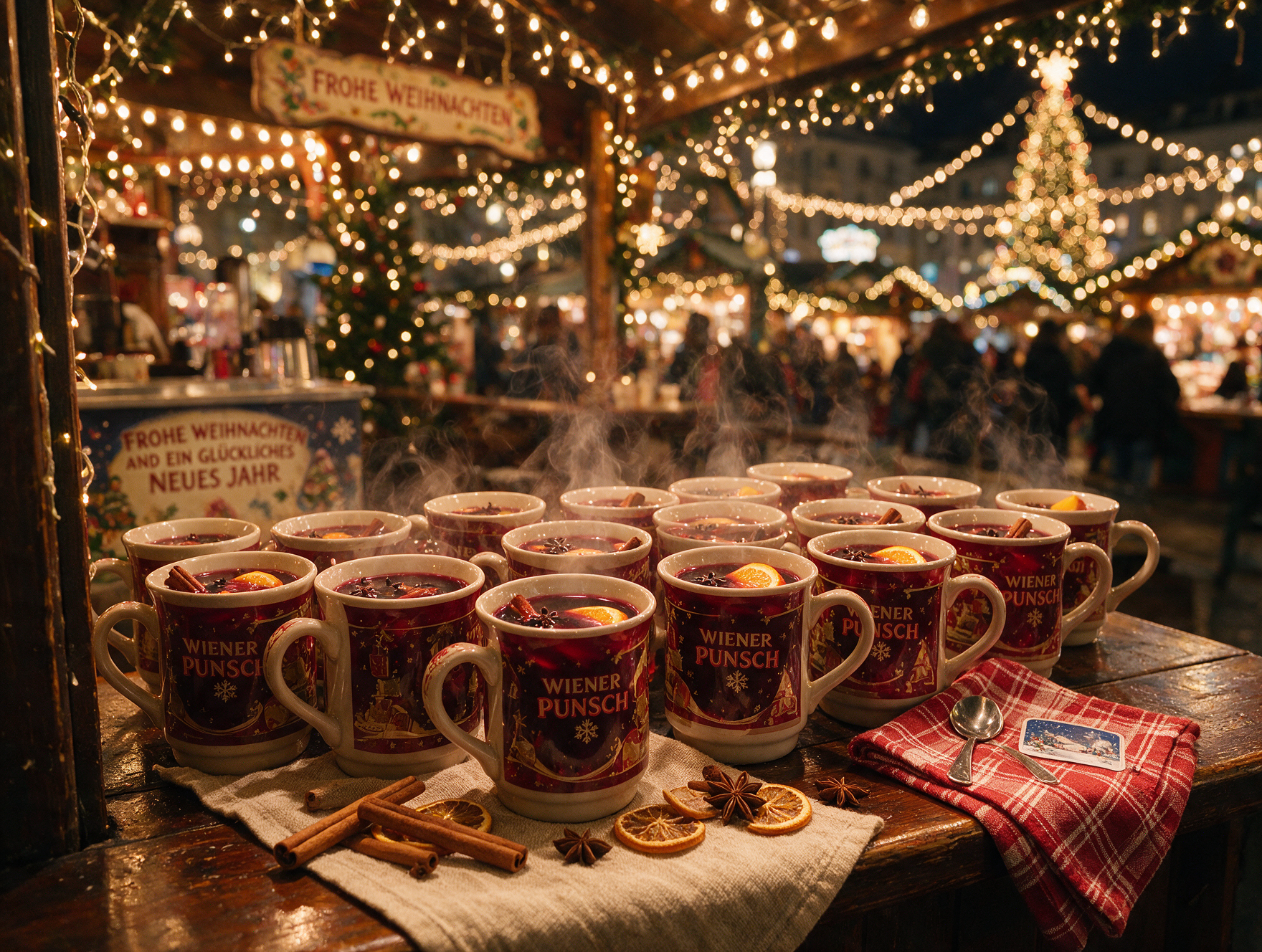
Ask what’s in a stall’s house Punsch before you order if you want to avoid a nasty sugar-and-spice surprise — recipes vary a lot between stalls, and the fruit-based versions in particular can be considerably sweeter than a classic red-wine Glühwein.
2026 dates and locations at a glance
Exact opening and closing dates shift slightly year to year, so always confirm current dates through Vienna’s official tourism site closer to your trip, but the general pattern holds: most of the smaller neighbourhood markets (Spittelberg, Karlsplatz, Am Hof, Freyung) run from mid-November through December 23rd, Rathausplatz and Stephansplatz extend a few days further to the 26th, and the Schönbrunn and Prater markets run the longest, into early January in some years. Note that Belvedere Palace’s market has been cancelled indefinitely due to ongoing construction work, so don’t plan a trip around it without checking current status first.
Costs, timing and getting to Vienna in winter
A Punsch runs roughly €4–6 including the mug deposit, and a full evening of market food and drinks across two markets rarely exceeds €30–40 per person — genuinely one of the more affordable evening activities in a city that can otherwise get pricey. Winter is a legitimately good time to fly into Vienna: Air India and Austrian Airlines both run the Delhi–Vienna route, and December fares aren’t dramatically higher than shoulder-season pricing, since Christmas markets pull leisure travel that partially offsets the usual winter dip in business travel.
The same Austria Schengen visa process applies for a winter trip, currently around €90 for an adult with processing up to 15 working days — apply with extra buffer time around the holidays, since embassy and VFS processing can slow slightly in the December rush alongside everyone else’s holiday travel plans.
Who each market suits
Couples get the most romantic mileage out of Karlsplatz or a quiet weeknight at Freyung — smaller crowds, better conversation, and a setting that doesn’t require shouting over a crowd to be heard. Families do best at Rathausplatz for the sheer spectacle and the ice rink, ideally on a weekday afternoon before the evening crowds build, or at the calmer Schönbrunn market if the kids are younger and the crush of a big city market feels like too much. Solo travellers, honestly, have the easiest time of anyone here — wandering Spittelberg’s side lanes alone with a Punsch in hand is one of the more pleasant solo evenings you’ll have anywhere in Europe in December, and nobody looks twice at someone browsing a market stall by themselves.
For photography, Rathausplatz’s illuminated facade is best shot from the far end of the square looking back, using the market’s own string lights as foreground bokeh rather than trying to fit the whole building in frame. Spittelberg photographs best from within its narrow lanes rather than from the wider entrance streets — get close to a single lit stall front rather than trying to capture the market’s full scale, which it doesn’t really have compared to Rathausplatz anyway.
Mistakes to avoid
- Mistake to avoid: only visiting Rathausplatz and assuming you’ve “done” Vienna’s Christmas markets. It’s the biggest, not the most representative — you’ll get a much fuller picture of the city’s actual holiday character by adding at least one neighbourhood market.
- Mistake to avoid: visiting on a Saturday afternoon expecting a calm experience anywhere. Weekend afternoons are peak crowd time at every market in the city; weeknight evenings are consistently calmer.
- Honest opinion: the mug-keeping habit is genuinely one of the nicer Viennese Christmas traditions, and it’s worth paying the small deposit to keep at least one from your trip rather than defaulting to returning every mug for the refund.
- Fun fact: the Freyung market’s roots go back to 1772, making Vienna’s Christmas market tradition considerably older than the “German Christmas market” reputation that gets applied to the whole region — Vienna was doing this well before it became a pan-European December ritual.
Frequently asked questions
Which Vienna Christmas market is best for families?
Rathausplatz, despite the crowds, has the most going on for kids specifically — an ice rink, a dedicated children’s area in past years, and the sheer scale that makes it feel like an event. Schönbrunn’s market, set against the palace grounds, is a calmer family alternative.
Is Spittelberg walkable from the city centre?
Yes — it’s about a 15–20 minute walk from Vienna’s inner Ringstrasse district, or a short tram or U-Bahn ride, making it easy to combine with a Rathausplatz visit on the same evening.
How cold does it get at Vienna’s Christmas markets?
Typically hovering around freezing (0°C) through December, sometimes colder on clear nights. Dress in proper layers — this isn’t a “light jacket” evening, and the Punsch helps but isn’t a substitute for a real coat.
Are Vienna’s Christmas markets open on Christmas Day?
Most close on or just before December 24th–26th, with a few of the longer-running markets like Schönbrunn and Prater continuing into early January. Confirm specific closing dates for the market you’re planning around, since they vary.
What’s the best market for buying gifts rather than just visiting?
Karlsplatz Art Advent, for curated artisan work, or Freyung, for a more traditional-crafts selection — both are better for genuine gift shopping than Rathausplatz’s larger but more generic stall mix.
Is it worth visiting more than one market in a single evening?
Yes, and it’s easy to do — Rathausplatz, Am Hof and Freyung all sit within a short walk of each other in the city centre, so a single evening can reasonably cover two or three markets with different characters.
The market for the photo, and the markets for the evening
Rathausplatz will always be the market people picture when they think of Vienna at Christmas, and there’s a real reason for that — it’s genuinely spectacular once. But the markets locals actually return to on an ordinary Tuesday in December are the smaller ones: Spittelberg’s cobblestone lanes, Karlsplatz beneath the Karlskirche dome, a quiet corner of Freyung. Doing both versions is what turns a Christmas market visit from a photo stop into an actual sense of how Vienna spends its winter.
If you’re planning a December trip around Vienna’s markets alongside the rest of Austria, Get Tripped’s Austria packages can time your Vienna stay around the market calendar and handle the winter visa and insurance details, so you’re free to actually wander rather than manage logistics.