The email from my cousin was three lines long: “Booked Cairo for December. Do I need a visa? What do I even fill out?” I get some version of this question every time someone from India tells their friends they’re headed to Egypt, and the honest answer is that Egypt’s visa process changed enough in the last couple of years that a lot of the advice floating around on travel forums is already out of date. If you’re planning an Egypt trip from India and searching for the current Egypt visa for Indians process, here’s what’s actually true right now, not what was true when someone wrote a blog post in 2022.
Short version: yes, you need a visa. No, it is not visa-free or visa-on-arrival for most Indian passport holders anymore in the way it used to be casually described online. And there’s a document requirement — a Letter of Guarantee — that catches a lot of first-time applicants off guard because it isn’t something you’d expect for a country India has warm diplomatic relations with.
Table of Contents
- Which Egypt Visa Do Indians Actually Need
- The E-Visa Process, Step by Step
- Documents You’ll Actually Be Asked For
- The Letter of Guarantee — Why It Exists and How to Get One
- Visa Fees and Validity
- Mistakes That Delay or Reject Applications
- After You’re Approved: What to Carry at Immigration
- How This Fits Into Planning Your Trip
- FAQs
Which Egypt Visa Do Indians Actually Need
There are technically three routes into Egypt on paper — e-Visa, visa on arrival, and an embassy visa applied for in advance — but for almost every Indian traveler booking a leisure trip, the e-Visa is the one that applies. Visa on arrival is officially reserved for holders of valid US, UK or Schengen visas, GCC residents, or travelers arriving as part of an organized tour group through a recognized operator. If you don’t fall into one of those categories, showing up at Cairo International Airport without a visa already secured is a genuinely bad idea — we’ve heard of travelers being put on the next flight back, and that’s not a story you want to be in.
The e-Visa is applied for entirely online, before you fly, through Egypt’s official government portal — visa2egypt.gov.eg. Bookmark that specific URL. There are third-party sites that will process an Egypt visa application for a service fee, and some are legitimate travel agencies genuinely helping with the paperwork, but there are also sites designed to look official that charge a markup for something you can do yourself in under an hour.
The E-Visa Process, Step by Step
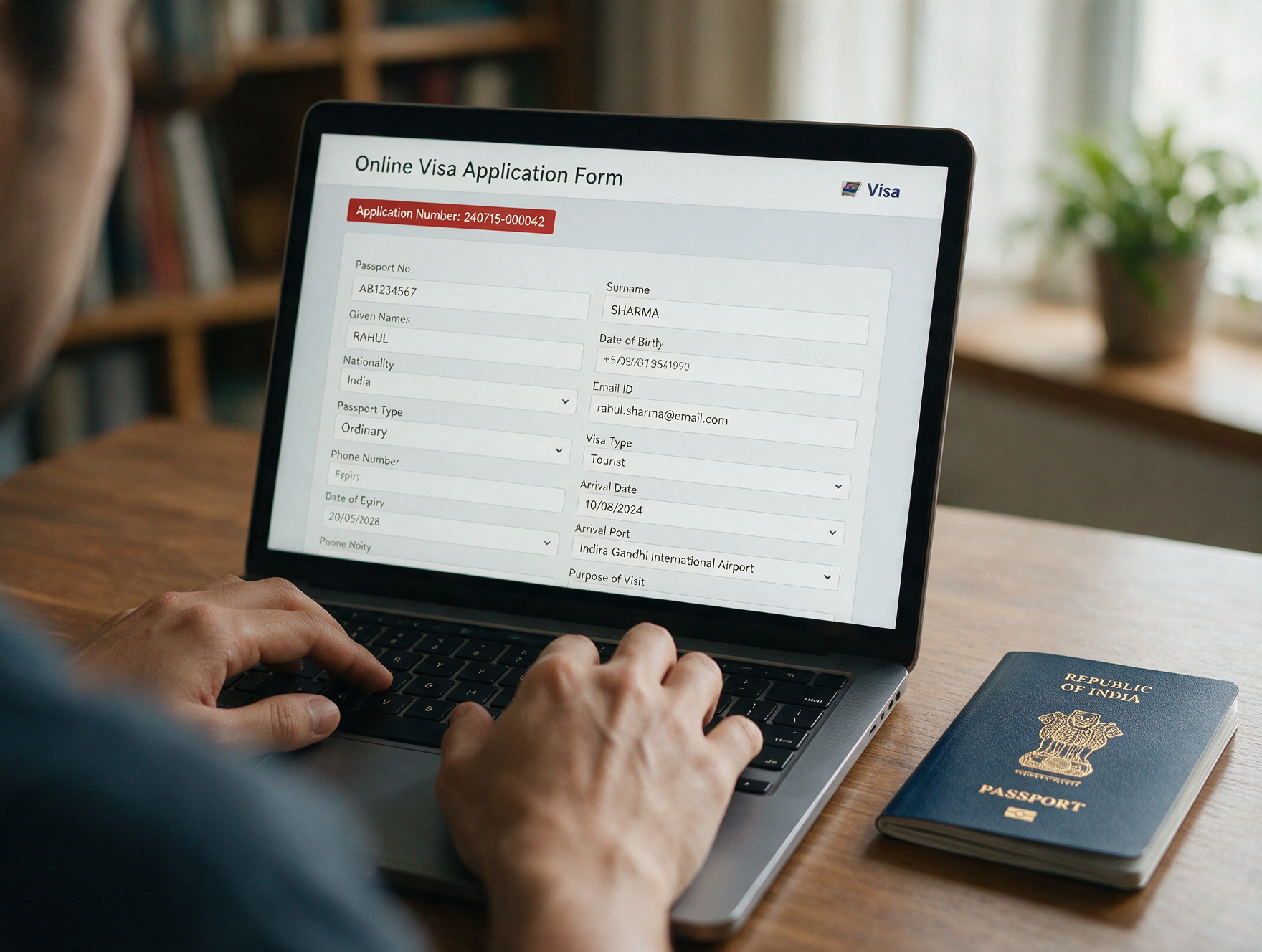
Once you’re on the official portal, the process itself is straightforward — it’s the preparation beforehand that trips people up. Here’s the actual sequence:
- Create an account on visa2egypt.gov.eg with a valid email address you check regularly — approval and any request for additional documents comes through there.
- Choose single-entry or multiple-entry tourist e-Visa. Single-entry covers the vast majority of leisure itineraries, including the standard Cairo–Luxor–Aswan loop.
- Fill in passport details exactly as they appear on your passport — a mismatched middle name or a transposed digit is one of the most common reasons applications bounce back for correction.
- Upload a passport-style photo (plain white background, taken in the last six months) and a scan of your passport’s information page.
- Upload supporting documents — flight booking, hotel confirmation or the Letter of Guarantee, and proof of funds (more on all three below).
- Pay the visa fee online by card.
- Wait for processing — budget 5 to 7 working days, though we’ve seen it clear in 3 during quieter periods and stretch closer to 10 during peak season (October through February, when half of Europe is also applying).
Apply at least 10-14 days before you fly. Applying the week of your trip and hoping it clears in time is the single most avoidable stress we see travelers put themselves through.
Documents You’ll Actually Be Asked For
Keep these ready as PDF or clear photo scans before you start the application, because the portal will time out your session if you go hunting for a document mid-form:
- Passport with at least 6 months’ validity remaining from your travel date, and a minimum of two blank pages
- Passport-style photograph, white background, recent
- Confirmed round-trip flight booking (a reservation hold usually isn’t accepted — it needs to show a ticketed booking)
- Hotel confirmation for the full length of stay, or a detailed itinerary if you’re moving between multiple hotels
- Bank statement covering the last 3-6 months, showing sufficient funds for the trip
- The Letter of Guarantee (see below — this is the one that surprises people)
The Letter of Guarantee — Why It Exists and How to Get One
This is the part of the Egypt visa process that has changed and that most older blog posts don’t mention: a Letter of Guarantee from an Egyptian travel agency authorized by the Ministry of Tourism is now a required document for Indian nationals applying for any Egypt visa type, including the standard tourist e-Visa. It’s essentially a formal statement from a licensed local operator confirming they’re aware of your visit and, in effect, vouching that you have a genuine, organized reason to be there.
In practice, this isn’t as heavy a requirement as it sounds. If you’re booking any part of your Egypt trip through a travel agency — even just accommodation and a Nile cruise, not the whole itinerary — they can usually issue this letter as part of the booking, sometimes at no extra cost. If you’re planning to travel fully independently with no local operator involved anywhere in your trip, you’ll need to specifically request this letter from a licensed Egyptian agency before you can complete the visa application, which is one more reason a fully DIY Egypt trip from India is more friction than it looks like from outside.
Visa Fees and Validity
As of this year, the tourist e-Visa fees are:
- Single-entry e-Visa: USD 30 (roughly ₹2,500 depending on the exchange rate) — valid 90 days from the date of issue, for a maximum stay of 30 days per visit
- Multiple-entry e-Visa: USD 65 (roughly ₹5,400) — valid 180 days from issue, also capped at 30 days per individual visit
Pay in the currency the portal quotes at checkout — some Indian cards apply a foreign transaction markup on top, so factor in an extra 2-3% when you’re budgeting the visa cost.
One quirk worth flagging honestly: fees and specific document requirements on government visa portals do shift without much fanfare, so treat the figures above as accurate as of this writing and double-check the live fee shown on visa2egypt.gov.eg at the time you actually apply — don’t budget down to the rupee based on any blog, including this one.
Mistakes That Delay or Reject Applications
A few patterns we’ve seen come up again and again:
- Passport name mismatches. If your passport has your name in a different order or format than your flight booking or bank statement, fix that before applying, not after a rejection.
- Uploading a blurry or cropped passport photo page. All four corners need to be visible and readable.
- Skipping the Letter of Guarantee because an older guide didn’t mention it. This is the single biggest cause of applications getting stuck in “additional documents required” limbo right now.
- Applying with less than 6 months of passport validity. Egypt checks this at immigration even if the online portal doesn’t flag it during application.
- Assuming a tourist visa covers volunteer work, an internship, or paid activity. It doesn’t — that needs a different visa category entirely.
After You’re Approved: What to Carry at Immigration
Print your e-Visa approval — don’t rely solely on showing it from your phone, since we’ve seen immigration officers at Cairo airport ask for a physical copy, especially during busy arrival windows when several flights land at once. Carry it along with your passport, printed hotel confirmation, and return flight ticket. Immigration in Cairo can move slowly regardless of your visa status simply because of arrival volume, so build in extra buffer time if you have a tight connecting flight to Luxor or Aswan the same day — we’d suggest at least 3 hours between international arrival and any domestic connection.

How This Fits Into Planning Your Trip
The visa is one piece of a bigger puzzle, and honestly the piece that trips people up least once they know the Letter of Guarantee requirement exists — the bigger planning questions are usually about how many days to spend between Cairo, Luxor, Aswan and Alexandria, and when to go given how brutal Upper Egypt heat gets by May. We cover the full route in our Egypt destination guide and our 7 nights, 8 days Egypt itinerary, which is worth reading before you lock in flight dates, since the visa’s 30-day stay cap is generous for almost any itinerary you’d realistically build.
If the paperwork above feels like more than you want to manage solo, this is exactly the kind of thing a good Egypt travel agency in India handles as part of putting together your custom Egypt itinerary — including sourcing the Letter of Guarantee, since they’re already the authorized local partner it needs to come from.
Budgeting the Visa Into Your Egypt Trip Cost
When people ask about Egypt trip cost from India, the visa fee is a rounding error compared to flights and the Nile cruise portion, but it’s still worth factoring in properly rather than as an afterthought. For a family of four, single-entry e-Visas alone run to roughly USD 120 (around ₹10,000) before you’ve booked a single flight. Add the courier or printing costs if you’re not comfortable managing digital documents at the airport, and a modest buffer for the currency conversion fee most Indian cards charge on international payments. None of this is a reason to avoid the trip — Egypt remains genuinely well priced compared to a lot of long-haul destinations Indian travelers consider — but it’s the kind of small cost that’s easy to forget when you’re mentally budgeting only for the big-ticket items like the Nile cruise and internal flights.
A mistake we’ve seen more than once: a traveler pays for the multiple-entry visa “just in case,” assuming it’s the safer option, when their entire trip is a single loop through Cairo, Luxor and Aswan with no plan to exit and re-enter Egypt. That’s an extra USD 35 per person for a feature you won’t use. Unless you’re genuinely planning a side trip that takes you out of the country and back in — a quick hop to Jordan to see Petra, for instance — the single-entry e-Visa covers you.
FAQs
Do Indians get visa-free entry to Egypt?
No. Indian passport holders need either an e-Visa, an embassy visa, or in limited cases (holders of valid US/UK/Schengen visas, GCC residents, or organized tour groups) a visa on arrival. There’s no visa-free route for a standard Indian tourist.
How long does the Egypt e-Visa take to process?
Typically 5-7 working days, though it can take longer during peak season (October-February). Apply at least 10-14 days before your travel date.
What is the Letter of Guarantee and do I really need it?
It’s a document from a Ministry of Tourism-authorized Egyptian travel agency confirming your visit. It’s currently a mandatory part of the Indian e-Visa application, and the easiest way to get one is by booking any portion of your trip — even just accommodation — through a licensed local operator.
Can I get an Egypt visa on arrival as an Indian citizen?
Only if you hold a valid US, UK, or Schengen visa, are a GCC resident, or are traveling with a recognized tour group. Otherwise, apply for the e-Visa before you fly.
Is the Egypt e-Visa single or multiple entry?
Both options exist. Single-entry (USD 30, 90-day validity) covers almost every standard itinerary. Multiple-entry (USD 65, 180-day validity) only makes sense if you’re planning to exit and re-enter Egypt, for example via a side trip to Jordan or Israel.
What happens if my Egypt visa application is rejected?
You can typically reapply after correcting the issue — most rejections come down to document mismatches or a missing Letter of Guarantee rather than anything more serious. Reapplying promptly matters if your travel date is close.
Do children need a separate Egypt visa?
Yes, every traveler needs their own visa regardless of age, including infants, though the application documents for a minor are usually simpler.
Before You Go
None of this is complicated once you know the Letter of Guarantee exists — it’s the one requirement that isn’t obvious if you’re going in cold. Start the process with enough runway, keep your documents consistent across passport, flight and bank statement, and the rest is paperwork rather than uncertainty.
If you’d rather have someone else own the visa timeline while you focus on the fun parts of planning, get in touch with Get Tripped about Egypt tour packages from India — we handle the Letter of Guarantee and documentation as a standard part of booking, so it’s one less thing on your list.