The queue for the Giza ticket office starts moving before the gates even open, and by 8am there are already three tour buses idling in the dust with their engines running. We’ve stood in that queue. It’s worth doing once. But the Egypt we keep sending travelers back to isn’t the one in that line — it’s the one four hours west of Cairo, where a Berber family in Siwa serves you olives grown on trees their grandfather planted, or the one in Aswan where a Nubian grandmother paints her house turquoise every year because that’s just what you do before the Nile floods.
This is a guide to that other Egypt. Not instead of the Pyramids — we’ll tell you exactly how to fit those in without losing a day to crowds — but built around six places most Indian travelers to Egypt never hear about from a standard tour operator.
Table of Contents
- Why Look Beyond the Pyramids and Cairo’s Tourist Trail
- Siwa Oasis: Egypt’s Quietest Corner
- The White Desert: Chalk Formations and a Sky Full of Stars
- Wadi El Rayan and Fayoum: A Day Trip Cairo Tourists Skip
- Aswan’s Nubian Villages: A Different Egypt Entirely
- Luxor’s West Bank, Minus the Coach Parties
- Dahab Over Sharm El Sheikh
- The Cairo Neighborhood Tourists Walk Past
- Best Time to Visit
- Visa and Flights from India
- Where to Stay
- What It Actually Costs
- Food Worth Planning Meals Around
- Culture and Etiquette
- Safety Notes
- How to Combine the Icons With the Hidden Gems
- FAQs
Why Look Beyond the Pyramids and Cairo’s Tourist Trail
Egypt has spent seven thousand years building its reputation on a handful of monuments, and those monuments are genuinely extraordinary. That’s exactly the problem. Everyone who’s ever thought about visiting Egypt has the same shortlist — Giza, the Sphinx, Karnak, the Egyptian Museum — which means everyone shows up at the same three sites on the same mornings, usually between October and March when the weather actually cooperates.
What most first-time visitors don’t realize is that Egypt is roughly the size of France and Spain combined, with deserts, oases, and a 1,600-year-old Nubian culture along its southern border that has almost nothing to do with pharaonic Egypt at all. The hidden-gem places in this guide aren’t hidden because they’re hard to reach or underwhelming — Siwa Oasis is a ten-hour drive, not a trek — they’re hidden because most itineraries never budget the time. A smarter itinerary does.
Siwa Oasis: Egypt’s Quietest Corner
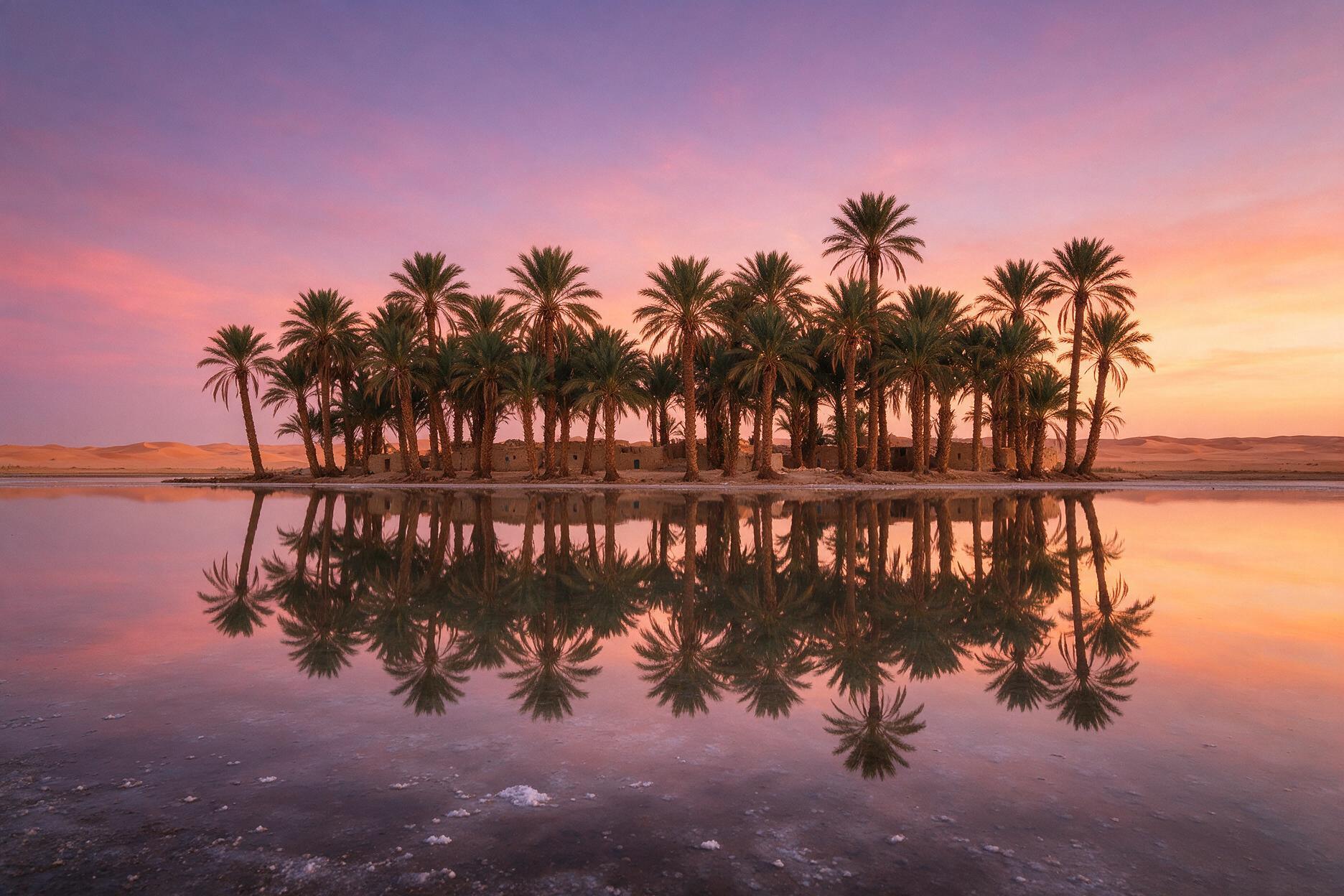
Siwa sits close to the Libyan border, about 560km west of Cairo, and it feels like it belongs to a different country. The people here are ethnically Berber (Amazigh), not Arab, and many still speak Siwi as a first language. Alexander the Great trekked out here in 331 BCE specifically to consult the Oracle of Amun, whose ruined temple you can still walk through today — a genuinely good fun fact to drop on anyone who thinks Siwa is a recent “discovery” for tourists.
What you’re actually here for: a salt lake so still at sunset it turns into a mirror for the palm groves around it; Cleopatra’s Spring, a natural freshwater pool locals still swim in; the mud-brick ruins of Shali, Siwa’s original hilltop fortress town, abandoned after a rare three-day rainstorm dissolved parts of it in 1926; and 4×4 runs into the Great Sand Sea, where dunes roll uninterrupted toward Libya.
Getting there: There’s no airport. It’s a private car or bus from Cairo, roughly 8-10 hours, or a private charter flight for travelers short on time. Most Get Tripped itineraries build in an overnight in Alexandria or Marsa Matrouh to break up the drive rather than doing it in one exhausting push.
Where the comfort is: Adrère Amellal, an eco-lodge built into a salt-rock outcrop with no electricity — the whole property runs on candlelight and oil lamps after dark, which sounds like a gimmick until you’re actually eating dinner under a wall of stars with zero light pollution. It’s a genuine splurge property, priced well into the luxury bracket per night, all-inclusive of meals and most excursions, so many travelers do one or two nights here rather than the whole Siwa stretch. Mid-range alternatives with proper Siwan character exist too, usually low-rise kershef (salt-and-mud) architecture built to stay cool without air-conditioning running constantly.
Mistake to avoid: Don’t try to “do” Siwa as a two-day dash from Cairo. Between the drive and the fact that most of what’s good here — the springs, the sand sea, the quiet — needs unhurried time, three full days is the minimum for it to feel worth the distance.
The White Desert: Chalk Formations and a Sky Full of Stars
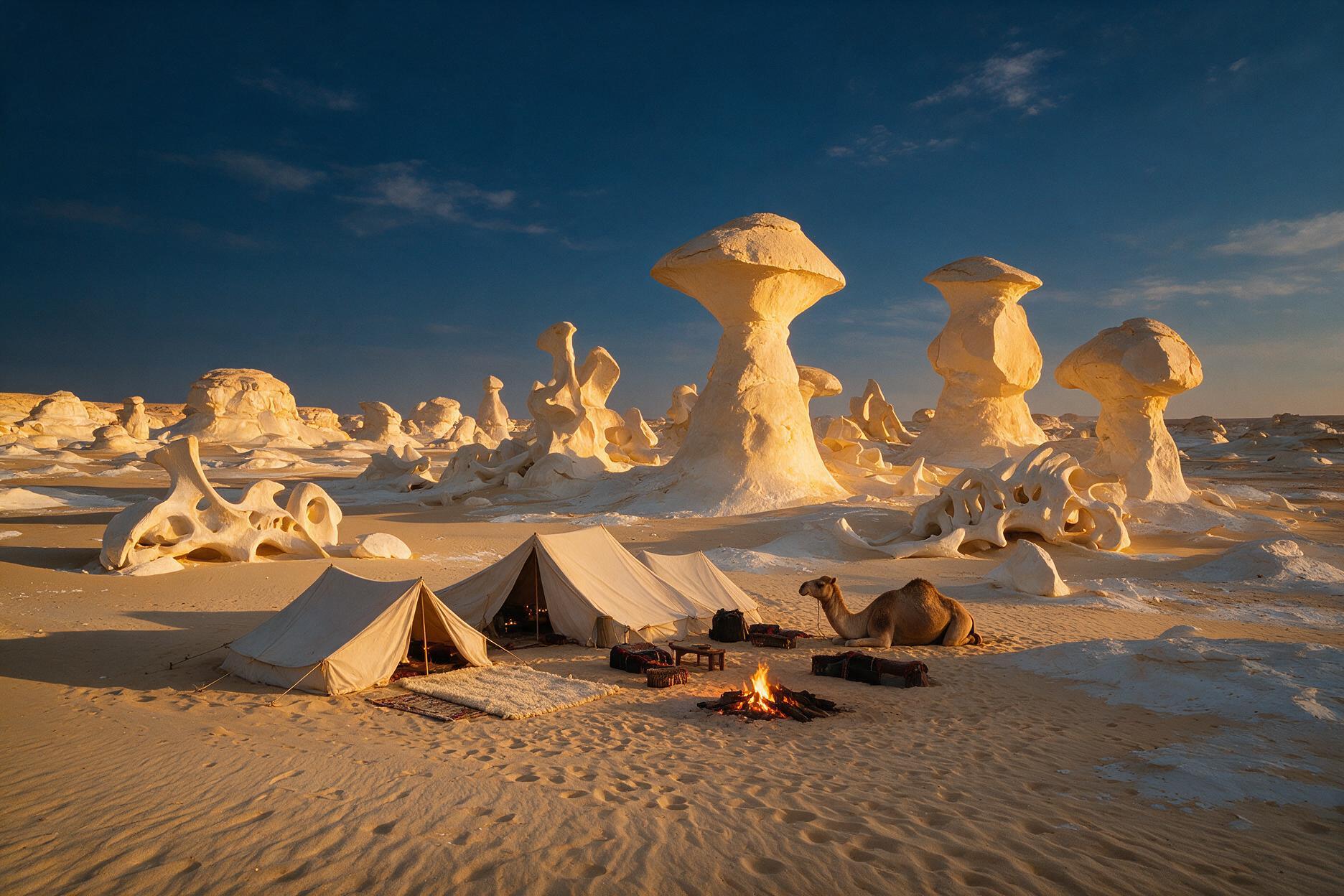
Sahara el-Beyda, the White Desert, is a national park about 4-5 hours southwest of Cairo via Bahariya Oasis, where wind erosion has carved chalk-white limestone into shapes that genuinely look sculpted — locals call the best-known cluster “the mushroom” and “the chicken” for obvious reasons once you see them. On the drive in you’ll pass the Black Desert, its hills dusted with volcanic basalt, and if your guide stops at Crystal Mountain, that quartz you’re standing on is real, not a photo prop.
The point of the White Desert isn’t a quick drive-through. It’s staying overnight in a Bedouin-run desert camp, watching the chalk formations turn pink and then grey as the sun drops, and then looking up at a sky with essentially no artificial light for a hundred kilometres in any direction. A 2-day/1-night private overnight camping trip from Cairo typically runs somewhere in the region of USD 350-450 for two people, including 4×4 transport, a desert guide, permits, and simple but genuinely good Bedouin-cooked dinner and breakfast; a 3-day/2-night version costs more but lets you add Bahariya’s own hot springs and palm groves rather than rushing straight back.
Photography tip: Shoot the formations about 40 minutes before actual sunset, not at golden hour itself — the white chalk blows out badly in direct low sun and reads far better in the softer light just before, with the rock formations throwing long, clean shadows across the sand.
Smart-spending tip: A private camp for two costs more per head than a shared group camp, but for a first desert overnight — especially for couples or solo travelers who value quiet over campfire small talk with strangers — it’s worth the difference. You’re not just paying for privacy, you’re paying for your guide to actually adjust the pace to you.
Wadi El Rayan and Fayoum: A Day Trip Cairo Tourists Skip
Here’s a fact that surprises most first-timers: Egypt has waterfalls. Not big ones — Wadi El Rayan’s cascades were formed by agricultural drainage overflow back in 1970, dropping into a depression 42 metres below sea level — but they’re genuinely pretty, set against golden dunes about 95km southwest of Cairo in the Fayoum region, roughly 90 minutes to two hours’ drive depending on traffic out of the city.
The better reason to come, though, is Wadi Al-Hitan — Whale Valley — a UNESCO World Heritage Site since 2005 where you can walk among the fossilised skeletons of Basilosaurus, an early whale species that still had tiny hind legs, proof of the evolutionary jump from land to sea some 40 million years ago. It’s an easy full-day trip from Cairo, doable with a private Egyptologist guide and a 4×4, usually combined with sandboarding on the dunes and a late lunch at a lakeside restaurant on Lake Qarun.
Who this suits: Families. It’s a single comfortable day (not an overnight commitment like Siwa or the White Desert), the walking is easy and flat, and kids tend to find fossilised whale skeletons in the middle of a desert genuinely more exciting than another temple wall.
Aswan’s Nubian Villages: A Different Egypt Entirely
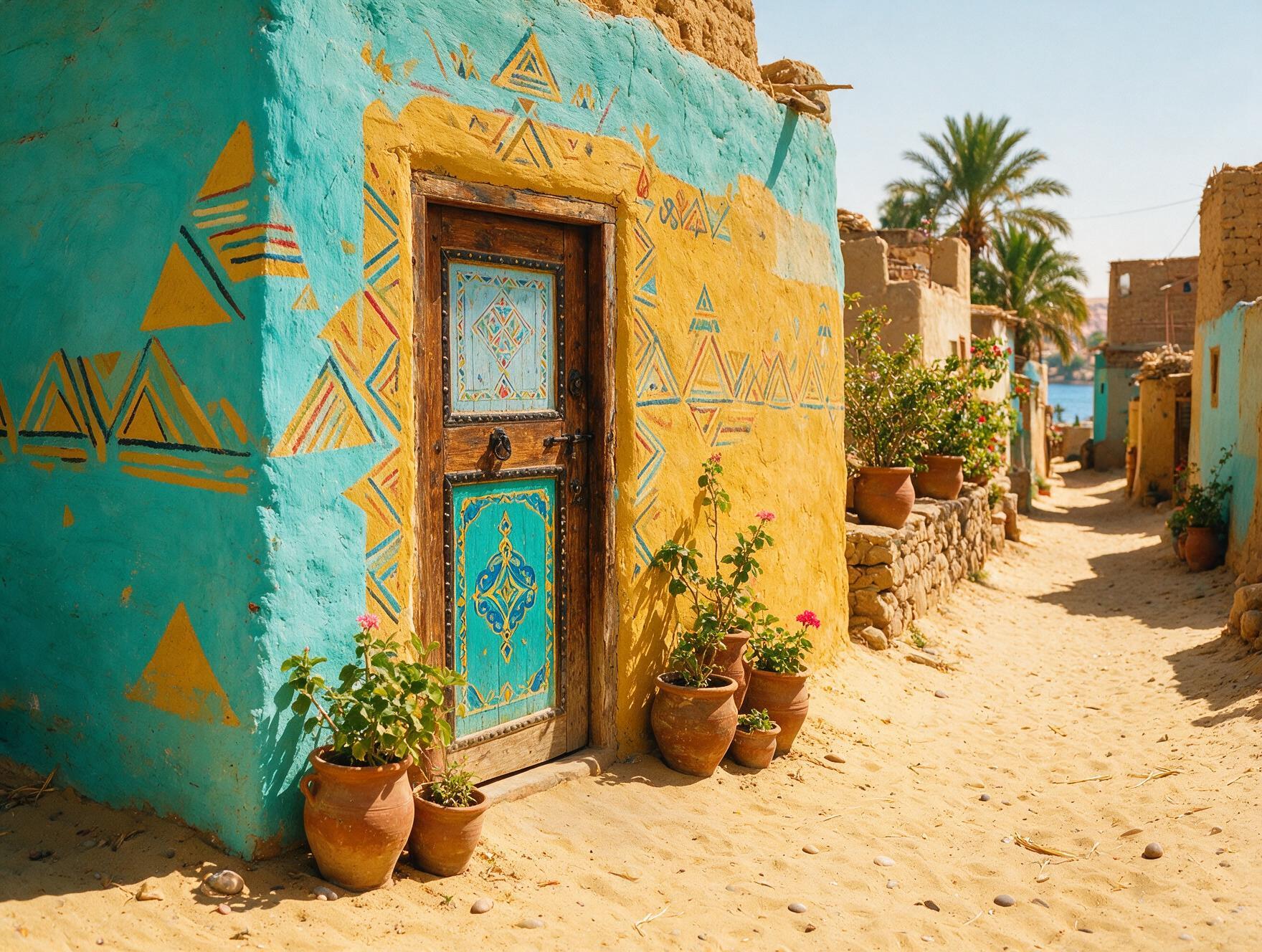
Nubia is its own culture, with its own language and history stretching back to the Kingdom of Kush, and Aswan is where you actually meet it, not just read about it on a museum placard. Elephantine Island, reachable by a five-minute motorboat from the Aswan corniche, has a working Nubian village where houses are painted in deliberately bright turquoise, ochre, and pink — originally to be visible from the river, now simply tradition. Gharb Soheil, on the west bank, is the more photogenic (and more visited by day-trippers) version of the same thing.
A private guide who’s actually Nubian makes an enormous difference here — not just for translation, but because he or she will walk you into a family’s home for tea rather than a staged “cultural experience” storefront. Some houses do keep domesticated Nile crocodiles as a photo-op tradition for visitors; it’s real, but we’d gently steer you toward the felucca ride and the tea instead — it’s a more honest slice of how people here actually live.
Do this: Take the felucca out at sunset rather than midday. The light on the Nile between roughly 5 and 6:30pm in winter turns the water gold, and the boat traffic thins out once the day-tour groups head back to their hotels.
Where to stay: Aswan has genuinely excellent Nile-view hotels — the kind with a terrace looking straight across at Elephantine Island — in the mid-range to luxury bracket, and a few Nubian-run guesthouses on the west bank if you want to fall asleep to the sound of the river rather than a hotel AC unit.
Luxor’s West Bank, Minus the Coach Parties
Everyone goes to the Valley of the Kings. Fewer people make it to Deir el-Medina, a 20-minute drive further into the hills, where the actual workers who built those royal tombs lived, and were buried, in tombs of their own that are — genuinely — some of the best-preserved painted chambers in Egypt. The Tomb of Sennedjem in particular has colour so vivid it barely looks 3,000 years old. Entry runs about 220 EGP, and because it demands a bit more effort to reach and doesn’t have the same “wow” of a pharaoh’s tomb, it stays quiet even in peak season.
Fun fact worth knowing before you go: the papyri and pottery shards (ostraca) found here recorded the world’s first documented labour strike, around 1155 BCE, when the tomb-builders downed tools over overdue grain rations. History nerds, this is your section.
Mistake to avoid: Arriving after 10am. The West Bank has almost no shade, temperatures climb fast even in winter, and the tour buses that skip Deir el-Medina still clog the Valley of the Kings road by mid-morning. Start at 6am when the sites open, and you’ll have Deir el-Medina, the nearby Tombs of the Nobles, and Medinet Habu practically to yourself.
Dahab Over Sharm El Sheikh
Sharm El Sheikh is a large, polished resort strip. Dahab, ninety minutes up the Sinai coast, used to be a Bedouin fishing village and still feels like one in places, with restaurants built right on the lagoon edge and a slower, low-rise pace. The Blue Hole — a 130-metre sinkhole that’s one of the most famous dive sites on the planet — is the headline draw, but Dahab’s real appeal for a Get Tripped traveler is that you get boutique, well-run hotels without Sharm’s mega-resort sprawl, at roughly 30-40% lower rates for a comparable standard of room.
Beyond diving: a pre-dawn trek up Mount Sinai (yes, that Mount Sinai) for sunrise, a 4×4 run into the Coloured Canyon, and kitesurfing on a lagoon that’s genuinely one of the best learning spots in the Middle East thanks to consistent, gentle wind.
Getting there: Fly Cairo to Sharm El Sheikh (about an hour), then a private transfer up to Dahab (roughly 75 minutes). It sounds like a detour but it isn’t — you’re simply landing at the nearest airport and driving the last stretch.
Good for: Couples wanting a slower, quieter Red Sea stop, and solo divers who’d rather train at a small, personal dive shop than a resort-chain operation.
The Cairo Neighborhood Tourists Walk Past
Most visitors to Islamic Cairo stop at Khan el-Khalili souq and Al-Muizz Street and call it done. A ten-minute walk further south is Al-Darb Al-Ahmar, a working Cairo neighbourhood that happens to also hold some of the city’s finest Mamluk-era mosques — Al-Maridani, with its carved wooden mashrabiya screens, and the Blue Mosque with its Iznik tilework — sitting next to mechanics’ shops and grocers going about an ordinary Tuesday. The Tentmakers’ Market here still hand-stitches khayamiya textile art the traditional way, and Bab Zuweila, the 11th-century city gate at the neighbourhood’s edge, is genuinely climbable for a rooftop view of Fatimid Cairo that rivals anything more famous — with a fraction of the visitors.
Transit tip: The lanes here are too narrow for cars in places, so a short guided walk (or a golf-cart tour, which several licensed operators run through the wider Islamic Cairo district) works better than trying to self-navigate with a ride-hailing app.
Best Time to Visit
For the desert stretches — Siwa and the White Desert — the sweet spot is November through March, with shoulder months of February-April and September-November also workable, though spring can bring the occasional Khamsin sandstorm. Summer (June-August) genuinely should be avoided out west; Siwa routinely climbs past 40°C (104°F), and desert camping in that heat is not the relaxed experience the photos suggest.
Aswan and Luxor are most comfortable November through March as well, with daytime highs around 20-25°C — outdoor sites like Karnak and the West Bank tombs are far more pleasant to walk in cool morning air than the 40°C+ heat of a Luxor summer. If you can time a trip around 22 February or 22 October, you’ll catch the Abu Simbel Sun Festival, when sunlight aligns directly with the inner sanctuary of Ramesses II’s temple — worth building a day around if the dates line up.
For Dahab and the Red Sea coast, March-May and September-November give the best combination of good diving visibility, comfortable air temperature, and thinner crowds than peak winter.
Visa and Flights from India
Indian passport holders need a visa for Egypt — there is no visa-free entry. The most straightforward route is Egypt’s official e-Visa, applied for online in advance through visa2egypt.gov.eg, the government’s own portal (be wary of third-party sites that charge a heavy markup over the official fee). As of this research, published fees are approximately USD 25 for a single-entry e-visa (valid 90 days from issue, for a stay of up to 30 days) and USD 60 for a multiple-entry e-visa (valid 180 days, 30 days per visit). Processing is typically quoted at 5-7 business days, so apply at least a week to ten days before travel, and make sure your passport has at least six months’ validity and two blank pages.
One honest caveat: visa-on-arrival at Egyptian airports is generally not available to Indian citizens travelling directly from India — it’s typically reserved for Indians who already hold a valid visa or residence permit from countries like the US, UK, Schengen states, Canada, Australia, or Japan. Egypt is also rolling out a new digital visa-on-arrival system at Cairo airport starting around August 2026, but reports indicate this changes the process (QR code instead of a paper sticker), not the underlying eligibility — so it doesn’t open up visa-on-arrival to Indians who weren’t already eligible. Confirm current eligibility on the official portal before you book, since visa rules are exactly the kind of thing that shifts without much notice.
Flights: EgyptAir runs a direct Delhi-Cairo service, roughly 6 hours 35 minutes, a handful of times a week on Airbus A320neo/A330 aircraft — this is the easiest routing if you’re flying out of Delhi. From Mumbai and Bengaluru, there are currently no non-stop options; expect one stop via a Gulf hub (Emirates, Etihad, Qatar Airways, Air India, or EgyptAir itself connecting through Cairo or a partner city), typically 9-13 hours door to door depending on the layover. Fares fluctuate a lot with season and how far ahead you book, so treat any number you see online as a ballpark rather than gospel — check current fares closer to your travel dates.
Where to Stay
Cairo: Base yourself near Zamalek or Garden City for a quieter, leafier stay with easy access to downtown and Islamic Cairo, rather than the busier Giza Pyramids-view strip (unless you specifically want a sunrise pyramid view from your balcony, which is a genuinely lovely one-night splurge, just not for your whole Cairo stay).
Siwa: Adrère Amellal for a genuine luxury eco-lodge experience, or one of several well-run mid-range kershef-style lodges if you want Siwan character without the top-tier price tag.
Aswan: Nile-view hotels on the east bank corniche for classic comfort, or a Nubian-run guesthouse on the west bank for something closer to the community you’re visiting.
Luxor: West Bank boutique hotels near the Theban hills put you close to the quiet sites and give you a proper garden and pool to retreat to after an early-morning tomb visit — genuinely a better base than the busier east bank strip for this itinerary.
Dahab: Lagoon-front boutique hotels, several of which run their own dive centres.
What It Actually Costs
Get Tripped doesn’t plan budget trips, so treat these as mid-range to luxury reference points, not a shoestring benchmark. A White Desert overnight for two, privately guided, typically runs USD 350-450 all-in. A Nile cruise between Luxor and Aswan (3-4 nights, the classic way to link the two cities in comfort rather than backtracking by road) ranges widely by ship standard, from solidly comfortable mid-range vessels to genuine five-star boats with a private balcony and a spa. Domestic flights between Cairo, Aswan, and Luxor on EgyptAir are the fastest way to stitch the itinerary together (roughly 1-1.5 hours each hop); the overnight Watania sleeper train Cairo-Luxor-Aswan is a real and romantic-sounding alternative, though we’d note it has a mixed reliability record on timing, so build in buffer if you use it rather than a same-day connection.
Smart-spending tip: Private Egyptologist guides cost more per day than joining a shared group, but at UNESCO sites like Deir el-Medina or Wadi Al-Hitan, where the value is entirely in the context someone gives you, that’s where the extra spend earns its keep — versus, say, a straightforward desert 4×4 transfer where a good shared vehicle does the job just as well.
Food Worth Planning Meals Around
Egyptian food outside hotel buffets is genuinely underrated. Koshari — a carb-heavy, oddly perfect mix of rice, lentils, macaroni, chickpeas, crispy onions, and a spiced tomato sauce — is the national comfort dish and entirely vegetarian, which makes Egypt easier for vegetarian Indian travellers than most people expect. In Siwa, meals lean on olives, dates, and slow-cooked lamb from the oasis’s own groves. In Aswan, Nubian cooking uses more spice and colour than Cairene food — try a proper Nubian home-cooked meal if your guide can arrange one, rather than a set hotel menu.
Culture and Etiquette
Modest dress travels well here — shoulders and knees covered, especially at mosques and in Siwa and Nubian villages, which are more conservative than central Cairo. Always ask before photographing people directly, particularly in Nubian villages where houses and gardens are private property, not photo backdrops. Friday is the main prayer day; some shops and sites adjust hours slightly, so check ahead if Friday falls inside your Cairo or Aswan days.
Safety Notes
Egypt’s main tourist circuit — Cairo, Luxor, Aswan, the Red Sea coast, and the oases covered here — sees heavy security presence around major sites and is well-travelled by international visitors year-round. As with any destination, keep to licensed guides and drivers (which any properly planned Get Tripped itinerary already builds in), keep copies of your visa and passport, and check the current Indian Ministry of External Affairs travel advisory before booking, since regional advisories do get updated and it’s worth five minutes to confirm nothing’s changed close to your travel dates.
How to Combine the Icons With the Hidden Gems
None of this means skipping the Pyramids entirely — that would be its own kind of overcorrection. The smart way to do it: spend your first Cairo morning at Giza early, at opening time (roughly 6-8am), before the tour buses arrive, then use the rest of your Cairo days for Al-Darb Al-Ahmar and the Egyptian Museum or the Grand Egyptian Museum rather than a second pyramid visit. Similarly in Luxor, do one focused, guided sunrise visit to Karnak Temple — it genuinely earns its reputation — and spend your second West Bank day on Deir el-Medina and the Tombs of the Nobles instead of a second round of the big-name sites.
A workable 10-12 day structure: 2 days Cairo (Giza at sunrise + Al-Darb Al-Ahmar), 3 days Aswan (Nubian villages, Abu Simbel as an optional day trip), Nile cruise or train to Luxor, 2 days Luxor (Karnak sunrise + West Bank quiet corners), fly back to Cairo, then a 3-day extension to either Siwa or the White Desert depending on how much desert time you want, with Dahab as an alternative extension for divers and couples who’d rather end on the coast.
FAQs
Do Indian citizens need a visa for Egypt?
Yes. There’s no visa-free entry for Indian passport holders. The most reliable route is Egypt’s official e-Visa via visa2egypt.gov.eg, applied for online before travel.
Can Indians get a visa on arrival in Egypt?
Generally no, not for Indians travelling directly from India. Visa-on-arrival is typically limited to Indian travellers who already hold a valid visa or residency from countries like the US, UK, Schengen area, Canada, Australia, or Japan. Apply for the e-visa in advance to avoid any surprise at immigration.
Is there a direct flight from India to Cairo?
Yes, from Delhi — EgyptAir operates a direct service, roughly 6 hours 35 minutes. From Mumbai and Bengaluru, current routings connect through a Gulf hub with one stop.
How many days do I need to see Egypt beyond just Cairo and the Pyramids?
For the itinerary in this guide — Cairo, Aswan, Luxor, plus one desert extension (Siwa, White Desert, or Dahab) — budget at least 10-12 days. Trying to compress it much further means cutting one of the hidden-gem stops, which defeats the point.
What’s the best time of year to visit Egypt from India?
November through March for the most comfortable weather across Cairo, Luxor, Aswan, Siwa, and the White Desert. Shoulder months (February-April, September-November) work well too and come with slightly thinner crowds and lower rates.
Is Dahab safe, and how far is it from Sharm El Sheikh?
Dahab is a well-established, tourist-friendly town on the Sinai coast, about 90 minutes’ drive from Sharm El Sheikh (fly into Sharm, then transfer up). It’s quieter and more low-rise than Sharm, with excellent diving.
Can vegetarians travel comfortably in Egypt?
Yes — koshari, ful medames, falafel (called ta’ameya locally), and a wide range of vegetable mezze are widely available and genuinely good, not just an afterthought on the menu.
Should I carry cash or can I use cards everywhere in Egypt?
Carry Egyptian Pounds for daily spending — taxis, markets, tips, small restaurants — since card acceptance drops off fast outside hotels and upscale restaurants. Cards work well for hotel bills, cruise extras, and major attractions. ATMs are widely available in Cairo, Luxor, and Aswan, but withdraw enough before boarding a Nile cruise, since onboard and small-town ATM access is limited.
The Egypt Worth Coming Back For
The Pyramids will still be there whenever you visit — they’ve managed 4,500 years, they’ll manage your trip too. What won’t wait forever, in the same way, is the version of Egypt that’s quieter: a Siwan family’s olive grove, a Nubian grandmother’s turquoise doorway, chalk formations under a sky with no light pollution left to speak of. That’s the Egypt that actually stays with people. It’s also, frankly, the trip that’s more interesting to plan and far more interesting to come home and talk about.
Thinking about an Egypt trip that goes past the standard checklist? Get Tripped’s travel specialists plan exactly this kind of itinerary — the Nile cruise, the Siwa extension, the Nubian village afternoon, all stitched together with proper guides and comfortable stays, not a rushed group-tour pace. Reach out and tell us how many days you have and what you’re drawn to, and we’ll build the route around it.