The first time someone told me Tegalalang was “free,” I showed up, walked ten feet down the rice-terrace path, and got stopped by a farmer holding a bamboo pole across the trail and a donation box that looked suspiciously official. It’s not a scam, exactly — the family whose land the path crosses is entitled to ask for it — but it’s not free either. That’s Indonesia’s whole free-attractions landscape in one moment: genuinely no-cost experiences sitting right next to ones that get called “free” in blog headlines but come with a ticket booth, a parking fee, or a very persuasive local custodian.
This guide sorts through that honestly, place by place, across the six Indonesia destinations Get Tripped covers most — Bali, Komodo National Park, the Gili Islands, Jakarta, Nusa Penida, and Flores. Some things here cost nothing at all. Some cost a token amount (think under a dollar). And one big one — Komodo National Park — we’re not going to pretend is free, because it isn’t, and the guides who tell you otherwise are setting you up for a surprise at the boat dock.
If you’d rather have someone else sort the free stuff from the fee traps and build it into a real itinerary, that’s literally what Get Tripped’s Indonesia trips are for. But if you’re planning it yourself, here’s what actually costs nothing.
Table of Contents
- Bali: Free Beaches, Temples, and the Rice Terrace Walk Everyone Gets Wrong
- Komodo National Park: The One That Isn’t Free (Here’s What Is)
- Gili Islands: The Most Genuinely Free Place on This List
- Jakarta: Old Town, a Mosque That Fits 200,000 People, and Free Museums
- Nusa Penida: One Small Island Fee, Then Mostly Free
- Flores: Honest About Kelimutu, and What’s Free Around It
- FAQs
Bali: Free Beaches, Temples, and the Rice Terrace Walk Everyone Gets Wrong
Bali gets marketed as an island of paid attractions — Tanah Lot (around IDR 75,000), Uluwatu (around IDR 50,000 plus the Kecak dance ticket), Tirta Empul’s holy spring (around IDR 75,000). All worth doing, none of them free. But the island’s actual daily rhythm — the stuff locals do — mostly isn’t ticketed at all.
Beaches and sunset. Every public beach in Bali is free to walk onto. Sanur’s promenade at sunrise, Canggu’s Batu Bolong at sunset, Balangan before the beach clubs fill in around 4pm — no gate, no ticket. The honest caveat: “free” doesn’t mean empty. Canggu at golden hour is now closer to a photo shoot convention than a quiet beach moment, so if you want the postcard version without three hundred other people in frame, go to Nyang Nyang Beach near Uluwatu instead. It’s a steep 15-minute walk down (and back up) a cliffside path, which filters out most of the crowd, and it costs nothing but the climb.
Campuhan Ridge Walk. This is Ubud’s best free thing, full stop. A paved-then-dirt ridge trail that runs about 2km through grassy hills just north of central Ubud, no entrance fee, no ticket booth. Go before 7am if you want it to yourself and the light to actually work for photos — by 9am it’s a steady stream of joggers and influencers doing the same three poses at the same bend in the path. Bring water; there’s exactly one warung about halfway that sells cold drinks, and it’s cash only.
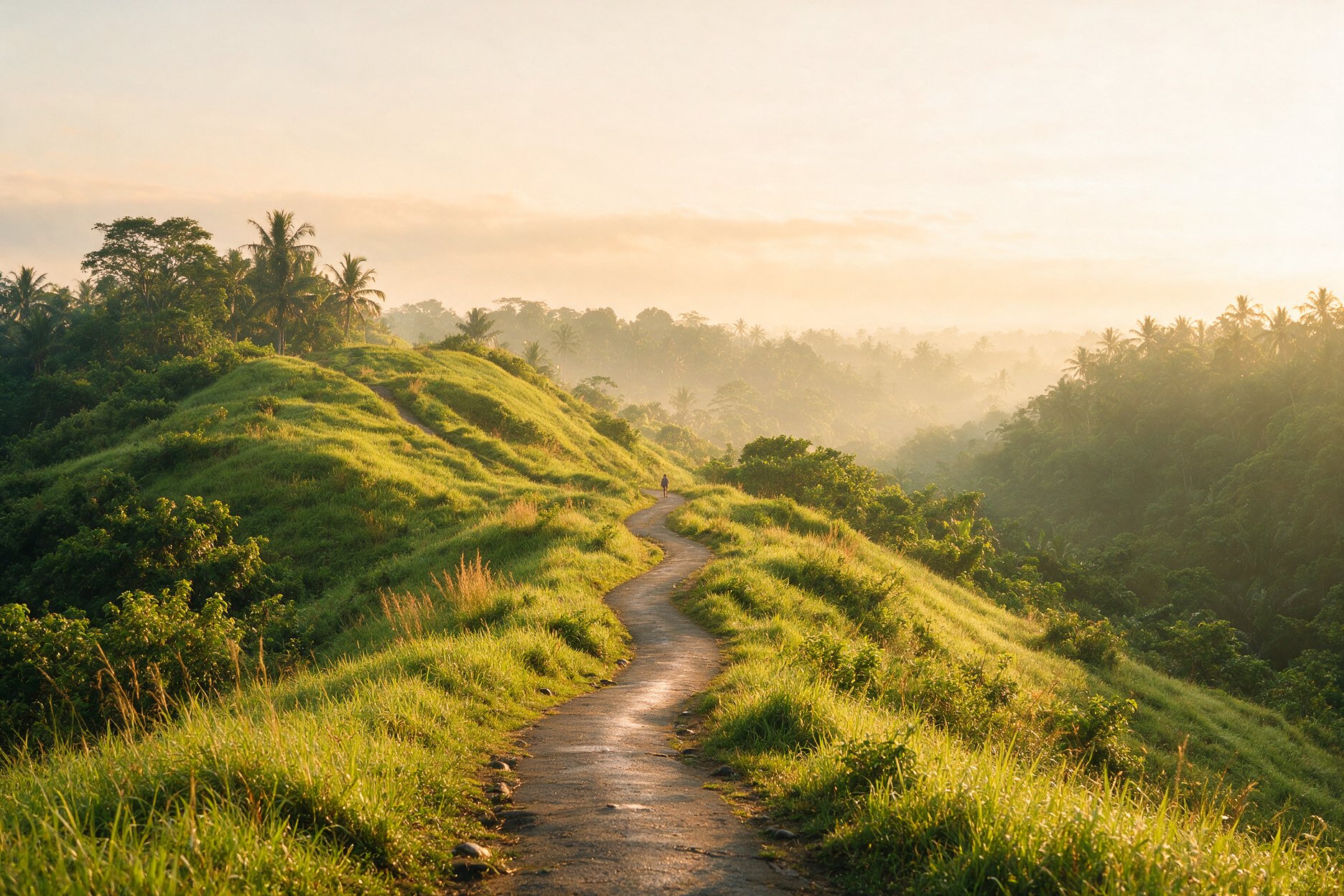
The rice terraces, honestly explained. Tegalalang’s official ticket is IDR 25,000, paid at a real booth — that part is legitimate government retribution, not a scam. What catches people off guard is that the path down through the terraces crosses private plots, and farmers along the way will ask for an additional IDR 10,000–20,000 to cross a bamboo bridge or reach a photo spot. You don’t have to pay every single one, but expect to hand over small notes a few times if you actually walk the terraces rather than just viewing from the road. If you want the same rice-paddy view with zero fees at all, skip Tegalalang and walk the Sidemen valley road instead, or the paths around Jatiluwih’s outer edges — less iconic on Instagram, quieter in real life.
Temples where entry is actually free. This is the part most “free Bali” lists get sloppy about. Tanah Lot, Uluwatu, Besakih, Gunung Kawi, Goa Gajah, Taman Saraswati in Ubud — all ticketed, typically IDR 30,000–150,000. What’s genuinely free: village temples like Pura Puseh Batuan (small donation box, not mandatory) and North Bali’s Pura Melanting, where there’s no entry fee at all — a donation is welcomed but not collected at a gate. The trade-off is these temples aren’t the postcard-famous ones; they’re working neighborhood temples, which honestly makes them more interesting if you’re there outside a ceremony. Sarongs are required at any Balinese temple, ticketed or not — most free village temples keep a communal box of sarongs at the entrance, but it doesn’t hurt to bring your own or wear a sarong-friendly outfit, since supply at smaller temples can run out on a busy weekend.
Markets to wander. Ubud’s morning market (before it becomes the afternoon art market around 10am) and Sukawati’s art market cost nothing to walk through — you’re only paying if you buy, and bargaining is expected and even a little rude to skip. A fun fact that surprises most first-time visitors: the woven offering baskets (canang sari) you see on every doorstep and sidewalk in Bali are made fresh daily, by hand, and Balinese households can go through several hundred a month. Watching someone assemble one at a market stall, for free, tells you more about daily Balinese life than most paid cultural shows do.
Get Tripped’s honest take: Bali’s free stuff is genuinely worth building a day around, but don’t let anyone convince you a single day in Bali is “the whole trip.” We’ve written more on this in our guides to Bali hidden gems beyond Ubud, Seminyak and Canggu and our broader Bali hidden gems post, if you want the paid stuff worth the money too.
Komodo National Park: The One That Isn’t Free (Here’s What Is)
Let’s be straight about this one, because a lot of content online blurs it: Komodo National Park entry is not free. As of current pricing, a standard permit covering Komodo Island and Padar Island runs around IDR 650,000 per person, and the Rinca Island route (also covering Padar) is closer to IDR 900,000. That covers the park entry and trekking fee, a mandatory ranger guide, conservation contribution, and usually a snorkeling permit — but it’s a real cost, not a formality, and it’s collected on top of whatever you’re already paying for a boat trip. Anyone telling you Komodo dragons are a free sighting hasn’t actually gone.
Where it gets interesting is everything around the park. Labuan Bajo itself, the gateway town, has plenty that costs nothing. Puncak Waringin, a hillside viewpoint a short drive or a steep uphill walk from the harbor, gives you a genuinely free sunset over the bay and the boats anchored below — arrive by 5pm to get a spot on the rocks before the crowd thickens. The town’s fish market near the harbor is worth an early wander (free to browse, and you’ll see the day’s catch coming in around 6–7am if you’re up for it). And walking the harbor promenade at dusk, watching the phinisi schooners lit up for the night, costs nothing and is honestly one of my favorite quiet moments in the whole region.
A mistake to avoid: booking a Komodo boat trip that quotes a price without the park fee included, then discovering it’s owed in cash at the ranger station. It happens more than it should. Confirm with your operator (or with us, if you’re booking through Get Tripped) whether the park entrance fee is bundled into the trip cost or payable separately on the day.
Gili Islands: The Most Genuinely Free Place on This List
If one destination on this list deserves to be called “free,” it’s the Gilis. There are no cars, no motorbikes, and no paved roads built for vehicles on Gili Trawangan, Gili Air, or Gili Meno — getting around is on foot, by bicycle, or by horse-drawn cidomo cart. Walking the full loop of Gili Trawangan takes about two hours at an easy pace and costs nothing except sunscreen and water. It’s flat, it’s sandy in patches, and the west side delivers one of the most reliable sunsets in Indonesia, with Bali’s Gunung Agung silhouetted across the strait on a clear evening.
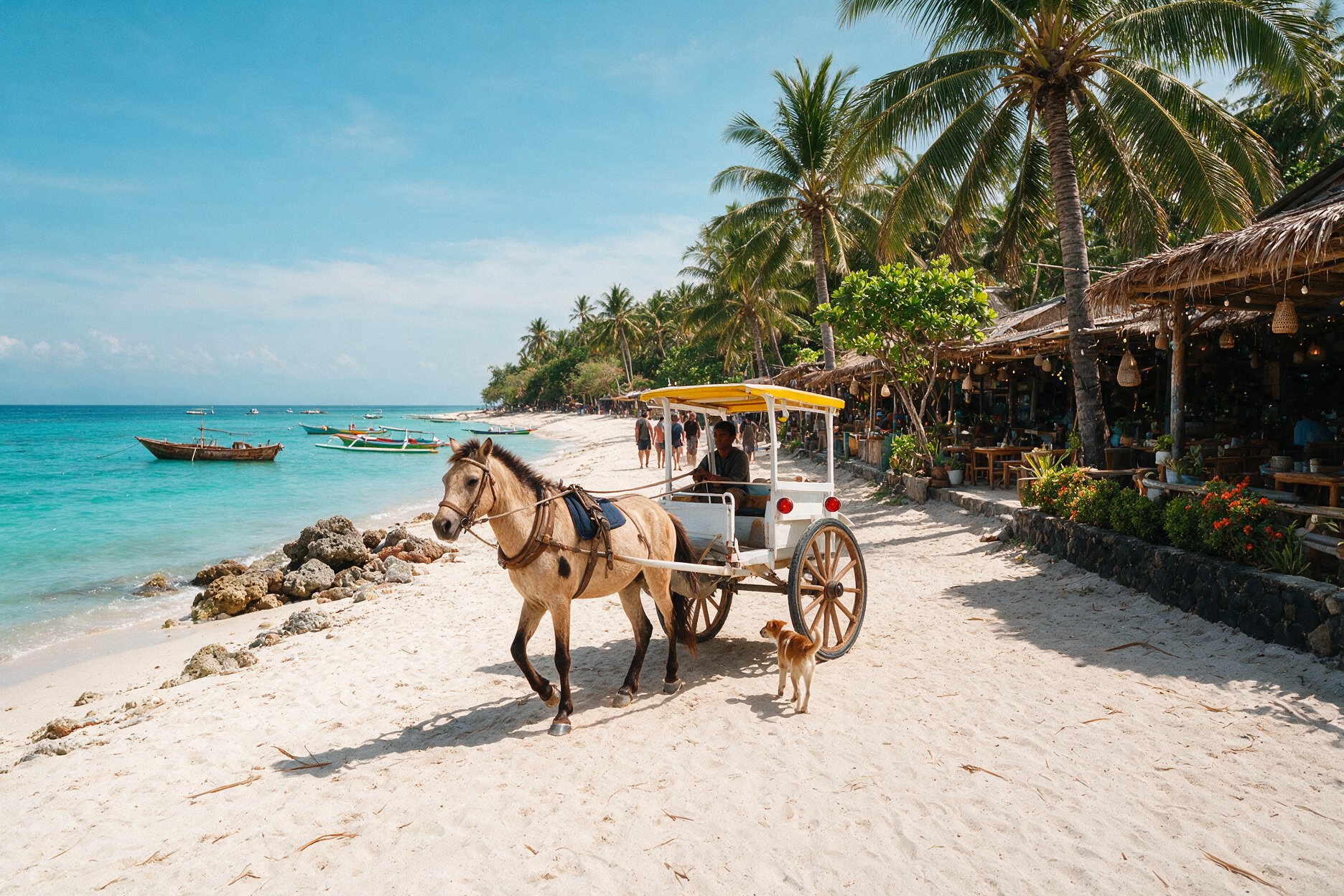
Snorkeling is the other big free-ish item, with a caveat. The water itself and the beach access cost nothing — there’s no entry gate to the sea. Renting a mask and snorkel runs a small daily fee (typically IDR 30,000–50,000) if you don’t bring your own, and the well-known turtle spots off Gili Trawangan’s east side and Gili Meno’s “Turtle Point” are best reached by boat if you want reliable sightings, which does cost money. But if you’re a confident swimmer, some of the reef starts close enough to shore near Gili Air’s east coast to snorkel straight from the beach for free, no boat required — it’s patchier coral than the boat spots, but I’ve seen turtles there on a slow afternoon with nobody else around.
An honest caveat about the Gilis: the night market food stalls on Gili Trawangan look like a free wander, and browsing is, but portions and prices have crept up noticeably in the last couple of years as the island has gone more upscale. It’s still good, and Get Tripped’s clients love the sunset-into-dinner rhythm here, but don’t expect the bargain-street-food prices some older blog posts describe.
Jakarta: Old Town, a Mosque That Fits 200,000 People, and Free Museums
Jakarta doesn’t get nearly enough credit as a free-things-to-do city, mostly because Get Tripped clients tend to treat it as a layover before Bali. That’s a missed opportunity if you have even half a day.
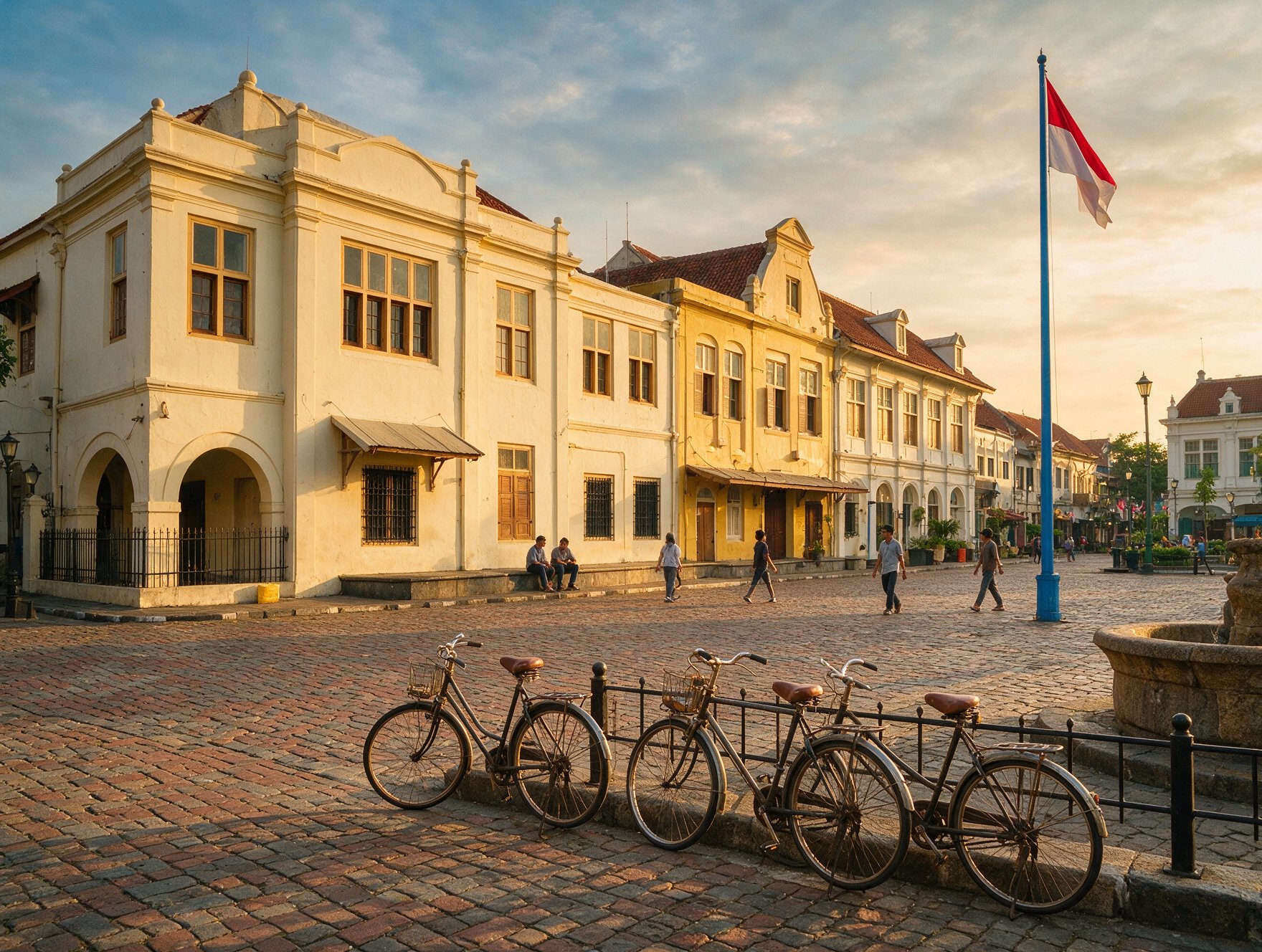
Kota Tua (Old Town) and its central square, Fatahillah, cost nothing to wander. Colonial Dutch architecture, street performers, vintage bicycle rentals (the bikes and colonial hats you see everywhere are a paid photo prop, easily skippable), and a genuinely atmospheric square that’s especially good in late afternoon when the heat breaks a little. The museums ringing the square — the Jakarta History Museum among them — charge a small entrance fee, usually just a few thousand rupiah, more a formality than a real cost, so don’t let “free” purism stop you from paying the equivalent of about 20 rupees to get inside one.
Istiqlal Mosque, one of the largest mosques in Southeast Asia and genuinely built to hold over 200,000 worshippers, is completely free to enter, even for non-Muslim visitors. You’re required to go with a mosque guide (also free, though a donation is appreciated), and sarongs and headscarves are provided on-site for anyone not dressed appropriately. Non-Muslim visitors can’t access the main prayer floor but can observe from the upper level, which is still an enormous, humbling space to stand in. It sits directly across from Jakarta Cathedral, and seeing both within a five-minute walk of each other says something about the city that a guidebook paragraph can’t quite capture.
A local tip that doesn’t make the top-10 lists: the area around Glodok (Jakarta’s Chinatown) rewards aimless wandering more than any single ticketed sight in the city — incense shops, a working temple or two you can step into respectfully for free, and food stalls that have been in the same family for three generations. Go hungry, because the smells will get you before the sights do.
Monas (National Monument) sits in a large public park that’s free to enter and popular with local families on weekends — kite-flying, food carts, the whole scene. Going up the monument’s observation deck for the city view is ticketed (a modest fee), but just being in the park at golden hour, watching Jakarta do its own version of an evening stroll, costs nothing.
Nusa Penida: One Small Island Fee, Then Mostly Free
Nusa Penida charges a single island entrance fee at the harbor when you arrive by boat — around IDR 25,000 per adult, a government-set retribution fee under local regulation, not a scam or a tour operator markup. That’s the honest baseline cost of setting foot on the island at all. From there, individual spots add their own small charges: Kelingking Beach’s viewpoint (the famous “T-rex” cliff shot) runs about IDR 10,000 to enter plus a small parking fee, and toilets near the vendors charge a few thousand rupiah more — genuinely under a dollar total, but not zero.
What actually is free once you’re there: Crystal Bay’s beach access has no separate ticket beyond the island fee, and it’s one of the better snorkeling-from-shore spots on Bali’s satellite islands. The clifftop views along the road between viewpoints — plenty of pull-off spots with a view nearly as good as the paid overlooks — cost nothing if you’re driving yourself or ask your driver to stop.
A mistake to avoid: trying to do Nusa Penida as a single rushed day trip from Bali, which is how most people see it and how most people end up disappointed. The roads are rough, unpaved in stretches, and the island is bigger than the map suggests once you’re stuck behind a truck on a one-lane cliff road. Staying even one night on the island changes the whole experience — you get Kelingking at actual sunrise, before the tour buses from Sanur harbor arrive around 10am, instead of fighting for a spot on the viewing platform at midday.
Flores: Honest About Kelimutu, and What’s Free Around It
Flores is the island on this list where I’ll push back hardest on the “free” framing some other guides use. Kelimutu National Park — the three-colored crater lakes that are the entire reason most people fly to Flores — is not free. Entrance runs around IDR 150,000 on weekdays and IDR 225,000 on weekends. It’s worth every rupiah for the sunrise view over the lakes, but don’t book a Flores trip expecting this centerpiece to be a free stop.
What’s genuinely free or near-free around it: the traditional villages in the Bajawa/Ngada highlands, particularly Bena village, ask for a nominal entry of around IDR 10,000–25,000, collected by a village attendant rather than at a formal booth, sometimes as a straightforward donation rather than a fixed price. That’s about as close to a “pay what feels right” arrangement as you’ll find in Indonesia, and it directly supports a community that’s kept its traditional megalithic houses and ancestor-worship customs intact rather than rebuilding for tourism.
A fun fact worth knowing before you go: Kelimutu’s three crater lakes change color over months and years due to mineral and gas activity beneath them — local Lio legend holds that the lakes are where the souls of the dead go, sorted by the lake’s color into where they lived their lives. It’s not folklore dressed up for tourists; it’s a belief still held locally, which is part of why the site feels different from a typical scenic overlook.
Beyond the ticketed centerpiece, wandering Moni village (the small town at Kelimutu’s base) costs nothing, and the black-sand beaches near Ende, a couple of hours south, are free public beaches with almost nobody on them outside of local fishermen bringing in the morning catch. Flores rewards slow travel more than any other stop on this list — it’s the least “packaged” of Get Tripped’s Indonesia destinations, and that’s exactly its appeal for travelers who’ve already done Bali.
FAQs
Is Komodo National Park actually free to visit?
No. This is one of the most commonly mis-stated facts about Indonesia online. Entry to Komodo National Park costs roughly IDR 650,000 per person for the Komodo/Padar route and around IDR 900,000 for the Rinca/Padar route, covering entrance, trekking, ranger guide, and conservation fees. Budget for it as a real line item, not an afterthought.
Do all Bali temples charge an entrance fee?
The famous ones do — Tanah Lot, Uluwatu, Besakih, Tirta Empul, and Taman Saraswati all charge somewhere between IDR 30,000 and 150,000. Smaller village temples, like Pura Melanting in North Bali or neighborhood temples such as Pura Puseh Batuan, are typically free to enter with only a suggested donation. Sarongs are required everywhere, ticketed or not.
What is the best time to visit Indonesia for outdoor free activities?
The dry season, roughly April to October, is best across most of Indonesia, including Bali, the Gilis, Nusa Penida, and Flores — clearer skies for sunset spots and viewpoints, and drier trails for things like Campuhan Ridge Walk and Kelimutu’s crater rim. July to September is peak dry season but also peak crowds; late April, May, or September often give you the same weather with noticeably fewer people at free spots like Kelingking Beach.
Is Indonesia safe for tourists, including solo travelers wandering free attractions?
Indonesia is generally safe for tourists, including solo travelers, and areas like Kota Tua Jakarta, Ubud’s markets, and the Gili Islands see heavy foot traffic day and night. Standard precautions apply — watch belongings in crowded markets, use official taxi apps in Jakarta rather than unmarked cars, and be cautious of the current at ocean beaches like Nyang Nyang, where lifeguards aren’t always present. Road conditions on Nusa Penida and parts of Flores are rougher than in Bali, which matters more for safety than crime does.
Can I visit the Gili Islands without spending much money at all?
Yes, more so than anywhere else on this list. Getting around the Gilis on foot or bicycle is free, beach access has no gate, and the boat transfer from Bali or Lombok is the main unavoidable cost. Snorkeling gear rental and boat trips to guaranteed turtle spots are the optional paid add-ons.
Is it worth stopping in Jakarta if I’m mainly headed to Bali?
If your flight routes through Jakarta anyway, yes, for even a half-day layover. Kota Tua and Istiqlal Mosque alone give you a genuinely different side of Indonesia than the beaches, and both are free or near-free to visit. It’s not a detour Get Tripped would build a full trip around, but it’s a strong use of a long layover.
How much should I actually budget for “free” attractions in Bali and Nusa Penida?
Realistically, plan for small cash amounts even on “free” days — IDR 10,000–50,000 here and there for parking, toilets, sarong rental, or a village donation. It adds up to only a few dollars across a full day, but showing up with zero small notes is a common mistake, since most of these fees are cash-only and change is not always available.
Do I need a guide to see the free things on this list?
No, most of what’s covered here — beaches, ridge walks, old town wandering, free temples, village strolls — is easy to do independently with a rented scooter, a driver for the day, or on foot. A guide adds real value at Komodo National Park (it’s mandatory there) and at Kelimutu if you want the local legends explained properly, but for the genuinely free stuff, independence works fine.
The Honest Bottom Line
Indonesia’s free things to do are real, plentiful, and worth planning around — but the honest version of this list has fewer “100% free” claims than most blog posts make, because a lot of what gets called free actually has a small, fair, locally-collected fee attached. Bali’s beaches, sunset points, and Campuhan Ridge Walk are the closest to true zero-cost. Komodo National Park is the clear exception, and budgeting for it properly matters more than chasing free experiences around its edges. Everywhere else falls somewhere in between: a token entrance fee here, a donation box there, mostly under a dollar and mostly fair.
If you’d rather not sort all of this out site by site — which fees are legitimate, which viewpoints are worth the climb, when to show up before the tour buses do — that’s exactly the kind of detail Get Tripped builds into a custom Indonesia itinerary. Have a look at our Indonesia destination page and tell us which of these six places you’re drawn to, and we’ll build the rest around it, free stuff included.