Tomorrow, the price of the Japan Rail Pass goes up. If you’re reading this on or before September 30, 2026, a 7-day Ordinary Pass still costs ¥50,000. From October 1, it’s ¥53,000, and the 14-day and 21-day passes climb too. That’s on top of the pass more than doubling back in October 2023, when it jumped from ¥29,650 to ¥50,000 overnight. Japan’s trains are extraordinary — clean, punctual to the minute, and genuinely pleasant to ride — but the pricing keeps shifting, and most of the advice floating around online is a year or two stale. This is the transit picture as it actually stands today, written for travelers who’d rather have a car pick them up and a driver forward their bags than spend a vacation staring at a fare calculator.
Get Tripped builds Japan tour packages from India that handle exactly this — JR Pass decisions, IC card setup, shinkansen seat reservations, airport transfers — before you land. If you’d rather have someone else sweat the logistics, our Japan vacation packages and custom Japan itinerary planning cover all of it. But if you’re navigating it yourself, here’s everything current as of today.
Table of Contents
- Why Japan’s Trains Are Worth Planning Around
- The JR Pass in 2026: New Prices and Whether It’s Still Worth Buying
- Suica, Pasmo, Welcome Suica and ICOCA: Which IC Card to Get
- Booking the Shinkansen Without a JR Pass
- Getting Around Tokyo: Metro, Toei and the Yamanote Line
- Osaka, Kyoto, Nara, Hiroshima and Sapporo: City-by-City Notes
- Airport Transfers: Narita, Haneda, Kansai and New Chitose
- Taxis and the GO App
- Luggage Forwarding: Traveling Light Between Cities
- Day Trips by Train: Shinjuku to Kamakura and Enoshima
- Train Etiquette Nobody Tells You
- How Much to Budget for Transit
- FAQs
Why Japan’s Trains Are Worth Planning Around
Every regional JR office famously publishes its average delay time for the year, and it’s usually measured in seconds, not minutes. That’s not a marketing line — it’s a real operational metric, and it shapes how you should plan a trip. Trains leave when the board says they leave. Miss it by ninety seconds and you’re waiting for the next one, full stop. The upside is that Japan’s rail network is also the single best reason to build a multi-city itinerary here: Tokyo to Kyoto by shinkansen is a smoother transition than most domestic flights in India, complete with a trolley cart selling hot coffee and ekiben (station lunch boxes) at your seat.
The one honest caveat: none of this is designed around convenience for someone dragging three checked suitcases. Stations are enormous, platforms aren’t always step-free to every exit, and transfers between subway and JR lines can mean a ten-minute underground walk. That’s exactly why the choices below — pass or no pass, which IC card, whether to forward your luggage — matter more than they’d seem to on paper.
The JR Pass in 2026: New Prices and Whether It’s Still Worth Buying
Here’s the number that matters most right now: the Japan Rail Pass sold through authorized overseas agents increases on October 1, 2026, for purchases made from that date onward (based on local time at point of purchase). It’s a modest 5-6% bump compared to the 2023 hike, but it’s worth knowing the current figures before you book.
| Pass | Through Sept 30, 2026 | From Oct 1, 2026 |
|---|---|---|
| 7-day Ordinary | ¥50,000 | ¥53,000 |
| 14-day Ordinary | ¥80,000 | ¥84,000 |
| 21-day Ordinary | ¥100,000 | ¥105,000 |
| 7-day Green Car | ¥70,000 | ¥74,000 |
| 14-day Green Car | ¥110,000 | ¥116,000 |
| 21-day Green Car | ¥140,000 | ¥147,000 |
For context: the 7-day Ordinary pass held steady near ¥29,650 for decades until October 2023, when it jumped 69% in one go — a 7-day pass now costs more than the old 14-day pass used to.
Is it still worth it? Run the numbers before you buy. A one-way Tokyo–Kyoto reserved seat (the pass covers Hikari, not the faster Nozomi) runs around ¥14,000-15,000. A Tokyo → Kyoto → Hiroshima → Osaka → Tokyo loop within a week clears ¥53,000 in point-to-point fares easily, so the pass wins comfortably. If you’re based mostly in one or two cities with a single round trip between them, buy point-to-point tickets instead — you’ll likely come out ahead and skip the exchange-order paperwork. A mistake we see constantly: travelers buy the pass out of habit, then spend half their week inside Tokyo on the subway, where it covers almost nothing. Map your intercity legs first.
One more thing: the JR Pass excludes Nozomi and Mizuho, the fastest Tokaido/Sanyo Shinkansen services. You’ll ride Hikari or Sakura instead, usually adding 15-30 minutes per leg — rarely a dealbreaker, but worth knowing if you’re connecting to a flight.
Suica, Pasmo, Welcome Suica and ICOCA: Which IC Card to Get
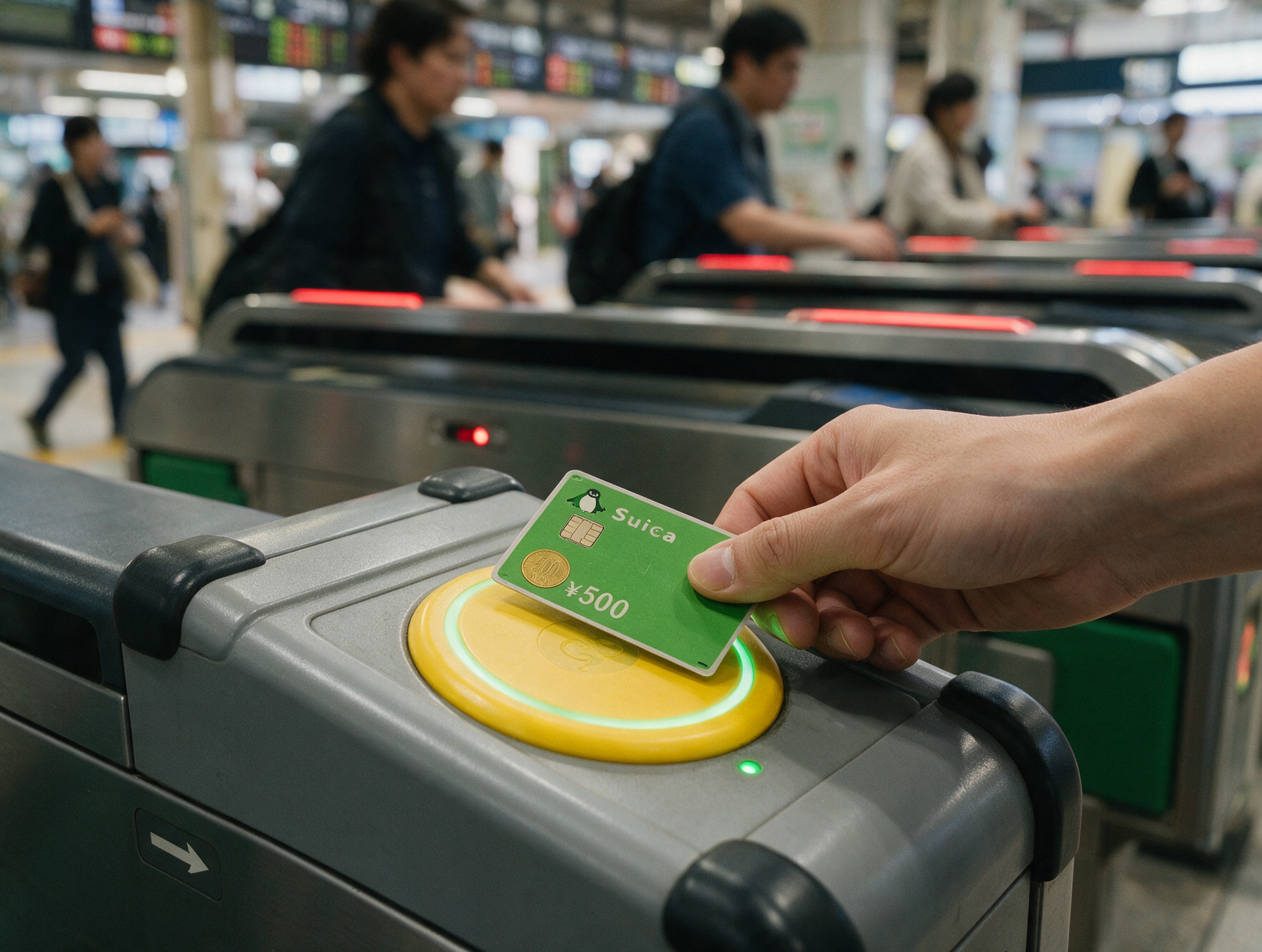
An IC card is the single most useful thing you’ll carry in Japan. It taps in and out of virtually every train and subway gate nationwide, pays for buses, and works at convenience store registers, vending machines, and coin lockers. You don’t need to think about fares at all — you just tap and go, and the system calculates the correct amount.
The regional brand names — Suica and Pasmo in Tokyo, ICOCA around Osaka and Kyoto, Kitaca in Sapporo — are functionally interchangeable almost everywhere in the country. Buy whichever one is easiest to get where you land; you won’t notice the difference once you’re tapping gates in a different city.
For visitors specifically, there are now several practical options:
- Welcome Suica — a tourist-only card valid for 28 days, no ¥500 deposit required. Available at JR East Travel Service Centers at Narita Airport (all terminals), Haneda Terminal 3, and major Tokyo stations. Any leftover balance isn’t refundable once it expires, so don’t overload it near the end of your trip.
- PASMO Passport — the same idea from the Pasmo side: 28-day validity, no deposit, available at Narita, Haneda, and tourist information counters.
- Mobile Suica via Apple Pay — if you’re on an iPhone, this is genuinely the easiest option. No deposit, no expiry, and you top it up directly with a foreign credit card from the Wallet app before you even land. Android users in Japan generally need a Japan-issued phone for the equivalent Osaifu-Keitai feature, so Apple Pay is the more realistic global option.
- Standard physical Suica/Pasmo — requires a ¥500 refundable deposit, works indefinitely, and can be refunded (minus a small fee) at a station window before you leave.
Top-ups are straightforward: station touchscreen machines take cash (and sometimes cards), and most convenience stores will reload a physical card at the register. A local tip that doesn’t make the top-10 lists — if a top-up machine only accepts coins and small notes and your only ¥10,000 bill is jamming the slot, walk to the nearest 7-Eleven counter and ask staff to charge it there; they do this constantly and it takes thirty seconds.
Booking the Shinkansen Without a JR Pass
If you’re buying point-to-point tickets rather than a pass, book online rather than queuing at a counter. Two platforms cover almost every route:
- SmartEX (smart-ex.jp/en) — covers the Tokaido, Sanyo, and Kyushu Shinkansen lines, meaning Tokyo–Nagoya–Osaka–Hiroshima–Hakata. This is the one most India-based travelers will use, since it covers the Tokyo–Kyoto–Osaka–Hiroshima corridor.
- eki-net.com (JR East) — for Tohoku, Hokkaido, and Hokuriku routes, including trips up toward Sapporo by rail.
Both accept major foreign cards, but 3D Secure 2.0 authentication trips up a fair number of Indian-issued cards — if a booking fails, it’s usually your bank’s fraud filter, not the platform. Call your bank before the trip to pre-clear international transactions, and keep a backup: any staffed JR ticket counter or multilingual machine will take a card in person even when the same card fails online.
Reservations open 30 days before travel at 10:00 a.m. Japan Standard Time. During the cherry blossom season (late March–early April) and autumn foliage weeks (late October–November), Nozomi and Hikari trains on popular legs sell out their reserved cars well ahead — if your trip lands in those windows, book the moment the 30-day window opens rather than winging it. We’ve covered the autumn timing in more detail in our Japan autumn travel guide.
Non-reserved cars exist on most Tokaido Shinkansen trains and are usually fine outside peak season, but standing for two hours because you gambled on car 1-3 during Golden Week is not a mistake you want to make twice.
Getting Around Tokyo: Metro, Toei and the Yamanote Line
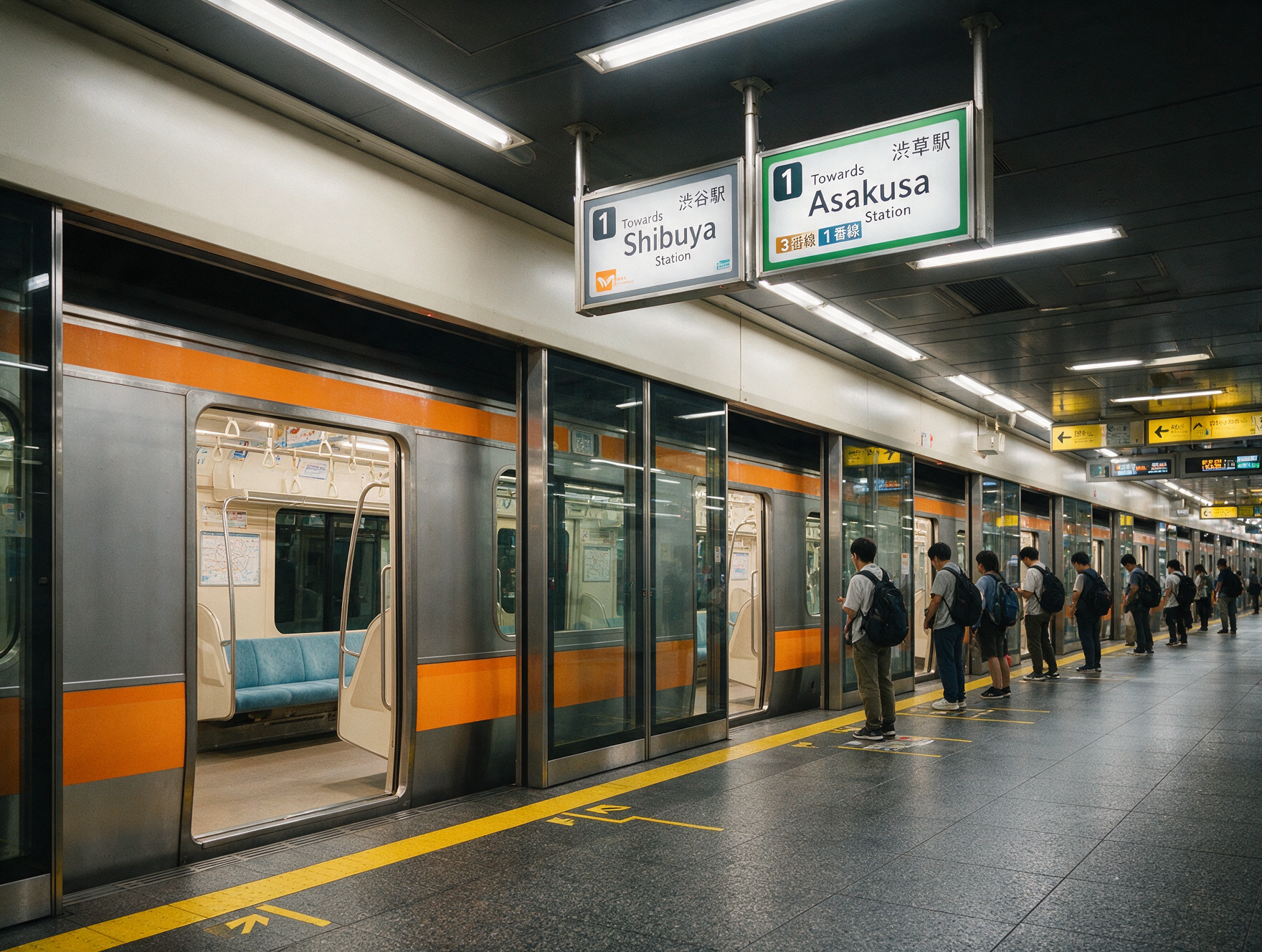
Tokyo’s underground network is really two separate companies — Tokyo Metro (9 lines) and Toei Subway (4 lines) — that happen to share stations and, mostly, fare gates. A Tokyo Subway Ticket covers all 13 lines: ¥1,000 for 24 hours, ¥1,500 for 48 hours, ¥2,000 for 72 hours, counted from first use rather than calendar day. It pays for itself at roughly four to five rides a day; for a lighter sightseeing day with two or three hops, an IC card working pay-as-you-go (around ¥180 minimum per ride) is cheaper.
The catch almost every first-timer misses: the JR-operated Yamanote Line — the loop line connecting Shinjuku, Shibuya, Tokyo Station, and Ueno — is not covered by the subway pass, because it’s JR, not Metro or Toei. If your day involves the Yamanote Line, keep an IC card topped up alongside whatever pass you’re using.
Escalator etiquette in Tokyo: stand on the left, walk on the right (it flips in Osaka — more on that below). Not an official rule, just one that locals expect and mild chaos results when tourists block both sides mid-rush hour.
Osaka, Kyoto, Nara, Hiroshima and Sapporo: City-by-City Notes
Osaka: Osaka Metro’s Enjoy Eco Card day pass costs ¥820 on weekdays and ¥620 on weekends and holidays, covering unlimited subway and city bus rides plus small discounts at roughly 20 attractions. If you’re front-loading sightseeing, the separately-sold Osaka Amazing Pass bundles transit with free entry to attractions like Osaka Castle — worth comparing against your planned stops rather than buying on reflex.
Kyoto — a mistake to avoid: A lot of older blog posts still recommend Kyoto’s one-day bus pass. It’s gone — the city stopped selling it in September 2023 and it stopped working entirely by March 2024, specifically to push crowds off overloaded buses and onto the subway. Use the Subway & Bus 1-Day Pass instead (¥1,100, covers both) or the Subway 1-Day Pass alone (¥800). A single bus ride is a flat ¥230. Given how congested Kyoto’s buses get in peak season, lean toward walking and subway wherever the route allows — it’s also a more pleasant way to see the city at street level.
Nara: Most of the park, the deer, and Todai-ji temple are walkable from Kintetsu Nara or JR Nara stations — you genuinely don’t need a transit pass here, just comfortable shoes.
Hiroshima: The city’s streetcar (tram) network is the easiest way to reach the Peace Memorial Park and connects onward to the ferry terminal for Miyajima. Single rides are inexpensive and IC cards work on board.
Sapporo: The Sapporo Municipal Subway plus a small streetcar loop covers the city center efficiently, and IC cards (Kitaca, or your Suica/Pasmo/ICOCA from elsewhere) work throughout. It’s a quieter, less crowded system than Tokyo or Osaka’s — one of the genuine pleasures of ending a Japan itinerary up north.
Airport Transfers: Narita, Haneda, Kansai and New Chitose
Most India-Japan routings land at Narita or Haneda (Tokyo), Kansai (Osaka/Kyoto), or New Chitose (Sapporo). If you’re flying the newer direct Mumbai–Tokyo route, we’ve broken down the full journey in our Mumbai to Tokyo direct flight guide. Here’s what to expect on arrival at each:
| Airport | Option | Fare | Time |
|---|---|---|---|
| Narita → Tokyo | Narita Express (N’EX) | ¥3,070 (Tokyo Stn) / ¥3,250 (Shinjuku/Shibuya) | ~55-80 min |
| Keisei Skyliner | ¥2,310 online / ¥2,580 counter | 36-41 min to Nippori/Ueno | |
| Limousine Bus | ¥3,100-3,600 | 60-120 min (traffic-dependent) | |
| Haneda → Tokyo | Keikyu + Yamanote | ~¥620 | ~45 min |
| Monorail + Yamanote | ~¥700 | ~50 min | |
| Taxi | ¥8,000-12,000 | 35-60 min | |
| Kansai → Osaka/Kyoto | Haruka Express (to Shin-Osaka / Kyoto) | ¥1,800 / ¥2,200 | ~50 / ~75 min |
| JR Pass holders | Free (covered) | Same as above | |
| New Chitose → Sapporo | JR Rapid Airport | ¥1,230 | 33-37 min |
| Taxi | ¥10,000-13,000 | ~60 min |
A practical tip: landing jet-lagged with heavy bags, the limousine bus is worth the extra yen over the train — it drops you at named hotels with luggage stowed underneath, no stairs, no transfers. We generally build this in as a private transfer for our curated Japan tour packages from India, especially honeymoon and family departures where nobody wants to wrestle suitcases through a station forty minutes after landing.
Taxis and the GO App
Japanese taxis are immaculate and metered fairly, and the doors open automatically — do not pull the handle, the driver operates it. They’re not cheap over longer distances, so use them for late-night returns, groups splitting a fare, or the last stretch with heavy luggage rather than as default city transport.
The app to download before you land is GO (by GO Inc.) — the most widely used taxi-hailing app in Japan, which went through a major Tokyo IPO in 2026, with English support and in-app card payment so you’re not fumbling with cash at 11pm. Uber operates here too, but mostly by routing you to the same taxi fleets GO already covers, with less reach outside major cities — GO is the more reliable default.
Luggage Forwarding: Traveling Light Between Cities
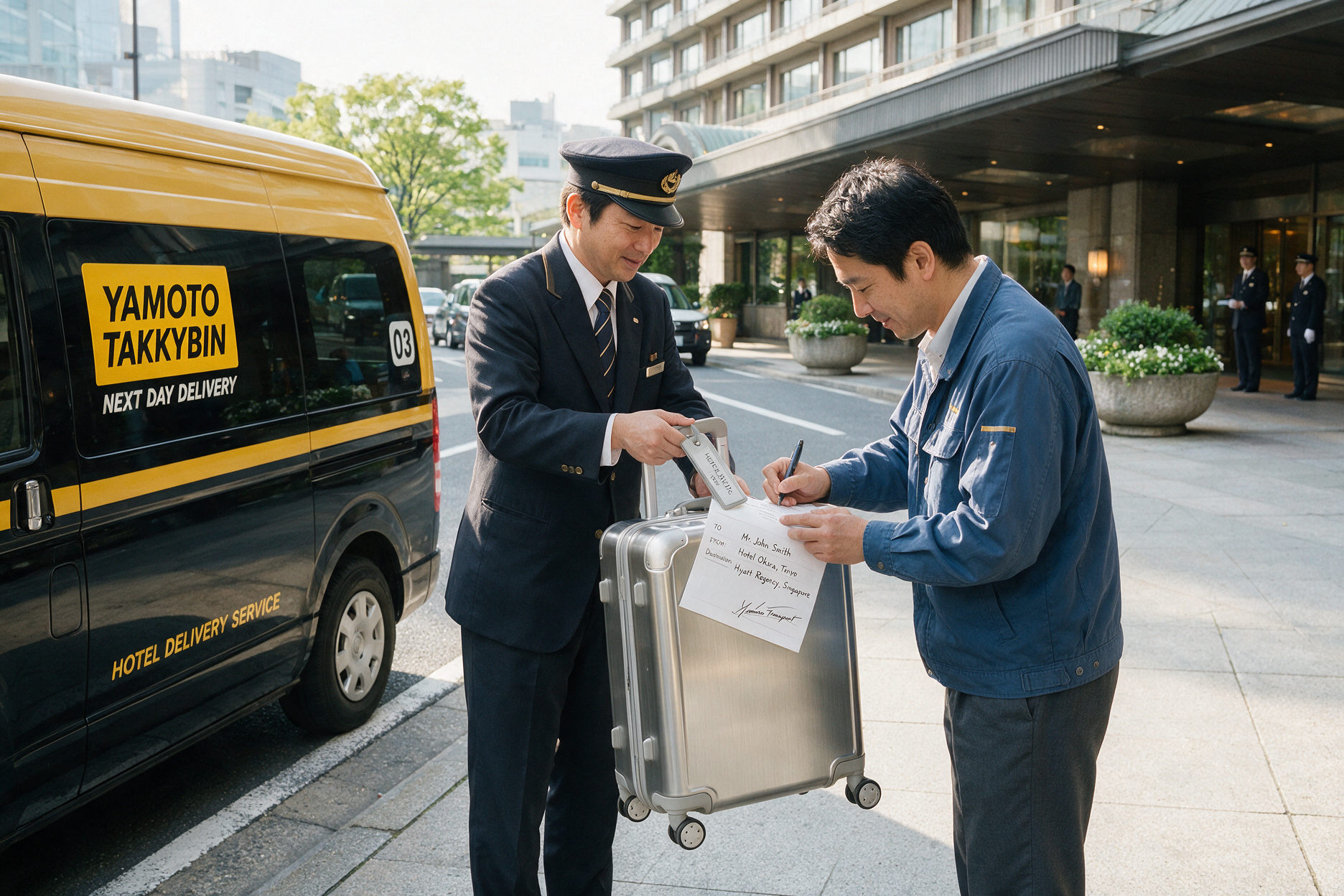
This is the single most underused comfort upgrade for multi-city Japan trips. Japan’s takkyubin (courier) network — Yamato Transport’s “TA-Q-BIN,” recognizable by its black cat logo, is the most common — will pick up your suitcase from your hotel and deliver it to your next hotel, so you ride the shinkansen carrying nothing but a day bag.
Roughly what it costs: a standard 26-inch suitcase runs about ¥2,040 for a same-region delivery, a larger 28-inch bag around ¥2,630, with inter-city routes (Tokyo to Kyoto or Osaka) adding a ¥300-600 regional surcharge. Airport counters at Narita and Haneda add a further ¥660 handling fee — genuinely inexpensive for what it saves you, a few thousand yen to skip dragging 23kg through three train transfers.
Timing matters, and this is the mistake to avoid: Tokyo to Kyoto, Osaka, or Nagoya typically takes until the next day to arrive, not same-day, so you need to check in somewhere for one night before your bag catches up, or send it a day ahead of your own travel. Tokyo to Sapporo takes two days. Same-city delivery can be same-day if dropped off before around 11am. Drop-off points include hotel front desks, airport counters, and most convenience stores (7-Eleven, FamilyMart, Lawson-adjacent chains, Daily Yamazaki). Maximum size is 200cm combined dimensions and 30kg per piece.
Day Trips by Train: Shinjuku to Kamakura and Enoshima
One of the best uses of Japan’s rail network isn’t intercity travel — it’s the day trips it makes effortless from Tokyo. The Shinjuku to Kamakura route (via the Odakyu Line, or JR’s Yokosuka Line) takes roughly an hour and drops you into a completely different pace: temples, a giant bronze Buddha, a coastline instead of skyscrapers.
From Kamakura, the Enoshima Electric Railway (“Enoden”) runs a slow, scenic coastal line out to Enoshima island, and the Shonan Monorail — which hangs suspended from its track rather than running on top of it — connects Ofuna to Shonan-Enoshima on a genuinely unusual ride worth doing for the novelty alone. None of this needs a JR Pass; an IC card covers the whole loop for a few thousand yen. It’s the kind of half-day detour that pairs naturally with the slower, scenery-first pace we cover in our guide to Japan’s autumn hidden gems beyond Kyoto.
Train Etiquette Nobody Tells You
- Phone calls are a no. Texting and silent scrolling are fine; talking on a call is one of the few things that draws visible stares on a Japanese train.
- Priority seats exist and are respected. Give them up for elderly, pregnant, or disabled passengers even if the car looks empty elsewhere — it’s noticed.
- No eating on local trains or subways, but it’s completely normal — expected, even — on the shinkansen, where the ekiben lunch box culture is part of the experience.
- Queue in the marked lines on the platform and let passengers off before you board. This is non-negotiable etiquette, not a suggestion.
- Women-only cars run on some lines during weekday rush hours, marked with pink signage on the platform and car itself — worth knowing so you don’t board one by accident during peak commute times.
- Escalators flip by city — stand left in Tokyo, stand right in Osaka. Small thing, but it’s the kind of detail that marks you as someone who’s done this before.
How Much to Budget for Transit
For a typical mid-range itinerary — Tokyo, Kyoto, Osaka, and Hiroshima over 10-12 days — budget roughly ¥15,000-25,000 per person for intercity rail without a JR Pass, plus ¥800-1,500 per person per day for local subway, bus, and taxi top-offs. Add ¥2,000-3,000 per bag per hop for luggage forwarding, and ¥1,500-4,000 each way for airport transfers. It’s a small slice of overall Japan trip cost from India — flights and hotels move that needle far more — but it’s the part that trips people up if it isn’t planned ahead, which is why we build it into our Japan honeymoon packages from India, Japan family holiday packages, and Tokyo and Kyoto tour packages as a fixed line rather than something you’re figuring out at a ticket machine mid-trip.
FAQs
Is the JR Pass worth it in 2026?
Only if your itinerary involves several long intercity legs within a short window — for example Tokyo–Kyoto–Hiroshima–Osaka–Tokyo in a week. Run your actual route cost against the pass price (¥53,000 for 7 days Ordinary from October 1, 2026) before buying; for trips based mostly in one or two cities, point-to-point tickets are usually cheaper.
What’s the difference between Suica and Pasmo?
Functionally, almost nothing — both are IC cards from different Tokyo-area operators, and both work identically across trains, subways, buses, and stores nationwide. Pick based on convenience (Welcome Suica vs. PASMO Passport availability where you land) rather than any functional difference.
Can I use my Suica card in Osaka or Kyoto?
Yes. Suica, Pasmo, ICOCA, and Kitaca are all part of the same nationwide interoperable IC card network and work interchangeably at nearly every gate, bus, and convenience store across the country.
Do I need to reserve shinkansen seats in advance?
Not always, but it’s strongly recommended during cherry blossom season (late March-early April) and autumn foliage weeks (late October-November), when reserved cars on popular routes sell out. Book via SmartEX or eki-net up to 30 days ahead, or reserve at a station counter after arrival.
How do I get from Narita or Haneda airport to central Tokyo?
From Narita, the Narita Express or Keisei Skyliner are the fastest rail options (roughly ¥2,300-3,300, 36-80 minutes depending on destination and train). From Haneda, the Keikyu Line or Tokyo Monorail connecting to the Yamanote Line gets you into the city center in about 45-50 minutes for under ¥700.
What is the GO app and do I need it?
GO is Japan’s most widely used taxi-hailing app, with English support and in-app card payment. It’s not essential if you’re mostly using trains, but it’s genuinely useful for late-night returns, airport pickups, or whenever you’re traveling with more luggage than the subway is comfortable for.
Can I send my luggage ahead between cities?
Yes — it’s called takkyubin, and it’s extremely common. Hand your suitcase to your hotel desk or a courier counter in the morning and it typically arrives at your next hotel the following day (same-city deliveries can be same-day). Costs run roughly ¥2,000-3,000 per standard bag depending on distance.
Do I need an International Driving Permit to drive in Japan?
Only if you’re renting a car, which most travelers on a Tokyo-Kyoto-Osaka itinerary won’t need given the rail network. If you want to self-drive — around Hokkaido, say — Indian licenses aren’t directly recognized; you’d need an International Driving Permit under the 1949 Geneva Convention, arranged before you leave India.
The Bottom Line
Japan’s transit system rewards a bit of upfront planning and punishes winging it — not because it’s unfriendly to tourists, but because the sheer number of overlapping networks (JR, private railways, subways, buses) means the “obvious” choice often isn’t the cheapest or fastest one. Get the JR Pass math right, pick the IC card that matches your phone, book shinkansen seats early in peak season, and let your suitcase travel separately from you. Do that, and the trains stop being a logistics problem and go back to being one of the actual highlights of the trip.
If you’d rather skip the spreadsheet entirely, Get Tripped’s Japan tour packages from India are built by a team that plans these routes constantly — private transfers, pre-booked shinkansen seats, luggage forwarding, and a custom Japan itinerary tuned to how many days you actually have. Get in touch to book your Japan holiday and we’ll handle the logistics end to end.