Since March 2, 2026, if you’re applying for a Japan visa out of Chennai, Cochin, Hyderabad, or Puducherry, you can’t just walk into the VFS centre with your documents anymore — you need a confirmed appointment, or they turn you away at the door. That’s the single biggest procedural change for Indian travellers this year, and it catches people off guard because half the blog posts written before March still say walk-ins are fine. Japan’s tourist numbers from India jumped roughly 28% in 2025, and the visa centres simply couldn’t process the queues anymore.
None of this makes a Japan visa hard to get. Indian passport holders have one of the smoother processes going — no interview, no biometrics, a flat fee of ₹500, and an approval rate that’s high if your paperwork is clean. But “clean paperwork” is doing a lot of work in that sentence, and most of the rejections we’ve seen come from applicants who treated this like a routine Southeast Asia visa-on-arrival and didn’t realise Japan wants a genuinely coherent, verifiable travel story. This guide walks through exactly what that means: the visa types, the current fees and documents, where to apply, how long it actually takes, and the specific things that get applications sent back.
If you’re past the visa stage and want the actual trip planned — flights, hotels, a route through Tokyo, Kyoto, and Osaka that doesn’t waste half your days in transit — that’s what we do at Get Tripped’s Japan desk, and we’ll touch on how that works toward the end.
Table of Contents
- Do Indians need a visa for Japan?
- Types of Japan visas available to Indian tourists
- Japan eVisa vs the traditional paper visa
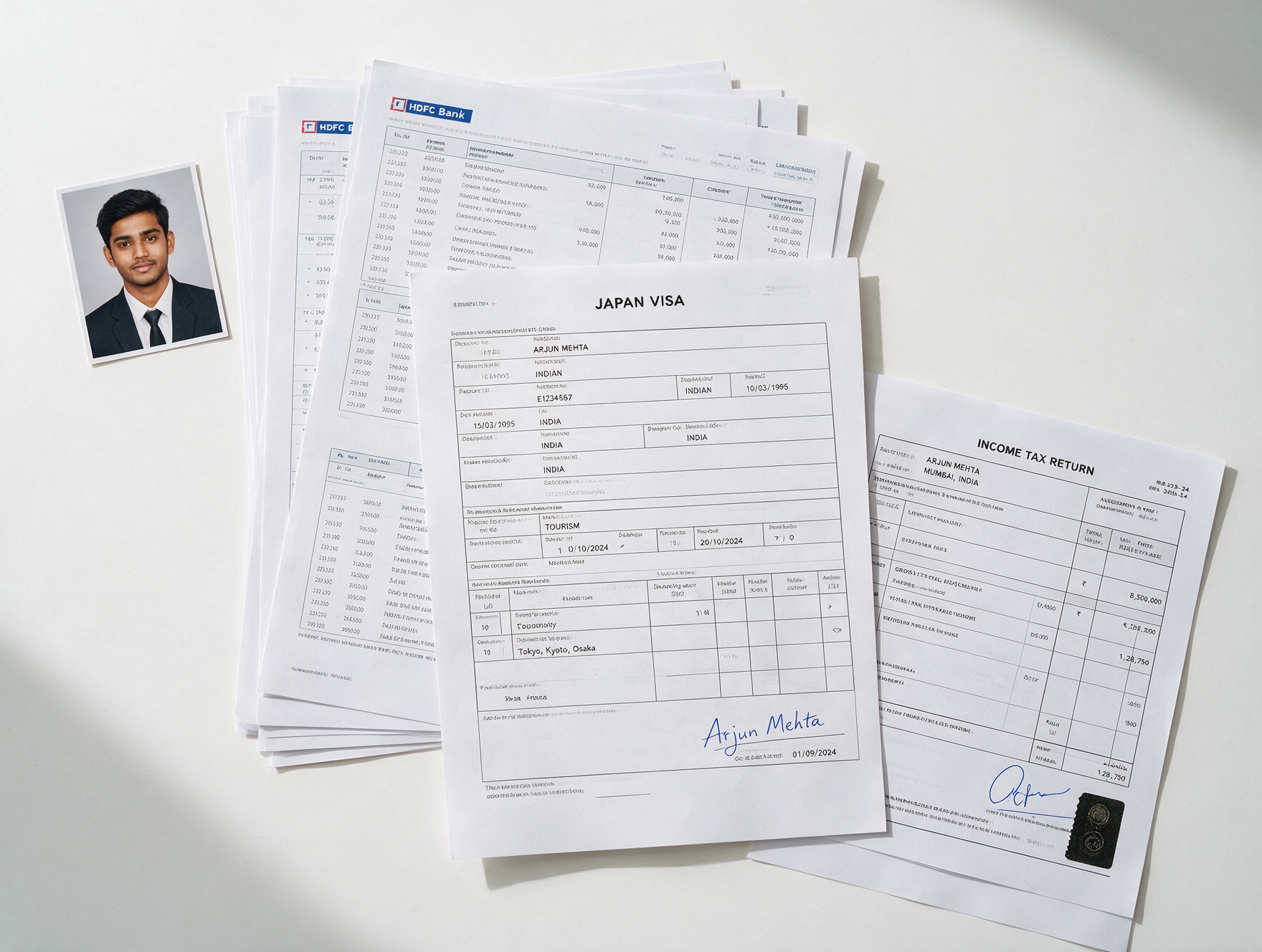
- Documents required for a Japan tourist visa
- Japan visa fees for Indians in 2026
- Where to apply: VFS Global centres across India
- How long the visa actually takes
- Common reasons Japan visa applications get rejected
- Applying as a family or with young children
- Tips for a smoother application
- When to apply, relative to when you want to travel
- FAQs
Do Indians need a visa for Japan?
Yes. There’s no visa-on-arrival and no visa-free entry for Indian passport holders, and that hasn’t changed for 2026 despite the eVisa rollout (more on that below — it’s still a visa, just issued digitally). Every Indian traveller, regardless of the purpose of the trip, applies for a Japan visa for Indians 2026 in advance through the Japan Visa Application Centre network run by VFS Global, and the application has to be lodged before you fly, not at Narita or Kansai immigration.
One thing worth knowing early: Japan doesn’t interview tourist applicants and doesn’t take fingerprints or photographs at the visa stage for a standard short-term visa. The entire decision is made on the paperwork you submit. That’s good news if you’re organised, and a genuine risk if you’re not, because there’s no interview where you can explain an odd bank statement in person.
Types of Japan visas available to Indian tourists
For most Get Tripped travellers, the relevant categories are:
- Single-entry tourist visa — one trip, valid for entry within three months of issue, stay up to 90 days.
- Multiple-entry tourist visa — useful if you’re combining Japan with a stopover elsewhere, or if you travel to Japan more than once a year. Fee is the same as single-entry for Indian nationals, which surprises a lot of people.
- Transit visa — for a layover where you’ll briefly leave the airport (this is separate from most airside transfers, which don’t need one at all).
Within the tourist category, Japan also splits applications into “with guarantor” and “without guarantor.” A guarantor is someone in Japan — a relative, friend, or business contact — who vouches for you and sometimes covers costs. Almost nobody planning a holiday needs this route; it exists mainly for visiting-family trips. If you’re travelling through a registered travel agency (which is how the vast majority of Indian tourist visas are processed), you go through the “without guarantor” category, and the agency’s accreditation with the Japanese consulate substitutes for a personal guarantor. This is one of those details that doesn’t show up in generic top-10 checklists but genuinely matters when you’re filling the form, since picking the wrong category means resubmitting.
Japan eVisa vs the traditional paper visa
Japan switched on its eVisa system for India on April 1, 2024, and by 2026 it’s the default route most applicants end up using without necessarily choosing it on purpose. Here’s the practical difference: instead of a sticker pasted into your passport, you get a digital visa issuance notice with a QR/barcode that you have to pull up live on your phone at Japanese immigration. A screenshot, PDF, or printout is not accepted — the airline and immigration counter both need to see the live app or portal screen, so make sure your phone has data or working Wi-Fi when you land.
A few limits worth knowing before you count on it:
- eVisa currently covers single-entry short-term tourist stays only (up to 90 days) — if you want multiple-entry, you’re on the paper route.
- It cannot be extended or renewed under any circumstances, even by a day.
- You must enter by air, not by sea (relevant if you’re arriving via a cruise).
- Applicants based in India still submit through VFS Global, not directly on Japan’s government portal — that direct-portal option is currently limited to applicants in a handful of countries like the US, UK, Singapore, Australia, and Saudi Arabia.
Everyone else — anyone wanting multiple-entry, or travelling with a guarantor, or arriving other than by air — goes through the traditional paper visa, which is the same VFS submission process, just with a sticker outcome instead of a digital one.
Documents required for a Japan tourist visa
This list covers a standard “without guarantor” tourist application for an employed, salaried applicant. Self-employed, retired, or student applicants swap out the employment proof for the equivalent (business registration, pension statement, or college ID and NOC).
| Document | Notes |
|---|---|
| Passport | Original, minimum 6 months’ validity from your planned entry date, at least 2 blank pages, plus a photocopy of the bio page |
| Visa application form | Filled and signed, available from the VFS Global Japan portal |
| Photograph | One, 2×2 inches, colour, plain white background, taken within the last 6 months |
| Bank statements | Last 3–6 months, showing a stable balance consistent with your trip cost — sudden large deposits right before applying are a common red flag |
| Income Tax Returns | Typically the last 2 years’ ITR-V or acknowledgment |
| Employment proof | Company NOC or leave letter on letterhead, confirming your dates of leave and that you’ll return to your role |
| Itinerary | Day-by-day plan matching your accommodation bookings — vague itineraries (“exploring Japan”) are a rejection trigger |
| Accommodation proof | Confirmed hotel bookings or, if staying with contacts, an invitation letter |
| Flight reservation | A round-trip reservation is enough; you don’t need to buy the ticket before the visa is approved, but the dates must match your itinerary |
For minors and family applications, add a copy of the birth certificate and, if only one parent is travelling with the child, a notarised consent letter from the other parent. We cover this in more detail further down.
A quick honest note: the “3–6 months of bank statements” line sounds routine until you’re the applicant staring at your own statement wondering if last month’s rent transfer looks weird to a visa officer. It generally doesn’t — consulates are looking for consistency and sufficiency, not a spotless account. What actually draws scrutiny is a large unexplained deposit landing two weeks before you apply.
Japan visa fees for Indians in 2026
Consular visa fees for Indian nationals are set well below the standard rate other nationalities pay, and they’re revised roughly once a year. For the period from July 2026 to March 2027, the fee is:
| Visa type | Consular fee (INR) |
|---|---|
| Single-entry tourist visa | ₹500 |
| Multiple-entry tourist visa | ₹500 |
| Transit visa | ₹50–₹100 (varies by jurisdiction) |
On top of that, VFS Global charges its own service fee, currently around ₹800 (inclusive of GST) per application, plus optional extras like courier return of your passport (roughly ₹550) or SMS/photocopy add-ons at the centre. So budget roughly ₹1,300–₹1,500 per applicant all-in for a standard tourist visa, which is genuinely one of the cheaper visas you’ll deal with for a developed-country destination — a Schengen visa costs several times more. Fees are payable at the VFS centre by cash, card, or UPI; the consular portion is non-refundable even if your application is rejected.
Where to apply: VFS Global centres across India
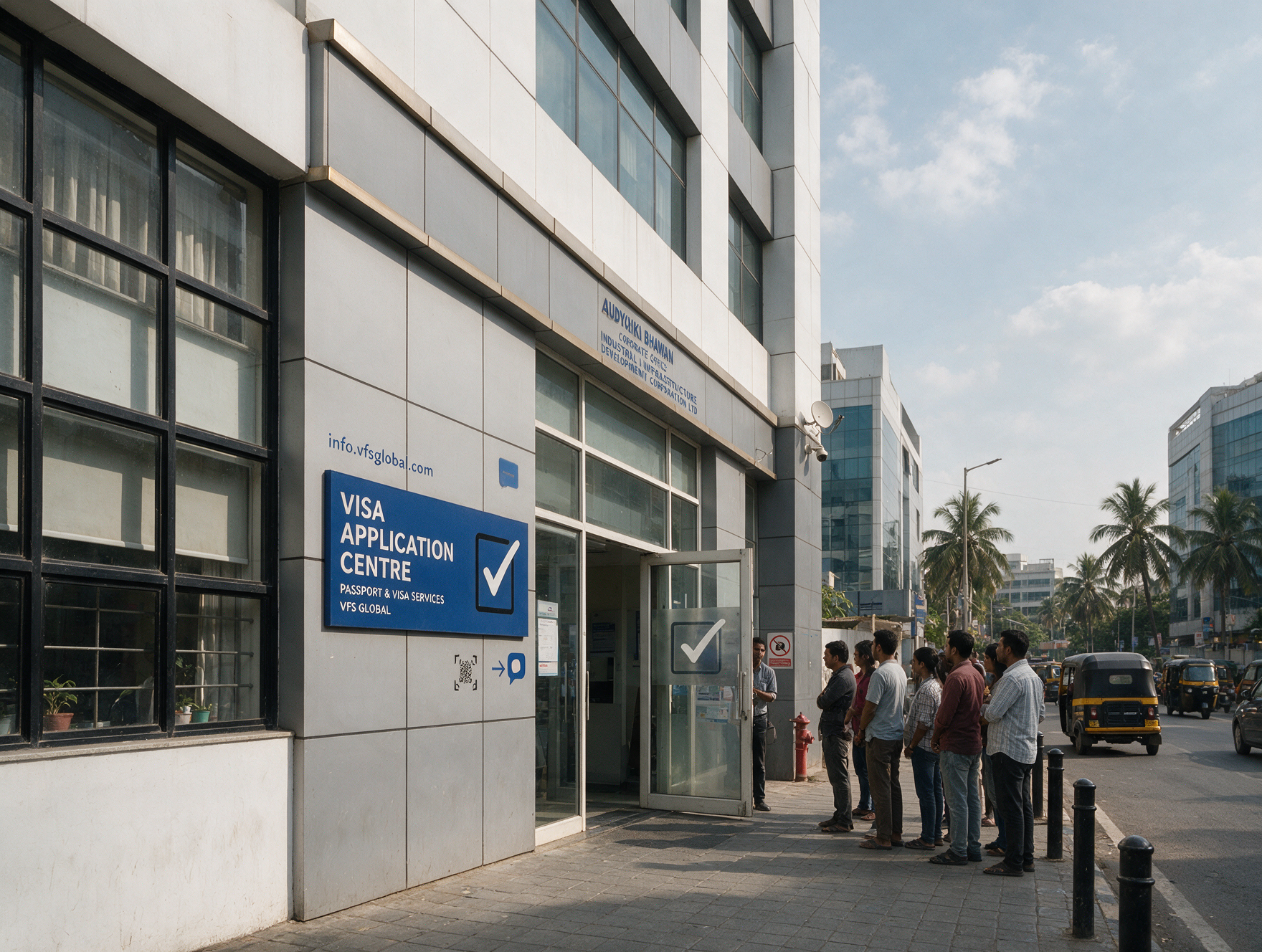
All Japan visa applications from India go through Japan Visa Application Centres operated by VFS Global — the Embassy in Delhi and the Consulates-General in Mumbai, Chennai, and Kolkata no longer accept walk-in applications directly. Mumbai’s consulate stopped taking direct submissions from applicants after April 20, 2026, following Delhi and other jurisdictions that had already moved to VFS-only intake.
VFS Global runs Japan visa centres in Delhi, Mumbai, Pune, Ahmedabad, Goa, Bengaluru, Chennai, Cochin, Hyderabad, Puducherry, Kolkata, and a few other cities, each tied to a specific consular jurisdiction — you apply at the centre covering the state your passport was issued in or where you’re a resident, not just whichever city is closest. Since March 2, 2026, the four South Indian centres — Chennai, Cochin, Hyderabad, and Puducherry — require a pre-booked appointment; turning up without one means you won’t be seen. Other centres still allow walk-ins at the time of writing, but given how fast this has shifted in 2026, we’d check the current status on the VFS Global Japan India page a few days before you go, since it’s the kind of rule that’s changed twice already this year.
A tip that isn’t in most guides: if you’re based in a smaller city without its own VFS Japan centre, you don’t need to travel to the jurisdiction city in person for the whole process — most centres accept applications couriered in through an authorised travel agent, which is one of the quieter benefits of booking your Japan trip through an agency rather than solo.
How long the visa actually takes
The Embassy and Consulates all quote the same baseline: a minimum of 5 working days from the day VFS accepts a complete application. In practice, indicative processing at VFS centres often runs longer — Mumbai lists around 10 working days, and Pune, Ahmedabad, and Goa around 12 — because that clock only starts once your file is complete, and any missing document resets it. None of the official pages guarantee these numbers; they’re explicitly described as indicative and can stretch during peak season (roughly March–May for cherry blossoms and October–November for autumn colour).
Applications can be submitted from 3 months before your travel date, and we’d treat that as close to a floor rather than a suggestion. For a trip during peak season, apply 4–6 weeks ahead if you can, purely as a buffer against a centre asking for one more document mid-process. Don’t book non-refundable flights until the visa is actually in hand — a reserved (unpaid) flight itinerary is exactly what the consulate wants to see at the application stage anyway, so there’s no upside to paying for tickets early.
Common reasons Japan visa applications get rejected
Japan’s tourist visa approval rate for Indians is high, but the rejections that do happen tend to repeat the same handful of mistakes:
- Financial proof that doesn’t add up. A balance too thin for the trip length, or a lump sum deposited right before applying with no clear source.
- Itinerary and bookings that don’t match. If your form says 10 days but your hotel bookings only cover 6, that inconsistency gets flagged.
- Placeholder or cancellable hotel bookings. Free-cancellation bookings made purely to satisfy the checklist, with no intention of honouring them, are noticeable to reviewers who process thousands of these.
- Employment proof that’s vague or missing. A leave letter without dates, or no letter at all for a salaried applicant.
- Photo and form errors. Wrong photo background, mismatched signatures, or blank mandatory fields — small, entirely avoidable, and still one of the most common reasons for a resubmission request.
- Weak ties to India. This mostly affects younger applicants without an employment history, a home, or dependents — the file needs to show a clear reason you’ll come back.
A mistake we’d specifically flag: applying with a passport that has less than 6 months’ validity from your travel date, not from today. People check the “valid until” date against when they’re applying rather than against the return date of the trip, and it’s an easy thing to get wrong by a matter of weeks.
Applying as a family or with young children
Family applications follow the same document list per person, with a few additions. Each child needs their own passport and photograph — there’s no adding children to a parent’s passport for this purpose. If both parents are travelling, add the marriage certificate and the children’s birth certificates to show the relationship. If only one parent is travelling with the child or children, most jurisdictions ask for a notarised consent letter from the absent parent, or in the case of a single parent, supporting documentation of sole custody.
Financial documents for a family application are usually assessed jointly against the earning parent(s)’ income rather than requiring separate bank statements for a non-earning spouse or for children, but it’s worth having a short cover letter that states this explicitly rather than leaving the reviewer to work it out. Kids under a certain age (this varies slightly by jurisdiction, so check with your centre) may also be exempt from providing a signature on the form.
One practical thing families get wrong: booking a fast-paced itinerary crammed with cities to “make the most of it,” then submitting that same packed schedule with the visa application. If your day-by-day plan has you in three cities in two days with two toddlers, it can read as unrealistic to a reviewer, aside from being genuinely exhausting to actually do. A visa itinerary that’s paced sensibly does double duty — it’s more likely to be approved cleanly, and it’s the trip you’ll actually enjoy.

Tips for a smoother application
- Match every date across every document. Passport, form, itinerary, hotel bookings, and flight reservation should all tell the same story with no contradictions.
- Don’t over-polish your bank statement. A normal account with normal transactions reads better than one that suddenly looks unusually tidy the month before you apply.
- Book fully refundable hotels, not fake ones. Use a real booking platform, keep the confirmation PDF, and only book stays you’d actually consider staying at if plans shift.
- Apply through an accredited travel agency if you can. It routes you into the “without guarantor” category cleanly and generally means someone checks your file before it’s submitted, catching the small errors that cause delays.
- Keep a digital and printed copy of everything, including the visa issuance notice if you get the eVisa — airline check-in staff sometimes ask to see it before boarding, separate from the immigration check on arrival.
- Ignore anyone offering “guaranteed fast-track” processing for a fee. Both the Embassy and Consulates explicitly warn about phone and email scams along these lines; there’s no legitimate paid fast-track for a standard tourist visa.
When to apply, relative to when you want to travel
Since the visa can only be lodged up to 3 months ahead, timing it against your travel window matters more than most people plan for. If cherry blossom season (typically late March into early April) or autumn foliage season (roughly October to late November) is the whole point of your trip, those are also the months every VFS centre is busiest, so the “indicative” processing times are the ones most likely to stretch. For a broader sense of what each season actually looks like on the ground before you lock in dates, our Japan autumn travel guide and notes on the Mumbai–Tokyo direct flight are worth a read while you’re mapping out your trip cost and dates.
If you’re booking a custom Japan itinerary with a travel agency — which is how most of our clients apply, since it simplifies the “without guarantor” paperwork — loop the visa timeline into your planning conversation early rather than treating it as a final step. It affects which flights you can safely book and whether a peak-season date is realistic at all.
FAQs
Do Indians need a visa to visit Japan in 2026?
Yes. There is no visa-free or visa-on-arrival entry for Indian passport holders. Every traveller applies in advance through a VFS Global Japan Visa Application Centre, either for the traditional paper visa or the eVisa.
How much does a Japan visa cost for Indians?
The consular fee for a single or multiple-entry tourist visa is ₹500 for the July 2026–March 2027 period, plus VFS Global’s service charge of roughly ₹800. Budget around ₹1,300–₹1,500 total per applicant, excluding optional courier or copy charges.
How long does it take to get a Japan visa from India?
The Embassy and Consulates quote a minimum of 5 working days once your complete application is accepted. VFS centres list indicative processing of 10–12 working days in practice, and it can stretch further during cherry blossom and autumn peak seasons, so apply at least 3–4 weeks before you travel.
What is the Japan eVisa, and is it different from a regular visa?
It’s the same visa, issued digitally instead of as a passport sticker. You get a visa issuance notice with a barcode that must be shown live on your phone at immigration — screenshots or printouts aren’t accepted. It currently covers single-entry tourist stays only; multiple-entry still requires the paper route.
Can I still walk into a VFS centre without an appointment?
It depends on the city. Since March 2, 2026, the VFS centres in Chennai, Cochin, Hyderabad, and Puducherry require a pre-booked appointment, and walk-ins are turned away. Other centres allowed walk-ins as of this writing, but check the VFS Global Japan India page shortly before you go, since this has changed more than once in 2026.
What documents does a child need for a Japan visa?
Each child needs their own passport, photograph, and application form. Add a birth certificate to show the relationship to the travelling parent(s), and if only one parent is travelling with the child, a notarised consent letter from the other parent is typically required.
Why do Japan visa applications get rejected?
The most common reasons are financial documents that don’t clearly support the trip, itineraries that don’t match hotel or flight bookings, vague or missing employment proof, and basic form or photo errors. Genuine, well-matched, consistent documentation is what gets approved cleanly.
Can I apply for a Japan visa without going through a travel agency?
Yes, individual applicants can apply directly through VFS Global. Going through an accredited travel agency routes you into the standard “without guarantor” category and typically means your documents get checked before submission, which reduces the chance of a document-related delay.
The bottom line
A Japan visa for Indians in 2026 is genuinely one of the easier developed-country visas to get right — cheap, no interview, and usually a clean approval if your documents tell a consistent, believable story about your trip. The places people trip up are almost always avoidable: mismatched dates, an itinerary that doesn’t match reality, or assuming last year’s walk-in rules still apply this year.
If you’d rather hand the paperwork and the itinerary to someone who does this every week, that’s exactly what Get Tripped’s Japan desk is for — we put together custom Japan itineraries across Tokyo, Kyoto, Osaka, Hiroshima, Nara, and Sapporo, handle the visa documentation end to end, and can tell you honestly whether your dates are realistic for the season you want. Get in touch to start planning your Japan trip, whether that’s a honeymoon, a family holiday, or a custom route built around cherry blossoms or autumn colour.