Outside the window of a crab restaurant near Susukino Station, snow was coming down sideways at seven in the evening, the kind that makes streetlights look like they’re underwater. Inside, the table next to ours had just fired up their tabletop grill for jingisukan, and the whole room smelled like charred lamb and soy. That contrast — frozen city outside, steam and noise inside — is basically what every evening in Sapporo runs on. It’s also why, when we’re putting together Japan tour packages from India, the question we get most isn’t “what do we do during the day” but “what do we do once it’s dark by 4:30 in February.”
Sapporo earns its reputation in daylight — the Snow Festival’s ice sculptures, Hokkaido’s wide skies, the drive out to the ski fields. But the city genuinely changes character after sunset. Susukino lights up, Odori Park turns into a corridor of gold, and dinner becomes an event instead of a meal. Sapporo consistently ranks among the best places to visit in Japan outside the Tokyo–Osaka circuit, and its evenings are a big part of why — the Japan National Tourism Organization lists it among Hokkaido’s top draws for exactly this reason. If you’re mapping a custom Japan itinerary around Hokkaido, the after-dark hours deserve as much planning as the days do — here’s where to spend them.
Table of Contents
- Susukino After Dark: Ramen Alleys and an Izakaya Crawl
- Sapporo TV Tower and Odori Park’s White Illumination
- A Beer Garden Evening at the Sapporo Beer Museum
- Crab and Jingisukan: The Dinner Sapporo Evenings Are Built Around
- Mt. Moiwa and the Quieter Side of Sapporo at Night
- FAQs
Susukino After Dark: Ramen Alleys and an Izakaya Crawl
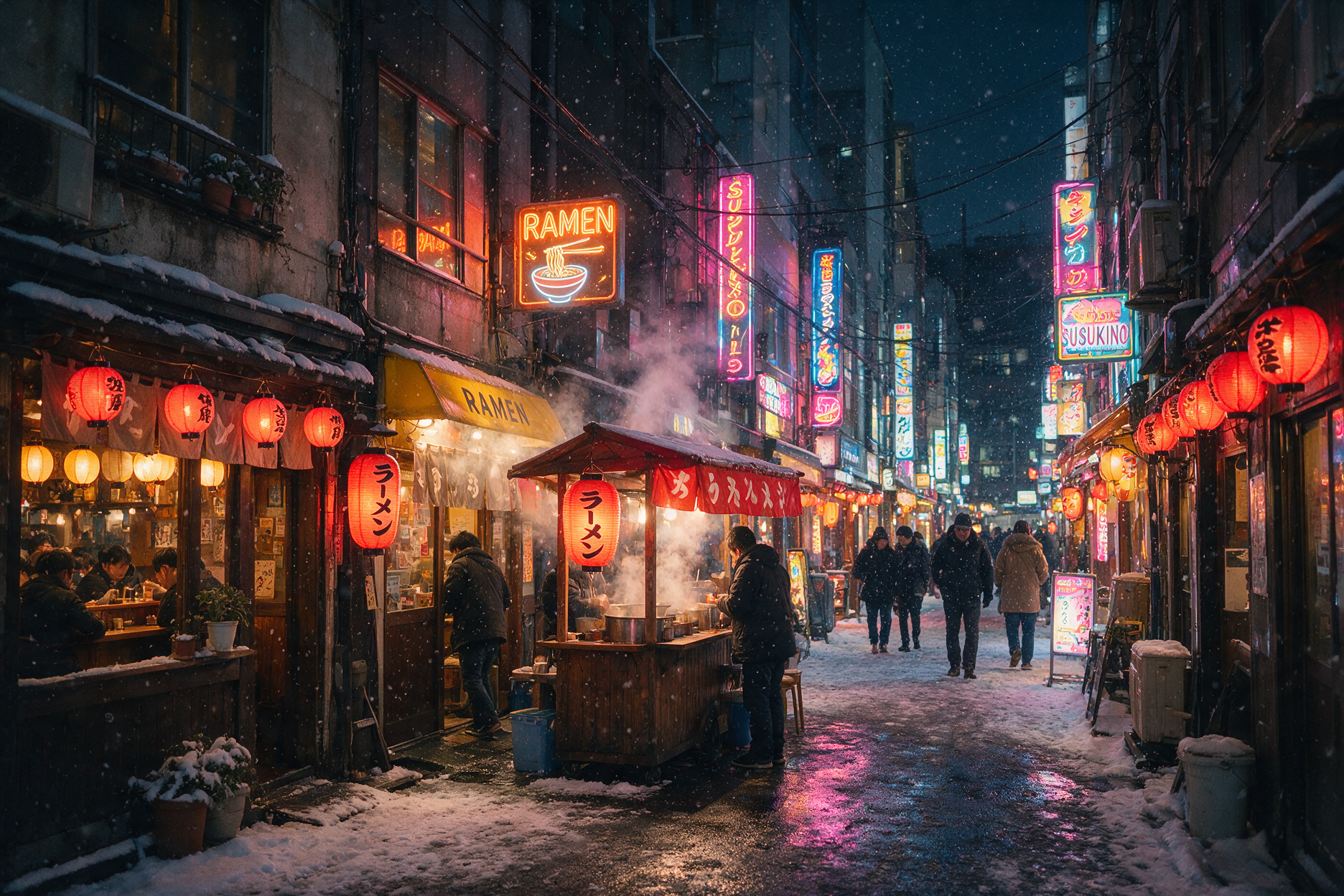
Susukino is one of Japan’s largest nightlife districts outside Tokyo — something like 4,000 bars, izakayas, restaurants and clubs packed into a grid a few blocks wide, all under neon bright enough to turn falling snow pink and blue. It’s loud in a good way. Groups of coworkers in suits spill out of izakayas around nine, ramen shops vent steam into the cold air, and the whole district smells like grilled lamb and soy sauce.
Ramen Yokocho, the narrow alley of ramen counters one block south of Susukino Crossing, is the obvious first stop. Aji no Karyu got a bump in fame after Anthony Bourdain filmed there, and it’s worth the ten minutes in line. But it’s also become a bit of a tour-bus stop in its own right. Locals in Sapporo tend to point newer visitors toward Shin Ramen Yokocho instead — a smaller, less-photographed alley nearby that runs until 3 a.m. and does a more modern take on the classic Sapporo miso base for around ¥900–1,400 a bowl. If you only get one ramen night here, that’s the one we’d pick.
For a proper crawl, go underground — literally. Several buildings on Susukino’s south side hide tiny four- and six-seat izakayas stacked across two or three basement floors, the kind of places you’d never find without someone pointing you toward them. Expect an otoshi (a small, mandatory starter dish, usually ¥400–600) at each one; that’s standard Japanese izakaya practice, not a scam, so don’t argue about it at the counter.
Honest caveat: Susukino is genuinely safe to walk through alone at night, and solo travelers — including women — commonly report feeling more comfortable here than they expected to, thanks to a heavy police presence and Japan’s generally low street crime. That said, skip the guys on street corners offering to walk you to a “good bar.” It’s a real pattern in Susukino, and the bar at the other end is never good value. Keep walking to wherever you’d already planned to go.
Sapporo TV Tower and Odori Park’s White Illumination
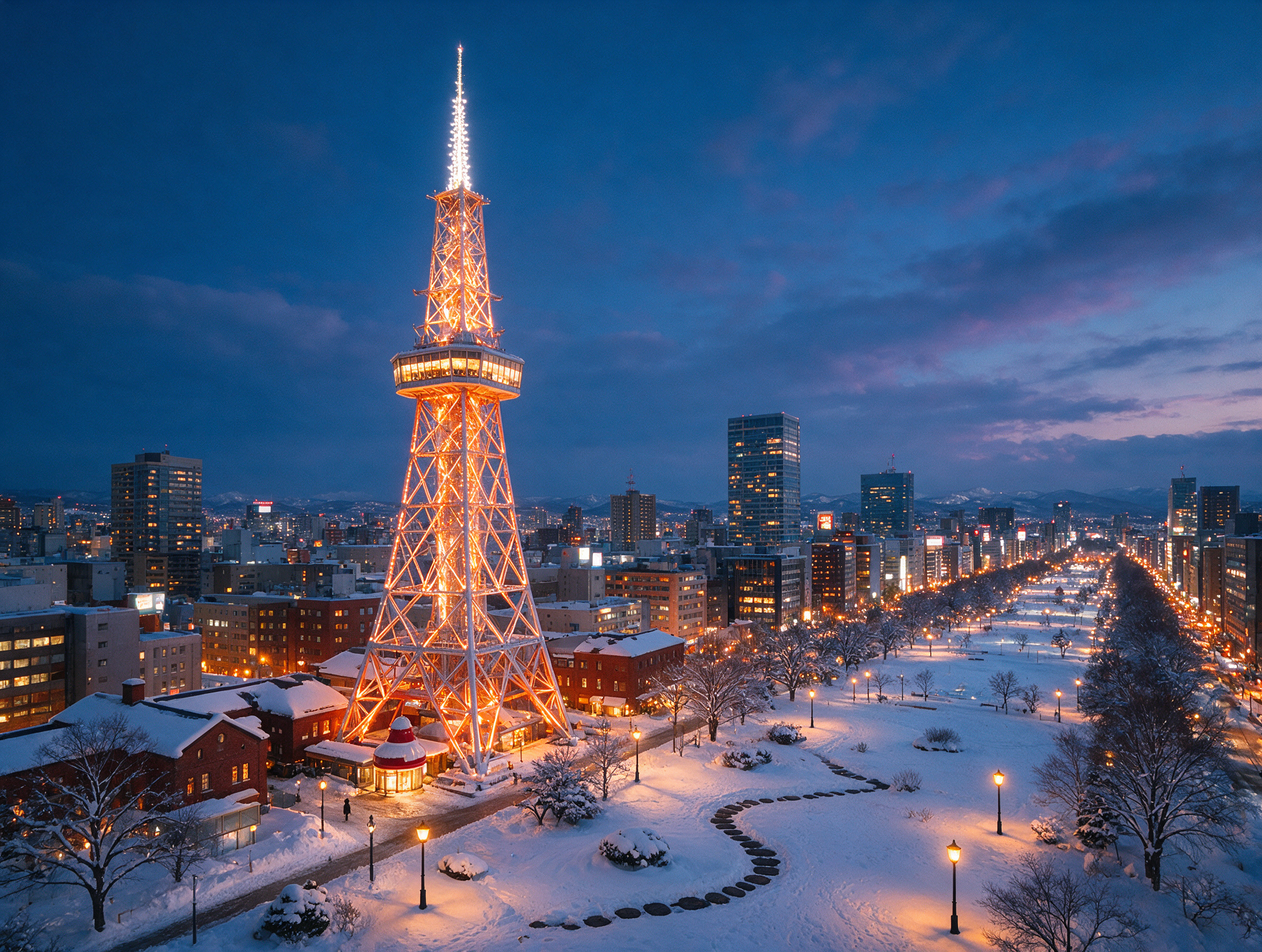
Odori Park splits the city in half, a 1.5-kilometer green spine that becomes the stage for Sapporo White Illumination every winter — one of Japan’s oldest winter light festivals, running continuously since 1981. For the 2026–27 season, the Odori site is lit from November 20 through December 25, while the Ekimae-dori stretch connecting JR Sapporo Station to Susukino keeps its roughly 220,000 LEDs glowing all the way through to mid-February. It’s free to walk through, which is unusual for something this polished, and the “City Aurora” installation near the old Hokkaido Government Office Building is worth the extra ten-minute detour. It’s quieter than the main strip and, honestly, prettier.
At one end of the park, Sapporo TV Tower gives you the view from above — a 90-meter observation deck officially recognized as one of Japan’s “New Three Best Night Views.” It’s open 9 a.m. to 10 p.m. (last entry 9:50 p.m.), and tickets run ¥1,200 for adults and ¥600 for elementary and junior-high students. During Snow Festival week itself (February 4–11, 2026), Odori’s snow sculptures stay lit until 10 p.m. and the roughly 60 ice sculptures at the Susukino site glow until 11 p.m., so you can realistically combine the tower, the park and dinner into one night without rushing.
Photography tip: skip the tower on your first night and shoot from ground level instead. A slow shutter on a small tripod — or even a park bench used as a brace — turns falling snow into soft streaks against the lit trees, which is the shot everyone actually wants from this park. Save the tower for night two, once you’ve picked which angle of the park looked best from above.
This is also, unapologetically, the best date-night stretch of the whole trip. Couples traveling together tend to linger here longer than anywhere else on a Hokkaido itinerary, and it’s easy to see why — warm lights, cold air, an excuse to share a hot drink from one of the stalls near the station end.
A Beer Garden Evening at the Sapporo Beer Museum
Sapporo’s beer culture isn’t an add-on experience here — the city is where the brand started, and the red-brick former brewery building that now houses the Sapporo Beer Museum is one of the better-looking industrial buildings in Japan. The museum itself closes early (11 a.m.–6 p.m., last entry 5:30 p.m., ¥1,000 for adults on the self-guided route), so treat this as a late-afternoon-into-dinner stop rather than a pure nightlife one.
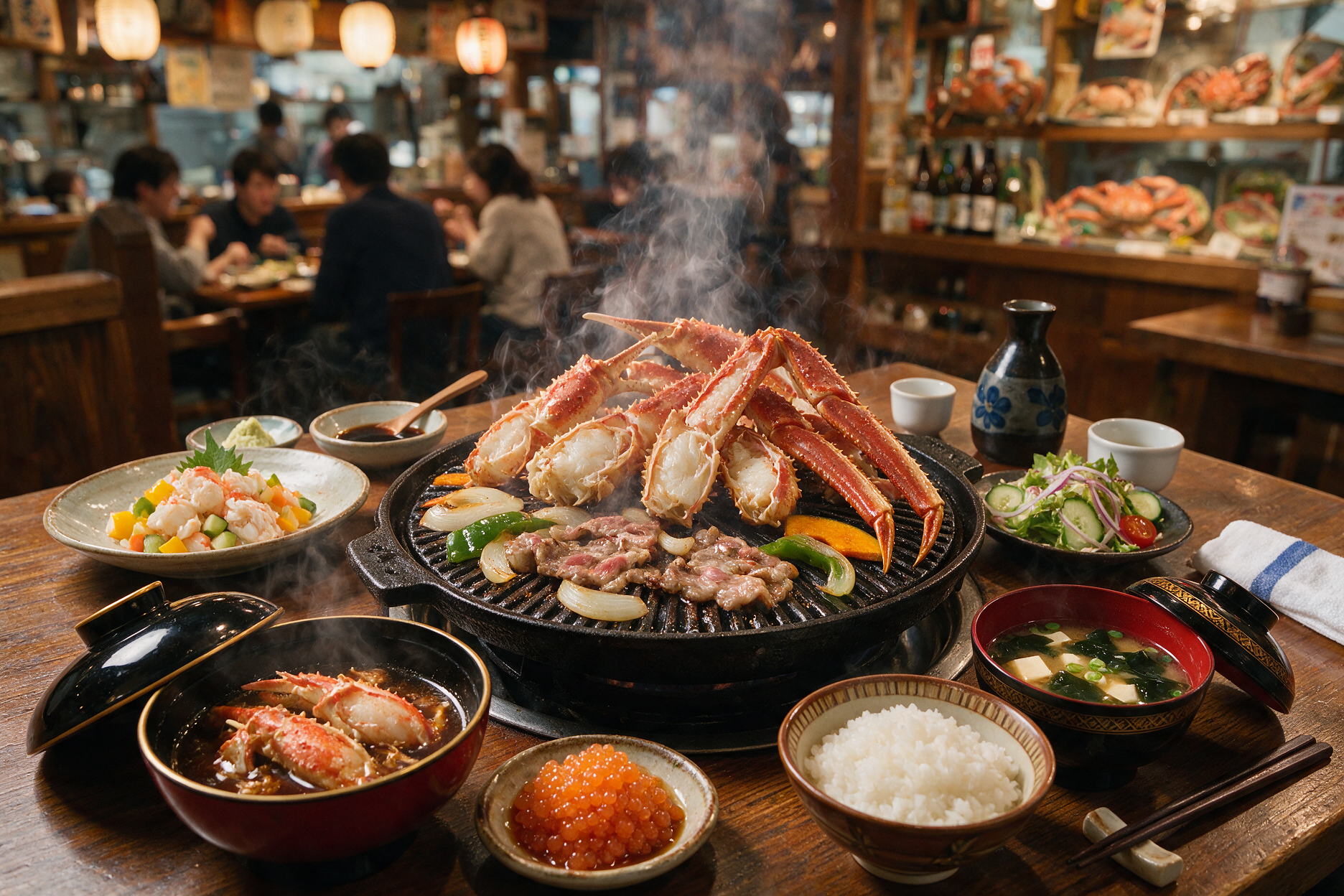
The real reason to come in the evening is next door: the Sapporo Beer Garden complex runs several dining halls built around jingisukan — thin-sliced lamb grilled tableside on a domed iron skillet — plus crab served at Garden Grill’s smokeless tabletop roasters. Poplar Hall does an all-you-can-eat-and-drink format if you’d rather set a flat budget for the evening than order à la carte, which, for a group, is often the smarter value call even though it’s not the “cheap” option. This is a destination dinner, not a quick bite.
Mistake to avoid: don’t assume you can walk in on a Saturday evening during peak Snow Festival week. Reservations matter here more than at most Japanese restaurants, specifically because tour groups block out entire halls in February. Book ahead through the museum’s English site rather than showing up and hoping.
Crab and Jingisukan: The Dinner Sapporo Evenings Are Built Around
If there’s one meal to build an evening around in Sapporo, it’s crab. Hokkaido’s cold waters produce some of Japan’s best king, snow and hairy crab, and Susukino has an entire cluster of specialist restaurants near Susukino Station doing everything from casual all-you-can-eat sets to full kaiseki courses where the crab arrives in five or six different preparations across two hours. Pair that with our Japan food trail guide for the rest of the country and you’ve got a pretty complete picture of why Hokkaido gets its own chapter in most Japan trip planning.
For luxury travelers building a Hokkaido leg around food, this is where to spend the splurge of the trip. A proper crab kaiseki dinner in Susukino, with sake pairings, costs considerably more than a standard izakaya meal, but it’s the kind of meal people remember years later — the one you’d mention to a travel agent in Mumbai when they ask what made the trip worth it. Jingisukan sits at the opposite end of the price spectrum and is just as worth doing: smoky, a little sweet from the glaze, usually served with bean sprouts and onion to cut the fat. It’s genuinely a Sapporo dish rather than a tourist invention — tied to the city since postwar sheep-farming days in Hokkaido, and supposedly named for the dome-shaped grill’s resemblance to a Mongolian soldier’s helmet. That’s the fun fact nobody asks for but everyone remembers.
Fair warning on both: portions at the all-you-can-eat crab places are often average quality stretched thin to hit a price point. If crab is genuinely the point of your evening, pay a bit more for an à la carte or kaiseki place with fewer but better plates. We’d rather eat half as much crab that’s actually good.
Mt. Moiwa and the Quieter Side of Sapporo at Night
Everyone photographs the TV Tower. Fewer people make the fifteen-minute cable car and mini-funicular combination up Mt. Moiwa, on the city’s western edge, even though locals will tell you — a little smugly — that it’s the better night view of the two. From the summit observation deck you get the whole Sapporo basin lit up below, ringed by dark mountains, without the crowd noise of Odori Park. Winter hours run 11 a.m. to 10 p.m., and the round-trip ropeway ticket is ¥1,700 for adults.
This is the spot for families with younger kids who’ve had enough of neon and crowds by seven, and for anyone who wants twenty quiet minutes after a loud dinner in Susukino. It’s also, frankly, a smarter photo than the tower shot everyone else is posting from the same angle — our hidden-gem pick for this trip.
Transit tip, and the mistake almost every first-time visitor to Sapporo makes: this city’s subway is not Tokyo’s. The Namboku Line — your main route back from Susukino or Odori — stops running just after midnight, and there’s no overnight train network to fall back on. In clear weather, that’s a minor inconvenience; you taxi home. In heavy snow during Snow Festival week, taxis get genuinely scarce after 11 p.m. because roads slow down and drivers are already stretched thin, and queues outside Susukino Station can run twenty or thirty minutes. Build your evening around the last train rather than around whenever you feel like leaving, and check our Japan public transit guide before you go, since Hokkaido’s rules differ from the mainland’s in a few small but annoying ways. Pack for it, too — our seasonal packing guide for Japan covers exactly what a Hokkaido winter evening calls for, which is more layers than most first-timers bring.
And since the park walk and the illuminations cost nothing, this entire evening pairs well with our guide to free things to do in Japan if you’re trying to balance a splurge dinner against a lighter day.
FAQs
Is Susukino safe to walk around alone at night?
Yes. Susukino is widely considered one of Japan’s safer big nightlife districts, and solo travelers — including women — commonly walk its main streets late at night without issue. Use normal city sense: stick to lit streets, and ignore the street touts offering to walk you to a bar.
What’s the best time of year to visit Sapporo for evening activities?
February, during the Snow Festival (February 4–11, 2026), gives you illuminated ice sculptures and the shortest daylight of the year, so evenings effectively start at 4:30 p.m. The best time to visit Japan overall is usually spring or autumn, but Hokkaido runs on its own calendar — if winter light shows and snow are the draw, this is the window. If you’d rather skip festival crowds, visit anytime during White Illumination season (late November through mid-February) for the lights without the Snow Festival’s peak congestion.
Do Indian travelers need a visa for Japan in 2026?
Yes. As of 2026, Indian passport holders still need a visa for any visit to Japan — there’s no visa-free or e-visa route for Indian citizens yet. You’ll apply through an authorized visa centre with a passport valid for at least six months, a completed application, photos, and proof of your itinerary and finances; processing typically takes 5–10 working days, so apply at least three weeks before travel. The Embassy of Japan in India’s visa page has the current document checklist, and our Japan visa guide for Indian travelers walks through it step by step.
How much does a typical evening out in Sapporo cost?
It depends heavily on where you eat. A bowl of ramen in Ramen Yokocho runs ¥900–1,400; a casual izakaya round with a few small plates and drinks lands around ¥3,000–5,000 per person; a proper crab kaiseki dinner with sake pairings can run ¥12,000–20,000 per person. The TV Tower (¥1,200) and Odori Park’s illuminations (free) are the cheapest parts of the evening by far. If you’re working out overall Japan trip cost from India, evenings like these are one of the more flexible line items in the budget — you can do a big splurge night and a cheap ramen night back to back and it balances out fine.
What time do the Sapporo Snow Festival’s evening illuminations run?
During the festival (February 4–11, 2026), the Odori site’s snow sculptures stay lit until 10 p.m., and the roughly 60 ice sculptures at the Susukino site glow until 11 p.m. The TV Tower keeps its usual 9:50 p.m. last-entry time, so plan your tower visit before dinner rather than after.
Can I get back to my hotel late at night in winter?
Yes, but plan around the subway, not against it. The Namboku Line stops just after midnight with no overnight service, so after that you’re relying on taxis, which get scarce and slow during heavy snow in Snow Festival week. If your hotel is more than a fifteen-minute taxi ride from Susukino, aim to leave by 11:30 p.m. on snowy nights.
What’s a good evening option in Susukino for vegetarians?
Jingisukan and crab dinners both lean heavily on meat and seafood, but Susukino’s sheer density works in your favor — soup curry, a Sapporo specialty, is easy to find meat-free, and several izakayas do solid vegetable-forward small plates. Our vegetarian and vegan food guide to Japan has specific pointers for Hokkaido.
Is jingisukan the same as Mongolian barbecue?
Not really, despite the name. Jingisukan is a Hokkaido invention from the postwar years — thin-sliced lamb or mutton grilled on a domed iron skillet with vegetables, usually glazed in a soy-based sauce — and it has little in common with actual Mongolian cuisine beyond the name.
Evenings Are Where Sapporo Actually Lives
Sapporo’s days get the postcards — the ice sculptures, the snow-covered shrines, the ski fields an hour out of the city. But its evenings are where the place feels lived-in. Susukino’s alleys smell like grilled lamb by eight for a reason, and the walk through Odori Park under all those lights tends to end up in every trip recap whether you planned for it or not. That’s the kind of endless discovery Japan keeps offering even on a trip you thought you’d already mapped out.
If you’re building a longer Hokkaido or wider Japan trip from India, Sapporo’s evenings slot neatly into our 7 nights, 8 days Japan itinerary alongside Tokyo and Osaka, or work just as well stretched across a longer Japan 10 days travel itinerary that gives Hokkaido its own dedicated leg. Explore more of the country on Get Tripped’s Japan destination page, where we cover the rest of what’s worth seeing beyond Sapporo.
Want a custom Japan itinerary that actually accounts for how early winter evenings start in Hokkaido? Get Tripped Travels is a Japan travel agency in Mumbai — get in touch and we’ll book your Japan holidays, flights, visa support and all, built around the evenings as carefully as the days.