Amboseli is one of those parks where the light does most of the work. The landscape is flat, dusty, and broad — not the dense bush of Tsavo or the rolling hills of Maasai Mara — which means that when the sun drops toward the horizon and Kilimanjaro catches the last of it, you have an unobstructed canvas that a photographer or even someone who just holds up a phone will not forget. This guide is about making the most of Amboseli’s evening hours specifically: where to be, what to look for, and why the light between 4 PM and 7 PM in this park is different from anywhere else in Kenya.
Table of Contents
- Why Amboseli is Different at Golden Hour
- 1. Observation Hill at Sunset
- 2. The Enkiama and Longinye Swamps
- 3. Lake Amboseli Seasonal Flats
- 4. The Kilimanjaro Road Viewpoints
- 5. Elephant Families at Dusk
- 6. Camp Sundowners — The Best Decks in the Park
- Getting to Amboseli from India
- Frequently Asked Questions
Why Amboseli is Different at Golden Hour
Most of Kenya’s wildlife parks are dense enough that the last light of the day gets filtered through acacia branches and thornbush before it reaches you. Amboseli isn’t like that. The park sits in a shallow basin — the dry bed of a former lake fed by Kilimanjaro’s snowmelt — and the main ecosystem is open marsh, grassland, and dust pan. There’s almost nothing between you and the horizon.
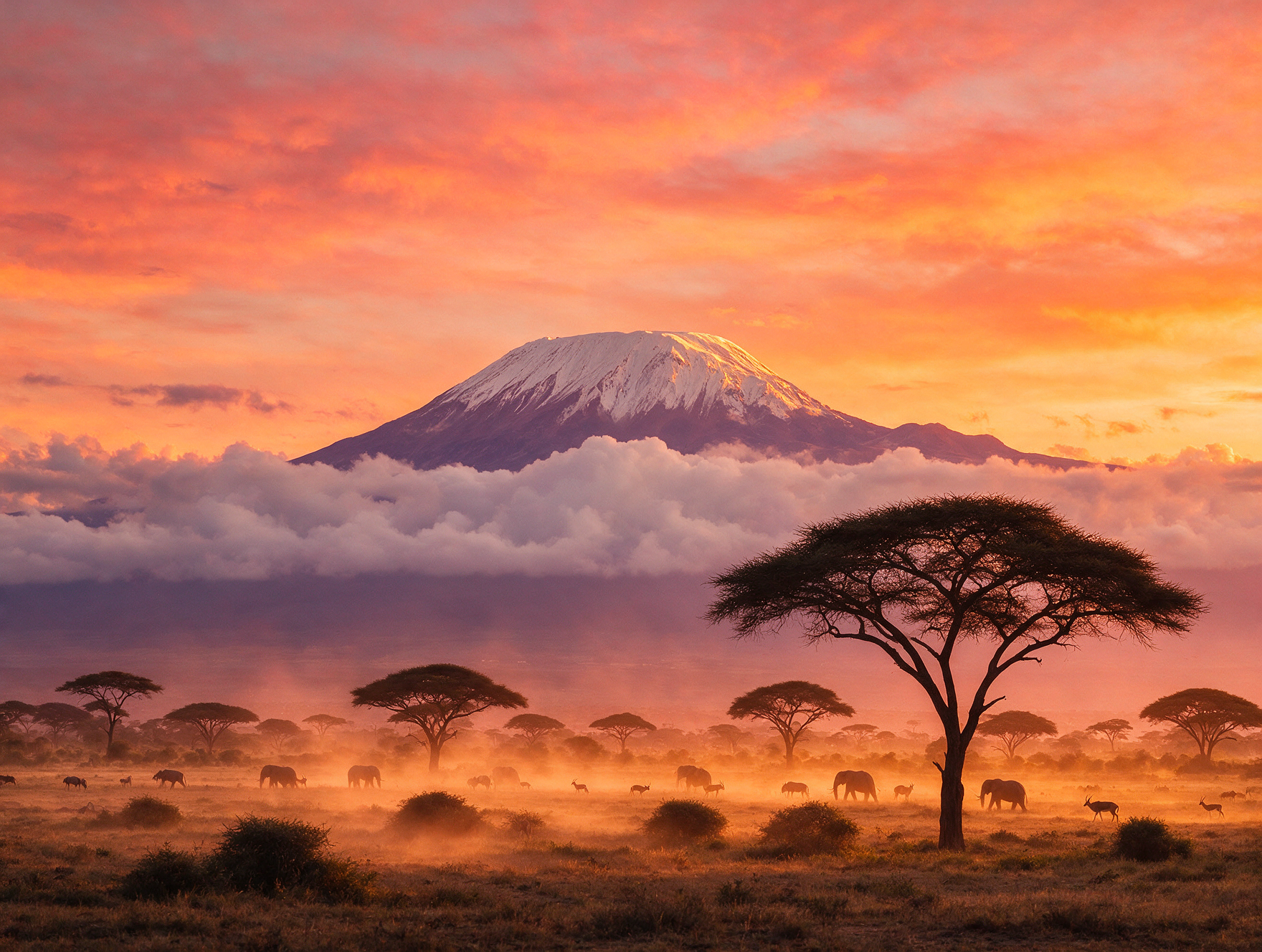
The result: when Kilimanjaro catches alpenglow (the pink-to-orange flush that peaks roughly 15–20 minutes after sunset), the mountain above cloud cover and the elephant herd below it are simultaneously in frame. Professional wildlife photographers come specifically for this and often wait a week or more for a perfectly clear summit combined with the right herd positioning. As a regular visitor, you won’t have that luxury — but even on a partially cloudy evening, the light on the grassland and the silhouettes it creates are worth the positioning effort.
Quick note on Kilimanjaro visibility: mornings are typically clearer. By afternoon, clouds often build around the summit and don’t always clear before dark. The best full-mountain evening shots tend to come from October–February, when rainfall is lower. This doesn’t diminish the evening experience in other months — the golden-hour light on the marshes and herds is constant year-round — but manage expectations on the perfect Kilimanjaro shot.
1. Observation Hill at Sunset
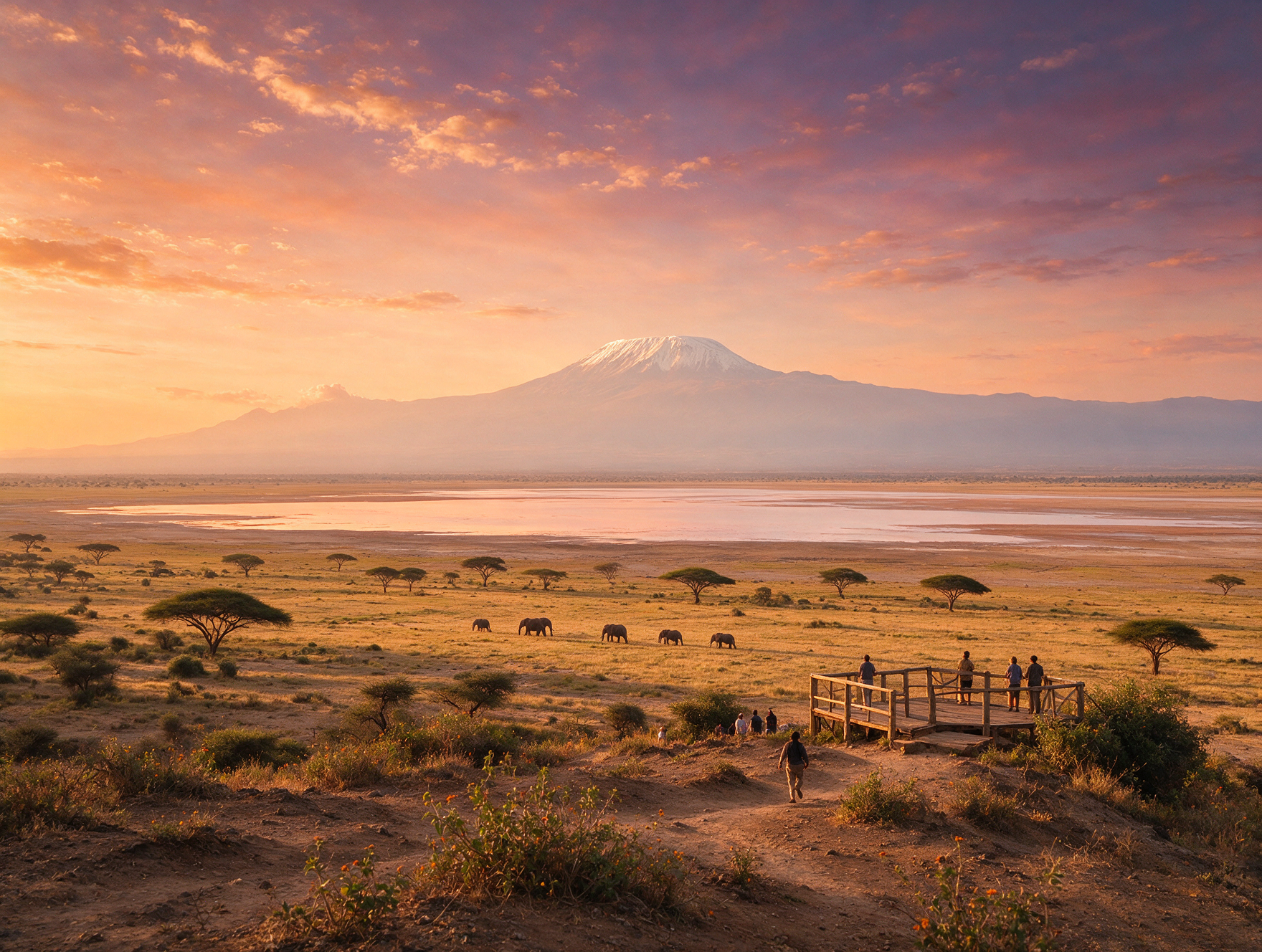
Observation Hill is the one elevated point in an otherwise flat park. It’s a volcanic kopje about 2 km from Amboseli Serena Lodge, and KWS (Kenya Wildlife Service) has a short walking path to the summit that you can access with a ranger escort. The view from the top is 360 degrees: south toward Kilimanjaro, east toward the Longinye Swamp and its elephant herds, north over the Enkiama Swamp, and west over the alkaline Lake Amboseli flats.
The hour before sunset is when game drives converge here, and it can get busy with vehicles at the base. The actual hill is small enough that most people don’t leave their vehicles — walk up the path, which takes about fifteen minutes, and you’ll often find you have the summit almost to yourself. At ground level you’re looking through vehicles and dust; from the hill you’re looking over everything.
Get there by 5:30 PM in the October–February dry season (sunset around 6:30–7 PM at this latitude). In June–August, sunset comes slightly earlier and the cloud patterns are different — check your guide’s recommendation for the specific week you’re there.
2. The Enkiama and Longinye Swamps at Dusk
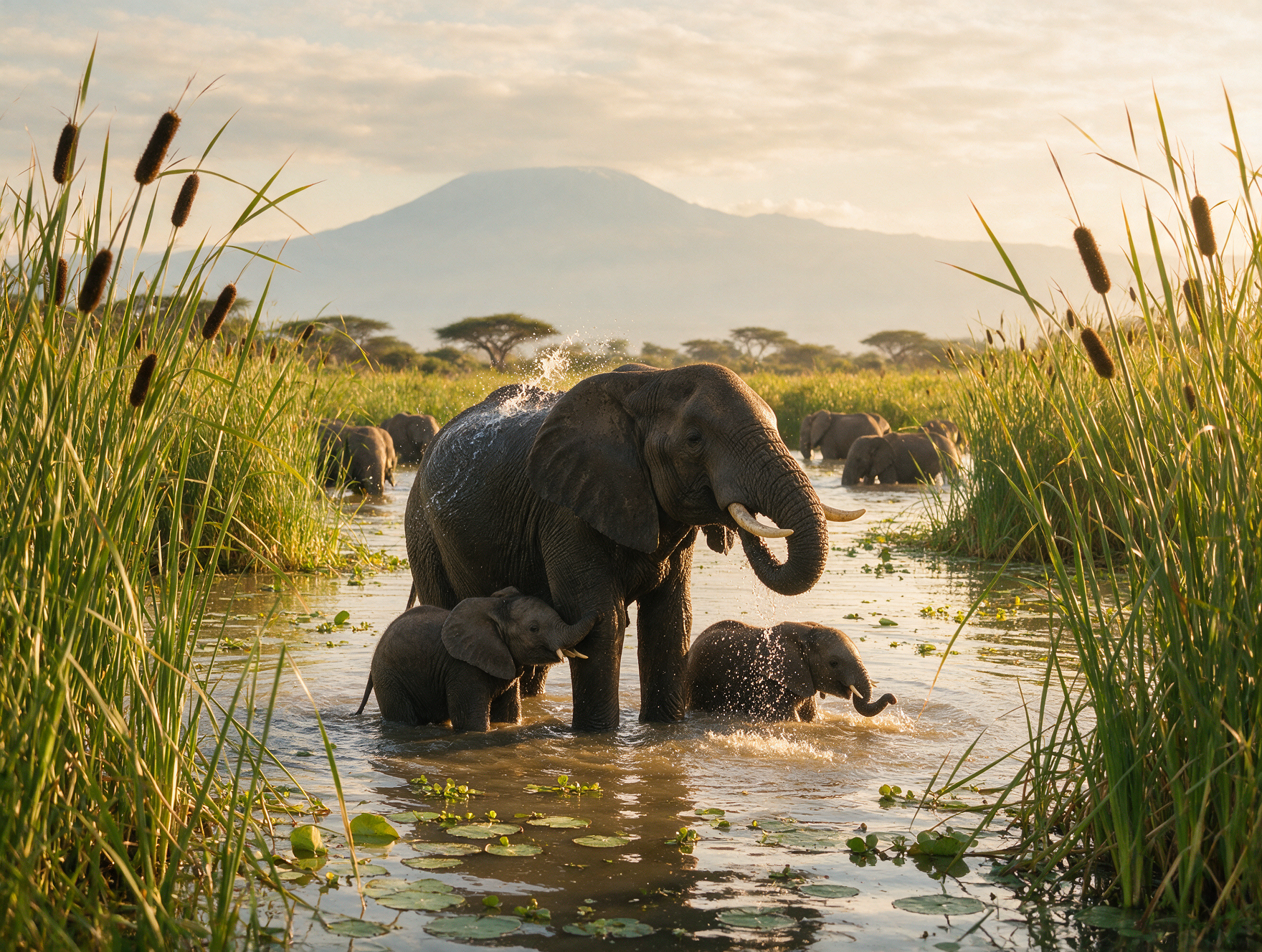
The two main swamp systems in Amboseli are fed year-round by underground water from Kilimanjaro’s snowmelt — even when the surrounding landscape is bone-dry and dusty, the swamps remain green and wet. This concentration of water means the swamps are where everything goes in the late afternoon: elephants drink and bathe, hippos surface for their evening yawn, herons and egrets stalk the shallows.
The Longinye Swamp, on the eastern side of the park, typically has the densest elephant activity in the late afternoon. Amboseli’s elephant population (numbering around 1,600 — one of Africa’s best-studied herds, subject to ongoing Amboseli Elephant Research Project monitoring since 1972) is habituated to vehicles and will approach to within a few metres without alarm. In the evening light, a matriarch leading her family through the papyrus edge of the swamp, Kilimanjaro behind her if the clouds cooperate, is the most iconic Amboseli image and it’s accessible to every visitor who positions well.
A mistake to avoid: many drivers park at the same established viewpoints on the swamp edge and don’t move, even if the light is coming from the wrong direction. Talk to your guide before the afternoon drive about which side of the swamp will have the sun behind you at golden hour — this changes based on the date and the direction of the herd movement. A guide who’s local to Amboseli (rather than flown in from another park) will know.
3. Lake Amboseli Seasonal Flats
Lake Amboseli itself is seasonal and usually dry except during and immediately after the long rains (April–May). When it has water — even a few centimetres across its vast shallow basin — flamingos arrive in numbers and the reflections on the flat surface create something that looks like a mirrored landscape. When it’s dry, the cracked white soda ash flat is photogenic in a different, stranger way: zebra and wildebeest crossing it look like they’re walking through a monochrome frame.
Even in the dry season, the western edge of the lake bed where it meets the Kilimanjaro road is worth a stop in the hour before sunset specifically for the low-angle light on the dust and the silhouettes it creates. This is where you’ll often find large mixed herds of wildebeest and zebra in the afternoon, grazing on the sparse grass at the lake’s edge.
4. The Kilimanjaro Road Viewpoints
The track that runs along the southern boundary of the park, roughly parallel to the Kenya-Tanzania border, offers the most direct Kilimanjaro views — it’s about 25 km from the mountain at its closest. In the dry months (January–February, June–September), the mountain is visible above the thornbush corridor in the late afternoon, and the evening light catches the summit’s Kibo glacier (which is, factually and sadly, retreating significantly — about 80% of the ice cover documented in 1912 has gone, according to the Kilimanjaro Glacier Retreat Research).
Your guide will know whether the summit is clear on a given afternoon — they check in the morning and again after lunch. Don’t plan an evening drive specifically for this view without a morning cloud check; clouds on the summit that morning often don’t clear by evening.
5. Elephant Families at Dusk: What to Look For
The Amboseli elephant research project, run since 1972 by Cynthia Moss and colleagues (now through the Amboseli Trust for Elephants), has catalogued and named every elephant family in the park — the families begin with the same letter of the alphabet (the FA family, the OA family, etc.). Some lodges have staff trained in the catalogue and can identify specific individuals. If yours doesn’t, ask whether they can arrange a session with a researcher or guide who knows the study — it transforms a general elephant sighting into something specific.
In the late afternoon, watch for the behaviour rather than just the sighting: elephants engage in extended greeting ceremonies when family groups merge at waterholes (rumbling, touching, intertwined trunks), the calves play and spar while the adults drink, and the matriarch — usually identified by size and by the deference other family members show her — makes decisions about movement that the whole group follows. None of this is hidden; it happens in full view. It’s just easy to miss if you’re focused on the photograph rather than the behaviour.
6. Camp Sundowners: The Best Decks in the Park
Some Amboseli camps build their evening around the sundowner ritual — drinks on a viewing deck or in the bush as the sun sets. The quality of this experience varies significantly by camp.
Tortilis Camp (by-far the most consistently recommended independent camp in the park) has a raised deck with direct Kilimanjaro views and runs bush sundowners — your sundowner position is changed each evening based on the best light and most active game. A proper picnic setup in the open bush with a table, drinks, and your guide telling you what’s happening around you in real time. Rates USD 400–700 per person per night all-inclusive.
Amboseli Serena Lodge is the mid-range choice and has good grounds, but the sundowner area is inside the camp perimeter — pleasant, but you’re watching into the camp’s manicured gardens rather than open bush. Still fine for most travelers; just a different character.
Tawi Lodge, a private conservancy property on the northern edge of the ecosystem, runs small-group sundowners by a seasonal waterhole that gets heavy elephant evening use. Good for families because the vehicles can position very close without the park’s regulations applying in the conservancy.
Getting to Amboseli from India
Fly into Nairobi Jomo Kenyatta International Airport, then either drive (4 hours via Emali Junction) or take a light aircraft flight to Amboseli Airport on scheduled services from Nairobi Wilson Airport with SafariLink (45 minutes, USD 200–260 one way). The road from Nairobi crosses the Athi Plains and approaches through Maasai country — worth doing at least one way for the landscape transition.
Amboseli pairs naturally with Tsavo East or West (a few hours’ drive), which together make a 5–7 day southern Kenya circuit. Combined with Maasai Mara (fly or drive), it forms the classic Kenya safari triangle.
For Indian nationals: eTA required, apply at evisa.go.ke, USD 50, 3–5 days processing. Park entry fees for Amboseli are USD 90 per person per day (adults). The KWS multi-park passes can reduce costs if your itinerary covers multiple parks.
Frequently Asked Questions
Is Amboseli good in October?
October is one of the better months. The rains haven’t started in earnest yet (short rains typically begin late October), the landscape is dry and open, and Kilimanjaro is often clear in the morning and early afternoon. Elephant and bird activity around the swamps is excellent.
What is the best time to visit Amboseli National Park?
January–February and June–September. January–February gives you dry conditions with calving season (elephant and zebra newborns visible), clear mountain views, and manageable heat. June–September is cooler and the grass is short, making wildlife easier to spot. Avoid the long rains (March–May) — some tracks become impassable.
Can you see the Big Five in Amboseli?
Four of the five, very reliably — elephant (outstanding), buffalo, lion, and leopard (the latter two present but less frequently seen than Maasai Mara). Rhino were historically present but are no longer found in Amboseli; you’d need to go to Lake Nakuru or Lewa Conservancy for rhino.
Is Amboseli worth it just for a day trip from Nairobi?
The drive is four hours each way. A full day in the park leaves you very little time and you’ll spend more of it in a vehicle on the road than in the park. Two nights minimum is the sensible lower limit. A day trip is technically possible but exhausting and unsatisfying — the park rewards patience.
How do Kenya safari packages from India typically include Amboseli?
Most mid-range to luxury Kenya packages combine Nairobi (1–2 nights), Amboseli (2–3 nights), and Maasai Mara (3–4 nights), sometimes with a beach add-on at Diani or Malindi. The Amboseli-Mara combination is the most popular structure for Indian travelers.
Conclusion
Amboseli at golden hour is worth engineering your day around. The flat basin, the unobstructed horizon, the elephant herds going about their evening business — and Kilimanjaro, when it shows itself, framing all of it — make for a combination that has no equivalent anywhere else in Kenya. The best photographers wait for it. The rest of us get lucky sometimes, and that’s fine too.
For help planning Kenya safari packages from India that sequence Amboseli, the Mara, and the coast into a genuinely good trip, Get Tripped’s Kenya team has been doing this for years. The logistics are more involved than they look on a map; we’re happy to sort them.