Netherlands Public Transport Guide for Indian Travelers: Trains, Trams, Buses & Bikes
The Netherlands has one of the highest public transport coverage rates in Europe, and it shows. Amsterdam’s tram network runs until 12:30am. Intercity trains leave every 15 minutes between major cities. The cycling infrastructure is so complete that the Dutch have essentially designed car-free movement into the fabric of daily life. For Indian travelers accustomed to navigating variable public transit quality, the Netherlands is one of the easier countries in Europe to get around without a rental car — which is fortunate, because driving in Amsterdam is genuinely more trouble than it’s worth.
This guide covers everything you need: the OV-chipkaart and the new OV-pas replacing it, the NS intercity train network between cities, Amsterdam’s trams and metro, cycling as a real option, and how to reach the six main destinations on Get Tripped’s Netherlands page.
Table of Contents
- The OV-chipkaart and OV-pas: How to Pay
- NS Intercity Trains: Getting Between Cities
- Amsterdam Public Transport: Trams, Metro & Buses
- Cycling: The Real Dutch Transport System
- Getting to Each Destination
- Schiphol Airport to City
- Taxis and Uber
- Practical Tips
- FAQs
The OV-chipkaart and OV-pas: How to Pay
The Netherlands uses a tap-on, tap-off system for all public transport. You must check in when you board and check out when you leave — failing to check out charges you the maximum fare for the route. This applies to trains, trams, metros, and buses.
OV-chipkaart (current card, being phased out)
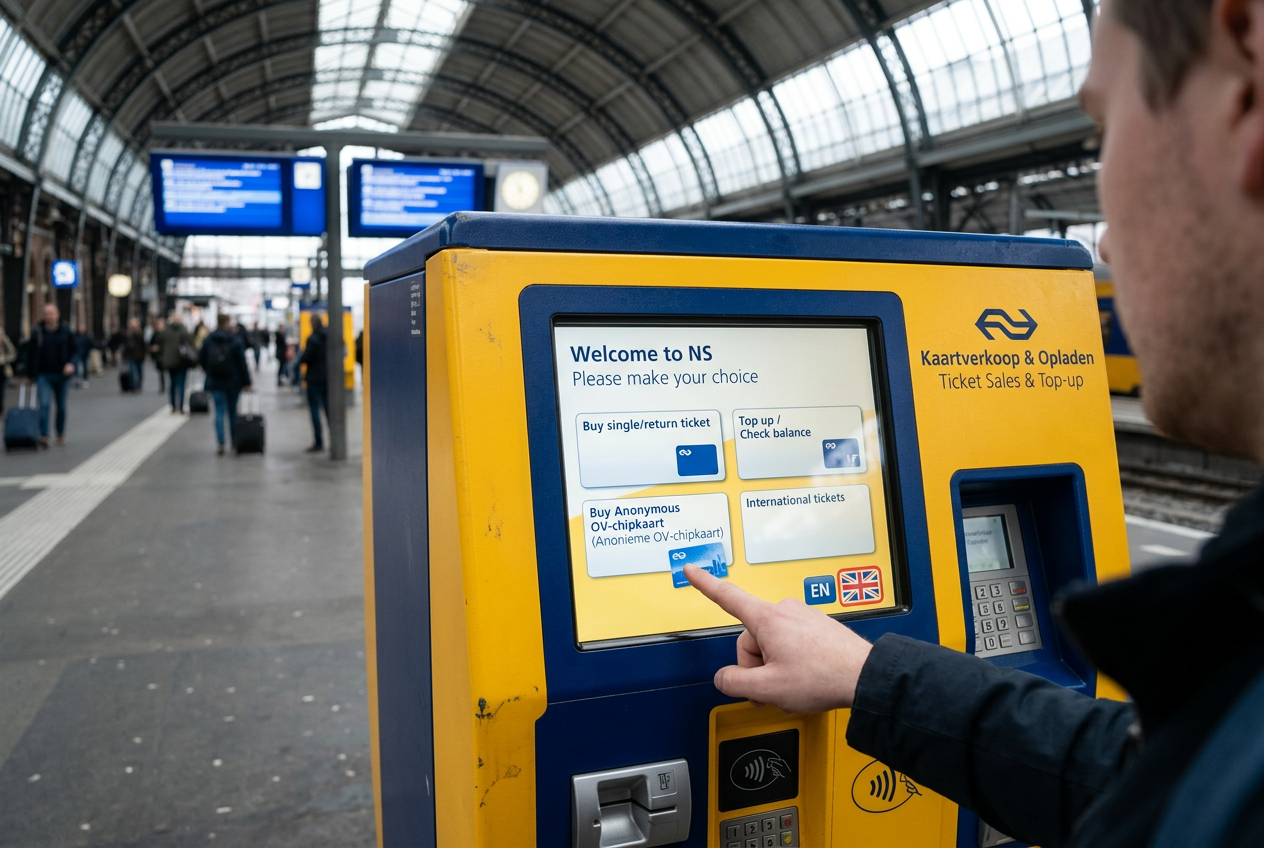
The orange OV-chipkaart has been the standard contactless transport card since 2012. As a visitor, you buy an anonymous OV-chipkaart at any NS station machine or major train station counter for €7.50 (non-refundable), then top up credit. The card is accepted on all NS trains, Amsterdam’s GVB trams/metro/buses, Rotterdam’s RET, Utrecht’s U-OV, and intercity buses.
Important update for 2026 travelers: The OV-chipkaart is being phased out in favor of the new OV-pas by end of 2027. Existing OV-chipkaarts continue to work through the transition period, and both cards are currently valid on all systems. If you’re buying a new card, ask at the station counter whether OV-pas cards are available for short-stay visitors — the transition rollout is ongoing.
OV-pas (new card)
The OV-pas is the successor card with improved contactless functionality and a cleaner top-up system. It works on the same tap-on, tap-off principle. For visitors arriving in late 2026 and beyond, check the NS website or station information for current availability.
Contactless bank cards and phones
On Amsterdam GVB trams and metro, you can also tap directly with a Visa or Mastercard contactless card or Apple Pay/Google Pay — no separate OV-chipkaart needed. This does not work on NS intercity trains yet. Check current GVB guidance at the time of travel as this is expanding.
Single-trip tickets
Paper single-trip tickets are available for NS trains from station machines. More expensive per journey than using an OV card, but workable if you’re only taking a few train trips.
NS Intercity Trains: Getting Between Cities
NS (Nederlandse Spoorwegen) runs the intercity network and is generally reliable. Trains run every 15–30 minutes between major cities, with more frequent services on busy corridors. The NS app (available on iOS and Android, full English) shows real-time departures, platform changes, and delays — download it before you travel.
Key routes and journey times
| Route | Journey Time | Frequency |
|---|---|---|
| Amsterdam Centraal → Rotterdam Centraal | ~40 min (Intercity Direct) | Every 15–30 min |
| Amsterdam Centraal → Utrecht Centraal | ~30 min | Every 15 min |
| Amsterdam Centraal → Zaandijk-Zaanse Schans | ~18 min (Sprinter) | Every 30 min |
| Amsterdam Centraal → Leiden Centraal (for Keukenhof) | ~35 min | Every 15 min |
| Amsterdam Centraal → Schiphol | ~17 min (Intercity Direct) | Every 10–15 min |
| Utrecht Centraal → Zwolle (for Giethoorn) | ~50 min | Every 30 min |
| Rotterdam Centraal → Utrecht Centraal | ~40 min | Every 15 min |
Intercity Direct supplement: The high-speed Intercity Direct between Amsterdam and Rotterdam requires a small supplement (~€2.60) on top of your regular fare, even with an OV-chipkaart. You pay this separately at the ticket machine or via the NS app. Sprinter trains on the same route take about 1 hour 20 minutes but require no supplement.
Schiphol fare zone
Schiphol Airport is in a separate fare zone. If you’re using an OV-chipkaart from/to Schiphol, make sure you have the correct balance or buy a separate Schiphol ticket at the airport station machine. The Intercity Direct to Amsterdam Centraal from Schiphol costs around €5–6 with the supplement.
Amsterdam Public Transport: Trams, Metro & Buses
Amsterdam’s public transport is run by GVB (Gemeentelijk Vervoerbedrijf). The tram network covers the canal belt and inner city; the metro runs to outer neighborhoods; buses cover everything else. All run until roughly 12:30am, with night buses taking over after that.
Trams
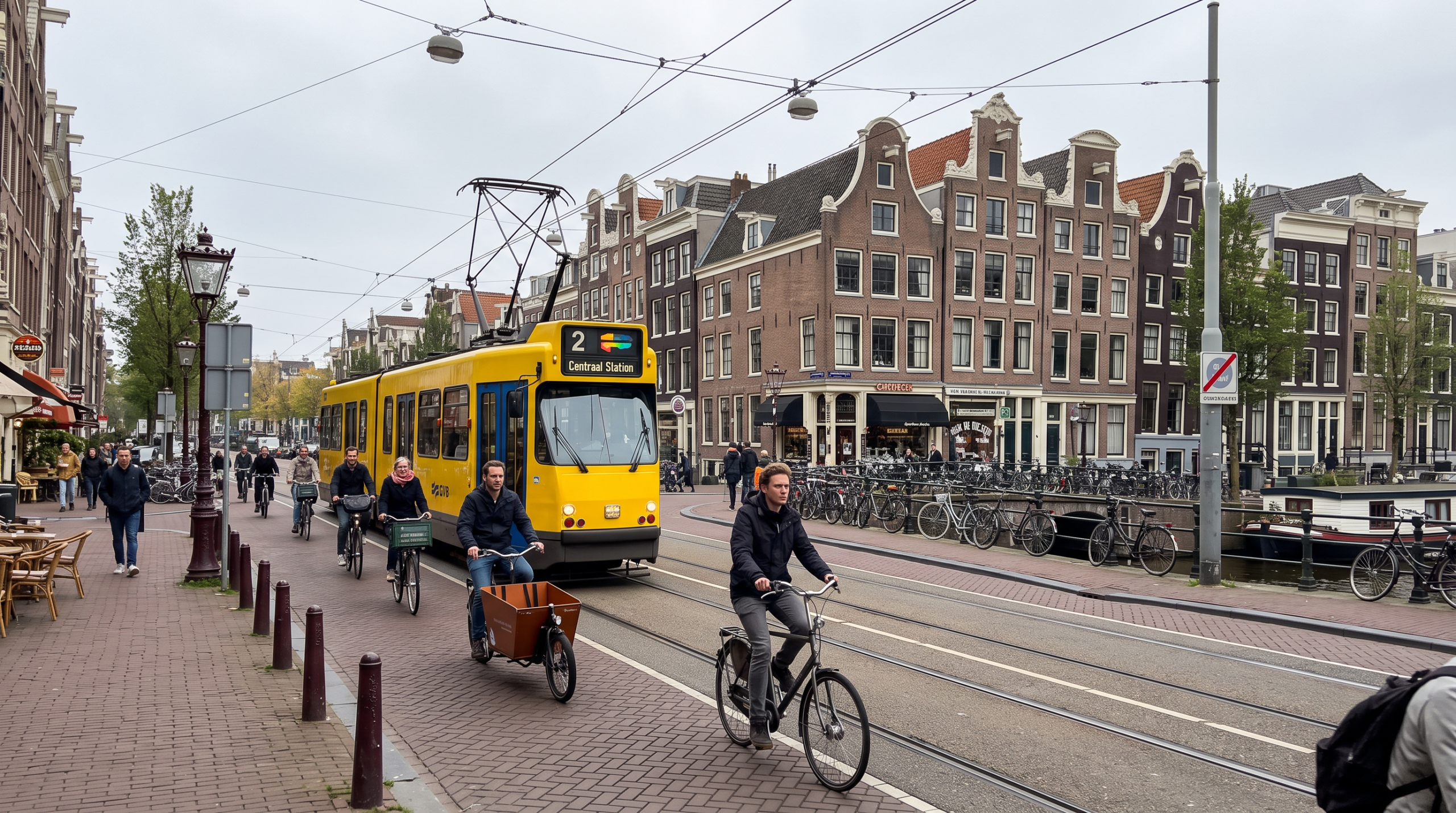
Trams are the most useful system for tourists. The main lines for sightseeing:
- Line 2 and 12: Centraal Station → Leidseplein → Museumplein (Rijksmuseum, Van Gogh Museum) → south. Essential for the museum quarter.
- Line 4: Centraal Station → Rembrandt Square → De Pijp (Albert Cuyp Market).
- Line 14: Centraal Station → Waterlooplein → Amsterdam Oost (for Dappermarkt).
Check in with your OV-card or contactless bank card when boarding any tram door. Check out when leaving.
Metro
The metro is less useful for central tourist areas but connects to Amsterdam Noord (useful for the free IJ ferry crossing), Amsterdam Oost, and Amsterdam Zuid (for the South Axis business district). The Noord/Zuidlijn (North-South Line, opened 2018) runs from Centraal Station south to De Pijp and beyond.
GVB day passes
GVB sells 1–7 day unlimited passes for Amsterdam’s trams, buses, and metro (excludes NS trains). A 1-day pass costs around €9; 24-hour ticket (or multi-day) can be cost-effective if you’re making more than 4 journeys per day within Amsterdam. Buy at Centraal Station or from tram ticket machines.
Cycling: The Real Dutch Transport System
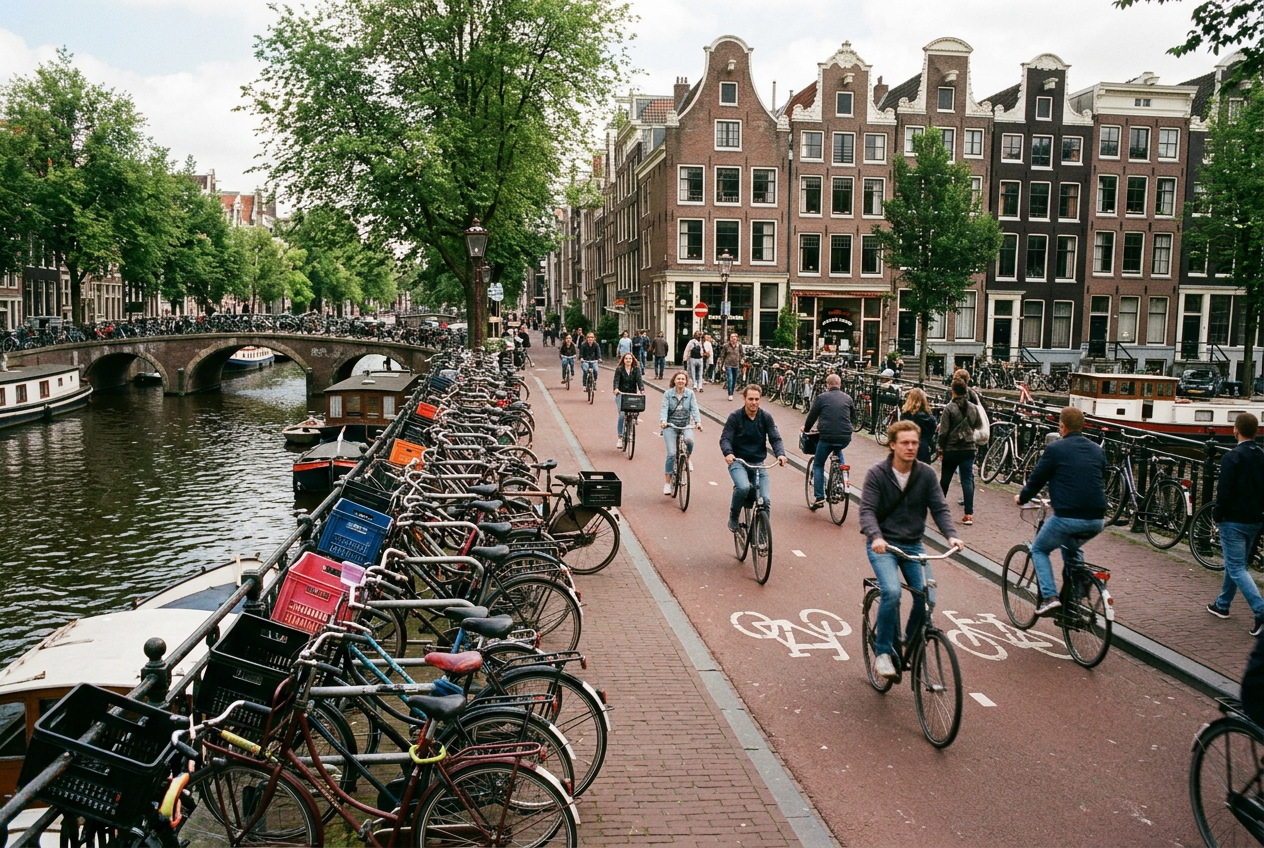
The Netherlands has 23,000 km of dedicated cycling paths. In Amsterdam, there are more bikes than people. Cycling is not a tourist activity here — it’s how people actually get around, and the infrastructure reflects it. For Indian travelers, this is worth taking seriously: renting a bike and using Amsterdam’s cycle paths is often faster than trams for medium distances, and the experience of moving through the city at bike level is genuinely different from any other mode.
Renting a bike in Amsterdam
Multiple rental shops cluster near Centraal Station and in the Jordaan. A basic city bike costs €12–18/day. MacBike near Centraal Station has multiple locations and well-maintained bikes. Rent-A-Bike on Damstraat is reliable. Both require a passport or ID and a credit card deposit.
Rules and safety
- Cycle in the dedicated cycle lanes (red asphalt, or marked paths) — not on footpaths
- Signal turns with your hand
- Yield to pedestrians on zebra crossings even when you’re on a cycle lane
- Lock your bike to a fixed object (bikes attached only to themselves are stolen routinely)
- Do not cycle on tram rails — the wheel can catch and throw you
Electric bikes (e-bikes) are widely available from rental shops for an extra €5–8/day — worth it if you’re covering longer distances or aren’t a confident cyclist.
Getting to Each Destination
Amsterdam
Amsterdam Centraal is the main hub. Intercity Direct from Schiphol takes 17 minutes. All intercity trains stop here. Within the city, use trams, the GVB day pass, or a rental bike.
Zaanse Schans
Take the Sprinter from Amsterdam Centraal toward Hoorn or Alkmaar, get off at Zaandijk-Zaanse Schans (18 minutes). The station is a 10-minute walk from the windmills — follow the signs. No shuttle needed. Return any time — trains run every 30 minutes.
Keukenhof (Lisse)
Keukenhof is not on a direct train line. The standard route: take the intercity from Amsterdam Centraal to Haarlem (20 min) or Leiden Centraal (35 min), then the Keukenhof Express bus (clearly signed at both stations, operates only when the garden is open, mid-March to mid-May). From Leiden, bus 858; from Haarlem, bus 50. Buy a combined train+bus+garden ticket in advance at ns.nl for convenience.
Rotterdam
Rotterdam Centraal on the Intercity Direct from Amsterdam Centraal takes 40 minutes with the supplement, or about 1 hour 20 minutes on the regular Sprinter. Rotterdam’s metro (RET) connects the station to the Cube Houses, Erasmus Bridge area, and the Markthal. Day tickets for Rotterdam’s RET are sold at station machines.
Utrecht
Utrecht Centraal is a direct 30-minute Intercity from Amsterdam. The historic center is a 15-minute walk from the station through the modern shopping area. Trams and buses cover the city but most tourist sites are walkable from the center.
Giethoorn
Giethoorn has no train station. The route: NS train to Zwolle (about 80 minutes from Amsterdam, 50 minutes from Utrecht), then Bus 70 toward Emmeloord, get off at Dominee Hylkemaweg stop (about 30 minutes). The bus runs roughly every 30–60 minutes — check exact times on 9292.nl (the Dutch journey planner). Return buses run in the late afternoon; last buses are around 7–8pm depending on the day, so plan your return time carefully.
Day tour alternative: Several Amsterdam-based operators run day tours to Giethoorn (typically 10 hours, coach + boat rental included) that remove the connection planning. These cost €45–70 per person. Convenient if you’re not confident with Dutch bus timetables.
Schiphol Airport to City
Amsterdam Schiphol Airport has a train station in the basement of the main terminal. The Intercity Direct to Amsterdam Centraal runs every 10–15 minutes (17 minutes journey, ~€5.80 with Intercity Direct supplement). Intercity trains to Rotterdam, Utrecht, and The Hague also depart directly from Schiphol — useful if you’re starting your trip in those cities.
Taxis from Schiphol to Amsterdam center cost €40–55 depending on destination and time of day. There’s an official taxi rank outside Arrivals (Schiphol Plaza). Uber is available but costs similar to taxis at airport pickup due to surge.
Taxis and Uber
Taxis are metered in the Netherlands. Amsterdam taxis use fixed zone-based pricing since 2023 — there’s a display board at major taxi ranks showing prices to city zones. From Centraal Station to the Museumplein is roughly €15–18. Uber operates widely in Amsterdam and Rotterdam; prices are competitive with metered taxis in off-peak hours.
Bolt is also active in Amsterdam and often cheaper than Uber at peak times — worth checking both apps.
Practical Tips
- Always check out: Tap out when leaving a tram, bus, or train. Failing to check out results in a maximum fare charge that can be significant on long train routes.
- Night buses: GVB night buses (N-prefix) run from Centraal Station after midnight. A useful option after an evening out — they cover most central Amsterdam routes.
- 9292.nl: The official Dutch journey planner covers all train, tram, bus, and metro routes in one tool. Essential for planning Giethoorn and Keukenhof connections.
- NS app: Real-time departures, platform changes, live delay information, and the ability to buy single-trip tickets. Download before arriving.
- Keep minimum OV balance: NS trains require a minimum balance of €20 on your OV-chipkaart to check in at the gate. Top up at any station machine.
- Platform changes: Dutch trains announce platform changes a few minutes before departure at major stations. Watch the departure board, not just your booked platform.
Frequently Asked Questions
Do I need an OV-chipkaart or can I pay cash on Dutch transport?
Cash is not accepted on NS trains or GVB trams and buses. You need either an OV-chipkaart (or the newer OV-pas), a contactless bank card (on GVB trams/metro in Amsterdam), or a pre-purchased paper ticket from a machine. Cards are the standard — carry one.
Can I use Google Pay or Apple Pay on Dutch trains?
On Amsterdam GVB trams and metro, yes — contactless mobile payments work. On NS intercity trains, not yet as of 2026. You need an OV-chipkaart or OV-pas for NS trains.
How do I get from Amsterdam to Rotterdam fastest?
The Intercity Direct takes approximately 40 minutes and requires a small supplement (~€2.60) on top of your OV fare. This is the fastest option. The regular Sprinter takes about 1 hour 20 minutes without the supplement.
Is it safe to cycle in Amsterdam as a tourist?
Yes, with basic awareness. The infrastructure is well-designed and forgiving. The main hazards are tram rails (don’t let your wheel catch in them), car doors opening into cycle lanes, and other cyclists who are moving fast. Stay on the red cycle paths, signal your turns, and you’ll be fine within an hour of starting.
How do I get from Giethoorn back to Amsterdam or Schiphol?
Bus 70 from the Dominee Hylkemaweg stop to Zwolle (about 30 minutes), then NS intercity to Amsterdam Centraal (about 80 minutes). Zwolle to Schiphol direct takes about 70–80 minutes. Check return bus times on 9292.nl before you go — the last afternoon buses from Giethoorn run around 7–8pm.
Are bikes allowed on NS trains?
Yes, with a day bicycle supplement ticket (around €7.50). Bikes are not allowed during rush hours (6:30–9am and 4–6:30pm on weekdays). Folding bikes are allowed free at all times when folded. Not practical for most tourist day trips, but useful if you want to cycle between destinations.
Planning a Netherlands trip and want the logistics handled for you? Get Tripped’s Netherlands packages include airport transfers, intercity transport connections, and local guidance on getting between all six destinations. Message us on WhatsApp to start building your itinerary.