Beyond the Common Spots in Rotorua, New Zealand
Rotorua smells like sulphur before you even see it — a faint, mineral note that drifts across the whole town and that most visitors stop noticing by the second day. It’s a strange thing to love about a place, but it’s also the first sign that Rotorua sits on genuinely active ground, not a theme-park version of geothermal activity. The trouble is that almost every traveller’s itinerary funnels through the same two or three attractions — Te Puia, Wai-O-Tapu, maybe a Māori cultural evening — and misses the quieter, equally real version of the district that exists five or ten minutes off that circuit.
This guide assumes you’ve already got the headline sights on your list, or you’re building them into a broader New Zealand itinerary, and you want the places locals actually send their visiting relatives to instead.
In This Guide
- Why Rotorua is more than its two famous geysers
- Kuirau Park: the free geothermal park nobody mentions first
- Blue Lake and the quieter lakes locals actually swim in
- Lake Tarawera and the Buried Village
- The Redwoods beyond the main Treewalk
- The Thursday night market
- A quieter way to see glowworms
- Māori art and craft, bought properly
- Where to actually eat
- A fun fact worth knowing
- Best time to visit and how long to stay
- A mistake to avoid
- Visa, costs, and getting around
- FAQs
Why Rotorua is more than its two famous geysers
Te Puia and Wai-O-Tapu are genuinely worth the entry fee — the Pōhutu Geyser and the Champagne Pool are the images most people picture when they think “Rotorua,” and I’m not going to talk anyone out of seeing them. But the district has an enormous amount of geothermal and volcanic landscape that doesn’t require a ticket at all, and most of it sits within a twenty-minute drive of the town centre. Rotorua’s geothermal field is one of the most active in the world — the ground genuinely moves, steams, and occasionally swallows a car park, which is a fact locals mention with more amusement than alarm.
Kuirau Park: the free geothermal park nobody mentions first
If you only have time for one off-list stop, make it Kuirau Park, a short walk from the town centre. It’s New Zealand’s only public park built directly on an active geothermal field, and it’s completely free. There’s a crater lake, bubbling mud pools fenced off at a safe distance, steaming vents, and — my favourite detail — a free hot foot bath where locals genuinely sit and soak their feet after a day of walking, newspaper in hand, like it’s the most normal public amenity in the world. There’s a playground and barbecue area too, and on Saturday mornings a small market runs alongside it.
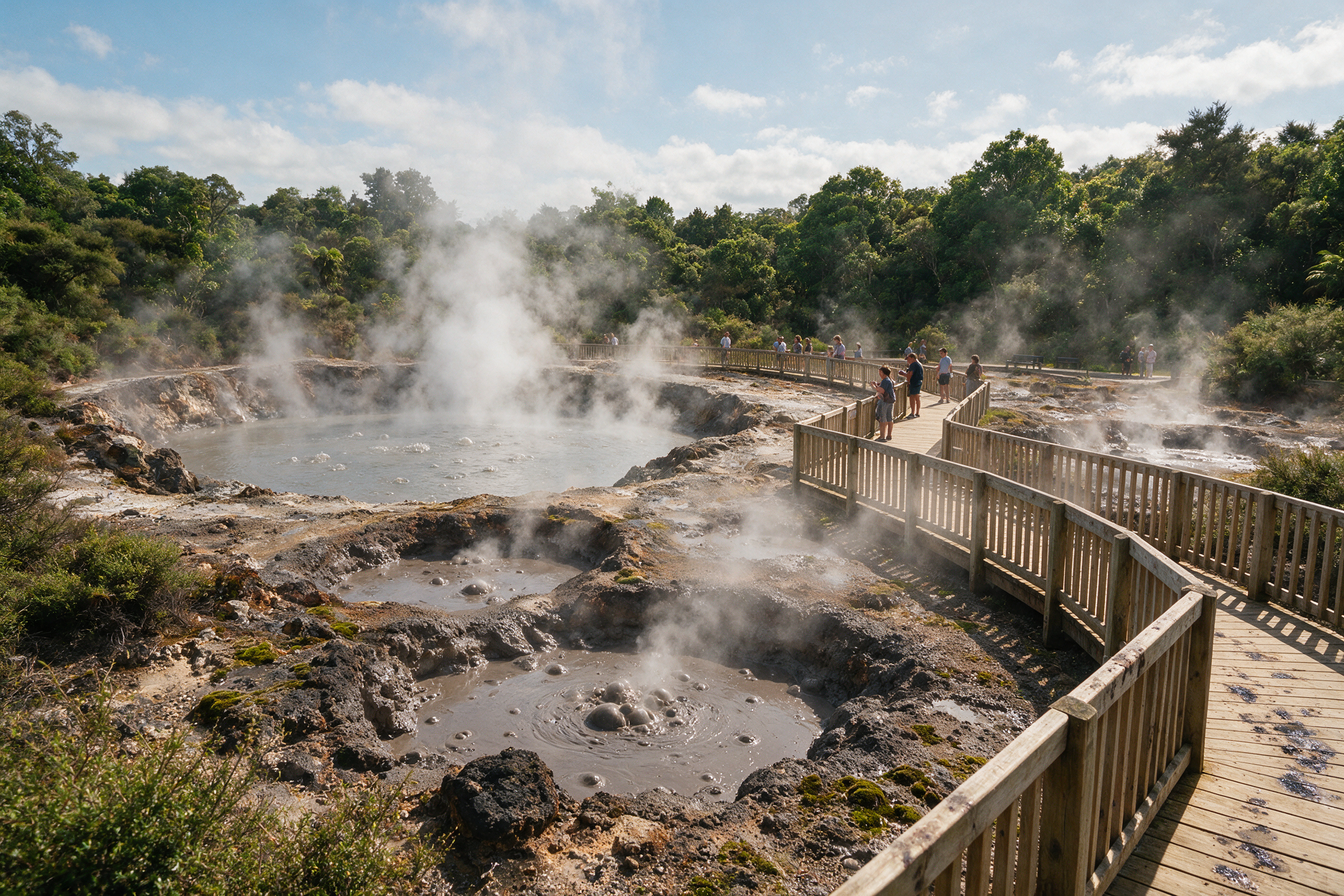
The honest caveat: the smell is stronger here than almost anywhere else in town, and if you’re sensitive to sulphur, give it twenty minutes rather than rushing through. It genuinely does fade from your senses once you adjust.
Blue Lake and the quieter lakes locals actually swim in
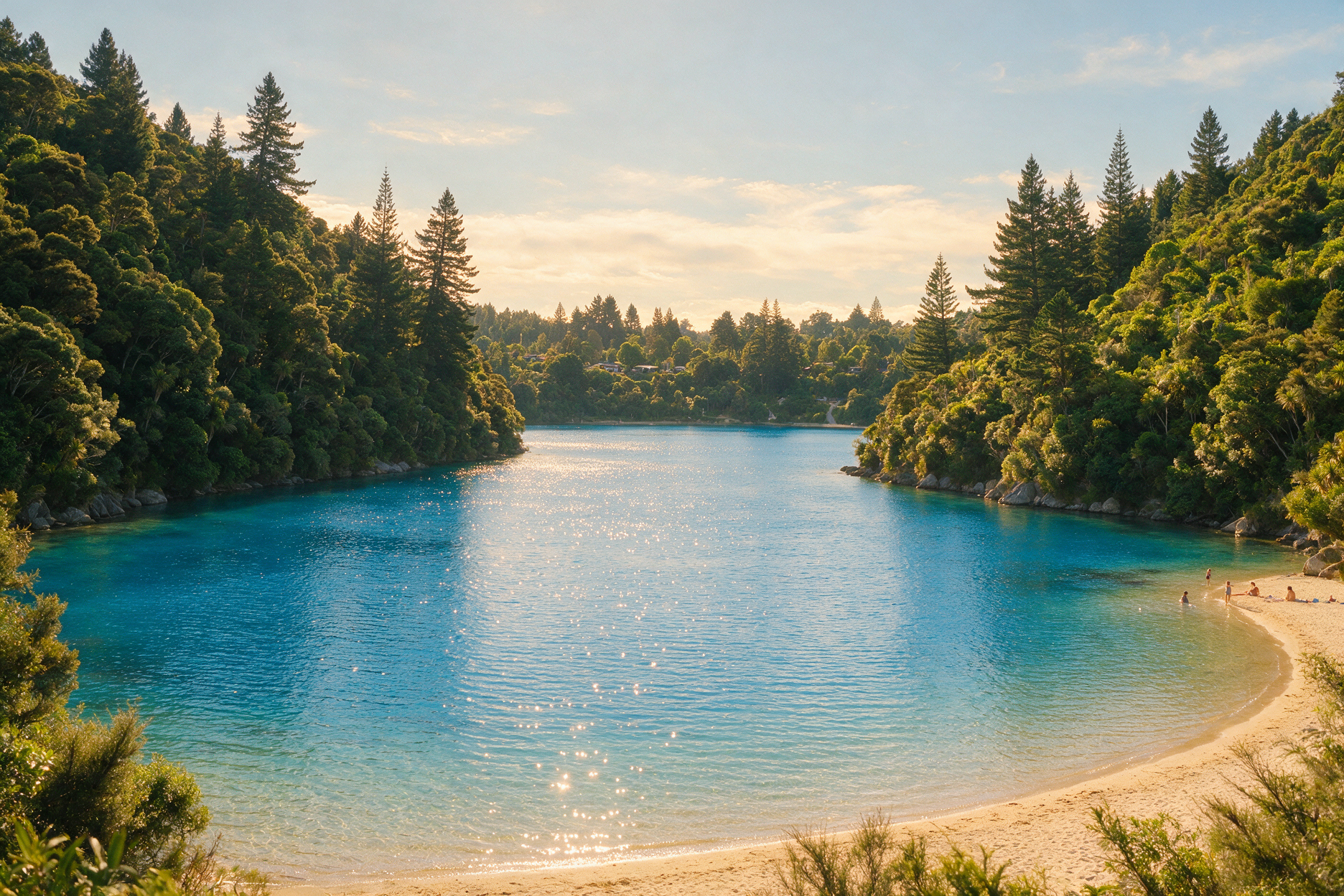
Blue Lake, known locally as Tikitapu, is about twenty minutes from the centre and is where Rotorua families go for a summer evening swim rather than a tourist boat trip. A 5.5km loop track circles it through native bush and a stand of exotic conifers, with sandy beaches at either end and dogs allowed on leads. It’s a sharp, clean blue — genuinely striking — and in summer it’s busy with locals rather than tour buses.
A step further out, Lake Ōkāreka has a more residential, lived-in feel — Boyes Beach has a playground and changing rooms for families, a short lakeside track for a stretch of the legs, and a stroller-friendly boardwalk with decent bird spotting. It’s not a “sight” in any brochure sense, but it’s an honest look at how people in this district actually spend a free afternoon.
Lake Tarawera and the Buried Village
Lake Tarawera is the North Island’s second-largest lake, and the drive out to it passes Blue Lake and the Buried Village of Te Wairoa — the site of a Māori village destroyed in the 1886 Mount Tarawera eruption, now a small historical site worth an hour. At Tarawera itself, tracks on either side of “the Landing” lead to secluded swimming spots, and the jetty is a popular (and genuinely cold) jumping-in point. Bring a picnic; there’s little in the way of food options right at the lake.
The Redwoods beyond the main Treewalk
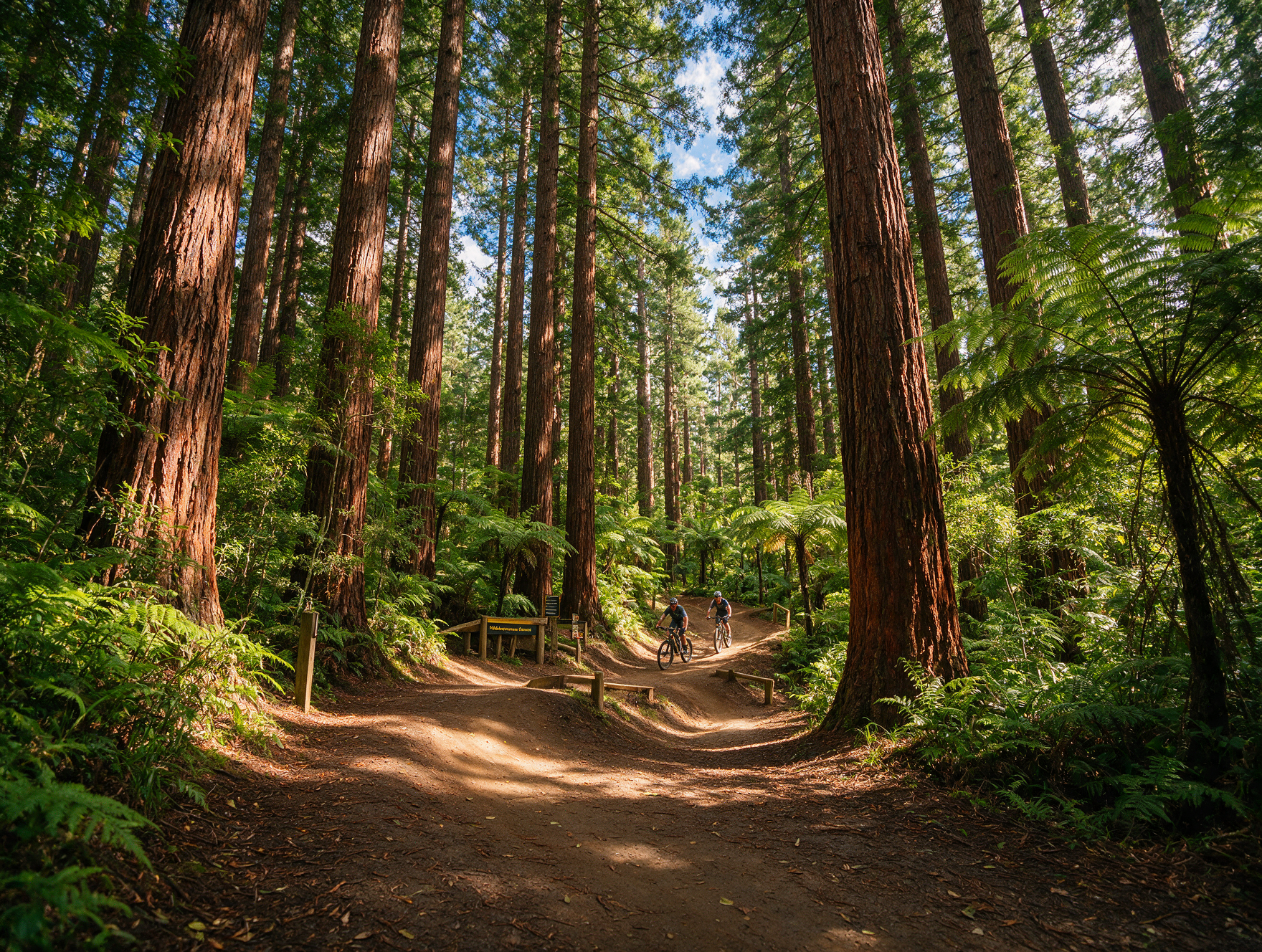
Most visitors know the Redwoods Treewalk — the elevated walkway through Whakarewarewa Forest’s towering Californian redwoods, strung with suspension bridges. It’s genuinely lovely, especially at dusk when it lights up. What fewer visitors realise is that the forest around it holds over 220km of mountain bike trails, enough that Rotorua genuinely calls itself New Zealand’s mountain biking capital. You don’t need to be a serious rider — bikes are available for hire locally, and there are gentle, well-shaded trails through quiet corners of the forest that most tourists on the Treewalk never see.
The Thursday night market
Rotorua’s night market runs on Thursday evenings and is a genuinely good read on the town’s community life — boutique stalls, dozens of food trucks, and live local musicians in a setting that feels distinctly unperformed for tourists, even though visitors are obviously welcome. If your trip lines up with a Thursday, it’s a far better dinner option than most of the restaurants directly facing the main tourist strip.
A quieter way to see glowworms
Waitomo gets most of the glowworm fame nationally, but Rotorua has its own, less crowded options. Some are reached only by kayak, like the Lake Rotoiti caves, while others sit along the Ōkere Falls Track or in pockets of the Redwoods Forest itself. Small-group operators run after-dark tours to several of these sites, and the experience — total darkness, then thousands of tiny blue-green lights overhead — tends to feel more intimate than the bigger commercial cave circuits elsewhere in the country.
Māori art and craft, bought properly
Rotorua has the country’s strongest concentration of genuine Māori arts and crafts, partly because Te Puia doubles as a working carving and weaving school. If you want a souvenir with real provenance rather than a generic gift-shop item, look for pieces sold directly through Te Puia’s own gallery or through artist-run studios in town, where the carvers and weavers themselves (or their direct representatives) can tell you about the piece’s meaning. It costs more than a mass-produced trinket, and that’s rather the point.
Where to actually eat
Skip the restaurants immediately facing the main geothermal attractions — they’re priced for one-time tourist traffic and it shows in the quality. The Thursday night market is the standout, and a few restaurants around the lakefront do a genuinely good job with New Zealand lamb and fresh trout, which the Rotorua lakes are well known for among local anglers.
A fun fact worth knowing
Rotorua sits inside a genuine caldera — Lake Rotorua fills the collapsed crater left by a massive eruption roughly 240,000 years ago, one powerful enough to eject hundreds of cubic kilometres of volcanic material in a matter of weeks. The whole district’s ongoing geothermal activity, from Kuirau Park’s mud pools to the famous geysers, is fed by the same underlying system. It’s a useful thing to know when the ground steams somewhere you weren’t expecting it to: this isn’t decoration, it’s an active volcanic field that happens to have a town built on top of it.
Best time to visit and how long to stay
Rotorua works year-round because its main appeal is geothermal rather than weather-dependent, but November to March gives you warm enough days to actually swim at Blue Lake or Tarawera, which adds a dimension most winter visitors miss entirely. Two to three days is a sensible stay — one day for the headline geothermal parks, one for the lakes and Redwoods, and a spare half-day if you want the night market or a glowworm tour.
A mistake to avoid
Don’t schedule Wai-O-Tapu for the afternoon if you can help it — the Lady Knox Geyser eruption (assisted, but still worth timing around) and the best light on the Champagne Pool both favour a morning visit, and tour buses arrive in clusters later in the day. Book the earliest slot you can get.
Visa, costs, and getting around
The same Visitor Visa rules apply here as anywhere else in New Zealand: Indian passport holders need to apply online through Immigration New Zealand’s system, with costs starting from NZD 441 and processing that Immigration New Zealand quotes at roughly 80% within two weeks, though it’s not a guarantee. Apply early, especially if you’re travelling in the Indian festive season or over Christmas–New Year, when application volumes spike. A rental car genuinely helps in Rotorua, since several of the sights in this guide — Blue Lake, Tarawera, the Redwoods — are a short drive apart rather than walkable from the centre, and public transport options are limited outside the main town.
Frequently Asked Questions
Is Rotorua worth more than a day trip from Auckland?
Yes — a day trip only allows time for one major attraction. Two to three days lets you see the geothermal parks and the quieter lakes and forest trails covered here.
What’s the best time to visit Rotorua?
November to March for warm enough weather to swim at Blue Lake or Tarawera; the geothermal attractions themselves are enjoyable year-round regardless of season.
Is Kuirau Park really free?
Yes, entirely free, including the hot foot bath, and it’s one of the better geothermal experiences in town for the price.
Do I need a car in Rotorua?
It helps considerably. The lakes, Redwoods, and some hidden-gem spots are a short drive apart and not well served by public transport.
Can I see glowworms in Rotorua, or only in Waitomo?
Rotorua has its own glowworm sites, including kayak-access caves on Lake Rotoiti and spots along the Ōkere Falls Track, generally with smaller crowds than Waitomo.
What visa does an Indian traveller need for Rotorua?
The same New Zealand Visitor Visa required for the whole country — apply online well ahead of travel, particularly during the busy Christmas period.
Is Rotorua family-friendly?
Very much so — Kuirau Park, Boyes Beach at Lake Ōkāreka, and the gentler Redwoods trails are all straightforward with children in tow.
How far is Rotorua from Auckland, and is it a reasonable day trip?
Rotorua is about three hours’ drive from Auckland. It’s doable as a long day trip, but given everything covered in this guide, an overnight stay is a far better use of the journey.
Is the sulphur smell in Rotorua unbearable for visitors?
It’s noticeable on arrival, especially near Kuirau Park, but most visitors stop registering it within a day. It’s strongest near active geothermal sites and much fainter elsewhere in town.
A Town That Rewards Curiosity
Rotorua’s two headline attractions earned their fame honestly, but the district has a lived-in side that most itineraries skip entirely — a free geothermal park with a foot bath, lakes locals actually swim in, and 220km of forest trails most visitors never notice. Give yourself the extra half-day to find them.
Planning to build Rotorua into a wider New Zealand holiday? Get Tripped Travels puts together custom itineraries that balance the big-ticket geothermal sights with the quieter corners covered here — reach out to start planning.