Every few weeks, someone emails Get Tripped asking for help with their “New Zealand eTA” — convinced that because Australia’s ETA worked for a short Bali stopover once, New Zealand must run the same way. It doesn’t, and the confusion costs people real time: the NZeTA, New Zealand’s quick electronic travel authority, is only open to passport holders from visa-waiver countries. Indian passport holders aren’t on that list. You need an actual Visitor Visa, applied for and approved before you fly, and since October 2026 that entire process has moved onto a new online system that behaves a little differently from the PDF-and-email routine agents got used to.
This guide walks through exactly what an Indian passport holder needs for a New Zealand visa in 2026 — the visa type, the documents, the fees, the new online application flow, and the timing mistakes that catch out even well-organised travellers. We put together custom New Zealand itineraries for Indian travellers at Get Tripped, and visa timing is the single most common thing we have to talk clients out of leaving too late.
In This Guide
- Do Indian Citizens Need a Visa for New Zealand?
- Which Visitor Visa You Actually Need
- Documents to Gather Before You Start
- New Zealand Visa Fees and the International Visitor Levy
- How to Apply: The New Immigration Online Process
- Processing Time and When to Apply
- Funds, Return Tickets and What Immigration NZ Actually Checks
- Common Reasons Applications Get Delayed
- Getting to New Zealand From India
- Planning the Rest of Your Trip
- FAQs
Do Indian Citizens Need a Visa for New Zealand?
Yes — and this is worth stating plainly because so much generic content online muddies it. Immigration New Zealand’s own NZeTA eligibility page lists who can use the fast electronic authority instead of a full visa: citizens of visa-waiver countries, Australian citizens and permanent residents, cruise or cargo ship crew, and a few other narrow categories. India is not a visa-waiver country for New Zealand, so Indian passport holders fall outside every one of those categories. If you’re searching “New Zealand visa for Indians 2026” because a friend mentioned an eTA, that’s the mix-up — you’ll need a Visitor Visa, which is a genuine application with supporting documents, not a five-minute form.
A mistake to avoid: don’t assume New Zealand works like Sri Lanka’s or Thailand’s recent visa-free pushes for Indian travellers. New Zealand hasn’t extended that to India, and applying for an NZeTA as an Indian citizen will simply get rejected at the eligibility check — wasting a few days you didn’t have to lose.
Which Visitor Visa You Actually Need
For a standard holiday, you’re applying for a Visitor Visa under the tourist category, and it comes in two shapes:
Multiple-entry visitor visa — lets you enter and leave New Zealand more than once, with a total stay of up to six months within any 12-month period. This is the one most Get Tripped clients end up with, especially if a New Zealand trip is bookended by a stop in Fiji, Australia, or the Cook Islands.
Single-entry visitor visa — one entry only, with stays of up to nine months within an 18-month window, which includes an option to study for up to three months during the visit. Most holidaymakers don’t need this length, but it exists for people combining tourism with a longer family visit or a short course.
Either way, a visitor visa does not allow you to work in New Zealand, and you cannot switch from a visitor visa into a work or study visa once you’re in the country — if your plans might change mid-trip, that’s a conversation to have with an immigration adviser before you apply, not after you land.
Documents to Gather Before You Start
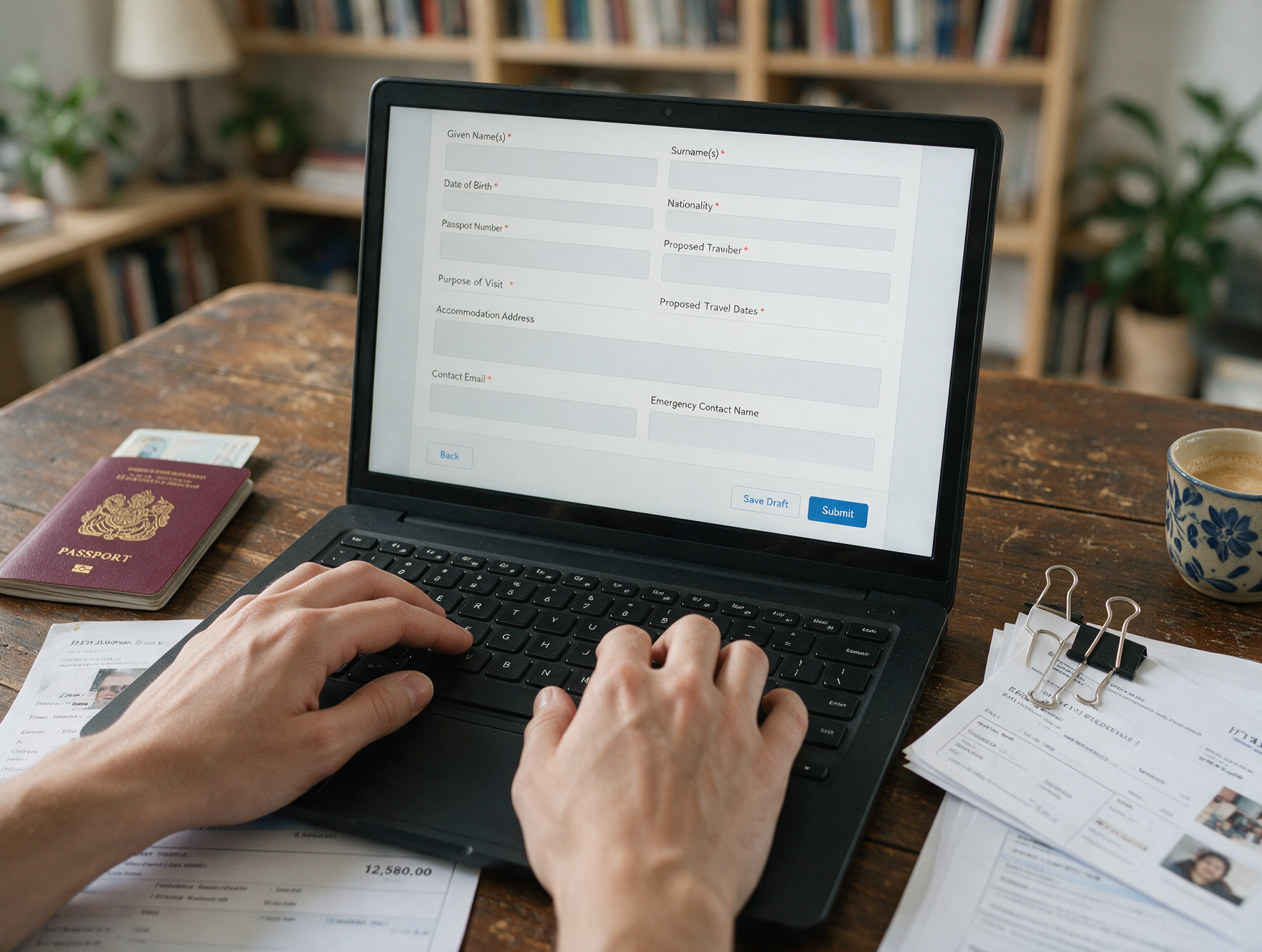
Have these scanned and ready before you open the application — the online system lets you save a draft, but a half-finished application with missing uploads is how people end up rushing in week three of a four-week processing window:
- Passport valid for at least three months beyond your planned departure date from New Zealand, plus a clear scan of the bio page
- A digital passport-style photo meeting Immigration New Zealand’s specifications
- Proof of travel plans — this can be a provisional flight itinerary rather than a fully paid ticket
- Evidence of sufficient funds (see the money section below)
- Proof of onward or return travel, or evidence you have enough funds to purchase a ticket out of New Zealand
- English translations of any supporting document not already in English
- If you’re including a partner or children under 19 on a family application, their passport and photo details too
Immigration New Zealand can also request a medical certificate or police certificate in some cases, though for a standard holiday stay under six months a chest X-ray usually isn’t required, and a full medical certificate usually isn’t either for stays under twelve months. If they do ask, submit a certificate that’s less than three months old when you send it.
New Zealand Visa Fees and the International Visitor Levy
Budget for two separate charges, since people often account for only one:
The Visitor Visa fee starts from NZD 441 per applicant, payable when you submit the application online. Exchange rates move, so check the live conversion rather than anchoring to a number you saw last year — treat it as roughly the cost of a decent one-way domestic Indian flight, paid once per passport.
The International Visitor Conservation and Tourism Levy (IVL) is a separate NZD 100 charge that most international visitors pay on top of the visa fee, collected at the same time as your visa application. It funds conservation and tourism infrastructure, and the main travellers exempt from it are Australian citizens and permanent residents and most Pacific Islands Forum nationals — which doesn’t include Indian passport holders. Factor both figures into your New Zealand trip cost from India before you start comparing it against a Southeast Asia alternative, since the all-in visa cost for New Zealand sits meaningfully higher than, say, Thailand’s current visa-free arrangement.
How to Apply: The New Immigration Online Process
From 1 October 2026, Immigration New Zealand moved Visitor Visa applications fully onto its Immigration Online platform, replacing the older mixed paper-and-portal system. In practice, that means:
- Create an Immigration Online account using a valid email address.
- Complete the Visitor Visa application form within the portal — it autosaves, but don’t rely on that for days at a stretch.
- Upload your documents directly as PDFs or clear photo scans — blurry phone photos of a passport are a common cause of requests for resubmission, which adds days.
- Pay the visa fee and IVL together through the portal’s payment gateway.
- Track your application status online rather than waiting for an email that may land in spam.
Honest caveat: a brand-new digital system in its first full year of operation is exactly the kind of thing that has occasional hiccups — session timeouts, document upload limits, a payment step that needs a retry. Build in a buffer week before any hard deadline, and don’t book non-refundable flights or hotels until the visa is actually approved, which is also Immigration New Zealand’s own advice.
Processing Time and When to Apply
Immigration New Zealand publishes a target of processing 80% of visitor visa applications within two weeks — but that’s a median, not a guarantee, and it’s explicitly not promised for every case. Applications with incomplete documents, a need for further information, or a request for a medical or police certificate can run considerably longer.
The one seasonal pattern worth planning around: Immigration New Zealand has flagged that application volumes spike heading into the December-January peak, which is also New Zealand’s own summer holiday season and a popular window for Indian travellers chasing the Southern Hemisphere’s warm months. If your New Zealand trip cost and itinerary are built around Christmas or New Year dates, apply at least six to eight weeks out rather than the standard four — the two-week target is the first thing to slip when the queue backs up.
Funds, Return Tickets and What Immigration NZ Actually Checks
Immigration officers want to see that you can support yourself without working illegally and that you have a genuine reason to leave. Concretely, that means:
Proof of NZD 1,000 per month of your stay in available funds, or NZD 400 per month if your accommodation is already paid for in full — a prepaid hotel or homestay booking lowers the bar meaningfully, which is one reason package holidays with accommodation locked in ahead of time tend to sail through this check.
A bank statement showing a healthy balance that’s been stable for a few months reads better than a large lump sum that appeared the week before you applied. If you’re travelling as a family, the visa officer will usually look at combined household funds rather than requiring each traveller to individually meet the threshold, but confirm the specific household calculation on the current application form rather than assuming.
Common Reasons Applications Get Delayed
From what we see helping Get Tripped clients prepare their paperwork, the repeat offenders are almost always avoidable:
A mistake to avoid: submitting a passport photo that doesn’t meet the exact size and background specifications — New Zealand’s photo standards are specific about head position and background colour, and a photo booth print meant for an Indian driving licence usually won’t pass. Use a dedicated visa-photo service and check it against the current spec before uploading.
Other frequent snags: a passport with less than three months of validity past the departure date (renew first, apply second), inconsistent travel dates between the application form and the attached itinerary, and bank statements that are photographs rather than clean PDF exports from net banking.
Getting to New Zealand From India
There’s no direct flight from India to New Zealand yet, though Air India and Air New Zealand signed a codeshare agreement in 2025 and have both said they’re studying a direct route, with 2028 floated as an earliest realistic target — worth checking back on if you’re planning further ahead than this trip. For now, you’ll connect through a hub: Singapore, Kuala Lumpur, Hong Kong, or increasingly via an Australian city, depending on which carrier and fare you book. Most international arrivals land in Auckland, with onward domestic flights fanning out to the rest of the country from there. Flights are bookable out of Delhi, Mumbai, Bengaluru, Chennai, Hyderabad, and Kolkata, and total travel time typically runs well over 20 hours door to door once you account for the stopover — plan your first day in New Zealand as a recovery day, not a sightseeing sprint.

Planning the Rest of Your Trip
Once your visa is sorted, the real planning starts. Our New Zealand Hidden Gems Beyond Queenstown piece is a good next read if you’ve already got the standard stops mapped out, and our 7 Nights / 8 Days New Zealand Itinerary lays out how a first trip typically splits between the North and South Islands. For the practical side, our New Zealand Public Transit Guide and packing guide by season cover what to sort out once you’ve landed.
FAQs
Can Indian citizens apply for the New Zealand NZeTA instead of a visitor visa?
No. The NZeTA is restricted to visa-waiver country citizens and a handful of other specific categories, none of which include Indian passport holders on a standard tourist trip. You need a Visitor Visa.
How much does a New Zealand visa cost for Indians in 2026?
Budget from NZD 441 for the Visitor Visa fee plus a separate NZD 100 International Visitor Levy, both paid together during the online application. Check the live INR conversion when you apply rather than using a figure from an earlier trip.
How long does New Zealand visa processing take from India?
Immigration New Zealand targets 80% of applications processed within two weeks, but this isn’t guaranteed, and it slows further around the December-January peak season. Apply at least four weeks ahead generally, and six to eight weeks ahead for a Christmas or New Year trip.
Can I get a multiple-entry visa if I’m also visiting Fiji or Australia on the same trip?
Yes — the multiple-entry visitor visa is designed for exactly this, letting you re-enter New Zealand within your approved period, with a total stay capped at six months in any 12-month window.
Do I need to show a return flight ticket to apply?
You need to show proof of onward or return travel, or sufficient funds to buy a ticket out of New Zealand. A provisional, unpaid itinerary is usually acceptable at the application stage.
Is the New Zealand visa application process different now compared to a year ago?
Yes — since 1 October 2026, applications run entirely through Immigration New Zealand’s Immigration Online platform rather than the older mixed system, which changes how documents are uploaded and tracked but not the underlying eligibility requirements.
What happens if my visa isn’t approved before my flight dates?
Don’t book non-refundable flights or hotels until approval comes through — Immigration New Zealand says this directly, and it’s the single biggest financial risk in the whole process if a visa runs long.

A New Zealand visa for Indian travellers isn’t complicated once you know it’s a genuine Visitor Visa application rather than an eTA — it just needs a realistic timeline and a clean set of documents. Get Tripped builds custom New Zealand itineraries, honeymoon packages, and small-group tours for Indian travellers and can talk you through exactly what your specific trip dates and travel history mean for your application. Talk to our New Zealand travel specialists about getting your visa timeline and itinerary planned together, instead of racing the clock separately.