The first time I heard someone in Bandra describe their Italy trip plan — “Rome, then Florence, then two nights in Positano, maybe a day trip to Capri if we can swing it” — I didn’t say anything. It’s a good trip. It’s also the exact same trip roughly forty thousand other Indian travellers will book this year, queuing for the same Vatican skip-the-line slot at 9 am, paying premium-season prices for a hotel room in Positano with a partial sea view and a €28 breakfast. Nobody is wrong to do it. But if you’ve already done the postcard circuit, or you’d rather skip the queue altogether, there’s a region at the very heel of the Italian boot that most Indian travel content hasn’t discovered yet — and that’s precisely why it’s worth your next Italy trip instead of your fourth.
Puglia (pronounced POOL-ya, called Apulia in English) is the long, flat stretch of Italy that forms the heel of the boot, running from olive country in the north down to Salento in the south, where the Adriatic and Ionian seas meet almost close enough to see both from one hilltop. It has whitewashed hill towns, a UNESCO village made of conical stone huts, a baroque city built from honey-coloured limestone, two coastlines of turquoise water, and some of the best olive oil and wine in the country — and outside a small circle of European travellers who’ve been quietly going for a decade, almost nobody talks about it. This guide is the real version: specific places, specific times of day, and where the crowds go so you can go somewhere else.
Table of Contents
- Why Skip the Rome-Venice-Amalfi Circuit for Puglia
- Best Time to Visit Puglia
- Getting There: Flights from India
- Getting Around: Why You Actually Need a Driver
- Ostuni Beyond the Postcard Shot
- Alberobello’s Quiet Side
- Polignano a Mare: The Viewpoints Nobody Photographs
- Lecce: Getting Lost in the Baroque Backstreets
- Salento’s Quieter Beaches
- Where to Stay: Life in a Masseria
- Food and Wine Off the Main Road
- A Considered 5-Day Puglia Route
- What Puglia Actually Costs
- Visa, SIM, Currency: The Practical Bits
- FAQs
Why Skip the Rome–Venice–Amalfi Circuit for Puglia
Rome, Venice, Florence and the Amalfi Coast earn their reputation — nobody’s arguing otherwise. But in July and August especially, they’ve become an exercise in crowd management dressed up as a holiday: timed entry slots, cruise-ship day-trippers flooding Positano by 11 am, restaurants in the Amalfi towns charging Milan prices for average seafood because they know you’re not coming back tomorrow. Puglia runs on a different rhythm. There’s no single monument pulling thirty thousand people a day — the appeal is spread across a dozen small towns instead of concentrated into three photo ops. You can stand on a viewpoint in Polignano a Mare or wander a backstreet in Lecce’s old town and, outside of August, genuinely have it to yourself. For a traveller who’s already done the obvious Italy trip, or wants a quieter, more considered one the first time round, Puglia is the answer nobody’s given you yet.
Best Time to Visit Puglia
Puglia has a proper Mediterranean summer — July and August bring temperatures well past 35–40°C, humidity, and every hotel room in Ostuni and Polignano booked out weeks ahead at peak rates. It’s also when Italians take their own August holiday (the country more or less shuts down for ferragosto around 15 August), so you’re competing with domestic tourism too, not just international.
The better window is late May through June, or September into early October. Daytime temperatures sit in a comfortable 22–28°C, the sea is warm enough to swim by June and stays that way through September, and restaurants and masserie are open but not overwhelmed. September in particular is a sweet spot — the sea’s still around 25°C, the worst of the heat has broken, and the crowds have visibly thinned. Winter (November to March) is genuinely quiet — some seasonal restaurants and masserie close outright, and it rains roughly a third of the month — but it’s when you’d see Lecce and Ostuni with almost nobody else there, if architecture and food matter more to you than the coast.
Getting There: Flights from India
There’s no direct flight from India to Puglia, so budget it as a two-leg journey. Air India, Etihad, Emirates, Qatar Airways and ITA Airways get you from Delhi, Mumbai or Bengaluru into Rome or Milan, usually via a Gulf hub, then you connect onward to Puglia’s two regional airports: Bari (BRI) or Brindisi (BDS). Both have multiple daily domestic connections from Rome and Milan, and the onward leg typically runs 60–75 minutes.
Bari suits a trip weighted north — Bari city, Polignano, Alberobello, Valle d’Itria — with more airline options and a rail link into the city. Brindisi sits closer to Lecce and Salento, cutting out an otherwise 90-minute-plus transfer south. If your itinerary runs Bari-to-Lecce, as most first trips do, fly into one and out of the other so you’re not backtracking. Budget a full travel day each way from India.
Getting Around: Why You Actually Need a Driver
This is worth being upfront about — it’s not a luxury flourish, it’s the one practical point that determines whether your trip works. Coastal towns — Bari, Polignano, Monopoli, Fasano, Ostuni, Brindisi, Lecce — sit on Trenitalia’s Adriatic line and connect easily by train. A smaller network, the FSE, links Valle d’Itria towns like Martina Franca and reaches into parts of Salento. The catch is that these networks don’t coordinate with each other, run infrequently outside peak hours, and don’t reach where the best of Puglia actually is: countryside masserie, inland wine estates near Locorotondo and Cisternino, and beach coves nowhere near a station.
A private driver for the region solves this cleanly, and it’s how most well-planned Puglia trips are actually done — not an indulgence layered on top. It also sidesteps a genuinely expensive mistake.
Mistake to avoid: Puglia’s historic centres — Lecce, Ostuni, Alberobello, Polignano — all have ZTL zones (zona a traffico limitato) enforced by automatic cameras, not a person with a clipboard. Drive a rental car in, even by accident because your GPS routed you through, and you won’t know until the fine — typically €80–100 per entry — turns up from the rental company months later. Visitors routinely rack up four or five of these in a single week without realising it. A licensed private driver (NCC) carries permits to legally drop you at your hotel door inside these zones. Self-driving the open countryside is fine — just park outside the old town walls and walk in.
Ostuni Beyond the Postcard Shot
Ostuni is “the White City” — lime-washed houses stacked toward a hilltop cathedral, a colour that was historically applied as a disinfectant against plague and is still refreshed today. Everyone photographs the same view: the town rising from the valley, shot from the SS16 road on the approach from Fasano. It’s a good shot. It’s also increasingly a shot with a tour bus parked in the foreground by mid-morning.
Go into the old town itself instead, before 9 am, while the stone is still cool and shutters are just opening. Walk the maze above Piazza della Libertà, where stairs cut between buildings at odd angles, up toward the Cattedrale di Ostuni. The terrace just below the cathedral gives you a version of that famous “white town” view but with the town in the frame, not looking at it from outside. Come back after 7 pm in shoulder season and the light does something different — the white walls hold a warm gold cast for the last hour before dusk that never shows up in the midday photos everyone else takes.
Where to eat: skip the restaurants directly on the main piazza charging tourist prices for average food. Osteria del Tempo Perso, set in a cave-like former grotto, is the best-regarded kitchen in town for proper Puglian cooking — book ahead. Osteria Cattedrale runs just six tables with a fixed three-course menu from around €30, so it needs a reservation days out. Outside the old town, Masseria Il Frantoio, a 500-year-old working olive farm ten minutes away, runs an eight-course dinner (around €80 with paired wines) using produce grown on the property — some of its olive trees are said to be nearly two thousand years old.
Alberobello’s Quiet Side
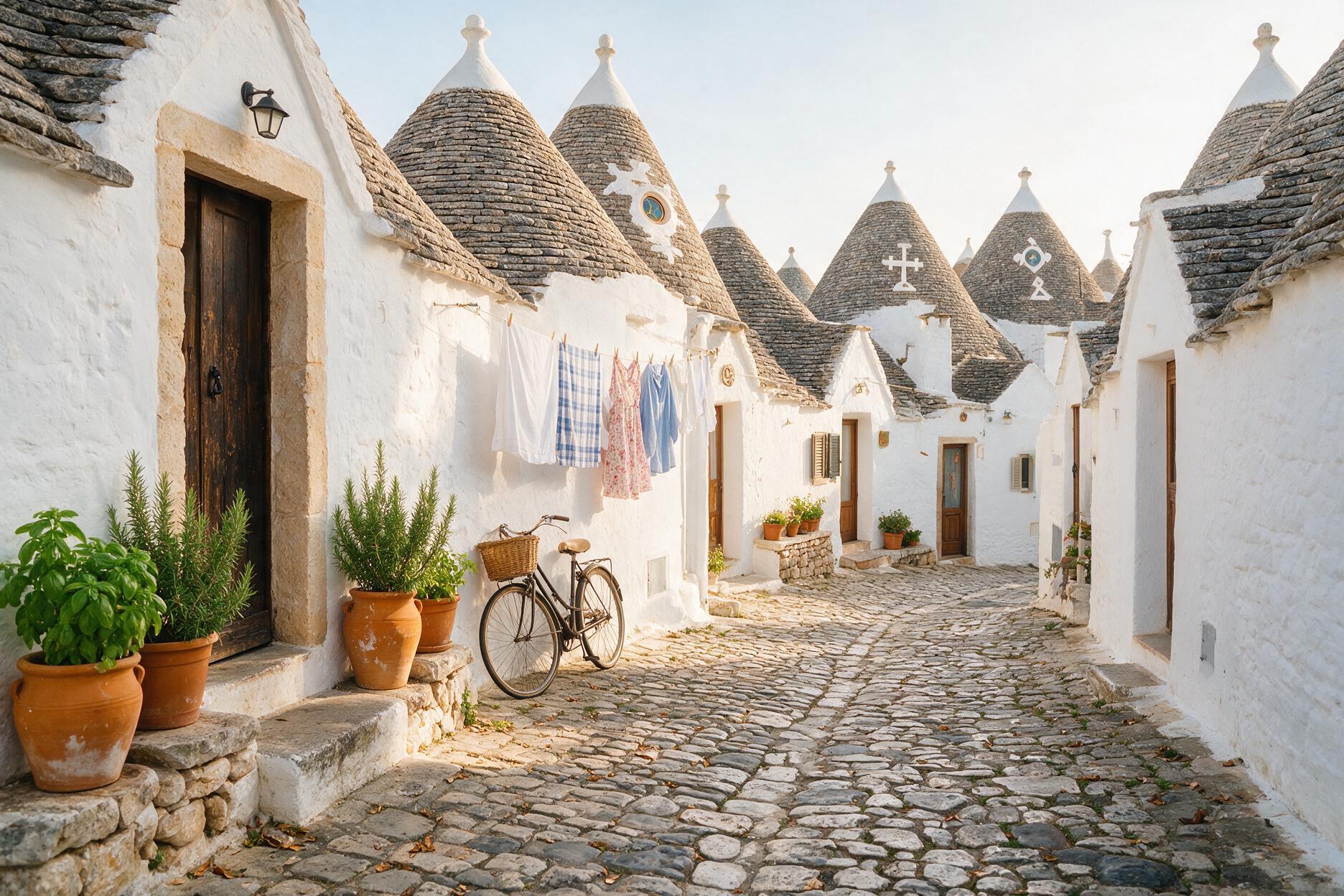
Alberobello is the trulli town — the UNESCO-listed village of small, whitewashed, cone-roofed stone houses that look almost cartoonish in photos and are, in person, genuinely strange and lovely. Nearly everyone photographs Rione Monti, the district with over a thousand trulli substantially converted into shops, gelaterias and Airbnbs — pretty, but by midday in season it functions more like a theme park than a neighbourhood.
Cross to Rione Aia Piccola instead. It has roughly 400 trulli of its own, and people actually live in them — laundry strung between buildings, a scooter parked outside a front door, someone on a plastic chair in the shade. Take the lanes east and west of the church of Saints Cosmas and Damian and you’ll likely have the backstreets to yourself, even in peak season, because there’s no shopfront pulling tour groups through. Same architecture, same UNESCO listing, completely different feeling — this is probably what Rione Monti felt like before it became a coach-tour stop.
Fun fact: local legend has it trulli were built dry-stone, without mortar, so they could be dismantled quickly whenever tax inspectors from the Kingdom of Naples came counting permanent structures — no roof, no house, on paper. It’s told constantly in Alberobello; most historians consider it more folklore than fact, but the dry-stone technique itself is real, and it’s why these buildings have survived largely unchanged for centuries.
Polignano a Mare: The Viewpoints Nobody Photographs
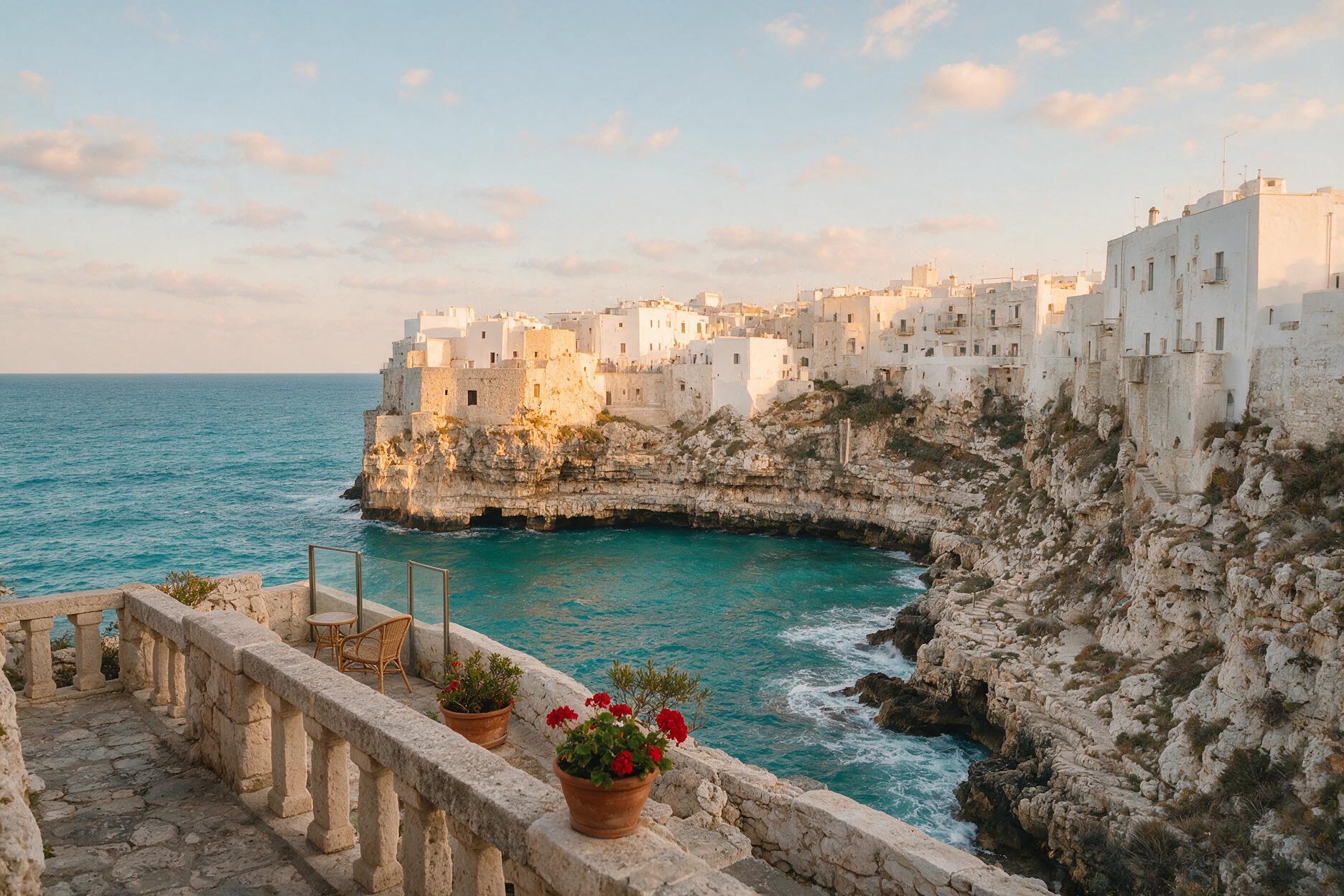
Polignano’s fame rests on one image: old buildings stacked on limestone cliffs above a small cove beach, shot from the Lama Monachile bridge. It’s a real, earned view — and also the one every visitor takes from the exact same spot, so by mid-morning in season you’re mostly photographing the backs of other people’s phones.
Walk instead to Via Roma along the clifftop, or the terraces near Terrazza Santo Stefano, for a different angle without the bridge crowd. For something quieter still, find the steps near the statue of Domenico Modugno — the Polignano-born singer who wrote “Volare” — leading to a small terrace looking back up at the old town from below, a genuinely different perspective most visitors never find because it means walking away from the main lookout. Inside the old town, duck into Vicolo della Poesia, a narrow alley where locals have written poetry on the walls since 1992 — a five-minute detour almost nobody takes.
Honest caveat: Grotta Palazzese, the restaurant built into a sea cave below the old town, photographs beautifully and gets recommended constantly — but the food rarely matches the €150+ per person price tag; you’re largely paying for the setting. Go for a drink rather than dinner if the setting alone is worth it. For the actual eating, locals point you to Cala Paura for grilled octopus panini at tables over the water, or Casa Orecchietta for honest, well-priced home cooking a few streets back from the crowds.
Photography tip: the cliffside light is flattest at midday. Go golden hour, roughly an hour before sunset, when the limestone turns warm and the crowds thin as day-trippers head back toward Bari for dinner.
Lecce: Getting Lost in the Baroque Backstreets
Lecce is Puglia’s baroque capital, built almost entirely from a soft golden limestone called pietra leccese that’s carved into elaborate, almost frosted-cake ornamentation on its churches — the style is genuinely called barocco leccese, and nowhere else in Italy looks quite like it. The Basilica di Santa Croce and Piazza Sant’Oronzo are the correct starting point, and Corso Vittorio Emanuele and Via Libertini connecting them are where the shops and day-trip crowds concentrate.
Beyond that main spine, Lecce rewards actually getting lost. Head toward the Chiesa del Carmine, which stays noticeably quieter even in high season, or wander past Porta Napoli into the streets near Piazza Mazzini, where the university crowd lives and cafés serve locals rather than tour groups. Time your visit to Piazza Duomo for after 9 pm — the coach-tour day-trippers who fill Lecce between roughly 11 am and 5 pm are long gone by then, the square is lit, and it’s one of the few places in southern Italy where you can stand in front of a major baroque monument in near silence.
Notes for couples: Lecce at night, once the day-trip buses clear out, is one of the more romantic settings in the region — quiet piazzas, warm stone, small wine bars open late. Worth a night here rather than treating it as a day trip from the coast.
Salento’s Quieter Beaches
Salento, the southern spur below Lecce, has two coastlines — Adriatic to the east, Ionian to the west — and both get seriously crowded at the famous spots: Gallipoli’s old town beaches and central Otranto are shoulder-to-shoulder by 11 am in July and August, parking is a genuine ordeal, and the water gets crowded enough that the “crystal clear” photos don’t quite match what you’ll see at peak hours.
Torre dell’Orso, a long stretch of soft white sand backed by pine trees with two sea stacks offshore known locally as the “Due Sorelle” (Two Sisters), is popular but big enough to spread out on before 10 am or after 4 pm. For something quieter, Porto Selvaggio near Nardò requires a walk through a pine forest reserve to reach — no beachfront parking, which is exactly what keeps the crowds down — with a rocky cove and some of the clearest water on the Ionian side. Further south, Baia dei Turchi near Otranto and the small pebble cove of Cala dell’Acquaviva near Marittima are reachable mainly on foot, which filters out the bus-tour crowd almost entirely.
Notes for families: Torre dell’Orso’s gently shelving sand suits children best, with proper lidos and lifeguards on the main stretch — the quieter coves further south are lovely but often rockier and without facilities, better suited to couples or solo travellers happy to pack their own water and shade.
Where to Stay: Life in a Masseria
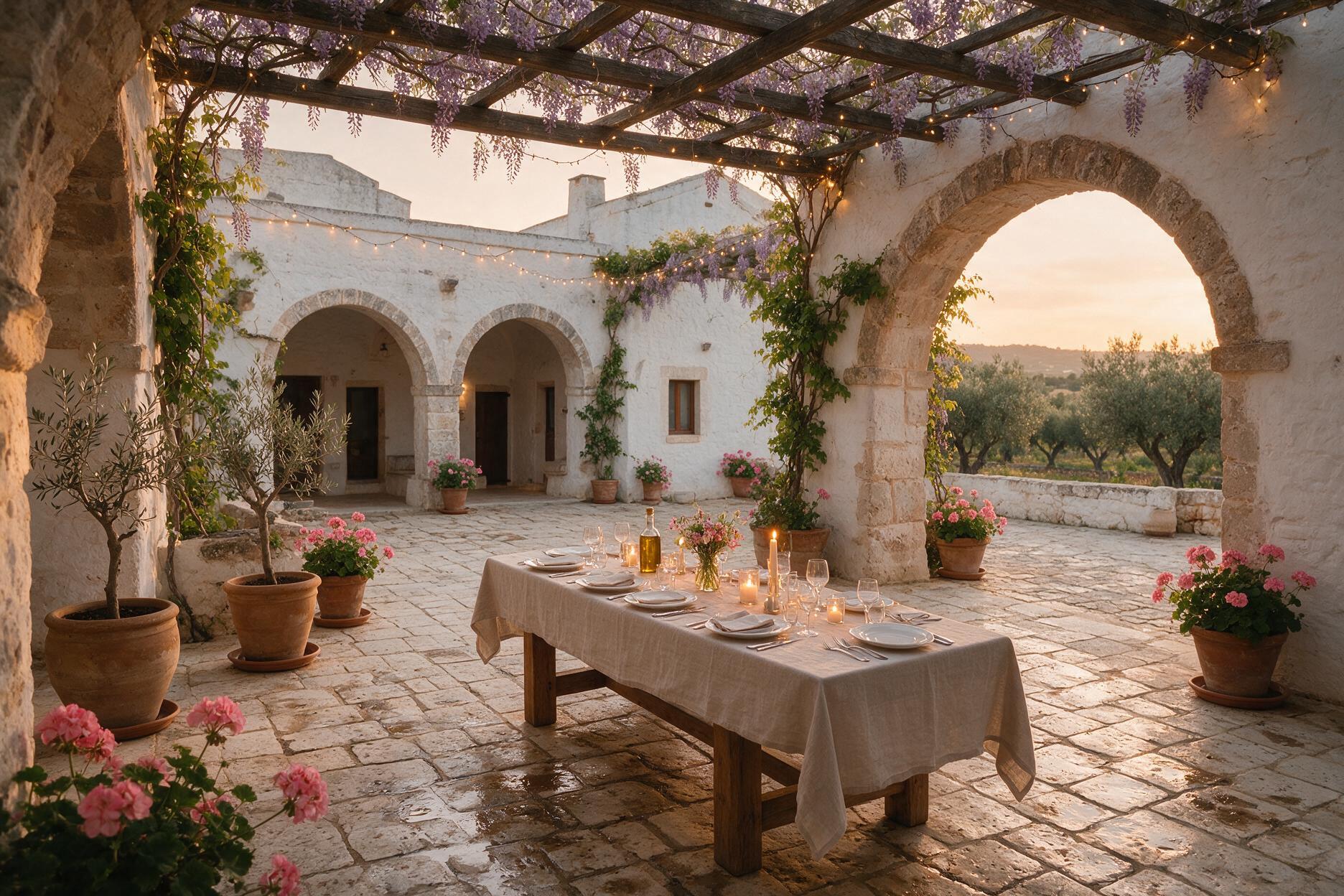
A masseria is a fortified farmhouse — originally built for large-scale olive and wine production, often centuries old, with thick stone walls that keep the interior cool — and converting them into boutique hotels has become one of Puglia’s real specialities. The good ones aren’t generic countryside hotels with a rustic name; they’re still working properties, with olive groves supplying the kitchen and rooms built into what were once granaries or stables. Staying in one, rather than a coastal hotel, is arguably the best way to feel like you’re in Puglia rather than passing through it.
Expect a range: mid-range boutique masserie in Valle d’Itria run roughly €200–350 a night for a well-appointed double in high season, while the region’s most exclusive properties, some with pools carved into old grain-storage cisterns, run considerably higher. Ask whether the property runs its own olive oil production and dinner service — the ones that do offer a materially better experience than the ones that have simply renovated rooms and outsourced the restaurant.
Notes for luxury travellers: book the masseria’s own tasting dinner rather than heading out each night — the good ones source almost everything from their own land, and the experience is genuinely hard to replicate at a restaurant.
Food and Wine Off the Main Road
Puglia’s food identity runs on a handful of things done extremely well: orecchiette pasta, burrata and other fresh cheeses, olive oil that’s genuinely some of Italy’s best, grilled octopus, and bombette — small rolls of meat stuffed with cheese, grilled over wood. The trap is eating exclusively in the main squares, where prices climb and quality drops because the restaurant knows you’re not coming back.
For wine and oil, head inland to Locorotondo and Cisternino rather than buying bottles from a gift shop in Alberobello. Locorotondo’s whites (Verdeca and Bianco d’Alessano grapes) and the region’s structured Primitivo and Negroamaro reds are worth tasting at a working estate rather than a supermarket bottle — several family wineries around Locorotondo run tastings by appointment. Cisternino is known regionally for its fornello pronto butcher-grills — you pick your cut at the counter and it’s cooked right there — about as far from a tourist trattoria as Puglia gets.
Smart-spending tip: the region’s best meals aren’t always its most expensive ones. A well-run osteria off the main piazza with a short, seasonal menu will consistently outperform a bigger restaurant with a photo menu and a view — and cost less. Ask your masseria host or driver for their actual weeknight recommendation, not the coach-tour one; in a region this size, everyone genuinely knows everyone.
Notes for solo travellers: Puglia is comfortable solo, especially for a food-and-wine-focused trip — osteria counter seating is normal, wine bars in Lecce and Ostuni are easy to strike up conversation at, and a private driver for day trips solves the one real friction point without needing a group.
A Considered 5-Day Puglia Route
Day 1: Land in Bari, private transfer to a masseria base in Valle d’Itria near Locorotondo or Cisternino, dinner on the property.
Day 2: Alberobello by 8:30 am for Rione Monti before the coach tours, then Rione Aia Piccola once it fills up. Afternoon wine tasting and a wander through Locorotondo.
Day 3: Ostuni’s old town before 9 am, lunch at a working farm like Masseria Il Frantoio, afternoon at a quiet beach near Monopoli or Torre Canne.
Day 4: Polignano’s clifftop viewpoints in the morning, private transfer to Lecce (roughly 1.5–2 hours), checking in for the night to catch Piazza Duomo after dark.
Day 5: Lecce’s backstreets in the morning, Torre dell’Orso or Porto Selvaggio in the afternoon, departing from Brindisi — or add a sixth day for Otranto and the far south.
What Puglia Actually Costs
Real numbers, not the cheapest-possible version: expect roughly €250–450 per person per day for a well-run mid-range-to-luxury trip covering a boutique masseria stay, a private driver, considered restaurant meals, and one or two paid experiences. Flights from India are the biggest single line item — figure roughly ₹55,000–90,000 return depending on season and routing. A private driver for a full day typically runs €150–250 depending on distance, worth weighing against the hidden cost of ZTL fines and time lost on an unfamiliar rail network.
Visa, SIM, Currency: The Practical Bits
Indian passport holders need a Schengen visa to visit Italy — there’s no visa-on-arrival, and it must be applied for in advance through VFS Global, generally allowing around 15 working days for processing, though it’s worth applying earlier given seasonal demand. Get Tripped has a dedicated Schengen visa guide with the full document checklist if you need the detailed walkthrough; the short version is proof of accommodation, return flights, travel insurance with at least €30,000 medical coverage, and recent bank statements.
For connectivity, an eSIM covering the EU (not an Italy-only plan) is the simplest option if your phone supports it — it activates before you land and covers day trips near the region’s borders. Italy runs on the euro; cards are widely accepted in towns and at masserie, but smaller trattorias, wine estates and beach kiosks in the countryside often still prefer or require cash. UPI isn’t used in Italy — carry a card with low or no foreign transaction fees, with cash as backup.
Frequently Asked Questions
How many days do you need in Puglia?
Five to seven days covers the highlights properly — Valle d’Itria, Ostuni, Polignano, Lecce and a couple of Salento beach days — without feeling rushed. Ten days lets you add Gargano in the north or push further south to Santa Maria di Leuca.
Is Puglia worth visiting if I’ve already done Rome and the Amalfi Coast?
Yes, and arguably more so — it feels like a genuinely different trip, with a slower pace, far fewer crowds, and a food and wine scene that stands on its own rather than in a famous city’s shadow.
Do I need to rent a car in Puglia?
Not necessarily. A private driver is generally the better option — it avoids ZTL fines in historic centres, sidesteps Puglia’s fragmented public transport for reaching masserie and countryside wineries, and means someone else deals with parking.
Is Puglia expensive compared to the rest of Italy?
Generally more affordable than Rome, Venice or the Amalfi Coast for comparable quality — a boutique masseria typically costs less than an equivalent hotel in Positano, and countryside restaurants offer considerably better value than coastal Amalfi ones.
Can I combine Puglia with other parts of Italy?
Yes — Matera, the cave-dwelling city in neighbouring Basilicata, is roughly an hour from Alberobello and pairs naturally as a day trip or overnight add-on.
When should I book to avoid the August rush?
Book masserie and popular restaurants at least two to three months ahead if travelling June through September — well-regarded properties and kitchens fill up before peak season starts.
The Bottom Line
Puglia isn’t a secret exactly — it’s simply a region that hasn’t made it onto the standard Indian Italy itinerary yet, which is precisely what makes it worth going now rather than in five years, once it has. Skip the fourth trip to Rome. Go stand in Rione Aia Piccola instead, or watch Piazza Duomo empty out after dark, or eat grilled octopus at a table over the water in Polignano while everyone else queues for a photo on the bridge. The heel of Italy has been quietly excellent for a long time. It’s just been waiting for the right traveller to notice.
If you’d rather not plan the driver logistics, masseria bookings and ZTL-avoidant routing yourself, that’s exactly the kind of trip Get Tripped puts together — get in touch with our team to start planning a private, considered Puglia itinerary, built around the quiet version of Italy rather than the crowded one.