Best Evening Spots on the Amalfi Coast: Where to Watch the Sun Go Down
Most visitors to the Amalfi Coast assume Positano is the sunset town, simply because it’s the one everyone’s seen in photos. It’s a reasonable assumption and it’s wrong — Positano’s cliffs actually face the wrong direction for a clean sunset, and the sun disappears behind the hillside well before it reaches the horizon. The coast’s real golden-hour spots are scattered along the road to towns most first-time visitors skip straight past. This guide is about finding those.
Table of Contents
- 1. Praiano — the actual sunset capital
- 2. Conca dei Marini viewpoint
- 3. Ravello’s Villa Rufolo gardens
- 4. Punta Campanella
- The twenty minutes after sunset
- Getting between towns: buses, ferries, and timing
- A mistake worth avoiding
- FAQs
1. Praiano — the actual sunset capital
Praiano sits between Positano and Amalfi and, unlike its more famous neighbor, the whole town genuinely faces west — which is why locals and photographers alike call it the real sunset capital of this coast. The terrace by the church of San Gennaro, near the old Torre a Mare watchtower, is the spot to aim for: the sun drops straight into the sea, Positano is visible off to the right catching the last light, and Capri sits on the horizon beyond it. Unlike Positano, Praiano keeps its sun until the actual horizon year-round, not just for part of the season.
There’s a small bar near the viewpoint that does a relaxed aperitivo as the light changes, which makes this an easy spot to build a full evening around rather than a five-minute photo stop.
2. Conca dei Marini viewpoint
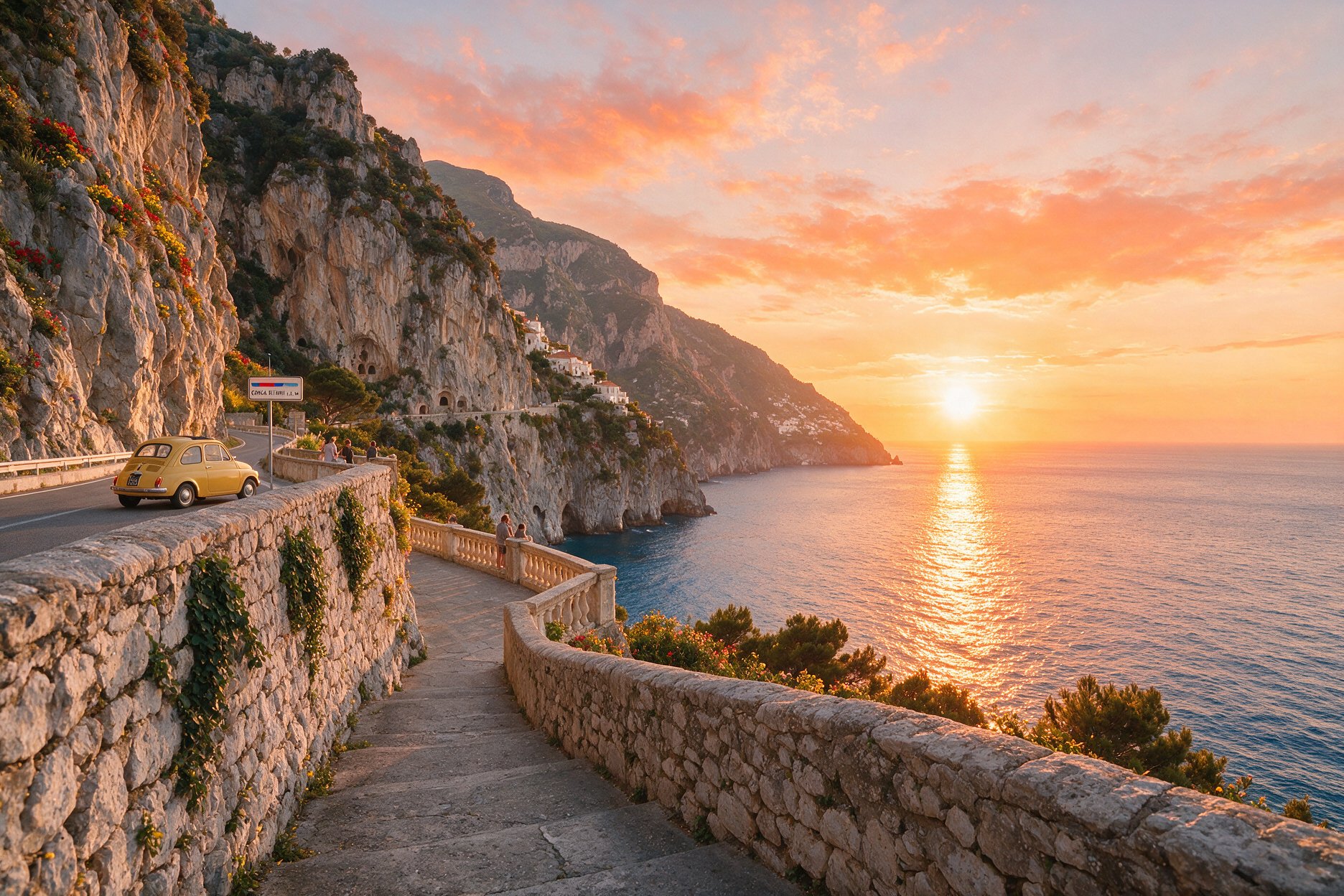
Between Amalfi and Positano on the SS163 coast road, just above the Grotta dello Smeraldo (Emerald Grotto), there’s an unmarked pullover with a stone wall overlooking the sea, facing due west with genuinely nothing between you and the horizon. It’s not signposted and most tour buses drive straight past it, which keeps it quiet even in peak season. June and July are the best months here, when the sun sets almost directly in line with the viewpoint; arrive about thirty minutes before sunset to get settled before the light starts changing fast.
3. Ravello’s Villa Rufolo gardens
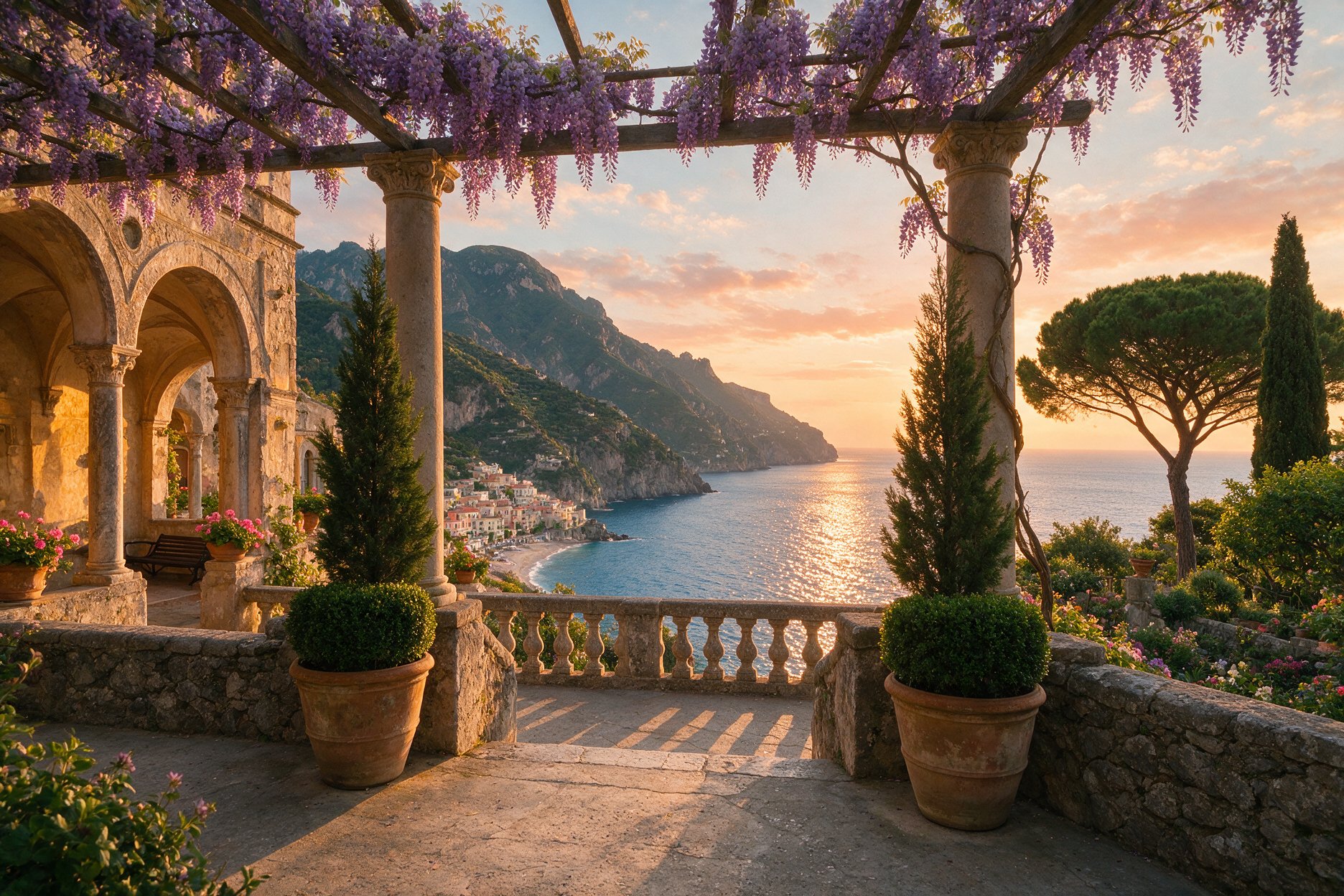
Ravello sits higher up than the coastal towns, which gives it a different kind of sunset view entirely — a wide terrace overlooking the coastline toward Maiori, backed by the Lattari mountains, from inside the manicured grounds of Villa Rufolo. The gardens typically stay open until 8 or 9 p.m. in the May-to-September window, which lines up conveniently with sunset. In summer, the Ravello Festival runs an orchestral concert series timed to overlap with the changing light on the terrace — genuinely one of the more memorable evening experiences on this entire coast, though it’s worth booking through the festival’s own site months ahead if you want tickets, since it sells out.
4. Punta Campanella
For a more adventurous option, Punta Campanella sits at the very tip of the Sorrentine Peninsula, roughly 25 minutes from Sorrento by car with a further 45-minute hike from where the road ends at Termini. It’s remote and genuinely wild compared to the developed coastal towns, with views straight across to Capri — the sunset here lights up the island’s famous Faraglioni rock stacks from the side, turning them gold. September and October are the strongest months for this one. It’s a bigger commitment than the other three spots on this list, so it’s best suited to travelers who’ve already seen the more accessible viewpoints and want something further off the standard route.
The twenty minutes after sunset
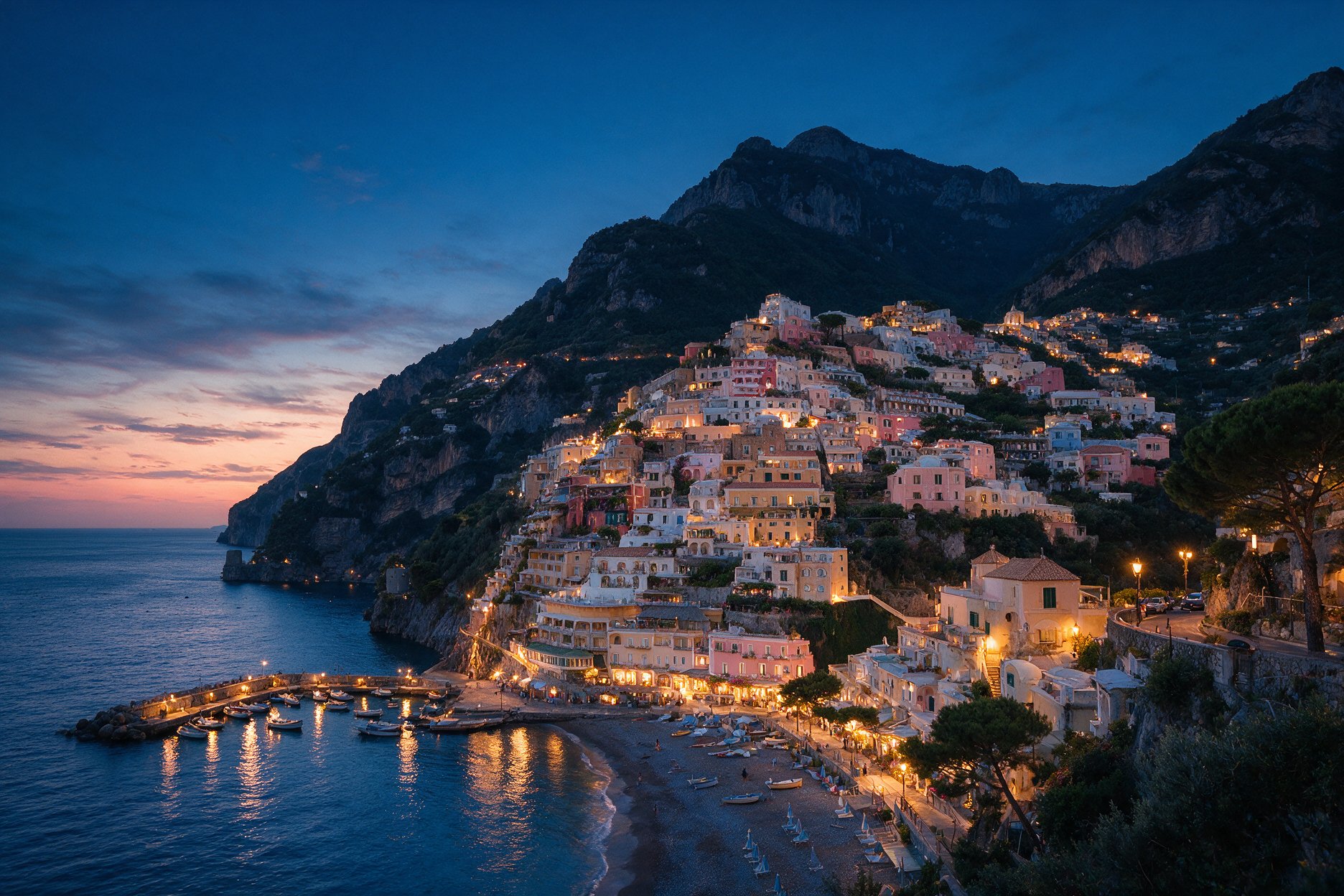
Don’t pack up the camera the moment the sun disappears. The twenty minutes that follow — the blue hour — is when the sky deepens to a rich dark blue and the coastal towns start switching their lights on, and photographers on this coast will often tell you it produces better, moodier shots than the sunset itself. Positano photographed from the SS163 road above during this window, town lights just starting to glow against the darkening cliffside, is one of the most striking images you can come home with from this coast.
Getting to the coast from Naples
Naples International Airport is the usual arrival point, and from there most travelers either take a train to Sorrento (via a connection in Naples or a direct summer service) and pick up the SITA bus network from that end of the coast, or arrange a private transfer straight to their hotel, which is considerably more comfortable if you’re arriving with luggage after a long flight and would rather skip the train-then-bus combination on day one. The drive from Naples to Positano or Praiano runs roughly ninety minutes to two hours depending on traffic and your exact destination, longer in peak summer weekend traffic.
Getting between towns: buses, ferries, and timing
The SITA bus is the workhorse of this coast, running the Sorrento-Positano-Amalfi route and on to Salerno, with service generally stopping around 10 p.m. A 24-hour unlimited pass runs about €10 (or around €12 if you want local Positano buses included too), and tickets have to be bought in advance at tobacco shops, newsstands, or bars in any coastal town — you cannot buy a ticket on board the bus itself, so plan that stop into your day.
A mistake to avoid seriously: during peak summer months, SITA buses running from Positano back toward Sorrento in the afternoon and early evening are notoriously prone to delay and overcrowding, sometimes standing-room only. If you have a flight or train connection that same evening, don’t cut it close — build in real buffer time, or consider a private transfer for that specific leg instead.
Ferries between the main towns run through the warmer months and are often faster and more scenic than the bus, especially between Positano, Amalfi, and Salerno, though service is reduced or paused in winter, so check current schedules if you’re traveling outside peak season.
A mistake worth avoiding
Don’t plan your one big Amalfi Coast sunset around Positano itself, assuming its fame means it’s also the best vantage point. As covered above, the town’s own cliffs block the direct sunset for much of the year — it photographs beautifully at blue hour from a distance, but if you want to actually watch the sun hit the horizon, Praiano or Conca dei Marini will serve you far better.
Where to base yourself for easy sunset access
Where you stay on this coast matters more than almost anywhere else in Italy, because the towns are strung along one narrow, slow-moving road, and being based in the wrong spot can turn a short evening trip into an hour each way. Praiano makes the most practical base if these sunset spots are a priority — it puts you within a ten-minute walk of the best viewpoint on the whole list, and it’s still meaningfully cheaper than Positano for comparable accommodation, without losing much in the way of restaurants or atmosphere. Ravello, being higher up and slightly removed from the coastal bustle, suits travelers who want a quieter, more refined base and don’t mind a bit more travel time down to the water for beach days. Amalfi town itself is the most central logistical choice, with good bus and ferry connections in both directions, if you’d rather not commit to one end of the coast or the other.
Choosing your spot by travel style
For honeymooners and couples, Ravello’s Villa Rufolo, especially paired with a summer festival concert, is the standout — it’s a genuinely romantic, slightly more formal evening than a roadside viewpoint offers. For families, Praiano is the easiest choice, since it’s an actual town with restaurants and gelato within walking distance of the viewpoint, rather than an isolated pullover on a cliffside road. Solo travelers and photographers will get the most out of Conca dei Marini or Punta Campanella, both of which reward patience and a bit of solitude rather than a social evening out. For luxury travelers, several of the coast’s high-end hotels in Praiano and Ravello have their own sunset-facing terraces and pools, which is worth factoring in when choosing where to stay if watching the sunset from your own room matters to you.
A smart-spending tip: hiring a private driver for an evening sunset run to Conca dei Marini or Punta Campanella, rather than a full-day private transfer, is a far more affordable way to access these spots without relying on the sometimes-unpredictable SITA bus schedule in the evening hours.
Frequently Asked Questions
What’s the best month to visit the Amalfi Coast for sunsets specifically?
June and July line up best with the Conca dei Marini viewpoint, while September and October are strongest for Punta Campanella. Praiano’s sunset works well nearly year-round given the town’s due-west orientation, making it the safest single bet if you’re only visiting once.
Do I need a car to reach these viewpoints, or can I get there by bus?
Praiano, Conca dei Marini, and Ravello are all reachable by SITA bus. Punta Campanella requires a car or driver to reach Termini, plus the hike from there, so it’s the one spot on this list genuinely better suited to a private driver.
Is the Amalfi Coast walkable between towns, or is transport essential?
Some sections connect via coastal hiking trails, most famously the Path of the Gods between Bomerano and Nocelle, but the towns themselves are spread far enough apart, and the roads narrow and cliffside enough, that bus, ferry, or private transfer are the practical way to move between them for most visitors.
Is the Amalfi Coast expensive to visit?
It’s on the pricier end of Italy, particularly for accommodation in Positano and Ravello during peak summer. Staying in a slightly less famous base like Praiano or Minori, and using the SITA bus pass rather than private transfers for day-to-day movement, keeps costs more reasonable without sacrificing much.
When is the Amalfi Coast least crowded?
Late April to early June and September through October offer warm, sunset-friendly weather with meaningfully thinner crowds than the July-August peak, when both accommodation prices and bus overcrowding are at their worst.
What’s a fun fact about this coast most visitors don’t know?
The Amalfi Coast’s steep terraced lemon groves — the source of the region’s famous limoncello — are cultivated on slopes so severe that much of the harvest is still done by hand, with pergolas of chestnut wood built to shade and support the vines along the cliffside, a technique that’s remained largely unchanged for generations.
Conclusion
The Amalfi Coast’s best sunset isn’t the one on the postcards — it’s a short drive or bus ride away from it, in a town most first-time visitors drive straight through on the way to somewhere more famous. Praiano, Conca dei Marini, and Ravello each offer a genuinely different version of the same golden hour, and any one of them is worth building an evening around.
Plan Your Amalfi Coast Trip with Get Tripped
Get Tripped’s Amalfi Coast itineraries are built around the timing that actually matters here — ferry schedules, sunset windows, and which town to base yourself in for the experience you actually want. Talk to us about a custom Amalfi Coast itinerary, and we’ll route the golden hour in for you.